20 AI Trends for 2027: What Will Shape Business, Work and Search
Twenty AI trends backed by late 2026 data, and what businesses should do about each one.
On this page
Last updated: 22 November 2026
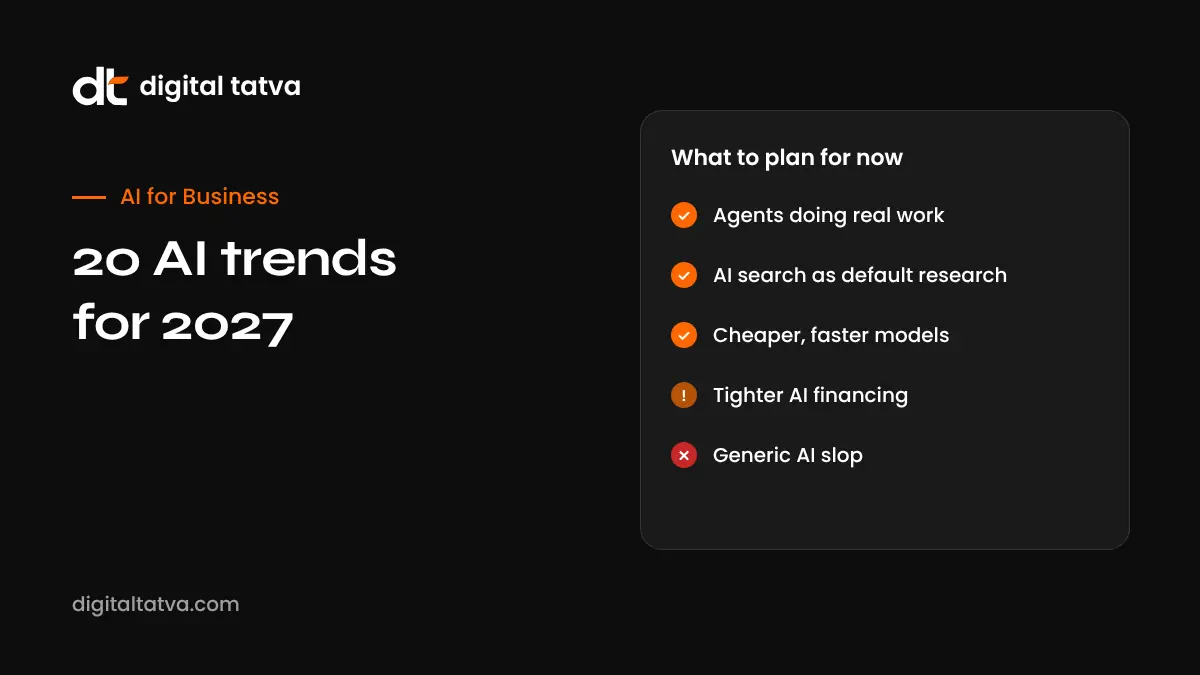
Quick answer: The AI trends most likely to shape 2027 are: AI agents that complete real work, coding agents running in teams, AI search replacing classic search for research, a consolidation around a few leading assistants, cheaper and faster models, strong open-weight models (many from China), voice-first AI, world models and AI video, AI in physical robots and glasses, a tougher financing climate for data centers, energy and local opposition to new data centers, AI-powered cyber attack and defence, regulation with real deadlines, agentic shopping and payments, AI in messaging apps, privacy pushback against OS-level agents, AI-made content fatigue (“AI slop”), AI-native ads, new AI jobs and a stronger focus on measurable return. Each of these is already visible in data and product launches from late 2026.
Key takeaways
- 2027 is likely to be about AI doing tasks, not just answering questions.
- Money is getting tighter: funding fell each quarter of 2026 and lenders are pricing more risk into AI infrastructure.
- Model prices keep falling, which makes AI viable for more everyday processes.
- Trust, privacy and content quality are becoming competitive advantages.
- Brands need visibility inside AI assistants, not only in classic search results.
Why these trends, and how we picked them
We based this list on signals from late 2026: product launches in November 2026, traffic data for the most used AI tools, search-demand data for AI topics, and reporting on AI funding, credit markets and regulation. Trends are not predictions of exact outcomes. They are directions with enough evidence behind them that businesses should plan for them. If you only read one other piece, read our SEO and AI search trends for 2027, which goes deeper on search.
The 20 AI trends for 2027 at a glance
| # | Trend | Signal from 2026 | Who should act |
|---|---|---|---|
| 1 | Agents that finish real work | Office, data and browser agents launched by every major lab | Operations, finance, marketing |
| 2 | Coding agents in teams | Multi-agent coding modes and terminal agents | Engineering leaders |
| 3 | AI search becomes default research | Google AI Mode searches up about 587% in a year | Marketers, SEO teams |
| 4 | Assistant consolidation | ChatGPT, Gemini and Claude dominate web visits | Brands, IT buyers |
| 5 | Cheaper, faster models | Fast tiers and intro pricing on new flagships | Product teams |
| 6 | Strong open-weight models | Large open releases from Chinese and Western labs | Developers, regulated sectors |
| 7 | Voice-first AI | “Voice mode” searches up sharply | Support, retail, apps |
| 8 | World models and AI video | Interactive world models and open video weights | Media, gaming, training |
| 9 | Physical AI | Robot models and AI glasses | Manufacturing, logistics, retail |
| 10 | Tighter AI financing | Global AI funding fell from $239B in Q1 to $103B in Q3 2026 | Founders, investors, buyers |
| 11 | Energy and local pushback | Data center votes and rising tech emissions | Infrastructure, sustainability |
| 12 | AI cyber offence and defence | Security-tuned models and AI kill switches | CISOs |
| 13 | Regulation with deadlines | EU AI Act obligations and new national rules | Legal, compliance |
| 14 | Agentic shopping and payments | Agent checkout standards and wallet features | E-commerce |
| 15 | AI inside messaging apps | Assistants that book and buy over text | Travel, local services |
| 16 | Privacy pushback | Apps blocking OS-level AI screen capture | Product, privacy teams |
| 17 | “AI slop” fatigue | “AI slop” searches up about 178% | Content teams |
| 18 | AI-native advertising | Ads in AI answers and “ad agents” | Performance marketers |
| 19 | New AI jobs and skills | “Data center jobs” searches up about 606% | HR, employees |
| 20 | Proof of ROI | Buyers cutting overlapping tools | Every budget holder |
Trends in how AI works
1. AI agents that finish real work
Through 2026 every major AI company shipped agents that act, not just chat: Claude Cowork and Claude Data, ChatGPT agent mode, Gemini Agent, Microsoft Copilot Cowork and team bots such as Grok Bot 1.0 for Slack and Teams. In 2027 expect agents to move from pilots to routine jobs such as reconciling spreadsheets, preparing reports, triaging support tickets and updating CRMs. The winners will be the teams that define clear tasks, permissions and review steps. See what is agentic AI and best personal AI agents.
2. Coding agents working as teams
Coding moved from autocomplete to agents, and now to groups of agents. Google added a swarm mode to Antigravity in November 2026, where a coordinator hands parallel work to several agents. Open-source terminal agents such as OpenCode saw searches grow about twelvefold. In 2027, software teams will spend more time reviewing and specifying work than typing it. See Claude Code vs Codex and AI code review tools.
3. AI search becomes the default way to research
Searches for Google AI Mode grew roughly sevenfold year on year, and ChatGPT, Gemini and Claude all answer with live web results. For many product and service questions, the first answer people see in 2027 will be written by AI. Brands that are not cited in those answers lose visibility even if they still rank. Read how AI search engines work.
4. Consolidation around a few assistants
ChatGPT, Gemini and Claude together drew more than 7 billion web visits in October 2026, while standalone tools like Perplexity and Kimi lost traffic. Expect more businesses to standardise on one or two assistants and fewer niche chatbots to survive on their own. See the most popular AI tools right now.
5. Cheaper and faster models
New flagships now arrive with fast, low-cost siblings. Google launched Gemini 4 Carbon with introductory pricing and a faster Hydrogen model, and Anthropic offers Claude Fable 5.2 with an optional fast mode it says runs up to 2.5 times faster. Cheaper tokens mean AI can be added to high-volume processes that were too expensive a year ago. See the cheapest AI model for each task.
6. Strong open-weight models
Open models are no longer far behind. In November 2026 alone, Moonshot released Kimi K3.1 Pro weights, MiniMax released an image model and several labs released Apache-licensed models. For regulated industries and cost-sensitive products, running open models on your own infrastructure becomes a real option. See open source AI models and best Chinese AI models.
7. Voice-first AI
Search interest in AI “voice mode” exploded in 2026, and Apple opened Siri to App Intents from any app in iOS 27.3 betas. In 2027 more customer service, booking and in-car interactions will start with a voice conversation with an AI. See AI voice assistants compared and AI receptionists.
8. World models and AI video
World models generate interactive environments you can move through, and they are also used to train robots. Google’s Genie 4 and Runway’s world model work point in this direction, and open video weights such as Pika’s latest release lower the cost of experimenting. Expect AI video to become standard in ads, training and previsualisation. See best AI world models and Genie 4.
9. Physical AI: robots and glasses
AI is moving into hardware: robot foundation models, humanoid pilots in warehouses and factories, and AI glasses with cameras and displays. 2027 will not bring a robot to every home, but more pilots will become paid deployments. See best humanoid robots and best AI smart glasses.
Trends in money, power and rules
10. A tighter financing climate
Fortune reported that global AI funding fell from $239.1 billion in Q1 2026 to $153.1 billion in Q2 and $103.3 billion in Q3. Lenders are asking for higher yields and tighter terms on data center debt, and circular deals between chipmakers, clouds and model labs are under scrutiny. At the same time, Anthropic completed a large IPO in November. Expect investors to reward revenue and efficiency over growth at any cost. See AI bubble signals to watch.
11. Energy and local pushback
AI data centers need enormous amounts of power. Reporting in November 2026 said Meta is re-evaluating its 2030 net-zero target after emissions rose sharply, and that voters rejected 40 of 41 local data center measures in the US midterms. In 2027, power, water and local approval will limit where and how fast AI capacity is built.
12. AI in cyber attack and defence
Security is now an AI arms race. OpenAI released a cyber-focused model for vetted defenders, research showed agents finding large numbers of working exploits, and CrowdStrike added an “AI kill switch” and bought AI security startups. Expect companies to treat AI agents as identities that need permissions, logging and shutdown controls. See AI agent security and Operation Snowball.
13. Regulation with real deadlines
The EU AI Act’s obligations are phasing in, including transparency duties for AI-generated content, and more countries and US states are adding their own rules. In 2027 compliance will be a practical project: inventories of AI systems, labelling, risk assessments and vendor contracts. See EU AI Act Article 50 for marketers and AI laws to know for 2027.
Trends in customers, content and marketing
14. Agentic shopping and payments
AI assistants can now research products, compare prices and in some cases complete checkout. Google’s agent checkout protocol, wallet features in ChatGPT and Gemini, and shopping research modes all launched or expanded in 2026. In 2027 product data quality will decide whether an AI agent recommends your product. See Google UCP and agentic checkout and ChatGPT shopping optimization.
15. AI inside messaging apps
A growing number of AI assistants work through iMessage, WhatsApp or SMS to book, buy and schedule. For travel, local services and support, the “app” in 2027 may simply be a chat thread. See WhatsApp AI for business.
16. Privacy pushback against OS-level agents
Signal began blocking screenshots by default on Android and iOS in November 2026, and its president described operating-system AI agents that read your screen as a serious threat to private messaging. Expect more apps to restrict what AI can see and more buyers to ask exactly what data agents access. See AI data privacy for business.
17. “AI slop” fatigue
Searches for “AI slop” grew about 178% in a year, and even “no AI slop” became a search term. Audiences, platforms and AI assistants are getting better at ignoring generic, mass-produced content. Original data, expert input and clear authorship will matter more in 2027. See how to spot AI slop and original research for AEO.
18. AI-native advertising
Ads now appear in AI answers, including Google AI Mode and ChatGPT, and searches for “ad agents” grew about 152%. Campaign creation, targeting and creative testing are increasingly run by AI. In 2027 organic visibility in AI answers and paid placement next to them will need to be planned together. See ads in AI Mode and AI Overviews and AI marketing trends for 2027.
19. New AI jobs and skills
Searches for “data center jobs” grew about 606%, and roles like AI operations, agent supervision and AI visibility are appearing. In 2027 the most valuable skill is knowing how to direct, check and combine AI output in your own field. See AI jobs in demand for 2027 and AI skills to learn.
20. Proof of return on investment
After two years of experiments, finance teams want evidence. Expect fewer overlapping AI subscriptions, more usage-based pricing, and projects judged on hours saved, revenue gained and errors avoided. See how to measure AI ROI.
How to prepare for AI in 2027
- Pick two or three processes for agents. Choose high-volume, rule-based work with clear success criteria.
- Standardise your assistant stack. One main assistant, a short list of approved specialist tools and clear data rules.
- Audit your AI visibility. Check how ChatGPT, Gemini, Claude and Google AI Mode describe your brand today.
- Fix your product and company data. Structured, consistent information helps both AI search and AI shopping agents.
- Write an AI policy and inventory. List the AI systems you use, who owns them and what data they touch.
- Budget for change. Prices, models and vendors will keep shifting, so prefer flexible contracts.
Illustrative example: A mid-sized B2B software company plans 2027 by choosing three agent projects (support triage, sales call summaries and monthly reporting), setting one assistant as the company default and running a quarterly AI visibility check on its ten most important buying questions. It reviews results every quarter and drops any project that does not save time within three months. This is an illustrative scenario, not a client story.
Checklist: your 2027 AI plan
- Agent pilots chosen with owners and success measures.
- Approved AI tool list and data rules published.
- AI visibility baseline recorded.
- Product, pricing and company facts consistent across your site and listings.
- AI system inventory and policy in place.
- Security controls for agents: permissions, logs and shutdown.
- Quarterly review of costs and results.
How Digital Tatva can help
As more research moves into AI assistants, Digital Tatva helps brands stay visible, accurate and recommended in ChatGPT, Gemini, Claude, Perplexity and Google AI answers. See our AEO services and AEO strategy guide.
Ready for AI search in 2027? Request an AEO audit or try the free AI visibility checker.
Frequently asked questions
What is the biggest AI trend for 2027?
AI agents that complete multi-step work, such as preparing reports or handling support tickets, are likely to have the biggest effect on businesses in 2027.
Will AI get cheaper in 2027?
Per-task model prices have been falling as labs release fast, low-cost tiers. Total spending may still rise because companies use AI for more work.
Is the AI bubble going to burst in 2027?
Nobody can know. Funding has slowed and credit markets are pricing more risk, but AI usage keeps growing. The likely outcome is a shake-out among weaker companies rather than an end to AI adoption.
How will AI change search in 2027?
More searches will be answered directly by AI in Google AI Mode, AI Overviews, ChatGPT and other assistants, so being cited in answers will matter as much as ranking.
Will open-source AI catch up with closed models?
Open-weight models are already close for many tasks, and several large ones were released in late 2026. The very top models are still mostly closed.
What AI skills will be most in demand in 2027?
Directing and checking AI agents, data and process design, AI security, AI visibility and domain expertise combined with AI tools.
How will AI regulation affect businesses in 2027?
Expect more transparency duties, such as labelling AI-generated content, and more documentation for high-risk uses, especially in the EU.
Will robots become common in 2027?
More humanoid and AI-powered robots will move from pilots to paid deployments in factories and warehouses, but home robots will stay rare.
What should small businesses do about AI in 2027?
Pick a main assistant, automate one or two repetitive processes, make sure AI assistants describe your business correctly and review costs every quarter.
Which industries will AI change most in 2027?
Software, customer service, marketing, finance operations, education and media are seeing the fastest change, with logistics and manufacturing following through physical AI.
Product details, prices and features are checked at the time of writing and can change. Sources are linked in the text so you can check them yourself.
How does your brand appear in AI answers?
We test the questions your buyers ask across the major AI assistants and search engines, then show you what to fix first.
Get an AI Visibility Audit