12 AI Skills to Learn in 2026 (For Every Career)
The 12 most valuable AI skills to learn in 2026, from prompting and research to automation, agents and AI coding, with time to learn, tools to practice and how to show them on your CV.

On this page
- Key takeaways
- Why AI skills matter right now
- The 12 most valuable AI skills in 2026
- Everyday AI skills for every professional
- Advanced skills that set you apart
- Technical AI skills for builders
- Human skills that matter more with AI
- How to show AI skills on your CV and LinkedIn
- Frequently asked questions
- The bottom line
The most valuable AI skills to learn in 2026 are prompting and AI communication, AI-assisted research and fact-checking, workflow automation, AI agent design, data analysis with AI, AI-assisted coding, AI content creation, and the judgment skills around privacy, ethics and quality control. You do not need to become a programmer: most of these skills are about using AI tools well inside the job you already do, and they are now listed in job descriptions far beyond tech roles.
This guide ranks the AI skills that matter most for professionals, explains what each one involves, how long it takes to learn, which tools to practice with, and how to show the skill on your CV or LinkedIn. It also covers technical skills for people who want to build AI products.
Key takeaways
- AI use at work is now mainstream: McKinsey’s global survey found 88% of organizations use AI in at least one business function, so AI skills are becoming a baseline expectation.
- The skills that pay off fastest for non-technical people are prompting, AI research, automation and data analysis with AI.
- Human skills such as judgment, verification, clear writing and domain expertise become more valuable, not less, when AI does the first draft.
- For technical careers, the most in-demand skills are building with LLM APIs, RAG, agents, evaluation and AI-assisted coding.
- Prove skills with projects and measurable results, not just certificates.
Why AI skills matter right now
AI moved from experiment to everyday tool very quickly. ChatGPT alone passed one billion weekly users in 2026, and Microsoft’s AI diffusion research estimates that about one in six working-age people worldwide now use generative AI, with much higher rates in countries such as the UAE and Singapore. In businesses, McKinsey’s State of AI research shows most companies using AI somewhere, but only a small group of high performers capturing large financial value. The difference is usually people: teams that know how to redesign work around AI. Our roundup of AI statistics for 2026 has the full numbers, and AI in India statistics covers the Indian market.
For individuals, that means AI skills are a career advantage today and will likely become a minimum requirement for many office roles.
The 12 most valuable AI skills in 2026
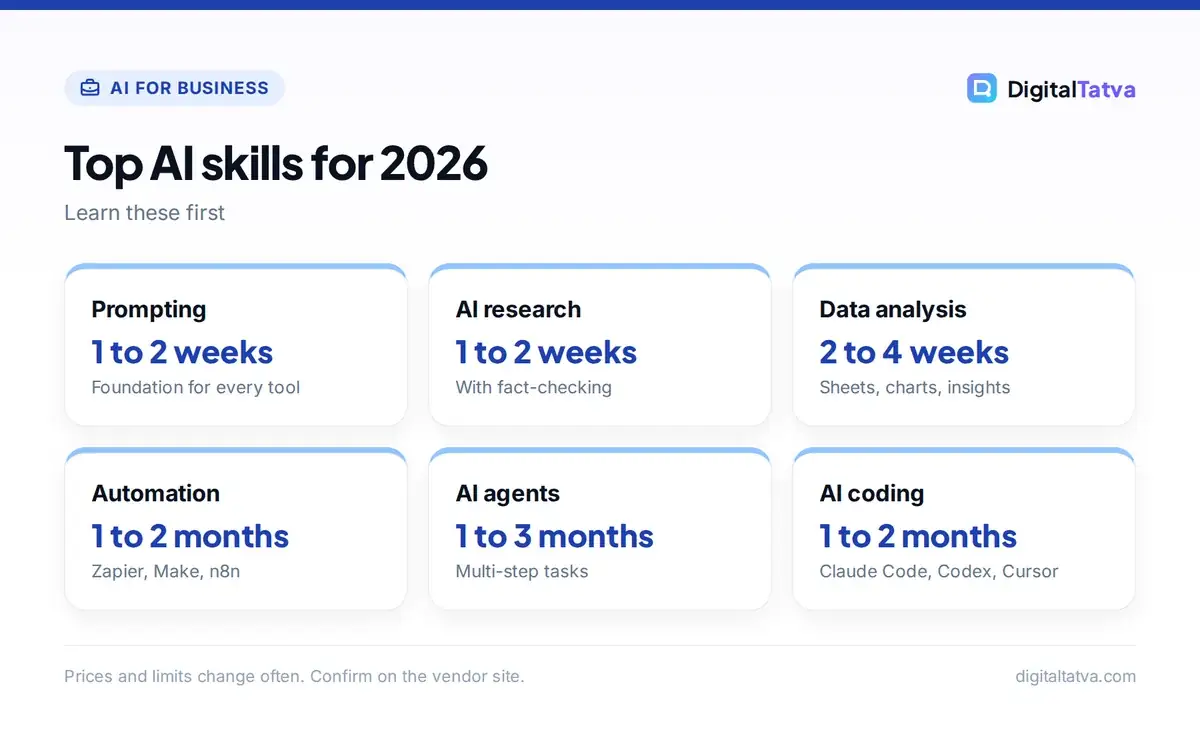
| Skill | Who needs it | Time to basic level | Coding? |
|---|---|---|---|
| Prompting and AI communication | Everyone | 1 to 2 weeks | No |
| AI research and fact-checking | Everyone | 1 to 2 weeks | No |
| AI writing and editing | Marketing, sales, HR, managers | 2 weeks | No |
| Data analysis with AI | Analysts, finance, operations | 2 to 4 weeks | No |
| Workflow automation | Operations, marketing, small business | 1 to 2 months | No |
| AI agent design | Ops leads, product, builders | 1 to 3 months | Helpful |
| AI content creation (images, video, voice) | Creators, marketers, designers | 2 to 4 weeks | No |
| AI-assisted coding | Developers, technical founders | 1 to 2 months | Yes |
| Building with LLM APIs and RAG | Developers | 2 to 4 months | Yes |
| AI evaluation and quality control | Team leads, product, builders | 1 month | Helpful |
| AI privacy, security and policy | Managers, IT, legal, HR | 2 to 4 weeks | No |
| AI search optimization (AEO and GEO) | SEO and content teams | 1 to 2 months | No |
Everyday AI skills for every professional
1. Prompting and AI communication
Prompting means giving AI clear context, a defined task, constraints and the format you want, then iterating. It is the foundation of every other skill. Practice by turning your weekly tasks into reusable prompt templates. Start with our prompt engineering guide.
2. AI research and fact-checking
AI can research in minutes, but it can also invent facts. The skill is using tools with citations, such as Perplexity, ChatGPT search or Gemini Deep Research, then checking key claims against original sources. See our list of the best AI research tools.
3. AI writing and editing
Drafting is now fast; the skill is editing AI output into something accurate, specific and in your own voice. Learn to give style examples, cut generic phrases and add real experience. Our guide to the best AI writing tools compares options.
4. Data analysis with AI
You can upload a spreadsheet and ask questions in plain language, get charts and spot trends. The skill is asking the right questions and checking the maths. Try the tools in our AI data analysis tools guide and AI tools for Excel.
Advanced skills that set you apart
5. Workflow automation
Connecting apps so routine work happens automatically, such as routing leads, summarizing forms or generating reports, is one of the most valuable skills for operations and small businesses. Learn Zapier, Make or n8n; our Zapier vs Make vs n8n comparison helps you pick.
6. AI agent design
Agents plan and complete multi-step tasks with tools. The skill is defining the goal, the tools an agent may use, its limits and when a human must approve. Read what AI agents are and our tutorial on how to build an AI agent.
7. AI content creation
Image, video and voice tools let one person produce what used to need a team. Learn at least one tool per format, plus the rules on copyright and disclosure covered in can you copyright AI content.
8. AI evaluation and quality control
Someone has to decide whether AI output is good enough. This means building test sets of real examples, scoring outputs, tracking errors and deciding where humans stay in the loop. It is a quiet skill that managers increasingly value.
9. AI privacy and policy
Knowing what data can go into which tools, how enterprise plans protect data and how to write an AI policy keeps companies safe. Our AI usage policy template and AI data privacy guide are good starting points.
10. AI search optimization
As people get answers from ChatGPT, Gemini and Google AI Mode, marketers need to make content easy for AI to retrieve and cite. Learn the basics in how to rank in AI search.
Technical AI skills for builders
- AI-assisted coding: using tools like Claude Code, Codex and Cursor to plan, write, test and review code. Compare them in Claude Code vs Cursor.
- LLM APIs: calling models from code, managing tokens, cost and latency, and choosing models; see our LLM API pricing comparison.
- RAG: connecting models to documents with embeddings and vector databases; read what RAG is.
- Tool use and MCP: letting models call functions and connect to apps through standards like the Model Context Protocol.
- Evaluation and monitoring: testing prompts and models systematically and catching regressions in production.
- Python and data basics: still the most common language for AI work.
Human skills that matter more with AI
Rising in value
- Judgment and decision-making
- Domain expertise and real experience
- Clear thinking and writing
- Critical evaluation of evidence
- Client relationships and trust
Easier to automate
- First drafts of routine documents
- Basic summaries and notes
- Simple data entry and formatting
- Generic research lookups
- Template-based design
The best career strategy is combining AI skills with deep knowledge of your field. An accountant who masters AI is more valuable than either an AI generalist or an accountant who avoids AI. See role-specific guides such as AI for accountants and AI for teachers.
How to show AI skills on your CV and LinkedIn
- List specific tools and uses, such as “Built Zapier and ChatGPT workflow to summarize 200 weekly support tickets”, not just “AI skills”.
- Add numbers: hours saved, output increased, errors reduced or revenue influenced.
- Show a portfolio: link to a prompt library, an automation demo video or a GitHub project.
- Add certificates as support, from free courses listed in our free AI courses guide.
- Share what you learn on LinkedIn with practical examples to build visibility.
For a learning plan to build these skills, follow our roadmap on how to learn AI. Microsoft’s Work Trend Index and the World Economic Forum Future of Jobs report also track which skills employers expect to grow.
Frequently asked questions
What is the most important AI skill to learn?
Prompting and clear AI communication is the most important starting skill, because it improves the results you get from every AI tool. After that, AI research with fact-checking and workflow automation give most professionals the biggest time savings.
Which AI skills are in demand for jobs?
Employers increasingly ask for practical AI use in the role, such as AI-assisted writing, data analysis, automation and research. Technical roles look for building with LLM APIs, RAG, agents, evaluation and AI-assisted coding. Domain expertise combined with AI skills is especially valued.
Can non-technical people learn AI skills?
Yes. Most valuable AI skills, including prompting, research, writing, data analysis with AI, content creation and no-code automation, require no programming. Free plans of ChatGPT, Claude and Gemini are enough to practice.
How long does it take to learn AI skills?
Basic prompting and AI writing take one to two weeks of daily practice. Data analysis with AI and content creation take two to four weeks. Automation and agent design take one to three months, and technical skills like building RAG systems take several months.
Will AI skills help me get a higher salary?
AI skills can make you more productive and more competitive for roles that use AI heavily, which can support better pay and promotions. The strongest results usually come from combining AI skills with expertise in your field and showing measurable outcomes.
The bottom line
You do not need to learn everything. Start with prompting and AI research, add the skill closest to your work, such as writing, data or automation, and build one real project that saves time. Pair those AI skills with your existing expertise and you will be in a strong position as AI becomes part of nearly every job.
Pricing and features are checked at the time of writing and can change. Some links may be affiliate links, which never affect our verdicts.