
Can You Copyright AI Generated Content? Rules for Creators and Brands
Can you copyright AI content? What the US Copyright Office, recent court rulings, India's Copyright Act and the terms of ChatGPT, Midjourney and Canva mean for creators and brands.

On this page
- Key takeaways
- Quick answer: can you copyright AI content?
- The US position on copyright for AI generated content
- How to register a work that contains AI content in the US
- India’s position on AI generated works
- What AI platform terms say about who owns the output
- The other side: infringement risk from AI training and outputs
- A practical playbook to protect AI-assisted work
- Frequently asked questions
- What creators and brands should do next
You cannot copyright AI content that a tool generated on its own, but you can copyright the human parts of a work made with AI: your own text or images, your creative edits, and your selection and arrangement of AI material. That is the US Copyright Office’s position, and the US Supreme Court declined in March 2026 to revisit the human authorship rule. In India, the Copyright Act names “the person who causes the work to be created” as the author of computer-generated work, but no court has applied that to generative AI and the government says the question is under review.
This guide explains when you can copyright AI content, what to disclose when you register, how India’s law differs, and what the terms of ChatGPT, Claude, Gemini, Midjourney, Canva and Adobe Firefly actually give you. It is written for creators, marketers and brand owners, using official sources checked on 10 October 2026. It is general information, not legal advice; for a specific work or contract, speak to an intellectual property lawyer.
Key takeaways
- US: purely AI-generated material is not protected; prompts alone are not enough. Human selection, arrangement and creative edits can be protected, judged case by case.
- Registration: the US Copyright Office requires you to disclose AI-generated content and claim only the human-authored parts.
- India: section 2(d)(vi) gives authorship of computer-generated works to the person who causes them to be created, but how this applies to AI is untested and under government review.
- Platform terms: OpenAI, Anthropic, Google and Midjourney assign or leave you whatever rights exist in outputs, but terms cannot create copyright the law does not grant.
- For brands: add real human authorship, document your process, use contracts and trademarks, and do not rely on copyright alone for AI-heavy assets.
Quick answer: can you copyright AI content?
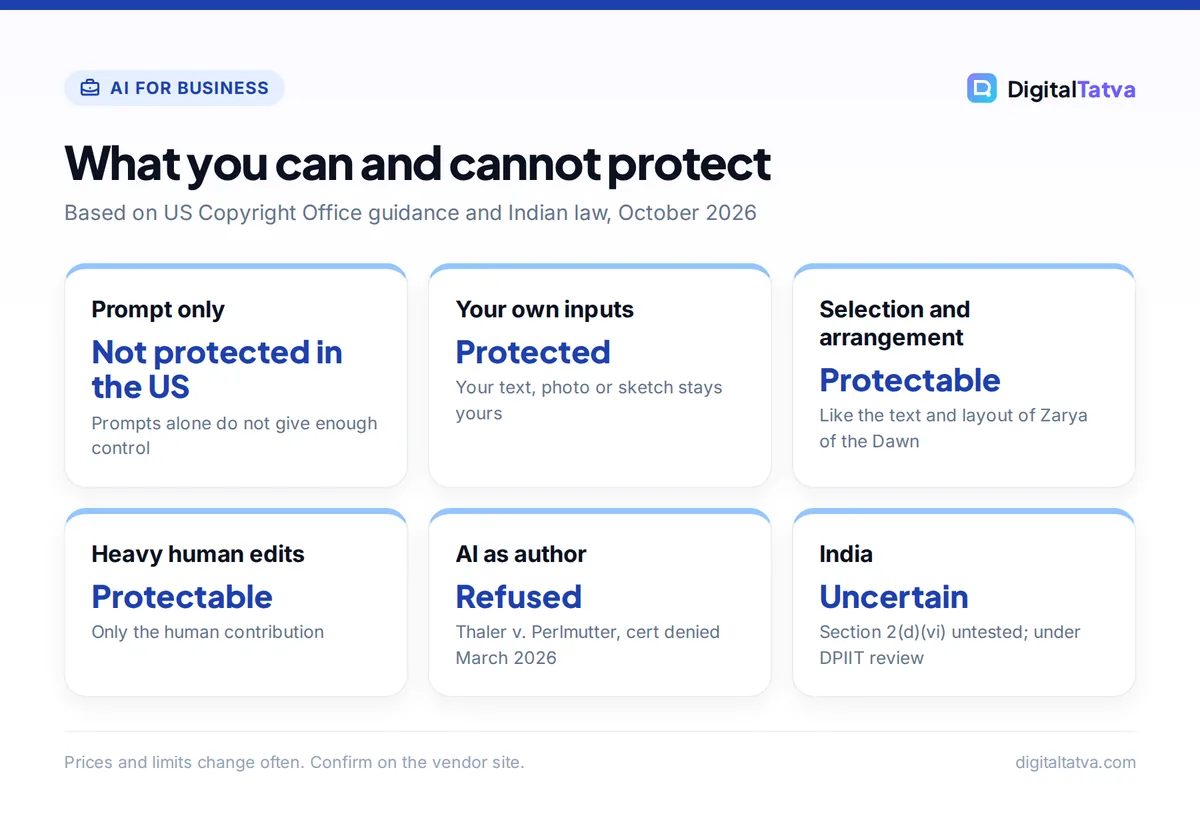
The table below summarizes how the main scenarios are likely to be treated. “Likely” reflects official guidance, not a guarantee, because each work is judged on its facts.
| Scenario | United States | India |
|---|---|---|
| Image or text generated from a prompt, used as is | Not protected (prompts alone are not enough) | Unclear; section 2(d)(vi) untested for AI |
| Your own photo or draft, lightly edited by AI | Your original expression stays protected | Your original expression stays protected |
| AI images arranged with your own text (comic, book, deck) | Text and arrangement protectable; individual AI images not | Likely similar for human parts; AI parts unclear |
| AI draft heavily rewritten by you | Your creative changes protectable | Your creative changes protectable |
| AI listed as author or co-author | Refused (Thaler v. Perlmutter) | Questioned by the Copyright Office in the SURYAST application |
The US position on copyright for AI generated content
The US Copyright Office set out its view in Part 2 of its Copyright and Artificial Intelligence report, published in January 2025. The core rule: “Copyright protects the original expression in a work created by a human author,” even when the work also contains AI-generated material, but protection does not extend to “purely AI-generated material.”
Why prompts alone are not enough
The Office concluded that “prompts do not alone provide sufficient control” over how an AI system turns your idea into expression. A prompt is treated like instructions to a commissioned artist: the ideas are yours, but the expressive choices are made by the system. Writing a long or clever prompt does not change that under current guidance, although the report leaves room for different results if tools give users much more control in future.
What can be protected
- Your own expressive inputs. If you upload your sketch, photo or text and it remains perceptible in the output, you are the author of at least that portion.
- Selection, coordination and arrangement. Choosing and arranging AI images and text into a book, comic or campaign can be protectable as a compilation.
- Creative modifications. Substantial human edits to AI output, such as repainting, rewriting or compositing, can be protected, but only the human contribution.
The Office says these questions “can be resolved pursuant to existing law” and must be “analyzed on a case-by-case basis”. It did not recommend new legislation.
The court cases that matter
Thaler v. Perlmutter: Stephen Thaler tried to register an image he said his AI system created autonomously, naming the AI as author. The district court called human authorship a “bedrock requirement of copyright” in 2023, the D.C. Circuit affirmed on 18 March 2025, and the Supreme Court declined to hear the case on 2 March 2026. The human authorship rule now stands firmly in US law.
Zarya of the Dawn: a graphic novel combining human-written text with Midjourney images. The Office registered the text and the arrangement but concluded that “the individual images themselves could not be protected by copyright.”
Allen v. Perlmutter: artist Jason Allen is challenging the refusal to register “Theatre D’opera Spatial”, an award-winning Midjourney image he refined over many iterations. As of early 2026 the case was pending in federal court in Colorado. Its outcome could clarify how much human control is enough.
How to register a work that contains AI content in the US
The Copyright Office’s registration guidance, in force since 16 March 2023, says “applicants have a duty to disclose the inclusion of AI-generated content.” Here is how that works in practice.
- Identify the human-authored parts. List what you wrote, drew, photographed, edited or arranged yourself.
- Claim only those parts. In the “Author Created” field, describe your contribution, for example “text, and selection, coordination and arrangement of text and images”. Never list an AI tool or its company as an author.
- Exclude the AI material. Disclaim AI-generated content that is “more than de minimis” in the Limitation of the Claim section, under Material Excluded.
- If unsure, say so. You can state generally that the work contains AI-generated material; the Office will contact you.
- Fix earlier filings. If you registered without disclosing AI content, file a supplementary registration. The Office warns that applicants who do not correct the record “risk losing the benefits of the registration.”
Tip: Keep your working files: drafts, prompt history, layered design files and edit logs. If your authorship is ever questioned, a documented creative process is your best evidence.
India’s position on AI generated works
India’s Copyright Act, 1957 already contains a rule for machine-made work. Section 2(d)(vi), added in 1994, says that for a computer-generated work, the author is “the person who causes the work to be created.” On paper, that is more generous than US law, because it does not demand that a human made every expressive choice.
Why it is still uncertain
The provision was written for computer-assisted creation decades before generative AI, and no Indian court has ruled on whether a prompt writer “causes” an AI image or text to be created in the legal sense. The best-known test, the SURYAST artwork, was filed listing both the human creator, Ankit Sahni, and the AI tool RAGHAV as co-authors; according to law firm summaries, the Copyright Office questioned the legal basis for treating an AI system as an author, and there has been no court decision.
What the government is doing
The Department for Promotion of Industry and Internal Trade (DPIIT) set up an expert committee on 28 April 2025 to study generative AI and copyright. On 9 December 2025 it published Part 1 of its working paper, on AI training: a hybrid model giving developers a blanket licence to train on lawfully accessed content, with royalties payable “only upon commercialisation of the AI tools” at rates set by a government-appointed committee. In a Lok Sabha reply reported on 17 December 2025, the government said “issues relating to authorship and copyrightability of AI-generated works are currently under review.” We could not confirm that Part 2 on authorship had been published by October 2026. Separately, the ANI v. OpenAI case over training on news content was still pending in the Delhi High Court, according to an August 2026 law firm review.
Note: For Indian creators selling abroad, the US rules matter too. A work that might be protectable in India could still be refused registration in the US if its expressive content is mainly AI-generated.
What AI platform terms say about who owns the output
Platform terms decide what the tool company claims, not whether copyright exists. Most major tools now hand you whatever rights they have, often with the words “if any”.
| Platform | What the terms say | Watch for |
|---|---|---|
| ChatGPT (OpenAI) | You “own the Output”; OpenAI assigns “all our right, title, and interest, if any” (terms effective 1 January 2026) | “Output may not be unique”; others may get similar results |
| Claude (Anthropic) | Anthropic assigns “all of our right, title, and interest, if any, in Outputs” (effective 8 October 2025) | Subject to complying with the terms |
| Gemini and Google tools | “Google won’t claim ownership over that content” (terms effective 30 July 2026) | You may not use Google AI output to build competing ML models |
| Midjourney | You own assets “to the fullest extent possible under applicable law” | Companies over $1M revenue need Pro or Mega; you grant Midjourney a perpetual license |
| Canva | You own your output, except output that modifies or incorporates Canva’s licensed content | Outputs may not be unique; do not present AI content as human-made |
| Adobe Firefly | Firefly model outputs are “safe for commercial use”; trained on licensed and public domain content | Partner model outputs may have different terms |
| Leonardo.ai | Paid plans keep “full ownership, copyright, and other intellectual property rights” | On free plans, Leonardo can reuse your images |
OpenAI’s terms of use are typical: the assignment covers only rights that exist. If the law says a raw AI image has no copyright, the terms cannot give you one. What the terms do give you is freedom to use the output commercially without the platform claiming it. Music tools vary more: Suno’s free plan has no commercial rights, and AIVA keeps copyright on its free and Standard plans. Our list of the best AI music generators compares their licenses, and the Midjourney pricing guide explains the revenue rule.
The other side: infringement risk from AI training and outputs
Ownership is half the story. The other half is whether your AI output copies someone else’s work. In May 2025 the US Copyright Office released a pre-publication Part 3 report on training, concluding that some training uses are fair use and others are not, depending on the works, their sources and how outputs are controlled. Lawsuits continue: Universal Music Group and Sony Music filed a second lawsuit against Suno in September 2026 over its v6 models, as covered in our Suno vs Udio comparison.
For brands, the practical risk is an output that closely resembles a known character, logo, photo or song. Tools trained on licensed content, such as Adobe Firefly, reduce that risk, which is one reason we compare them in Canva AI vs Adobe Firefly.
Watch out: Never prompt for a living artist’s name, a brand’s logo or a film character for commercial work. Even if you own the output under platform terms, you could still infringe someone else’s copyright or trademark.
A practical playbook to protect AI-assisted work
Here is how creators and brands can get the most protection while using AI heavily.
For writers and bloggers
Use AI for research, outlines and first drafts, then rewrite in your own voice, add original examples and reporting, and restructure. The more expressive choices you make, the stronger your claim. Our guide to writing a blog post with AI that ranks follows exactly this workflow, and our list of AI writing tools covers which ones make editing easiest. If you self-publish on Amazon, KDP requires you to disclose AI-generated text, images or translations, even if you edited them, while AI-assisted work (your own writing refined with AI) does not need disclosure.
For designers and brands
Treat AI images as raw material. Composite, repaint, add your own photography and typography, and keep layered files. For logos, copyright is the weakest protection anyway: register a trademark, which protects your brand use regardless of how the design was made. Our list of AI logo generators notes which tools grant full rights to the final files.
For agencies and freelancers
Clients increasingly ask “will we own this?” Put it in the contract: disclose AI use, assign all rights you hold, and avoid promising copyright you cannot guarantee for AI-generated elements. Our guide to AI for marketing agencies covers pricing and disclosure, and an AI usage policy template helps set rules for your team.
Protection beyond copyright
- Trademarks for names, logos and slogans.
- Contracts and licenses that control how clients and partners may use your assets.
- Trade secrets for prompts, workflows and internal tools you never publish.
- Speed and brand: in many markets, being first and recognizable matters more than legal exclusivity.
Frequently asked questions
Can I copyright an image I made with Midjourney or ChatGPT?
Not the raw image, if you only wrote a prompt. The US Copyright Office says prompts alone do not give enough control, so purely AI-generated images are not protected. You can protect your own creative changes, any original material you added, and your selection and arrangement of images in a larger work. Midjourney’s and OpenAI’s terms still let you use the image commercially.
Who owns AI generated content in India?
Section 2(d)(vi) of the Copyright Act says the author of a computer-generated work is the person who causes it to be created, which could point to the user. But no court has applied this to generative AI, and the government told Parliament in December 2025 that authorship of AI-generated works is under review. Until that is settled, treat ownership of raw AI output in India as uncertain.
Do I have to disclose AI use when registering copyright?
In the US, yes. Since March 2023 the Copyright Office has required applicants to disclose AI-generated content that is more than de minimis, claim only the human-authored parts, and exclude the AI material. If you already registered without disclosing, file a supplementary registration, or you risk losing the benefits of the registration.
Can someone copy my AI generated blog post or design?
If the content is purely AI-generated, copyright may not stop them, at least in the US. If you substantially rewrote or designed it yourself, your human contribution is protected. Platforms may still remove copied content under their own policies, and trademarks or contracts can protect brand assets that copyright cannot.
Is it legal to use AI content for commercial purposes?
Generally yes, if the tool’s terms allow it and the output does not infringe someone else’s rights. Most paid plans allow commercial use, but some free tiers do not, such as Suno Free, and Midjourney requires Pro or Mega for companies over $1 million revenue. Check the license of each tool and avoid outputs that imitate known brands, characters or artists.
What creators and brands should do next
Assume raw AI output is free for anyone to copy, and build protection through the parts only you can add: your writing, your design decisions, your arrangement, your brand and your contracts. Disclose AI use when you register in the US, watch for India’s Part 2 working paper on authorship, and read the terms of each tool you pay for. For a related risk, see our guide to AI data privacy for business.
Laws, guidance and platform terms change, so confirm the current versions on the official sites before you rely on them, and check your tool’s pricing page for which plans include commercial rights.
Pricing and features are checked at the time of writing and can change. Some links may be affiliate links, which never affect our verdicts.



