Is Your Data Safe With AI Tools? A Business Privacy Guide
How ChatGPT, Claude and Gemini handle business data in 2026, which settings and plans keep it out of training, what never to paste, and what India's DPDP Act means for AI use.

On this page
- Key takeaways
- How AI tools actually use your data
- Data privacy by AI tool: consumer vs business plans
- What you should never paste into an AI chatbot
- India’s DPDP Act and AI: what businesses need to know
- A 7-step AI data privacy checklist for your business
- When to keep AI fully in-house
- Frequently asked questions
- Next steps
Your data can be safe with AI tools, but only if you use the right plan and the right settings. The biggest risk for most businesses is not hackers: it is staff pasting customer data, contracts or financials into free consumer accounts, where chats may be used to train models, kept for years if reviewed by humans, or stored longer than you expect. Business plans such as ChatGPT Business, Claude Team and Google Workspace with Gemini do not train on your data by default, which is why they are the safer choice for company work.
This guide explains how the major AI tools handle your data in 2026, which settings to change, what never to paste into a chatbot, and what India’s Digital Personal Data Protection (DPDP) Act means for businesses using AI. It is practical guidance, not legal advice: for contracts, regulated data or compliance decisions, talk to a qualified lawyer.
Key takeaways
- Consumer AI accounts can use your chats for training unless you opt out. OpenAI lets you switch off “Improve the model for everyone”; Claude Free, Pro and Max users choose whether to allow training.
- OpenAI does not use ChatGPT Business, Enterprise or Edu content for training by default, and Anthropic’s consumer training terms do not apply to Claude Team, Enterprise or the API.
- Gemini app chats reviewed by humans can be kept for up to three years, even after you delete your activity.
- India’s DPDP Rules were notified on 13 November 2025, with most obligations and penalties scheduled from 13 May 2027. Penalties can reach Rs 250 crore for security failures.
- The cheapest fix is a written AI policy, business-tier accounts for client work, and a clear “never paste” list.
How AI tools actually use your data
When you type into an AI chatbot, three things can happen to that text. Understanding them makes every privacy setting easier to judge.
- Model training: your conversations may be used to improve future models. Once data is used in training, you cannot pull it back out.
- Retention: the provider stores chats for a period, for safety, abuse monitoring or your own history. Deleting a chat in the app does not always delete every copy immediately.
- Human review: some providers let trained reviewers read a sample of conversations to improve quality. Reviewed chats may follow different retention rules.
There is also a fourth risk that has nothing to do with the vendor: connectors and agents. When you connect an AI tool to Gmail, Drive, Slack or your CRM, it can read whatever that account can read. An agent that browses the web can also be tricked by hidden instructions on a page, a risk called prompt injection.
Data privacy by AI tool: consumer vs business plans
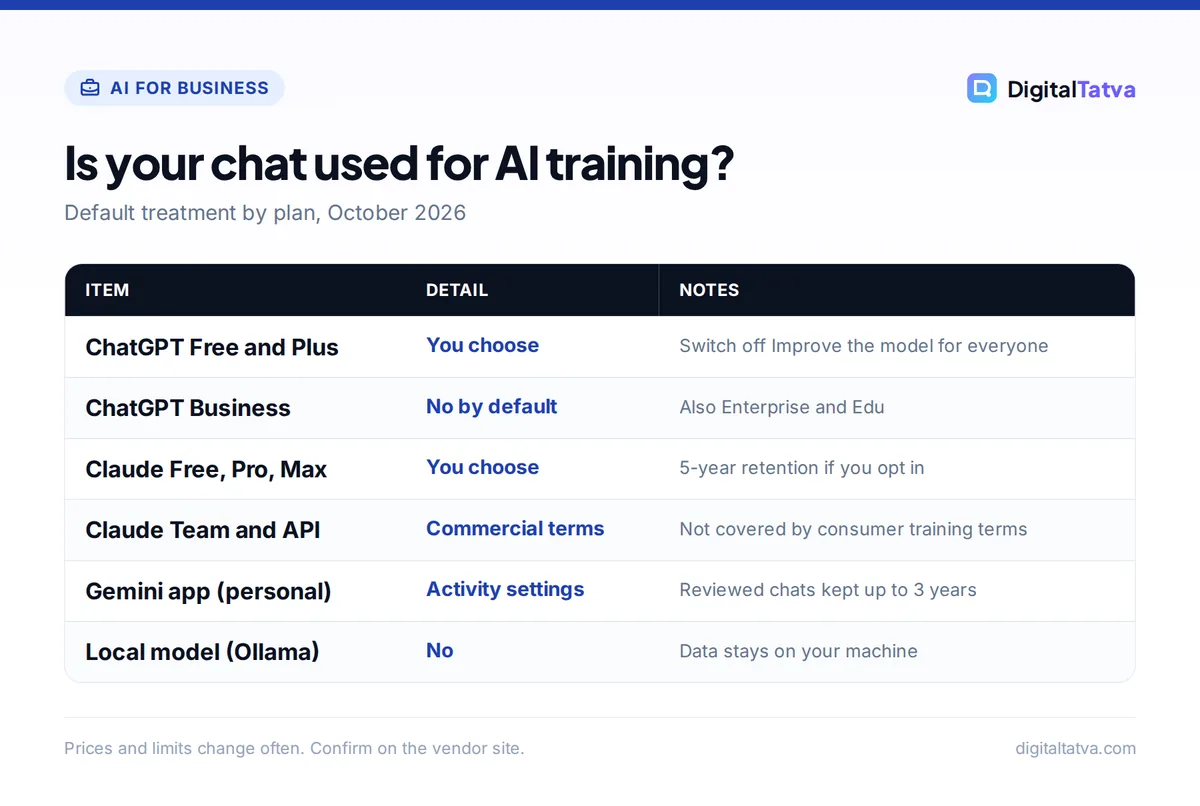
The table below summarizes how the main tools treat business data, based on each vendor’s own help pages and announcements checked in October 2026.
| Tool and plan | Used for training by default? | Key retention or review detail |
|---|---|---|
| ChatGPT Free, Go, Plus, Pro | You choose, via “Improve the model for everyone” | Temporary chats are not used for training but may be kept up to 30 days for safety |
| ChatGPT Business, Enterprise, Edu | No, by default | Admin controls and centralized billing |
| Claude Free, Pro, Max | You choose in Privacy Settings | If you allow training, retention is five years; otherwise 30 days |
| Claude Team, Enterprise, API | Not covered by consumer training terms | Governed by Anthropic’s commercial terms |
| Gemini app (personal accounts) | Activity settings apply | Human-reviewed chats kept up to three years; 72 hours kept even with Keep Activity off |
| Gemini Notebook (Workspace and Education) | No | Uploads and queries “will not be reviewed by human reviewers” |
| Notion AI | No (subprocessor contracts prohibit training) | Enterprise adds zero data retention with LLM providers |
| Local models (for example Ollama) | No | Data stays on your own machine |
ChatGPT
On personal plans, OpenAI’s data controls help page explains that you can choose whether your conversations help train its models. To opt out on the web, go to Settings, then Data controls, and switch off “Improve the model for everyone”. On mobile, open the sidebar, then Settings, then Data controls. Temporary Chat is useful for one-off sensitive questions, but those chats may still be retained for up to 30 days for safety purposes. On ChatGPT Business, Enterprise and Edu, OpenAI does not use your content for training by default. Business seats cost $25 per user per month, or $20 billed annually, with a two-seat minimum; our ChatGPT pricing guide compares every plan.
Claude
Anthropic updated its consumer terms in 2025 so that Claude Free, Pro and Max users decide whether their chats and coding sessions are used to improve Claude. If you allow it, Anthropic keeps that data for five years; if not, the standard 30-day period applies. These consumer terms do not cover Claude for Work (Team and Enterprise), Claude for Education, Claude Gov, the API or access through Amazon Bedrock and Google Cloud Vertex AI. Read the official announcement for details, and see our Claude pricing guide for Team seat costs.
Google Gemini
For personal Google accounts, chats that human reviewers have looked at are not deleted when you delete your Gemini activity, and they can be retained for up to three years. Even with Keep Activity turned off, Google keeps conversations for 72 hours to respond and protect its services. For business use, Gemini inside Google Workspace is the better path; our guide to using Gemini in Gmail, Docs and Sheets explains what each Workspace plan includes. If you use Gemini Notebook (formerly NotebookLM) for research, Google says Workspace and Education uploads are not reviewed by humans or used to train models; see how to use NotebookLM.
DeepSeek and other hosted apps
Before using any AI app for business, check where it stores data and under which country’s laws. Our DeepSeek vs ChatGPT comparison covers privacy trade-offs of using a low-cost hosted model.
Watch out: A single employee using a personal ChatGPT, Claude or Gemini account for client work can undo your whole privacy setup. Give staff a business account for company work and make the rule explicit.
What you should never paste into an AI chatbot
Even on business plans, some data should stay out of general AI tools unless you have a specific, approved setup for it.
- Government ID and financial numbers: Aadhaar, PAN, passport numbers, bank account and card details.
- Passwords, API keys and access tokens. Rotate any key that was pasted into a chat.
- Health, children’s and other sensitive personal data about customers or employees.
- Unreleased financials, M&A plans and board material.
- Client data covered by an NDA or contract that does not allow third-party processing.
- Source code with secrets or proprietary algorithms, unless your coding tool is on an approved business plan.
Tip: Teach staff to anonymize before they paste. Replace names with “Client A”, remove phone numbers and emails, and round financial figures. The AI usually gives an equally useful answer.
India’s DPDP Act and AI: what businesses need to know
India’s Digital Personal Data Protection Act, 2023 governs how businesses collect and process personal data of people in India. Its rules, the DPDP Rules 2025, were notified by the Ministry of Electronics and Information Technology (MeitY) on 13 November 2025 and come into force in phases:
| Date | What applies |
|---|---|
| 13 November 2025 | Definitions and Data Protection Board provisions |
| 13 November 2026 | Consent manager registration opens |
| 13 May 2027 | Most obligations: notice and consent, security safeguards, breach reporting, retention limits, children’s data, and penalties |
This timeline comes from law firm and compliance summaries, and MeitY sought industry views in early 2026 on shortening it to 12 months. Check the latest official notification before you plan around these dates.
Why it matters for AI: if you paste a customer’s personal data into an AI tool, you are processing it, and the AI vendor acts on your behalf. Under the Act, you remain responsible. In practice that means:
- Purpose and consent: only use personal data in AI tools for purposes customers were told about.
- Security safeguards: use business plans with admin controls, restrict access and keep logs. Summaries of the Act list penalties of up to Rs 250 crore for failing to take reasonable security safeguards or to report a breach.
- Breach reporting: the rules require notifying the Data Protection Board and affected people; compliance summaries describe a 72-hour reporting window for the Board.
- Retention: do not keep personal data in chat histories, projects or knowledge bases longer than needed.
If you also serve customers in Europe, the EU AI Act already requires providers and deployers of AI systems to support AI literacy among their staff (Article 4, applying since 2 February 2025), on top of GDPR. A lawyer can tell you which rules apply to your situation.
A 7-step AI data privacy checklist for your business
- List the AI tools people already use. Ask every team which chatbots, browser extensions, meeting recorders and writing tools they use. Shadow AI is common.
- Classify your data. Use three simple levels: public, internal and confidential. Decide which levels may go into which tools.
- Move work to business plans. ChatGPT Business, Claude Team or Google Workspace with Gemini give admin controls and no training by default. Our guide to AI team plans shows when business seats are worth the cost.
- Change default settings. On any personal accounts that remain, switch off training, use temporary chats for sensitive questions, and review connected apps.
- Write an AI usage policy. Put approved tools, the “never paste” list and review rules in writing. Start from our free AI usage policy template.
- Check vendor contracts. For important tools, read the data processing terms: data location, retention, subprocessors and breach notice timelines.
- Train staff and review quarterly. A 30-minute session with real examples prevents most mistakes. Revisit the policy when vendors change their terms.
Questions to ask any AI vendor
- Do you train on our inputs or outputs, and can we turn that off at the organization level?
- How long do you keep prompts, files and logs, and can we set shorter retention?
- Do humans review our data, and under what conditions?
- Where is data stored and processed? Is regional processing available, and at what cost?
- Do you offer SSO, audit logs and admin controls?
- How and how fast will you tell us about a breach?
Regional processing often costs extra on APIs. For example, OpenAI lists a 10% surcharge for data residency on newer models, and Anthropic charges 1.1x for US-only inference on its 4.6 and later models.
When to keep AI fully in-house
For the most sensitive workloads, such as patient records, legal case files or proprietary research, consider running an open model on your own hardware. Local tools like Ollama keep prompts on your machine, and models such as gpt-oss and Gemma 4 use the permissive Apache 2.0 license. See our guides to open source AI models you can use for free and running an LLM locally. You then own the security of that server, so this route suits businesses with IT support. Customer-facing channels need care too; our WhatsApp AI for business guide covers consent for chat broadcasts.
Frequently asked questions
Is it safe to use ChatGPT for business data?
It can be, on the right plan. OpenAI does not use ChatGPT Business, Enterprise or Edu content for training by default, and admins get controls over the workspace. On personal plans, switch off “Improve the model for everyone” in Data controls. Even then, avoid pasting ID numbers, passwords and confidential client data unless your policy allows it.
Does Claude train on my data?
On Claude Free, Pro and Max, you choose in Privacy Settings whether your chats can be used for training. If you allow it, Anthropic keeps that data for five years; otherwise standard retention is 30 days. Claude Team, Enterprise, Education, Gov and the API are not covered by these consumer training terms.
Which AI tool is best for data privacy?
For maximum privacy, a local open model run with a tool like Ollama keeps data on your own machine. Among cloud tools, business tiers such as ChatGPT Business, Claude Team and Google Workspace with Gemini are safer than personal accounts because they do not train on your data by default and include admin controls.
Does India’s DPDP Act apply to AI tools?
Yes, whenever you process personal data of people in India, including by pasting it into an AI tool. Most obligations, such as consent, security safeguards and breach reporting, are scheduled to apply from 13 May 2027 under the notified rules, though the government has discussed shortening the timeline. This is not legal advice; consult a lawyer for your situation.
How do I stop employees leaking data into AI tools?
Combine policy, tools and training. Provide approved business accounts so staff do not need personal ones, write a short AI usage policy with a clear never-paste list, switch off training where possible, and run a brief training session with real examples. Review usage every quarter as tools and vendor terms change.
Next steps
Start this week with three actions: move client work to business-tier AI accounts, publish a one-page AI policy with a never-paste list, and check the privacy settings on every tool your team uses. Small businesses on a tight budget can follow our guide to using AI without a big budget and still apply these basics. This article is general information, not legal advice, and AI vendors update their privacy terms and plan pricing often, so confirm the current details on each vendor’s site and with your legal adviser before you rely on them.
Pricing and features are checked at the time of writing and can change. Some links may be affiliate links, which never affect our verdicts.