
40 AI Prompts to Practice Job Interviews and Get Hired
40 copy-ready AI interview prep prompts for ChatGPT, Gemini and Claude: company research, STAR stories, mock interviews, technical rounds, salary talks and follow-up emails.

On this page
- Key takeaways
- Which AI tool is best for interview prep?
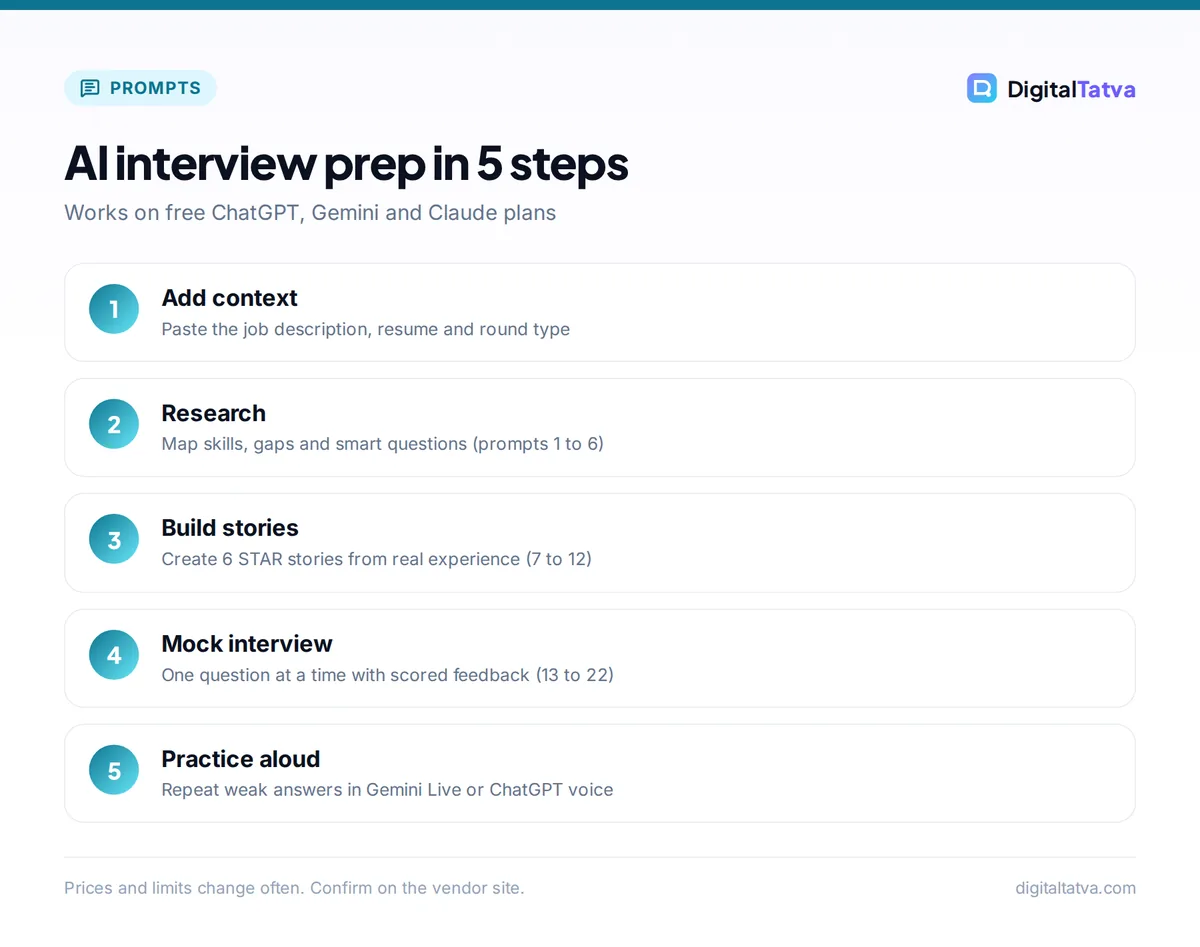
- How to use these AI interview prep prompts
- Research the company and role (prompts 1 to 6)
- Build your stories and resume talking points (prompts 7 to 12)
- Mock interview prompts (13 to 22)
- Behavioral and situational questions (prompts 23 to 28)
- Technical and role-specific practice (prompts 29 to 34)
- Salary, follow-up and after the interview (prompts 35 to 40)
- Practice out loud: voice mode and a scoring rubric
- Mistakes to avoid when using AI for interview prep
- Frequently asked questions
- Next steps: build your interview prep routine
The fastest way to do AI interview prep is to paste the job description and your resume into ChatGPT, Gemini or Claude, ask it to act as the interviewer one question at a time, answer out loud, and request honest feedback after each answer. Below are 40 copy-ready prompts that take you from researching the company to mock interviews, salary talks and the thank-you email, with [brackets] for your details.
Every prompt works on the free plans of ChatGPT, Gemini and Claude. For speaking practice, Gemini Live and ChatGPT’s voice mode turn these into realistic spoken interviews; even Google’s own career site suggests Gemini Live to “simulate a real-time, conversational interview”. This AI interview prep guide also covers which tool to use, a scoring rubric, and the mistakes that make AI practice backfire.
Key takeaways
- Give the AI three things first: the job description, your resume and the interview type (HR, technical, case or panel). Generic prompts give generic questions.
- Ask for one question at a time and feedback after each answer; that turns a chatbot into a mock interviewer.
- Practice out loud with Gemini Live or ChatGPT voice. Speaking exposes weak answers that look fine on screen.
- Build five to eight STAR stories from your real experience and reuse them across behavioral questions.
- Never invent experience with AI, and do not use AI during a live interview unless the employer allows it.
Which AI tool is best for interview prep?
Any major chatbot can run these prompts. The differences are voice practice, file handling and price.
| Tool | Best for | Free plan | Paid option |
|---|---|---|---|
| ChatGPT | Mock interviews, feedback and rewriting answers | Yes, with limited voice chats and uploads | Go $8/mo, Plus $20/mo |
| Gemini | Spoken practice with Gemini Live | Yes, Gemini Live included | AI Plus $4.99/mo (Rs 399 in India) |
| Claude | Long job descriptions, case prep and polished writing | Yes | Pro $20/mo |
| Yoodli | Dedicated roleplay practice with speaking feedback | 5 lifetime roleplay sessions | Pro $8/mo billed annually |
If you are unsure which assistant suits you, our ChatGPT vs Claude comparison covers writing quality, and our list of the best AI chatbots compares free plans.
How to use these AI interview prep prompts
Start every session with a context prompt. It takes two minutes and makes every later answer specific to your role.
Tip: Paste this first, then use any prompt below. “I am preparing for a [HR / technical / case / final] interview for the role of [job title] at [company]. Here is the job description: [paste]. Here is my resume: [paste]. I have [X] years of experience in [field]. Keep this context for the whole conversation.”
Remove phone numbers, addresses and ID details from your resume before pasting. If you use ChatGPT or Claude regularly, a project or saved memory keeps this context between sessions; our guide to how ChatGPT and Claude memory works shows how to control what is saved, and Claude Projects are ideal for a job search with several applications.
Research the company and role (prompts 1 to 6)
- Based on this job description, list the top 8 skills and qualities the interviewer will test. Rank them by importance and give one sign of each that I should show in my answers.
- Compare my resume with this job description. Show a table of requirements, my matching evidence, and gaps. For each gap, suggest how I can address it honestly in the interview.
- Summarize what [company] does, who its customers are and its main competitors in 150 words. Then list 5 things I should verify on the company website or recent news before the interview, because your information may be out of date.
- What are the likely day-to-day challenges for a [job title] in a [company type, e.g. Series B fintech startup]? Give me 3 smart ways to show I understand them.
- Write 8 thoughtful questions I can ask the interviewer at the end, grouped into role, team, success metrics and growth. Avoid anything I could find on the website.
- Explain the interview format usually used for [role] at [company type or industry], including rounds, typical duration and what each round tests. Mark anything that varies by company.
Build your stories and resume talking points (prompts 7 to 12)
- Help me build STAR stories (Situation, Task, Action, Result). Ask me questions one at a time about my experience at [company] until we have 6 strong stories covering leadership, conflict, failure, initiative, teamwork and a measurable win.
- Turn this rough story into a 90-second STAR answer. Keep my facts exactly as given, use “I” for my actions, and end with the result and what I learned: [story]
- Write a 60-second answer to “Tell me about yourself” for this role. Structure it as present, past, future, and connect it to the job description. Then give a 30-second version.
- For each bullet in my resume, write the follow-up question an interviewer is most likely to ask, and a short note on what a strong answer should include.
- I am changing careers from [old field] to [new field]. Write an honest, confident answer to “Why are you switching?” that turns my background into an advantage.
- I have a gap in my resume from [dates] because [reason]. Write a brief, truthful answer that addresses it in under 40 seconds and moves the conversation forward.
Mock interview prompts (13 to 22)
These turn the AI into an interviewer. Answer by typing or, better, out loud in voice mode.
- Act as a hiring manager interviewing me for this role. Ask one question at a time, wait for my answer, then give a score out of 10, what worked, what to improve, and a stronger sample answer. Ask 8 questions in total.
- Run a 15-minute HR screening interview for this role. Include questions about notice period, current and expected salary, relocation and why I am leaving. Give feedback only at the end.
- Act as a tough, skeptical interviewer. Challenge my answers with follow-up questions like a real panel would. Do not accept vague answers.
- Simulate a panel interview with three people: the hiring manager, a senior peer and an HR partner. Each asks questions from their angle. Label who is speaking.
- Ask me the 10 most common interview questions for a [job title] with [X] years of experience, one by one. After all 10, rank my answers from weakest to strongest.
- Ask me 5 curveball questions (for example “What would your last manager say is your biggest weakness?”). Coach me on staying calm and specific.
- Here is my answer to “[question]”: [answer]. Rate it for clarity, relevance, evidence and length. Then rewrite it to be 30% shorter without losing the key result.
- Play the interviewer for a final round with the [VP or founder]. Focus on motivation, long-term fit and how I think about the business, not technical details.
- Run a campus placement interview for a fresher applying to [role] at [company type]. Include an HR round and a basic technical round, and keep the questions suitable for a final-year [degree] student.
- At the end of this mock interview, give me a report card: overall readiness score, my three best moments, three patterns to fix, and the three questions I should practice again.
Behavioral and situational questions (prompts 23 to 28)
- List 12 behavioral questions this employer is likely to ask, based on the job description. For each, tell me which of my STAR stories fits best.
- Ask me “Tell me about a time you failed.” After my answer, check whether I took ownership, explained what I changed, and avoided blaming others.
- Give me 5 situational questions (“What would you do if…”) for this role. After each answer, show how an excellent candidate would reason through it.
- Ask me about a conflict with a colleague or manager. Coach me to show empathy and a clear outcome without sounding negative about anyone.
- Ask “Why should we hire you over other candidates?” and help me answer with three specific proof points from my resume, not adjectives.
- What are my strengths and weaknesses for this role based on my resume? Help me write a weakness answer that is real, relevant and shows active improvement.
Technical and role-specific practice (prompts 29 to 34)
- Act as a technical interviewer for a [junior / mid / senior] [software engineer] role using [language]. Give me one coding problem, let me explain my approach before code, then review my solution for correctness, complexity and edge cases.
- Ask me 8 marketing interview questions for a [performance marketing / SEO / brand] role, including one where I must analyze campaign numbers you provide. Score my reasoning.
- Run a sales roleplay: you are a skeptical prospect for [product]. I will pitch and handle objections. Afterwards, rate my discovery questions and objection handling.
- Give me a case interview for a [consulting / product] role: [e.g. “A food delivery app’s orders fell 15% in a month”]. Let me structure it step by step and push back on weak logic.
- Ask me 10 SQL and Excel questions for a data analyst interview, from easy to hard. Show the correct answer only after I respond.
- I will send you a take-home assignment brief. Help me plan my approach, list what reviewers likely look for, and draft questions to clarify with the recruiter. Do not complete the assignment for me.
Prompt 34 matters: many employers treat AI-written take-home work as misconduct. Use AI to plan and review, then do the work yourself.
Salary, follow-up and after the interview (prompts 35 to 40)
- Help me prepare for the salary question. My current CTC is [amount], my target is [amount], and the role is in [city]. Give me three ways to answer depending on whether they ask first or I do, and tell me what to research to check market rates.
- Roleplay a salary negotiation. You are the recruiter offering [amount]. I want [amount]. Push back realistically and coach me after each reply.
- Write a short thank-you email to [interviewer name] after my [round] interview. Mention [specific topic we discussed] and keep it under 120 words.
- Here are my notes from today’s interview: [notes]. Identify what went well, what I may have missed, and anything I should clarify in my follow-up email.
- Write a polite email asking for an update when I have not heard back [X] days after my interview. Keep it warm and under 80 words.
- I received an offer from [company A] and am waiting on [company B]. Help me write an email to ask [company A] for a few more days to decide, without risking the offer.
If you want more general prompts for your job search and work, see our 100 best ChatGPT prompts and 40 Claude prompts for writing and editing, which help with cover letters too.
Practice out loud: voice mode and a scoring rubric
Typed practice helps you plan; spoken practice gets you hired. Open Gemini Live (included on the free Gemini plan) or ChatGPT voice mode (limited on Free, more on paid plans), paste your context prompt, then say “Start the mock interview from prompt 13.” Answer as if you are on a video call, and ask for feedback at the end.
- Set the scene. Give the role, round and interviewer style (“friendly HR manager” or “strict technical lead”).
- Answer one question at a time. Aim for 60 to 120 seconds per behavioral answer.
- Ask for a transcript review. After the session, ask the AI to list filler words, rambling answers and missing results.
- Repeat weak questions. Re-answer the three lowest-scored questions until each scores 8 or more.
- Do a full dress rehearsal. The day before, run a complete mock interview without pausing.
Ask the AI to score each answer with this rubric so feedback is consistent across sessions.
| Criterion | What a 9 or 10 looks like | Common problem |
|---|---|---|
| Relevance | Answers the exact question and links to the role | Drifts into a rehearsed story that does not fit |
| Structure | Clear STAR or point, reason, example | No beginning or end |
| Evidence | Specific numbers, names of tools, concrete actions | Adjectives like “hardworking” with no proof |
| Ownership | “I did” for your actions, credits the team fairly | “We” throughout, so your role is unclear |
| Length | 60 to 120 seconds | Three-minute monologues |
| Delivery | Calm pace, few fillers, confident close | Rushed, trailing off at the end |
Save money: You do not need a paid plan for interview prep. If you hit free limits, rotate between ChatGPT, Gemini and Claude, or see our list of free ChatGPT Plus alternatives. Students should check AI student discounts, including a free year of Google AI Plus for eligible Indian university students.
Mistakes to avoid when using AI for interview prep
- Memorizing AI answers word for word. Interviewers notice scripted answers. Use AI drafts to find structure, then speak in your own words.
- Letting AI invent experience. AI will happily add achievements you never had. Every claim must be true and something you can discuss in depth.
- Trusting AI company facts. Chatbots can be out of date or wrong about a company’s products, leaders or numbers. Verify on the official site and recent news.
- Using AI during the real interview. Reading AI answers in a live or recorded interview is usually against the rules and easy to spot. Ask the recruiter if AI tools are allowed in assessments.
- Oversharing data. Keep salary slips, ID numbers and confidential employer details out of chatbots, and turn off training on your conversations if you prefer.
- Vague prompts. “Ask me interview questions” gets generic results. Our prompt engineering guide shows why role, context and format matter.
Frequently asked questions
Can ChatGPT conduct a mock interview?
Yes. Paste the job description and your resume, then ask ChatGPT to act as the interviewer, ask one question at a time and give feedback after each answer (prompt 13 above). It works on the free plan. For spoken practice, use ChatGPT’s voice mode, which is limited on Free and expanded on paid plans, or Gemini Live, which is included on Gemini’s free plan.
What is the best free AI for interview preparation?
Gemini is a strong free choice because Gemini Live lets you practice speaking and Google itself suggests it for simulated interviews. ChatGPT Free is excellent for typed mock interviews and rewriting answers, and Claude Free handles long job descriptions and case prep well. Yoodli offers five free roleplay sessions if you want dedicated speaking feedback.
Is it cheating to use AI to prepare for an interview?
No. Using AI to research a company, practice questions and improve your answers is preparation, like working with a career coach. It becomes a problem when you use AI to fabricate experience, complete take-home assignments that are meant to be your own work, or read AI answers during a live interview. When in doubt, ask the recruiter what is allowed.
How do I practice interview answers out loud with AI?
Open Gemini Live or ChatGPT voice mode, give the role and interview type, and ask it to interview you one question at a time. Answer as if you are on a call. Afterwards, ask for feedback on clarity, length and filler words, then repeat the weakest questions. Doing two or three spoken sessions before an interview makes a noticeable difference.
Can AI help me answer salary questions in India?
Yes. Prompt 35 helps you prepare answers about current and expected CTC, and prompt 36 lets you rehearse a negotiation. AI can suggest how to frame your number, but its salary data can be outdated, so check current market ranges for your role and city from job portals, recruiters and people in your network before you name a figure.
Next steps: build your interview prep routine
Pick one assistant, paste your context prompt, and work through the prompts in order: research (1 to 6), stories (7 to 12), mock interviews (13 to 22), then role-specific practice. Do at least two spoken mock interviews before every important round, and keep a document of your best answers to reuse. If you are new to chatbots, our beginner guide on how to use ChatGPT covers the basics, and students can find more study tools in our list of the best AI tools for students.
Free plan limits and paid plan prices change often, so check each tool’s pricing page for current details.
Pricing and features are checked at the time of writing and can change. Some links may be affiliate links, which never affect our verdicts.



