LLM API Pricing Comparison 2026: Cost per Million Tokens for Every Major Model
LLM API pricing compared for October 2026: price per million tokens for GPT-6, Claude 5.5, Gemini, Grok, DeepSeek and Muse Wonder, with cost examples, discounts and hidden charges.

On this page
- Key takeaways
- LLM API pricing comparison table (October 2026)
- OpenAI API pricing
- Anthropic Claude API pricing
- Google Gemini API pricing
- xAI, DeepSeek and Meta API pricing
- Discounts that change your real cost
- Hidden costs to watch
- How to estimate your own LLM API cost
- Which LLM API should you choose?
- Frequently asked questions
- The bottom line
LLM API prices in October 2026 range from $0.10 per million input tokens (Claude Haiku 5.5 and GPT-6 Luna) to $10 per million (GPT-6 Astra and Claude Fable 5.1), a 100-fold spread. Output tokens cost more, from $0.50 to $50 per million. For most apps, a mid-tier model such as Claude Sonnet 5.5 or GPT-6.1 Sol at $2 input and $10 output gives near-flagship quality, while budget models handle high-volume tasks for a few dollars a month.
This LLM API pricing comparison lists the standard price per million tokens for every major model from OpenAI, Anthropic, Google, xAI, DeepSeek and Meta, shows what a typical workload costs on each, and explains the discounts and hidden charges that change your real bill. Prices are list rates in US dollars from official pricing pages unless marked otherwise.
Key takeaways
- Cheapest capable models: Claude Haiku 5.5 and GPT-6 Luna at $0.10 input and $0.50 output per million tokens, and DeepSeek V4.1 Flash from $0.15 / $0.60 off-peak.
- Mid-tier sweet spot: Claude Sonnet 5.5 and GPT-6.1 Sol at $2 / $10, and Grok 4.7 at $2 / $6.
- Flagships: Claude Opus 5.5 and Meta Muse Wonder at $4 / $20; GPT-6 Astra and Claude Fable 5.1 at $10 / $50.
- Caching cuts repeated input by 90% or more, and Batch APIs halve prices for work that can wait.
- Watch long-context surcharges: OpenAI’s GPT-6 rates rise above 272K input tokens, and Haiku 5.5 costs five times more above 100K.
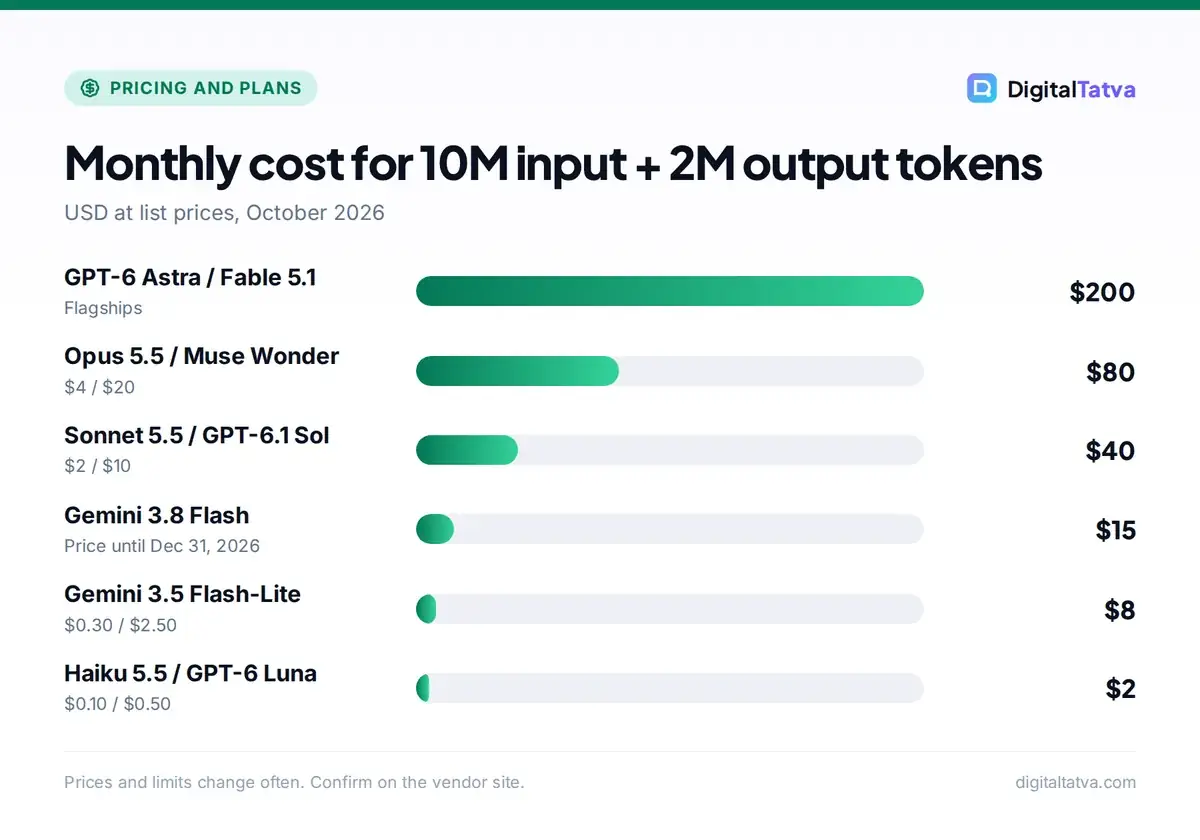
LLM API pricing comparison table (October 2026)
| Model | Provider | Input per 1M | Output per 1M | Cost for 10M in + 2M out |
|---|---|---|---|---|
| GPT-6 Astra | OpenAI | $10.00 | $50.00 | $200 |
| Claude Fable 5.1 | Anthropic | $10.00 | $50.00 | $200 |
| Claude Opus 5.5 | Anthropic | $4.00 | $20.00 | $80 |
| Meta Muse Wonder | Meta | $4.00 | $20.00 | $80 |
| Gemini 4 Argon (standard rate, reported) | $4.00 | $20.00 | $80 | |
| Claude Sonnet 5.5 | Anthropic | $2.00 | $10.00 | $40 |
| GPT-6.1 Sol | OpenAI | $2.00 | $10.00 | $40 |
| Gemini 3.5 Flash | $1.50 | $9.00 | $33 | |
| Grok 4.7 | xAI | $2.00 | $6.00 | $32 |
| Gemini 3.8 Flash (price until Dec 31, 2026) | $0.75 | $3.75 | $15 | |
| Gemini 3.5 Flash-Lite | $0.30 | $2.50 | $8 | |
| DeepSeek V4.1 Flash (peak / off-peak) | DeepSeek | $0.30 / $0.15 | $1.20 / $0.60 | $5.40 / $2.70 |
| Claude Haiku 5.5 (prompts up to 100K) | Anthropic | $0.10 | $0.50 | $2 |
| GPT-6 Luna | OpenAI | $0.10 | $0.50 | $2 |
The last column shows a typical monthly workload of 10 million input tokens and 2 million output tokens, calculated as input price x 10 plus output price x 2. For example, Claude Sonnet 5.5 costs 10 x $2 + 2 x $10 = $40. If tokens are new to you, start with our explainer on what tokens are in AI.
OpenAI API pricing
OpenAI’s current family has three tiers. GPT-6 Astra is the flagship at $10 input, $1 cached input and $50 output per million tokens. GPT-6.1 Sol, launched at DevDay 2026, costs $2, $0.10 cached and $10 and nearly matches Astra on coding, according to OpenAI. GPT-6 Luna is the budget tier at $0.10, $0.01 cached and $0.50. Requests with more than 272K input tokens are billed at 2x input and 1.5x output for the whole request. The older GPT-5.6 Sol is on a promotional $4 / $20 rate at least through November 21, 2026. Full details are in our OpenAI API pricing guide and on the official pricing page.
Anthropic Claude API pricing
Anthropic’s 5.5 family covers every tier. Claude Opus 5.5 costs $4 / $20, Claude Sonnet 5.5 costs $2 / $10, and Claude Haiku 5.5 costs $0.10 / $0.50 for prompts up to 100K tokens ($0.50 / $2.50 above that). Claude Fable 5.1 is the premium tier at $10 / $50. Cache reads are much cheaper: $0.20 per million on Opus 5.5, $0.10 on Sonnet 5.5 after the October 7 cut, and $0.01 on Haiku 5.5. The Batch API takes 50% off. See our Claude API pricing breakdown, plus our reviews of Sonnet 5.5 and Haiku 5.5, and the official Claude pricing page.
Google Gemini API pricing
Gemini 3.8 Flash costs $0.75 input and $3.75 output until December 31, 2026, then rises to $1.50 / $7.50 from January 1, 2027. Gemini 3.5 Flash costs $1.50 / $9.00 and Gemini 3.5 Flash-Lite $0.30 / $2.50. Batch pricing halves these. Gemini 4 Argon was reported at an introductory $2 / $10 with a standard rate of $4 / $20; check Google’s pricing page for current terms, since Argon access was still expanding in October 2026. Our Gemini API pricing guide has the full list.
Watch out: Gemini 3.8 Flash doubles in price on January 1, 2027. If you build on it now, budget for the higher rate from next year.
xAI, DeepSeek and Meta API pricing
- xAI Grok 4.7: $2 input, $0.50 cached, $6 output per million tokens, with a 500K context window. Low output pricing makes it attractive for long generations.
- DeepSeek V4.1 Flash: $0.30 input and $1.20 output at peak times, and half that off-peak ($0.15 / $0.60), with cache hits from $0.003. It has a 1M context window. Our DeepSeek API pricing guide covers peak hours and the V4 Pro changes.
- Meta Muse Wonder: $4 input and $20 output on the Meta Model API, priced head to head with Claude Opus 5.5. See our Muse Wonder guide.
Discounts that change your real cost
Prompt caching
If your app resends the same instructions or documents, caching makes repeat input very cheap. On GPT-6.1 Sol, cached input is $0.10 instead of $2, a 95% saving. On Claude Haiku 5.5, a cache read is $0.01 instead of $0.10. Our guide to prompt caching explains how to structure prompts to hit the cache.
Batch APIs
OpenAI, Anthropic and Google all offer about 50% off for jobs processed asynchronously, usually within 24 hours. Sonnet 5.5 drops to $1 / $5 on Batch. See our Batch API guide.
Off-peak pricing
DeepSeek halves prices outside peak hours, which suits scheduled jobs.
Hidden costs to watch
- Long-context surcharges: OpenAI’s GPT-6 family bills the whole request at higher rates above 272K input tokens; Haiku 5.5’s rate jumps five times above 100K.
- Thinking tokens: reasoning models bill their internal thinking as output tokens, so higher effort levels raise cost even if the visible answer is short.
- Tokenizer differences: the same text can produce different token counts across providers. Anthropic says its 5.5 tokenizer produces about 30% more tokens than earlier Haiku models.
- Premium speed tiers: OpenAI’s Ultrafast costs six times the standard Astra rate, and Claude’s Fast mode doubles Opus 5.5 prices.
Our guides on estimating AI API costs and reducing token usage help you control these.
How to estimate your own LLM API cost
- Measure one real request. Run a typical prompt and note the input and output token counts in the API response or dashboard.
- Multiply by monthly volume. If one support reply uses 2,000 input and 400 output tokens, 50,000 replies a month is 100M input and 20M output tokens.
- Apply the price. On GPT-6.1 Sol: 100 x $2 = $200 input, plus 20 x $10 = $200 output, for $400 a month. On Claude Haiku 5.5 the same volume costs 100 x $0.10 + 20 x $0.50 = $20.
- Subtract caching. If 1,500 of the 2,000 input tokens are a fixed system prompt, 75M tokens can be cached. On GPT-6.1 Sol that portion drops from $150 to $7.50, cutting the bill to about $257.50.
- Add a safety margin. Budget 20% to 30% extra for retries, longer conversations and reasoning tokens.
Repeat the calculation for two or three candidate models and test quality on your own examples before deciding. A model that costs ten times less but needs twice as many retries may not be cheaper in practice.
Which LLM API should you choose?
| Use case | Best value picks |
|---|---|
| Classification, tagging, routing | Claude Haiku 5.5, GPT-6 Luna, DeepSeek V4.1 Flash |
| Customer support chatbot | Haiku 5.5 or Gemini 3.8 Flash, with caching |
| Coding agents | Claude Sonnet 5.5 or GPT-6.1 Sol; Opus 5.5 for hard tasks |
| Long documents | Models with 1M context: Sonnet 5.5, Opus 5.5, Gemini, DeepSeek |
| Hardest reasoning | GPT-6 Astra, Claude Fable 5.1 or Opus 5.5 |
The best setups route each request to the cheapest model that can handle it; our model routing guide and list of the cheapest AI model for each task show how.
Frequently asked questions
What is the cheapest LLM API in 2026?
Among major providers, Claude Haiku 5.5 and GPT-6 Luna are the cheapest at $0.10 per million input tokens and $0.50 per million output tokens. DeepSeek V4.1 Flash is close at $0.15 / $0.60 off-peak. Gemini 3.5 Flash-Lite costs $0.30 / $2.50.
Is Claude cheaper than GPT?
At matching tiers they are priced the same or close. Claude Sonnet 5.5 and GPT-6.1 Sol both cost $2 / $10, and Haiku 5.5 and GPT-6 Luna both cost $0.10 / $0.50. At the top, Claude Opus 5.5 at $4 / $20 is cheaper than GPT-6 Astra at $10 / $50.
How much does it cost to run a chatbot on an LLM API?
It depends on volume and model. A chatbot using 10 million input and 2 million output tokens a month costs about $2 on Claude Haiku 5.5 or GPT-6 Luna, $40 on Sonnet 5.5 or GPT-6.1 Sol, and $200 on GPT-6 Astra, before caching discounts.
Why are output tokens more expensive than input tokens?
Generating text takes far more computation per token than reading it, so providers charge two to ten times more for output. Long answers, verbose formats and high reasoning effort all increase output tokens and cost.
Do LLM API prices change often?
Yes. Prices have fallen sharply with each new model generation, and promotions start and end regularly, such as Gemini 3.8 Flash’s rate rising on January 1, 2027. Always check official pricing pages before committing to a budget.
The bottom line
For most new projects, start with a mid-tier model like Claude Sonnet 5.5 or GPT-6.1 Sol, add caching from day one, and route simple tasks to Haiku 5.5, GPT-6 Luna or DeepSeek. Use flagships only where they clearly earn their price. Prices in this table were checked in October 2026, and they change often, so confirm current rates on each provider’s pricing page before you build your budget.
Pricing and features are checked at the time of writing and can change. Some links may be affiliate links, which never affect our verdicts.