Meta Muse Wonder: Features, Pricing and How It Compares
Meta Muse Wonder explained: Meta's first frontier model, Active Memory and Active Focus, $4 / $20 API pricing, Muse Wonder Full, how it compares with Claude and GPT-6.

On this page
Meta Muse Wonder is Meta’s first frontier AI model, released on October 12, 2026 by Meta Superintelligence Labs together with a bigger version called Muse Wonder Full. Muse Wonder is built for AI agents: Meta says it remembers what you tell it across conversations, keeps working on hard tasks, and scores comparably to Claude Fable 5.1 and GPT-6 Astra. Developers can use Muse Wonder through the Meta Model API at $4 per million input tokens and $20 per million output tokens, while Muse Wonder Full is only for Muse Code subscribers.
If you use Meta AI on WhatsApp or Instagram, Muse Wonder does not change your chats yet. It is aimed first at developers, coders and paying users of Meta’s Muse agent. This guide explains what Meta Muse Wonder is, its key features, pricing, how it compares with Claude Opus 5.5 and GPT-6, how to try it, and what is still unknown.
Key takeaways
- Meta released Muse Wonder and Muse Wonder Full on October 12, 2026, calling them its most capable models to date. Both build on Muse Spark, the model behind Meta AI.
- Muse Wonder is available on the Meta Model API and in Muse Code; Muse Wonder Full is only for Muse Code subscribers and is not on the API.
- API pricing is $4 input and $20 output per million tokens, the same as Claude Opus 5.5 and double GPT-6.1 Sol.
- Headline features are Active Memory, which carries details across conversations, and Active Focus, which keeps an agent working and checks in before important actions.
- Meta’s announcement gives no benchmark numbers, there are no independent tests yet, and Meta has not announced Muse Wonder for Meta AI on WhatsApp or for India.
What is Meta Muse Wonder?
Muse is Meta’s new family of AI models from Meta Superintelligence Labs, the group Meta rebuilt in 2025 under Alexandr Wang. The first model, Muse Spark, launched in April 2026 and replaced Llama inside Meta AI. Spark was designed to be light and fast. Muse Wonder is the opposite: a large frontier model meant to compete directly with the best models from OpenAI, Anthropic and Google.
Meta trained the Wonder models at its Prometheus data center in Ohio, which came online earlier in 2026. It positions them for “personal and professional agentic tasks”, with examples such as handling insurance claims, reviewing leases and building apps. Meta says the models are especially strong in law, finance, health and coding. You can read the details in Meta’s official Muse Wonder announcement.
| Model | Released | Built for | Where you can use it |
|---|---|---|---|
| Muse Spark | April 8, 2026 | Fast everyday answers | Meta AI app, meta.ai, WhatsApp, Instagram, Facebook (rolling out) |
| Muse Wonder | October 12, 2026 | Agents, coding, professional work | Meta Model API, Muse Code, soon the Muse agent app |
| Muse Wonder Full | October 12, 2026 | Hardest long-running tasks | Muse Code subscribers only |
Meta has not said whether the weights will be released. That matters because Meta was known for open Llama models; if you need models you can download and run yourself, see our guide to open source AI models.
Key features of Muse Wonder
Active Memory
Active Memory lets the model keep relevant details across conversations and pull them back when they matter. Meta’s pitch is that you should not have to repeat your preferences, project details or past decisions every time you start a new chat. Meta claims Muse Wonder scores higher than Fable, Opus and Astra on its MemoryBench test, though it has not published the numbers in its announcement. Our explainer on how ChatGPT and Claude memory works covers how rival memory features compare and how to control them.
Active Focus
Active Focus is about persistence. When a task gets hard, the model tries other approaches, recovers from errors and asks for clarification instead of giving up or guessing. It also checks in with you before important actions, which is the right default for an agent that can click, type and spend on your behalf.
Long coding projects
Meta says Muse Wonder handles extended coding assignments with many files, changing requirements and repeated testing. Its demos included a playable 3D kitchen game built from image inputs. Meta evaluated it on long-horizon coding tests such as SWE-Marathon and DeepSWE.
Agent tasks across the web
Another demo showed the model building a personalized running plan by working through a browser and apps. This is the same agent direction as OpenAI’s dots and Anthropic’s computer use tools. If agents are new to you, read what AI agents are and how they work.
Safety
Meta says the models are trained not to share private information without permission, to resist malicious instructions and to refuse help with harmful acts, with limits on biological and cybersecurity misuse. A full safety report is promised soon under Meta’s Superintelligence Scaling Framework.
Muse Wonder pricing
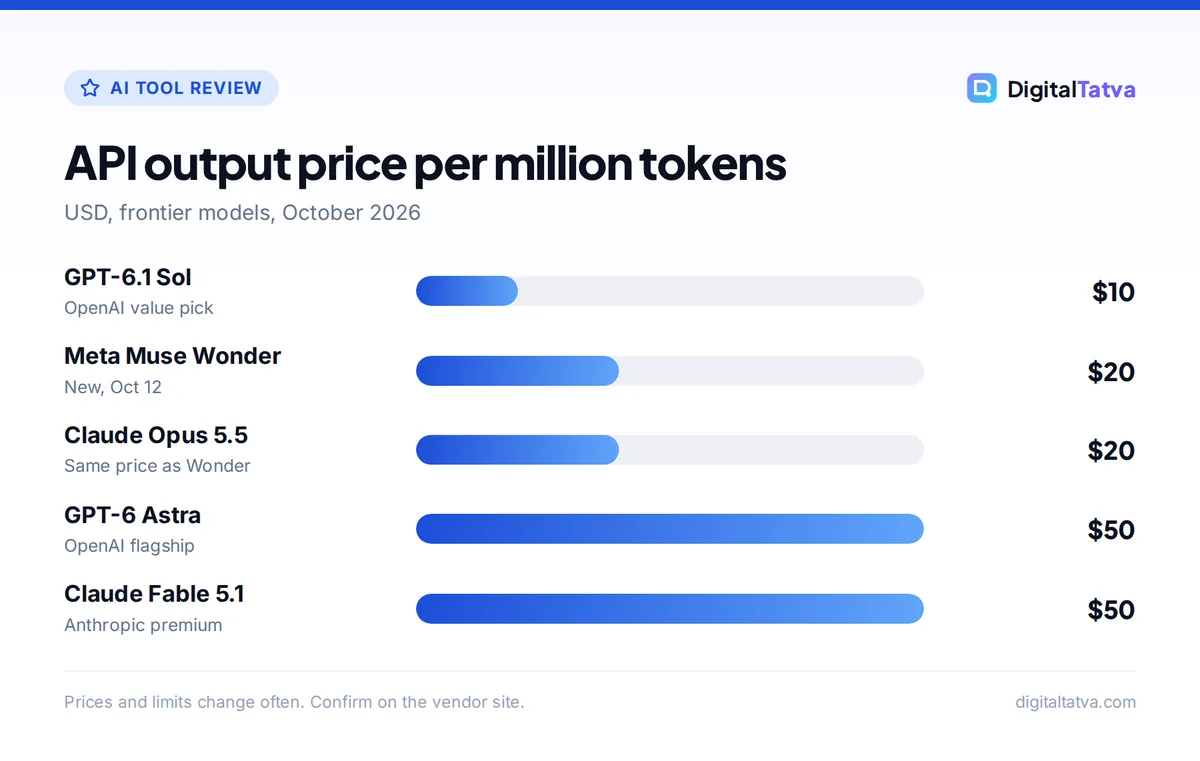
On the Meta Model API, Muse Wonder costs $4 per million input tokens and $20 per million output tokens. Meta has not published a context window or caching discounts in its announcement. Here is how that compares with the main rivals.
| Model | Input per 1M | Output per 1M | Cost for 10M in + 2M out |
|---|---|---|---|
| Meta Muse Wonder | $4 | $20 | $80 |
| Claude Opus 5.5 | $4 | $20 | $80 |
| GPT-6.1 Sol | $2 | $10 | $40 |
| GPT-6 Astra | $10 | $50 | $200 |
| Claude Fable 5.1 | $10 | $50 | $200 |
The arithmetic for Muse Wonder: 10 x $4 = $40 input, plus 2 x $20 = $40 output, for $80. So Meta is pricing Wonder head to head with Claude Opus 5.5, below Astra and Fable, and above OpenAI’s GPT-6.1 Sol. Rival rate cards are in our Claude API pricing and OpenAI API pricing guides.
For individuals, Meta’s Muse Code coding agent has monthly plans starting at $5, and the separate Muse agent app launched in the US in September 2026 with a free tier and paid tiers reported at $20 and $100 a month. Meta has not said which Muse Code plan includes Muse Wonder Full.
Muse Wonder vs Claude Opus 5.5 vs GPT-6
Meta’s model card says Wonder and Wonder Full achieve benchmark scores comparable to Fable 5.1 and GPT-6 Astra, but the public announcement does not give the numbers, and no independent lab has published results yet. That makes a fair, numbers-based comparison impossible for now. Here is what we can say from what each company has published.
| Question | Muse Wonder | Claude Opus 5.5 | GPT-6.1 Sol |
|---|---|---|---|
| Published benchmark scores | Claims only, no numbers in announcement | Yes, e.g. Terminal-Bench 4.0 66.4% | Yes, near Astra on DeepSWE |
| Standout strength | Memory across conversations | Agentic coding | Price for quality |
| Consumer chat app | Muse app, subscribers first | Claude, Pro plan and up | ChatGPT Work and Codex, Plus and up |
| API price (in / out) | $4 / $20 | $4 / $20 | $2 / $10 |
| Open weights | Not stated | No | No |
Our advice: until independent results arrive, treat Muse Wonder as a promising option to test, not a default. If you need a proven coding model today, Opus 5.5 or GPT-6.1 Sol are safer choices; our Claude Code vs Cursor guide and our list of the best AI coding assistants cover the leading tools. For OpenAI’s latest launches, see our OpenAI DevDay 2026 recap.
How to try Meta Muse Wonder
- Developers: use the Meta Model API. Sign up for Meta’s model API, pick Muse Wonder, and run your own test set before committing. Compare quality and cost against your current model on the same prompts.
- Coders: try Muse Code. Meta’s coding agent has monthly plans from $5. Subscribers get Muse Wonder Full for the hardest tasks.
- Everyday users: watch the Muse app. Meta says Muse Wonder will soon power its Muse agent app (muse.ai), starting with subscribers. The app launched in the US first.
- WhatsApp and Instagram users: nothing to do yet. Meta has not announced Muse Wonder for Meta AI in your chats. Our guide on how to use Meta AI covers what works there today.
Note for India: Meta has not announced India availability for Muse Wonder or the Muse agent app, which launched in the US only. Indian developers may be able to reach the API, but check Meta’s terms and supported regions before building on it.
What Muse Wonder means for businesses
For most small businesses in India, Meta’s AI matters most through WhatsApp. Muse Wonder is a sign of where that is heading: agents that remember customer context and can complete multi-step tasks. Over time, Meta says it will use Muse Wonder to build specialized models for its wider product ecosystem, which could reach business messaging. For what is possible right now, read our WhatsApp AI for business guide.
For developers and agencies, Wonder adds a fourth serious frontier provider alongside OpenAI, Anthropic and Google. More competition tends to push prices down, as we saw with Claude Haiku 5.5 and GPT-6 Luna both landing at $0.10 per million input tokens. If you are choosing a tool for agent work today, our list of the best AI agents and our roundup of ChatGPT alternatives are good places to compare.
Pros and cons
Pros
- Meta’s first frontier model, aimed at real agent work.
- Active Memory and Active Focus target two big weaknesses of current agents.
- API price matches Claude Opus 5.5 and undercuts GPT-6 Astra.
- Strong focus areas: law, finance, health and coding.
Cons
- No published benchmark numbers in the announcement and no independent tests yet.
- Muse Wonder Full is locked to Muse Code subscribers.
- Not in Meta AI on WhatsApp, Instagram or Facebook yet.
- No India launch announced, and open weights not confirmed.
Frequently asked questions
What is Meta Muse Wonder?
Muse Wonder is Meta’s first frontier AI model, released on October 12, 2026 by Meta Superintelligence Labs. It is built for agents, with Active Memory to remember details across conversations and Active Focus to keep working on hard tasks. A larger version, Muse Wonder Full, is available to Muse Code subscribers.
Is Meta Muse Wonder free?
Not on the API, which costs $4 per million input tokens and $20 per million output tokens. Meta’s Muse Code plans start at $5 a month, and the Muse agent app has a free tier, but Meta says Wonder will reach Muse subscribers first. Meta AI on WhatsApp stays free, but Meta has not said it uses Muse Wonder.
Is Muse Wonder better than ChatGPT or Claude?
Meta says Wonder scores comparably to Claude Fable 5.1 and GPT-6 Astra and leads on its MemoryBench test, but it did not publish the numbers in its announcement, and there are no independent results yet. Until there are, test it against Claude Opus 5.5 or GPT-6.1 Sol on your own tasks.
Can I use Muse Wonder in India?
Meta has not announced India availability. The Muse agent app launched in the US only, and Meta AI on WhatsApp and Instagram in India does not use Muse Wonder yet. Developers should check the Meta Model API’s supported regions and terms before relying on it.
Is Muse Wonder open source?
Meta has not said. Unlike the earlier Llama models, Meta has not released weights for Muse Spark, and its Muse Wonder announcement does not mention open weights. Treat it as a closed model available through Meta’s API and apps.
Our take
Muse Wonder shows that Meta is now a real contender at the frontier, with a sensible focus on memory and persistence for agents and a price that matches Claude Opus 5.5. But with no published numbers, no independent tests and limited access, it is too early to switch your workflows. Developers should run a pilot on the API; everyone else can wait for it to reach the Muse app and, eventually, Meta AI. Prices, plans and availability change quickly, so confirm current details on Meta’s official pages before you build on it.
Related reading: GPT-6 models explained and what generative AI is.
Pricing and features are checked at the time of writing and can change. Some links may be affiliate links, which never affect our verdicts.