
What Is Generative AI? A Simple Explanation With Real Examples
What is generative AI? A plain-English explanation of how it works, real examples for text, images, video, voice and code, what it costs and how to start using it safely.

On this page
- Key takeaways
- What is generative AI? The quick answer with examples
- How generative AI works, in plain English
- Generative AI vs traditional AI
- Real examples of generative AI you can try today
- What generative AI is good at, and where it fails
- How much does generative AI cost?
- Risks, ethics and rules to know
- How to start using generative AI today
- Frequently asked questions
- The bottom line on generative AI
Generative AI is a type of artificial intelligence that creates new content, such as text, images, video, music or code, in response to a request written in plain language. Instead of only sorting or predicting things like older AI, a generative AI model learns patterns from huge amounts of examples and then produces something original that follows those patterns, which is how ChatGPT writes an email, Midjourney paints an image and Suno composes a song.
This guide explains what generative AI is in simple words, how it works under the hood, real examples you can try today (most of them free), what it is good and bad at, what it costs, and how to start using it safely. No technical background needed.
Key takeaways
- Generative AI creates new content (text, images, video, audio, code) from a prompt, while traditional AI mostly classifies, ranks or predicts.
- Text tools like ChatGPT, Claude and Gemini are large language models that predict the next piece of text, called a token, one step at a time.
- Image and video tools learn to turn noise into pictures that match your description, which is why prompts with clear detail work best.
- Generative AI can be wrong while sounding confident (a “hallucination”), so always check facts, numbers and quotes.
- You can start free: ChatGPT, Gemini, Claude and Microsoft Copilot all have free plans, and paid plans mostly start around $20 a month.
What is generative AI? The quick answer with examples
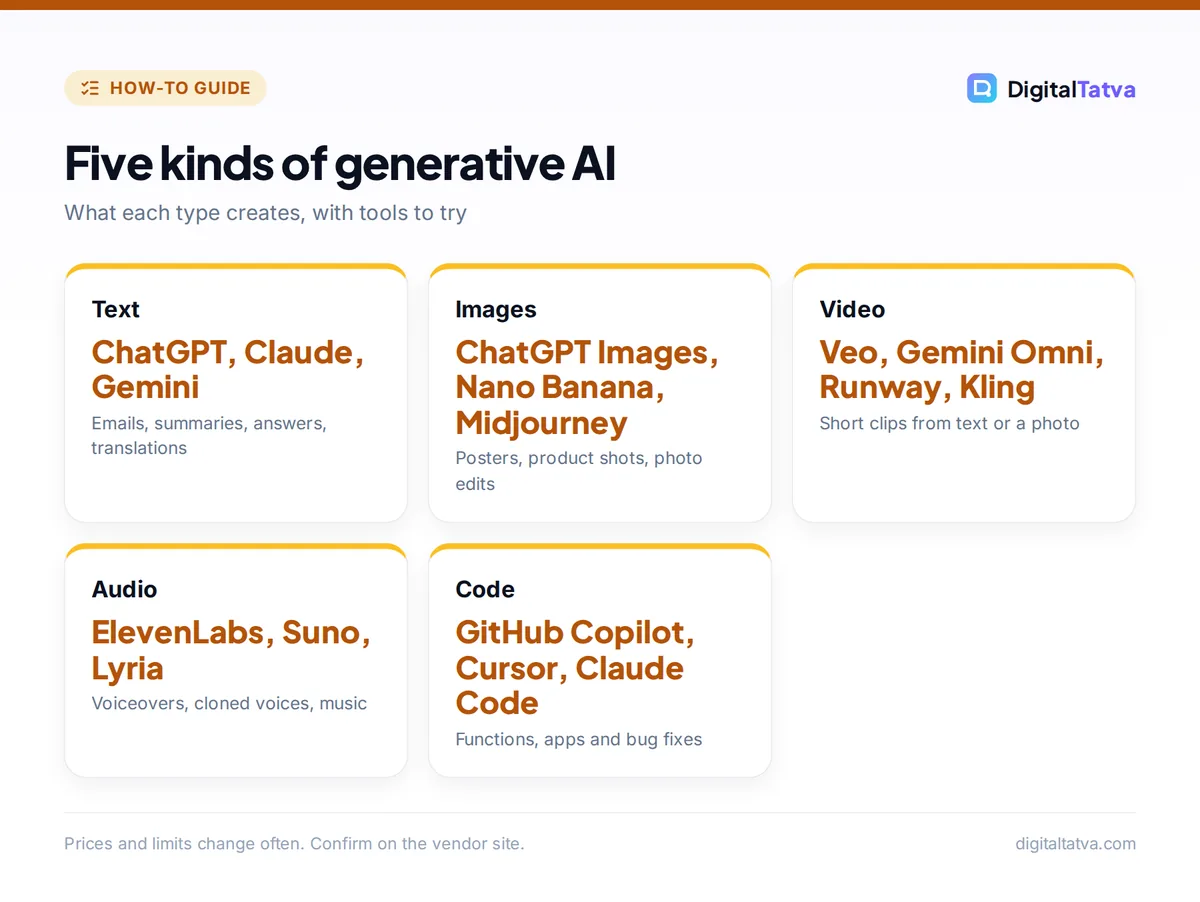
The easiest way to understand generative AI is by what it makes. Each row below is a different kind of generative AI, with tools you can try.
| Type | What it creates | Popular tools | Free option? |
|---|---|---|---|
| Text | Emails, articles, summaries, answers, translations | ChatGPT, Claude, Gemini, Copilot | Yes, all four |
| Images | Illustrations, product shots, logos, photo edits | ChatGPT Images, Nano Banana in Gemini, Midjourney, Adobe Firefly | Yes, except Midjourney |
| Video | Short clips from text or a photo | Google Veo and Gemini Omni, Runway, Kling | Limited free credits |
| Audio and voice | Voiceovers, cloned voices, music | ElevenLabs, Suno, Google Lyria | Yes, with limits |
| Code | Functions, apps, bug fixes | GitHub Copilot, Cursor, Claude Code | Free tiers on some |
How generative AI works, in plain English
You do not need maths to understand the basic idea. Every generative AI tool goes through two phases: training and generation.
Phase 1: Training on huge numbers of examples
A model is shown an enormous amount of data: text from books and websites for a language model, or millions of captioned pictures for an image model. During training it adjusts billions of internal settings (called parameters) so it gets better at predicting what comes next. It is not memorizing a database of answers. It is learning patterns: grammar, facts that appear often, styles, how a cat usually looks, how a sentence about cooking usually continues.
Phase 2: Generating something new from your prompt
When you type a prompt, the model uses those learned patterns to produce a response. How it does that depends on the type of content.
- Text models (large language models, or LLMs) break text into small chunks called tokens and predict the most fitting next token, again and again, until the answer is complete. A token is roughly three quarters of an English word. Our plain-English guide to what tokens are in AI explains why this also decides what you pay.
- Image and video models commonly start from random visual noise and refine it step by step until it matches your description. That is why being specific about subject, style, lighting and framing improves results so much.
- Audio models work in a similar way on sound, producing speech in a chosen voice or a full song from a description of genre and mood.
Most of today’s text models are built on the transformer architecture, which lets the model pay attention to every part of your prompt at once. How much text a model can consider in one go is called its context window: GPT-6 Astra and Claude Opus 5.5, for example, accept around one million tokens through their APIs. Our guide to the context window explains what that means in pages.
Note: Generative AI does not “look things up” by default. Unless a tool searches the web or reads a file you give it, it answers from patterns learned in training, which have a cutoff date. GPT-6 Luna’s knowledge cutoff, for example, is 18 May 2026.
Generative AI vs traditional AI
AI has been around for decades. What changed is that models became good enough to create, not just analyze.
| Traditional (predictive) AI | Generative AI | |
|---|---|---|
| Main job | Classify, rank, detect, forecast | Create new text, images, audio, video, code |
| Everyday example | Spam filter, fraud alert, Netflix recommendations | ChatGPT writing a reply, Gemini editing a photo |
| Output | A label, score or number | Original content |
| How you use it | Usually invisible, built into apps | You talk to it with prompts |
| Main risk | Biased or wrong decisions | Confident but false content, copyright and misuse |
Generative AI went mainstream when OpenAI released ChatGPT in late 2022. By October 2026 OpenAI says more than 1.2 billion people use ChatGPT every week, and Google reports that AI Overviews in Search has more than 2.5 billion monthly users. The next step beyond generation is AI that takes actions for you; our explainer on what AI agents are covers that shift.
Real examples of generative AI you can try today
Here are practical, everyday uses, with the tool we would try first for each.
- Write and polish emails. Paste a rough draft into ChatGPT or Claude and ask for a shorter, friendlier version. Start with our beginner guide on how to use ChatGPT.
- Summarize long documents. Upload a PDF to Claude, Gemini or NotebookLM and ask for key points and open questions.
- Create images for social media. Ask ChatGPT or Gemini (which uses Google’s Nano Banana image models) for a poster or product shot. Our list of the best AI image generators compares quality and price.
- Edit photos with words. Upload a photo to Gemini and say “remove the person in the background” or “make it look like evening.”
- Make short videos. Google’s Flow gives free daily credits for Veo clips, and Runway and Kling sell credit plans. See the best AI video generators for a full comparison.
- Generate voiceovers. ElevenLabs’ free plan includes about 10 minutes of speech a month.
- Compose music. Suno’s free plan gives 50 credits a day for personal use; commercial rights need a paid plan.
- Write and fix code. GitHub Copilot, Cursor and Claude Code suggest code and fix bugs. Our ranking of the best AI coding assistants covers free tiers.
- Translate and localize. Gemini supports more than 70 languages, including Hindi, Tamil, Gujarati and Bengali.
- Learn something new. ChatGPT’s study mode and Gemini’s Guided Learning teach step by step with questions instead of just giving answers.
What generative AI is good at, and where it fails
Good at
- First drafts, rewrites and summaries in seconds
- Brainstorming many options quickly
- Explaining hard topics at your level
- Turning one format into another (notes to slides, text to image)
- Repetitive writing and coding tasks
Weak at
- Guaranteed accuracy: it can invent facts, quotes and sources
- Very recent events, unless it searches the web
- Precise maths and counting without tools
- Small text inside images and consistent faces across clips
- Knowing your private context unless you provide it
The biggest risk is the hallucination: an answer that sounds right but is false. Vendors are reducing this (OpenAI reports a 4.2% rate on its own internal hallucination test for GPT-6 Astra), but no model is perfect. Treat AI output like a draft from a fast, well-read intern: useful, but checked before it goes out.
Tip: Better prompts reduce mistakes. Give context, examples and the format you want, and ask the model to say when it is unsure. Our prompt engineering guide lists 12 techniques that work.
How much does generative AI cost?
For individuals, most tools follow the same pattern: a free plan with limits, a main paid plan around $20 a month, and power-user tiers above that.
| Tool | Free plan | Main paid plan |
|---|---|---|
| ChatGPT | Yes (GPT-6 Luna for everyday chat) | Go $8/month, Plus $20/month |
| Claude | Yes (Sonnet and Haiku models) | Pro $20/month, or $17/month billed annually |
| Google Gemini | Yes (Gemini 3.6 Flash) | AI Plus $4.99/month, AI Pro $19.99/month (Rs 399 and Rs 1,950 in India) |
| Microsoft Copilot | Yes | Microsoft 365 Personal $9.99/month |
| Midjourney | No | Basic $10/month |
Developers who build apps pay per token through APIs instead. GPT-6 Luna costs $0.10 per million input tokens and $0.50 per million output tokens, while Claude Opus 5.5 costs $4 and $20. A 1,000-word answer is roughly 1,300 output tokens, so on GPT-6 Luna it costs about $0.00065, and on Opus 5.5 about $0.026. Our comparison of GPT-6 vs Claude Opus 5.5 vs Gemini 3.1 Pro helps you pick a model, and the list of best free AI tools shows how far you can get for $0.
Risks, ethics and rules to know
- Copyright. The US Copyright Office says purely AI-generated material is not protected, and prompts alone do not give enough control; human selection, arrangement and edits can be. India’s law is under review. Read can you copyright AI generated content before selling AI work.
- Privacy. Do not paste customer data, passwords or confidential files into consumer chatbots unless you have checked the data settings. Business plans from OpenAI and Anthropic do not train on workspace data by default.
- Disclosure. Platforms like YouTube require labels for realistic AI content, and Amazon KDP requires disclosure of AI-generated text and images.
- Deepfakes and misuse. Many tools add invisible watermarks such as SynthID (Google) and C2PA metadata (OpenAI, Microsoft) so AI images can be identified.
- Detection is unreliable. AI detectors make mistakes, especially on writing by non-native English speakers. See our honest review of the best AI detectors and their accuracy.
How to start using generative AI today
- Pick one free assistant. ChatGPT, Gemini, Claude or Copilot. Any of them is fine to learn on.
- Choose one real task. Something you do every week, like writing a client update or summarizing meeting notes.
- Write a clear prompt. Say who you are, what you need, who it is for and the format you want back.
- Iterate. Reply with what to change (“shorter”, “more formal”, “add a table”) rather than starting over.
- Check and own the result. Verify facts and numbers, and edit so it sounds like you.
When you meet unfamiliar words along the way, keep our AI glossary of 60 terms open in another tab.
Frequently asked questions
What is generative AI in simple words?
Generative AI is software that creates new content when you ask for it in normal language. You type or say what you want, such as “write a birthday message for my manager” or “draw a red bicycle in watercolor”, and it produces original text, images, audio, video or code based on patterns it learned from huge amounts of examples during training.
Is ChatGPT generative AI?
Yes. ChatGPT is one of the best-known generative AI tools. It is powered by large language models from OpenAI (currently the GPT-6 family) that generate text one token at a time, and it can also create images. Claude, Gemini, Microsoft Copilot, Midjourney, ElevenLabs and Suno are other generative AI tools for text, images, voice and music.
What is the difference between AI and generative AI?
AI is the broad field of making computers do tasks that normally need human intelligence. Generative AI is one branch of it that creates new content. Traditional AI powers things like spam filters, fraud detection and recommendations, where the output is a label or score. Generative AI produces something new, such as a paragraph, an image or a song.
Is generative AI free to use?
Many tools have free plans. ChatGPT, Gemini, Claude and Microsoft Copilot all offer free chat, and image, voice and video tools often give free daily or monthly credits. Free plans have usage limits, may use smaller models and sometimes add watermarks or exclude commercial use. Paid individual plans usually start around $20 a month, with cheaper options like ChatGPT Go and Google AI Plus.
Can generative AI replace human jobs?
It changes many jobs more than it replaces them today. Generative AI is fast at first drafts, summaries and repetitive tasks, but it makes mistakes, lacks your private context and cannot take responsibility for results. People who learn to use it well tend to get more done. Roles built mostly on repetitive content production face the most pressure.
The bottom line on generative AI
Generative AI is a tool that turns plain-language requests into new content, and it is now built into the apps most people already use. Learn it with one free assistant and one real task, check its work, and expand from there. For official details, see OpenAI’s ChatGPT pricing page and Google’s Gemini plans page. Prices and free limits change often, so confirm them on each vendor’s site before you subscribe.
Pricing and features are checked at the time of writing and can change. Some links may be affiliate links, which never affect our verdicts.



