10 Best AI Detectors in 2026 and How Accurate They Really Are
GPTZero, Originality.ai, Turnitin, Copyleaks and six more AI detectors compared on price and free limits, plus what independent research says about their accuracy.

On this page
- Key takeaways
- Quick picks: the best AI detectors compared
- How accurate are AI detectors, really?
- The 10 best AI detectors in 2026, reviewed
- How to choose the right AI detector
- What to do if an AI detector flags your writing
- Detectors, humanizers and paraphrasers: the honest picture
- Frequently asked questions
- Our verdict: use AI detectors as a flashlight, not a judge
The best AI detector for most people in 2026 is GPTZero for education, Originality.ai for publishers and agencies, and the free checkers from QuillBot, Grammarly or Scribbr for a quick second opinion. But no AI detector is accurate enough to prove that someone used AI: every tool on this list gives a probability, every vendor admits false positives happen, and independent researchers have called these tools “neither accurate nor reliable”.
Below we compare 10 detectors by price, free limits and what they are actually good for, as of October 2026, and explain how to read a score without making an unfair call.
Key takeaways
- GPTZero, Originality.ai, Copyleaks, Pangram and Winston AI are the strongest paid detectors; QuillBot, Grammarly and Scribbr offer useful free checks with word limits around 1,200 words per scan.
- Vendors claim around 99% accuracy, but those are their own tests. A 2023 study of 14 detectors, including Turnitin, found them unreliable and easy to fool with paraphrasing.
- Turnitin hides AI scores between 1% and 19% “to avoid potential incidences of false positives” and needs at least 300 words to produce a report.
- Detectors are known to flag non-native English writing unfairly, which matters for students and professionals in India.
- Never punish, fire or reject someone on a detector score alone. Look at drafts, version history and a conversation about the work.
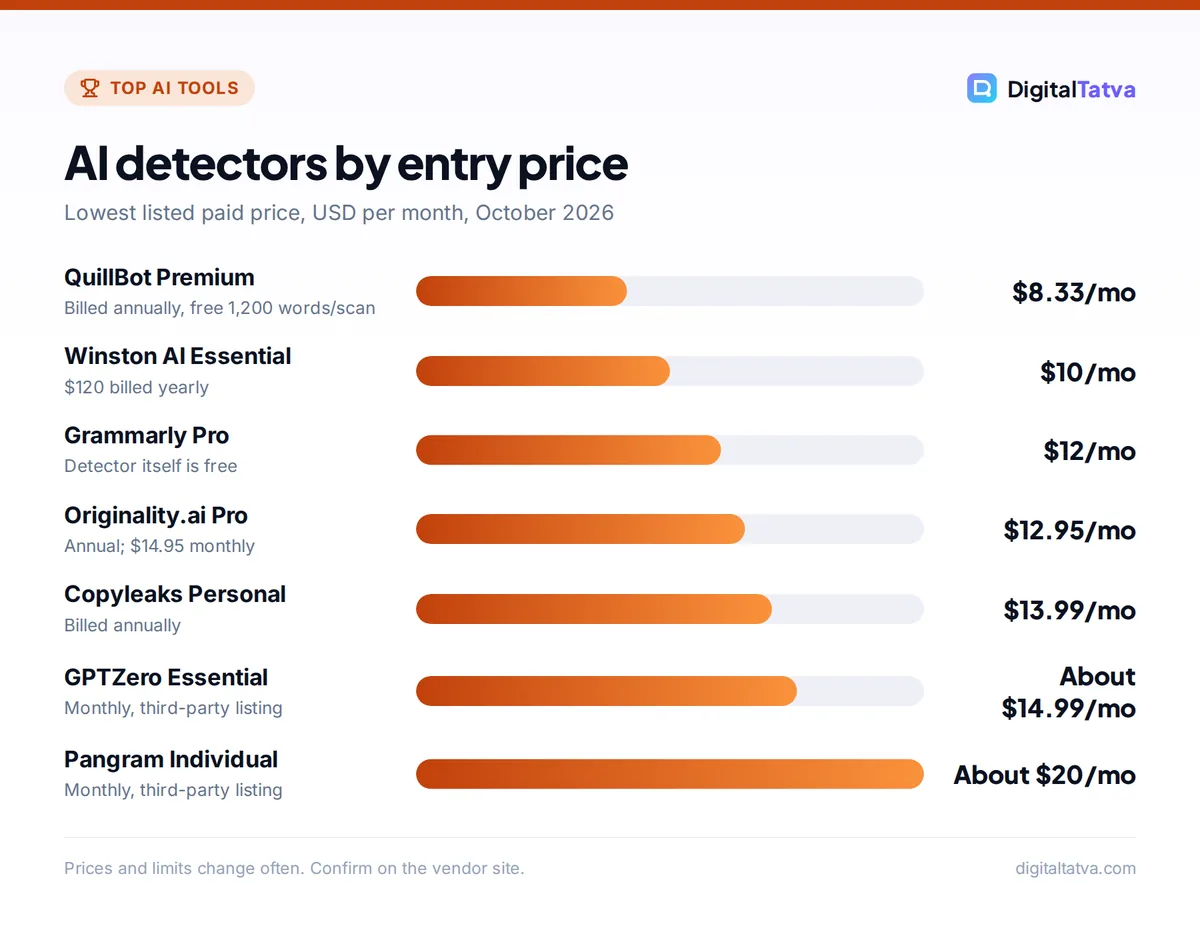
AI detectors by entry price
Lowest listed paid price, USD per month, October 2026
Prices and limits change often. Confirm on the vendor site.
Quick picks: the best AI detectors compared
Here is the short version. Prices are the lowest listed paid rate we could confirm; free limits are what you get without paying.
| AI detector | Best for | Starting paid price | Free option |
|---|---|---|---|
| GPTZero | Teachers and schools | About $14.99/mo (third-party listing) | Yes, about 10,000 words/mo |
| Originality.ai | Publishers, SEO teams, agencies | $14.95/mo or $12.95/mo annual | 3 scans/day, 2,000 words each |
| Turnitin | Universities that already use it | Institutional licence only | Through your school |
| Copyleaks | Multilingual teams | $13.99/mo billed annually | No published free plan |
| Pangram | Low false-positive focus | About $20/mo (third-party listing) | About 4 scans/day |
| Winston AI | Text plus AI image checks | $18/mo or $120/year | 2,000 credits for 14 days |
| QuillBot AI Detector | Students checking their own drafts | $8.33/mo billed annually | 1,200 words/scan, 6 scans/day |
| Grammarly AI Detector | Writers who want an authorship record | Grammarly Pro $12/mo | Yes, no sign-up |
| Scribbr AI Detector | Quick free checks, no account | Premium (price not shown) | Unlimited, 1,200 words each |
| Google SynthID Detector | Checking Google-watermarked images, video and audio | Free | Yes |
Watch out: An AI detector score is not evidence of misconduct. GPTZero’s own FAQ says its results “should not be used to punish students”, and QuillBot says scores should not be the sole basis for academic or employment decisions. If you are a teacher or manager, treat a high score as a reason to talk, not a reason to penalize.
How accurate are AI detectors, really?
AI detectors look for statistical patterns, such as how predictable each word is and how evenly sentence lengths vary. They do not find a hidden tag in normal text. That approach works reasonably well on long, unedited AI output and poorly on everything else.
What the independent evidence says
- OpenAI gave up on its own detector. Its AI text classifier caught only 26% of AI-written text in testing and wrongly flagged human text 9% of the time. OpenAI withdrew it in July 2023, citing its “low rate of accuracy”.
- A 14-tool study found them unreliable. Weber-Wulff and colleagues tested 12 public detectors plus Turnitin and PlagiarismCheck in 2023. They concluded the tools are “neither accurate nor reliable”, tend to label AI text as human, and perform much worse once text is paraphrased.
- Bias against non-native writers. A 2023 Stanford study found popular detectors “consistently misclassify non-native English writing samples as AI-generated”.
- Even vendors’ own tests show limits. Scribbr’s comparison found the best premium tool reached 84% accuracy and the best free tool 68%, and Scribbr states that no model, “including ours”, can guarantee 100% accuracy.
Why vendor claims look so much better
GPTZero, Originality.ai, QuillBot and Grammarly all advertise accuracy around 99%, often citing the RAID benchmark or internal test sets. Those numbers can be true on the test data and still mislead you, because your document is not the test data. Short texts, heavily edited AI drafts, technical or legal writing, and second-language English all push error rates up. Turnitin, for example, claims a false positive rate under 1% but still hides any score from 1% to 19% to avoid false accusations.
Note: A 1% false positive rate sounds tiny until you scale it. A university checking 10,000 genuinely human essays would wrongly flag about 100 of them at that rate. That is why every serious policy pairs detector results with human review.
The 10 best AI detectors in 2026, reviewed
We have not run our own benchmark, so we do not rank by a made-up accuracy score. We rank by who each tool suits, its pricing transparency and how honestly it describes its limits.
1. GPTZero: Best for teachers and schools
- Starting price: Essential about $14.99/month, around $8.33/month billed annually (third-party listing)
- Free plan: Yes, about 10,000 words a month
- Best for: educators, students checking drafts, admissions teams
GPTZero is the best-known education detector, with over 17 million users and a partnership with the American Federation of Teachers. It highlights likely AI sentences, offers batch file uploads, and adds writing replay and authorship tools so a teacher can see how a document was built. GPTZero claims that for high-confidence results it classifies 99.1% of human articles as human and 98.4% of AI articles as AI, and it is unusually direct that results should not be used to punish students.
Its official pricing page did not show prices when we checked, so the plan figures above come from a September 2026 third-party listing (Premium about $23.99 and Professional about $45.99 a month). Confirm at checkout.
Skip it if: you mainly check marketing content at scale; Originality.ai has better site-wide tools.
2. Originality.ai: Best for publishers, SEO teams and agencies
- Starting price: Pro $14.95/month, or $12.95/month billed annually ($155.40/year)
- Free plan: Basic, 3 scans a day up to 2,000 words each
- Best for: content managers checking freelance work, website owners
Originality.ai is built for content businesses. Pro gives 2,000 credits a month (1 credit covers 100 words for an AI-only scan, or 50 words when you add the plagiarism check), plus URL scans, full-site scans, team management and a Chrome extension that scans inside Google Docs. Enterprise ($179/month, or $136.58 on annual billing) adds 15,000 credits, API access and a year of scan history.
Agencies using AI in their own workflow should read our guide to AI for marketing agencies before using a detector to police freelancers, because a flagged article is a conversation starter, not a breach of contract.
Skip it if: you are a student; credits run out fast and the tool is aimed at publishers.
3. Turnitin: Best for universities that already license it
- Starting price: Institutional licence (not sold to individuals)
- Free plan: Students see it only through their school
- Best for: instructors grading submissions in an LMS
Turnitin’s AI writing report sits next to its plagiarism report inside tools like Canvas and Moodle. It needs at least 300 words of prose (up to 30,000), supports English, Spanish, Japanese and Arabic, and shows an asterisk instead of a number for scores between 1% and 19% to reduce false positives. Turnitin says it “does not make a determination of misconduct” and that instructors should use judgment. In 2025 it added detection for text run through humanizer tools, which we cover in our AI humanizer comparison.
Skip it if: you are not at an institution that pays for it; you cannot buy it yourself.
4. Copyleaks: Best for multilingual teams
- Starting price: Personal $13.99/month billed annually ($167.88/year), or $16.99 month to month
- Free plan: None published
- Best for: companies and schools that work in several languages
Copyleaks detects AI text in 30+ languages and plagiarism in 100+ languages, and it now checks images for AI generation too. The annual Personal plan covers up to 300,000 words a year, while the monthly version covers up to 25,000 words a month. Pro ($74.99 a month annually, or $99.99 monthly) adds 25 seats, sitemap scanning and cross-language translation detection.
Skip it if: you only need an occasional English check; the free tools below are enough.
5. Pangram: Best for teams that worry most about false positives
- Starting price: Individual about $20/month, around $15 billed annually (third-party listing)
- Free plan: About 4 scans a day
- Best for: editors and educators who want a conservative second check
Pangram is a newer detector that markets itself on keeping false positives low, and it has become a popular second opinion among researchers and editors. A June 2026 third-party listing shows about 600 scans a month on Individual, about 3,000 on Professional (around $65 a month), and one scan covering up to 1,000 words.
Skip it if: you need published, official pricing before you sign up.
6. Winston AI: Best for checking text and AI images together
- Starting price: Essential $18/month or $120/year (about $10/month)
- Free plan: 2,000 credits for 14 days
- Best for: small publishers, schools and HR teams
Winston AI’s Essential plan includes 100,000 credits a month, AI image detection and writing feedback. Advanced ($29 a month or $192 a year) doubles the credits and adds plagiarism checks and team access, and Elite ($49 a month or $312 a year) gives 500,000 credits.
Skip it if: you need a permanent free tier; the free plan is a two-week trial.
7. QuillBot AI Detector: Best free detector for students checking their own work
- Starting price: Premium $8.33/month billed annually
- Free plan: Up to 1,200 words per scan, 6 scans a day
- Best for: students and non-native English writers reviewing drafts
QuillBot’s detector sorts text into AI-generated, human-written, or human-written and AI-refined, which is more useful than a single number when you used AI for light editing. It flags sentences with explanations and supports 20+ languages. QuillBot warns that formulaic academic or legal writing can trigger false positives. Premium removes the word and scan limits and adds shareable reports.
Skip it if: you need to check other people’s work at scale.
8. Grammarly AI Detector: Best for proving how you wrote something
- Starting price: Free; Grammarly Pro $12/month (annual billing)
- Free plan: Yes, no sign-up needed
- Best for: writers, freelancers and students who want an authorship trail
Grammarly’s free detector gives a percentage estimate and says plainly that “No AI detector is 100% accurate.” The more valuable feature is Grammarly Authorship, which records whether text was typed by you, generated by AI or pasted from online sources and produces a writing activity report. If a client or teacher ever questions your work, that report beats any detector score. Our Grammarly review explains what Pro adds.
Skip it if: you need batch scanning or an API.
9. Scribbr AI Detector: Best for a quick check with no account
- Starting price: Premium detector (price not shown)
- Free plan: Unlimited checks up to 1,200 words each, with ads
- Best for: students who want a fast second opinion
Scribbr’s free detector needs no sign-up, labels text as AI-generated, AI-refined or human, gives paragraph-level feedback and works in English, Spanish, German and French. Scribbr says it does not store or share submitted text.
Skip it if: you need detection in Hindi or other Indian languages.
10. Google SynthID Detector: Best for checking AI images, video and audio
- Starting price: Free
- Free plan: Yes, public website
- Best for: journalists, social media teams and anyone checking viral media
SynthID works differently from text detectors. Google and partners embed an invisible watermark in AI-generated media, and the SynthID Detector website, opened to everyone in October 2026 according to press reports, checks images, video and audio for it, including watermarks from partners such as OpenAI, ElevenLabs and Nvidia. A positive result is strong evidence; a negative result only means no SynthID watermark was found, not that the media is human-made. You can also upload an image to Gemini and ask whether Google AI made it. Our guide to free AI image generators explains which tools add watermarks.
Skip it if: you need to check plain text; this is for media.
How to choose the right AI detector
- Teachers: use what your institution licenses (often Turnitin or GPTZero), and pair it with in-class writing, oral follow-ups and draft checkpoints. Our guide to AI for teachers covers assessment ideas that make detectors less necessary.
- Students: run your own draft through two free detectors (QuillBot and Scribbr, for example) only to spot passages that read as generic, then rewrite them in your own voice. Turn on version history before you start. Our list of the best AI tools for students focuses on tools that help you learn.
- Publishers and agencies: Originality.ai or Copyleaks for volume, with site scans and team seats. Judge content on accuracy and usefulness first.
- HR and hiring: avoid rejecting applications on detector scores. Cover letters are short and formulaic, which is where detectors are weakest.
- Media checks: SynthID Detector for watermarked media, plus reverse image search and source checking.
Tip: Run the same text through two or three detectors. If they disagree strongly, that disagreement is your answer: the text is in the zone where detectors cannot tell, and only the writing process can.
What to do if an AI detector flags your writing
False positives are common enough that you should prepare before it happens.
- Stay calm and ask which tool and score were used. Point out that vendors, including GPTZero and Turnitin, say scores are not proof of misconduct.
- Show your process. Share Google Docs or Word version history, outlines, notes, sources and earlier drafts. A Grammarly Authorship report helps if you used it.
- Offer to explain the work. Walk through your argument and sources in person. People who wrote their work can usually discuss it easily.
- Cite the research. Mention OpenAI’s withdrawn classifier and the Stanford finding on non-native writers if language background is a factor.
Organizations should put these rules in writing. Our AI usage policy template includes a disclosure section, and if you are worried about pasting confidential documents into third-party checkers, read our guide to AI data privacy for business.
Detectors, humanizers and paraphrasers: the honest picture
AI detectors exist in an arms race with humanizers and paraphrasing tools. The 2023 study above found paraphrasing alone sharply cut detection rates, and humanizer vendors openly market “undetectable” output. That cuts both ways: a clean score does not prove human writing, and a flagged score does not prove AI. If you use rewriting tools legitimately, our comparison of the best paraphrasing tools explains which ones are built for editing rather than evasion.
For writers, the better question is “is this accurate, original and useful?”, which is also what Google rewards, as we explain in how to write a blog post with AI that actually ranks.
Where detectors help
- Spotting long, unedited AI output pasted in bulk
- Prompting a conversation about how work was produced
- Screening large volumes of freelance or user content
- Checking watermarked AI media with SynthID
Where they fail
- Short texts under about 300 words
- Non-native or highly formulaic English
- Human-edited or paraphrased AI drafts
- Any case where a single score decides a penalty
Frequently asked questions
Which AI detector is the most accurate?
No independent test crowns a reliable winner. GPTZero, Originality.ai, Pangram, QuillBot and Grammarly all claim accuracy near 99% on their own or benchmark data, but independent studies found detectors unreliable on edited, paraphrased or non-native writing. Use two or three detectors together and treat agreement as a signal, not proof, then look at the writing process.
Is there a free AI detector?
Yes. QuillBot checks up to 1,200 words per scan with 6 scans a day, Scribbr offers unlimited free checks up to 1,200 words each without an account, Grammarly’s detector is free with no sign-up, and GPTZero and Originality.ai have limited free tiers. Free tools are fine for checking your own drafts but not for high-stakes decisions.
Can Turnitin detect ChatGPT?
Turnitin can flag text that matches patterns of AI writing, including ChatGPT output, when a submission has at least 300 words. It hides scores between 1% and 19% to reduce false positives and says it does not decide misconduct. Independent research shows it can miss edited AI text and can wrongly flag human writing, so instructors are expected to use judgment.
Why did an AI detector flag my own writing?
Detectors flag predictable, evenly structured text, which describes a lot of careful academic, technical and second-language writing. A Stanford study found detectors often misclassify non-native English writing as AI. Short texts are also risky. Keep your drafts and version history so you can show how you wrote it.
Can AI detectors check images and videos?
Some can. Google’s SynthID Detector checks images, video and audio for SynthID watermarks used by Google and partners such as OpenAI. Copyleaks and Winston AI also offer AI image detection. Watermark checks are only conclusive when a watermark is found; a missing watermark does not prove the media is real.
Our verdict: use AI detectors as a flashlight, not a judge
For schools, GPTZero is the most education-focused choice and Turnitin is fine where it is already licensed. For publishers and agencies, Originality.ai offers the best mix of price, team tools and site scanning, with Copyleaks the pick for multilingual work. For a free second opinion, QuillBot, Scribbr and Grammarly are all good enough, and SynthID Detector is the tool to use for AI media. Whatever you choose, never let a detector score decide a grade, a job or a contract on its own, and check out our best free AI tools for more no-cost options. Prices and limits change often, so confirm them on each vendor’s site before you subscribe.
Pricing and features are checked at the time of writing and can change. Some links may be affiliate links, which never affect our verdicts.