
What Is ChatGPT? How It Works, Plans and What You Can Do With It
What is ChatGPT? A plain-English guide to how OpenAI's AI assistant works, what it can and cannot do, plans and models, privacy basics and how it compares with Claude and Gemini.

On this page
- Key takeaways
- What ChatGPT is, in simple terms
- How ChatGPT works
- What can ChatGPT do?
- What ChatGPT cannot do well
- ChatGPT plans and models
- Everyday ways people use ChatGPT
- How to get started with ChatGPT in 5 minutes
- Is ChatGPT safe and private?
- ChatGPT vs other AI tools
- A short history of ChatGPT
- Frequently asked questions
- The bottom line
ChatGPT is an AI assistant made by OpenAI that understands and writes text, answers questions, analyzes files and images, creates pictures, talks by voice and, through ChatGPT Work, carries out multi-step tasks for you. It runs on OpenAI’s GPT family of large language models, currently GPT-5.6 and GPT-6, and it is free to use at chatgpt.com and in the mobile and desktop apps, with paid plans from $8 a month. With more than 1 billion weekly users, it is the most widely used AI tool in the world.
This guide explains what ChatGPT is in plain English: how it works, what it can and cannot do, the plans and models, everyday examples, privacy basics and how it compares with Claude, Gemini and Google Search. If you want step-by-step instructions, see our companion guide on how to use ChatGPT.
Key takeaways
- ChatGPT is OpenAI’s AI assistant, launched on November 30, 2022, and now used by more than 1 billion people every week.
- It is built on large language models that predict the next words in a response, trained on large amounts of text and refined with human feedback.
- The free plan offers unlimited text chats with GPT-5.6 Luna; Go costs $8 a month and Plus $20 a month for stronger models.
- It can write, explain, translate, analyze data, create images, browse the web and complete tasks in ChatGPT Work.
- It can make mistakes, so check facts, especially for health, legal and money questions.
What ChatGPT is, in simple terms
Think of ChatGPT as a very well-read assistant you talk to in plain language. You type or say what you want, such as “explain GST input tax credit simply” or “turn these notes into a polite email”, and it replies in seconds. You can keep the conversation going, ask it to change the answer, or give it files and photos to work with.
“Chat” refers to the conversational interface. “GPT” stands for Generative Pre-trained Transformer, the type of AI model behind it. The model is “generative” because it creates new text, “pre-trained” because it learned from large amounts of text before you ever use it, and a “transformer” is the neural network design that makes this possible. Our explainer on what a large language model is goes deeper.
| Fact | Detail |
|---|---|
| Made by | OpenAI |
| Launched | November 30, 2022 |
| Weekly users | More than 1 billion (August 2026) |
| Current models | GPT-5.6 (Luna, Terra, Sol) and GPT-6 (Luna, Sol, Astra) |
| Where to use it | chatgpt.com, iPhone and Android apps, Mac and Windows desktop apps |
| Price | Free; Go $8, Plus $20, Pro from $100 a month |
How ChatGPT works
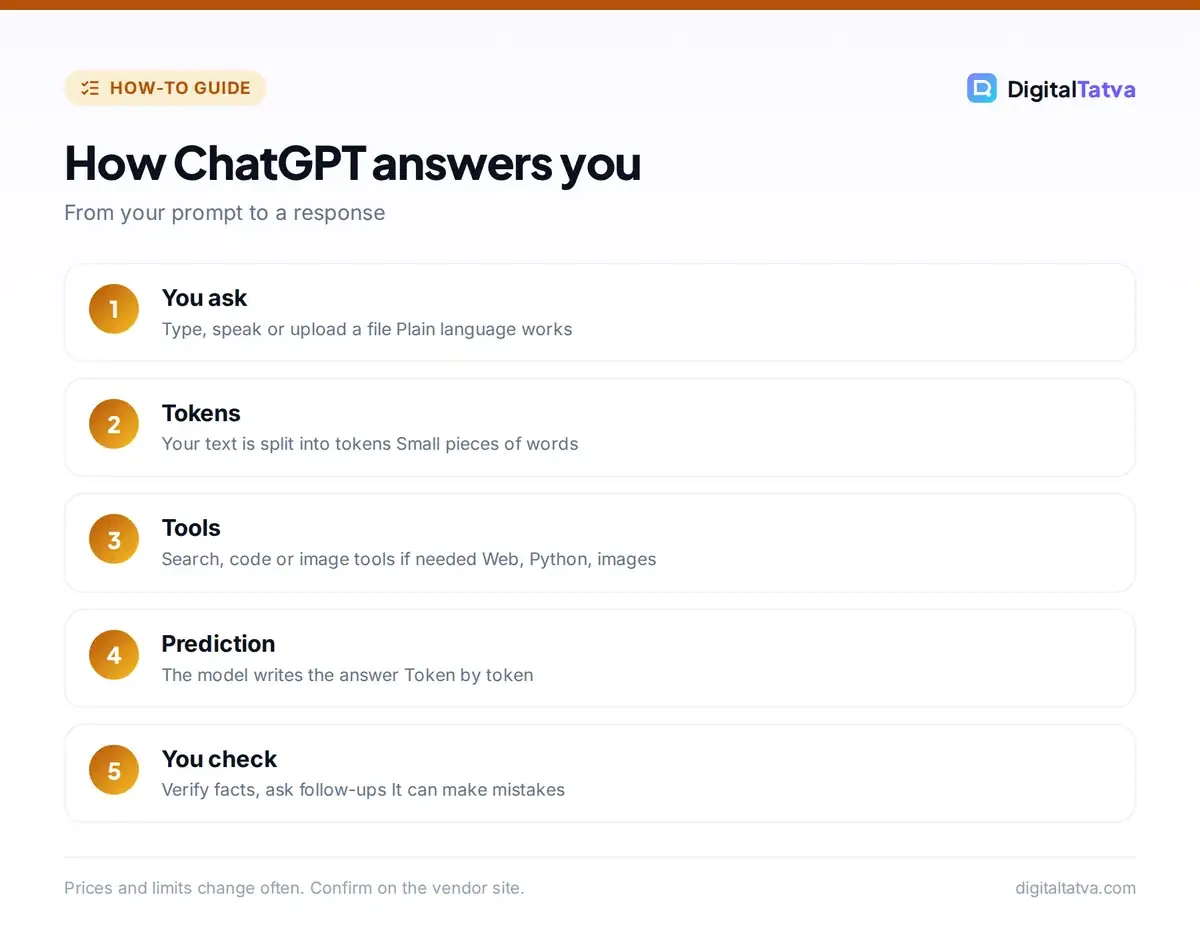
- Training. OpenAI trained its models on a very large collection of text, learning patterns of language, facts and reasoning. It then refined them with human feedback so answers are more helpful and safer.
- Your prompt becomes tokens. When you send a message, it is split into small pieces called tokens. Our guide to tokens in AI explains this.
- Prediction. The model predicts the most likely next token again and again to build a response. Reasoning models “think” through steps before answering.
- Tools. For some questions ChatGPT searches the web, runs Python code on your data, reads your files or creates an image, then uses the results in its answer.
- Memory and context. It considers the conversation so far, and, if you allow it, saved memories about your preferences.
Because it predicts likely text rather than looking up a single truth, ChatGPT can sound confident and still be wrong. These errors are called hallucinations.
What can ChatGPT do?
| Task | Example |
|---|---|
| Write and edit | Emails, blog drafts, captions, résumés, reports |
| Explain and teach | “Explain compound interest like I’m 15” |
| Research | Web search with sources, deep research reports |
| Analyze data | Upload an Excel file and ask for trends and charts |
| Read documents and images | Summarize a PDF, read a bill, describe a photo |
| Create images | Posters, product mockups, edits with ChatGPT Images |
| Talk by voice | Spoken conversations in many languages |
| Code | Write, explain and fix code; Codex for bigger projects |
| Complete tasks | ChatGPT Work builds sheets, decks and reports, and runs scheduled tasks |
For ready-made ideas, browse our list of the best ChatGPT prompts, and for agent-style tasks see how to use ChatGPT Work.
What ChatGPT cannot do well
- Guarantee accuracy. It can invent facts, numbers or citations. Verify anything important.
- Replace professionals. It is not a doctor, lawyer or financial adviser.
- Know everything recent. Models have a training cutoff; web search helps but is not perfect.
- Act without access. It can only use the files, apps and websites you connect or allow.
- Keep secrets by default. On personal plans, chats can be used to improve models unless you turn that off.
ChatGPT plans and models
| Plan | Price | What you get |
|---|---|---|
| Free | $0 | Unlimited text chats with GPT-5.6 Luna; limited uploads, images, voice and deep research |
| Go | $8/month (about Rs 399 in India) | Higher limits for images, uploads and data analysis |
| Plus | $20/month | GPT-5.6 Sol, plus GPT-6 Astra and GPT-6.1 Sol in Work and Codex; no ads |
| Pro 100, 200, 500 | $100 to $500/month | Highest limits, dots agents, ChatGPT Space |
| Business and Enterprise | Per seat | Team features, admin controls, no training on your data by default |
OpenAI’s model tiers are named Luna (fast and economical), Sol (balanced) and Astra (most capable). Our GPT-6 models explainer, ChatGPT pricing guide and Free vs Plus comparison cover the details. Official plans are on the ChatGPT pricing page.
Everyday ways people use ChatGPT
- Students: explanations, practice questions and feedback on essays. See our ChatGPT prompts for students.
- Small businesses: customer replies, social posts, product descriptions and simple data analysis.
- Job seekers: résumé edits, cover emails and interview practice.
- Professionals: meeting summaries, report drafts, spreadsheet formulas and research.
- Families: trip planning, recipe ideas and help with forms written in difficult language.
How to get started with ChatGPT in 5 minutes
- Open ChatGPT. Go to chatgpt.com or install the official ChatGPT app from the App Store or Play Store. Check that the developer is OpenAI, since copycat apps exist.
- Sign up or log in. Use an email, Google, Microsoft or Apple account. You can try some features without an account, but signing in saves your history.
- Ask a real question. Start with something you need today, such as “Write a short, polite message asking my landlord to fix the water heater.”
- Refine the answer. Reply with changes: “make it shorter”, “more formal”, “add a deadline of Friday”. This back-and-forth is where ChatGPT shines.
- Try a file or photo. Upload a PDF, a screenshot or a photo of a document and ask for a summary or explanation.
- Adjust privacy settings. In Settings, review Data Controls and memory so ChatGPT works the way you are comfortable with.
Tip: Good prompts give context, a goal and a format. “I run a small bakery in Pune. Write three Instagram captions for our new millet cookies, under 20 words each, friendly tone” gets far better results than “write captions”. Our prompt engineering guide shows more patterns.
Is ChatGPT safe and private?
ChatGPT is generally safe for everyday use with sensible settings. On personal plans, turn off “Improve the model for everyone” in Data Controls if you do not want chats used for training, use Temporary Chat for one-off sensitive questions, and turn on multi-factor authentication. Never paste passwords, ID numbers or confidential client data. Business, Enterprise and Edu plans do not train on workspace data by default. Our full guide on whether ChatGPT is safe walks through every setting, and OpenAI’s data controls FAQ explains the options.
ChatGPT vs other AI tools
| Compared with | Key difference |
|---|---|
| Google Search | Search finds pages; ChatGPT writes an answer and can act on it |
| Claude | Claude is often preferred for long writing and coding; ChatGPT has broader features |
| Gemini | Gemini is built into Google apps and Search |
| Meta AI | Meta AI lives inside WhatsApp and Instagram, free |
See our comparisons of ChatGPT vs Google Search, ChatGPT vs Claude, ChatGPT vs Gemini and our list of ChatGPT alternatives.
A short history of ChatGPT
- November 2022: ChatGPT launches and reaches 100 million monthly users in about two months.
- August 2025: the low-cost Go plan launches in India first.
- January 2026: Go goes worldwide, and OpenAI starts testing ads on the free US tier.
- July 2026: ChatGPT Work launches for multi-step tasks.
- August 2026: ChatGPT passes 1 billion weekly users.
- September 2026: GPT-6 arrives in Work and Codex, and DevDay adds always-on dots agents.
Read our recap of OpenAI DevDay 2026 for the latest features.
Frequently asked questions
What is ChatGPT used for?
People use ChatGPT to write and edit text, get explanations, research with web sources, analyze spreadsheets and documents, create images, practice languages, write code and, with ChatGPT Work, complete multi-step tasks such as building a report or slide deck from their files.
Is ChatGPT free?
Yes. The free plan includes unlimited text chats with GPT-5.6 Luna and limited access to uploads, images, voice and deep research. Paid plans start at $8 a month for Go (about Rs 399 in India) and $20 a month for Plus, which adds stronger models.
Who owns ChatGPT?
ChatGPT is made by OpenAI, the San Francisco-based AI company led by CEO Sam Altman. OpenAI also builds the GPT models, the Codex coding agent and the image models behind ChatGPT Images.
Is ChatGPT always right?
No. ChatGPT can produce confident but wrong answers, known as hallucinations, including made-up facts and sources. Use it as a helpful first draft or explainer, and verify important information, especially health, legal, tax and financial details, with trusted sources.
Can I use ChatGPT in Hindi or other Indian languages?
Yes. ChatGPT understands and replies in Hindi and many other languages, including in voice mode. Quality is usually best in widely used languages, so check important translations with a fluent speaker.
The bottom line
ChatGPT is a general-purpose AI assistant that has become, for many people, the first place they go to write, learn, research and get work done. Start with the free plan, learn a few good prompting habits, and upgrade only when you hit limits. Treat its answers as a strong starting point, not the final word. Features and plans change quickly, so check OpenAI’s pricing and help pages for the latest details. Ready to try it? Follow our step-by-step guide on how to use ChatGPT, and if it ever stops responding, see ChatGPT not working fixes.
Related reading: what generative AI is.
Pricing and features are checked at the time of writing and can change. Some links may be affiliate links, which never affect our verdicts.



