GPT-6 Models Explained: Astra vs Sol vs Luna and Which Plan Gets What
GPT-6 Astra, Sol and Luna compared: what each model does, which ChatGPT plan gets it, GPT-6 Pro limits and API prices, with a worked cost example for developers.

On this page
- Key takeaways
- GPT-6 Astra vs Sol vs Luna at a glance
- GPT-6 Astra: the flagship for long, hard tasks
- GPT-6 Sol: the default model most people will use
- GPT-6 Luna: fast, cheap and on the free plan
- Which ChatGPT plan gets which GPT-6 model
- GPT-6 API pricing compared
- GPT-6 vs GPT-5.6: what changed
- Choose Astra, Sol or Luna: a quick guide
- Frequently asked questions
- Verdict: which GPT-6 model should you use?
GPT-6 comes in three models: GPT-6 Astra is the flagship for the hardest, longest tasks, GPT-6 Sol is the balanced everyday model (now on version 6.1 in Work, Codex and the API), and GPT-6 Luna is the fast, very cheap model. In ChatGPT, paid plans (Plus, Pro, Business, Enterprise) chat with GPT-6 Sol, Free and Go chat with GPT-6 Luna, and Astra powers GPT-6 Pro on Pro, Business and Enterprise plans plus Work and Codex on Plus and up.
The quick verdict: most people should simply use GPT-6 (Sol) at the right thinking level. Astra is worth paying for only if you run long, multi-step projects, and Luna is the best value for high-volume API work. Below we compare all three on capability, plan access, limits and API price.
Key takeaways
- GPT-6 Astra launched on 3 September 2026, GPT-6 Sol and Luna on 22 September, GPT-6.1 Sol on 29 September, and GPT-6 reached the ChatGPT Chat tab on 7 October.
- In Chat, Plus and above get GPT-6 Sol, Free and Go get GPT-6 Luna, and GPT-6 Pro (on Astra) is limited to Pro, Business and Enterprise.
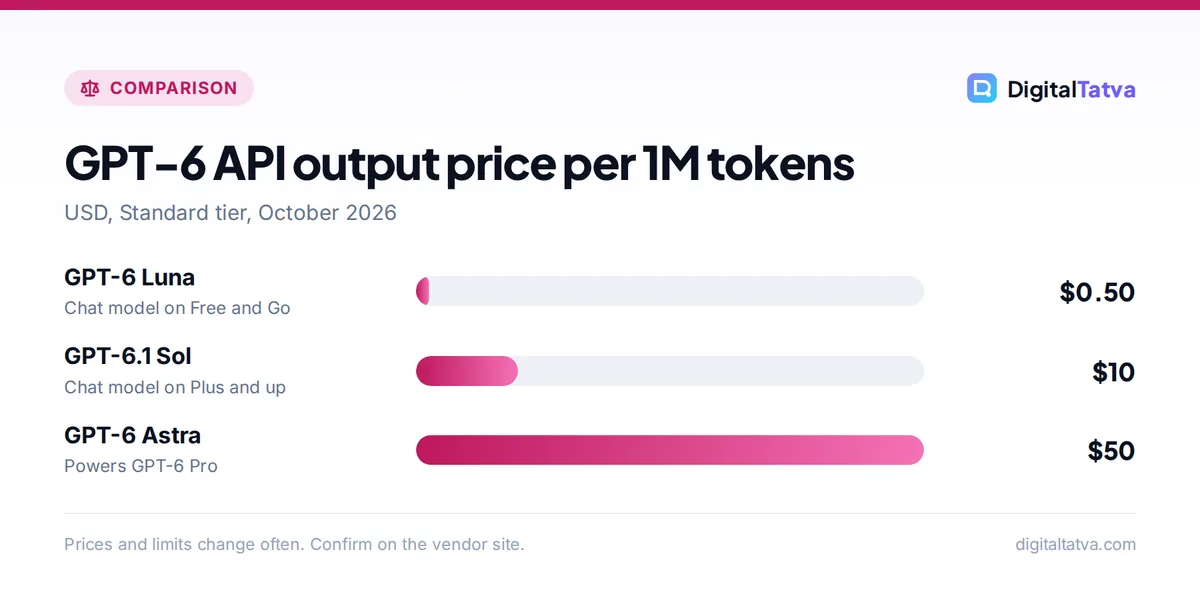
- API prices per million tokens: Astra $10 input and $50 output, 6.1 Sol $2 and $10, Luna $0.10 and $0.50.
- All three API models share a 1,050,000-token context window and 128,000 max output tokens.
- GPT-5.6 Sol is still selectable in ChatGPT, so you can switch back if a workflow depends on it.
GPT-6 Astra vs Sol vs Luna at a glance
OpenAI now names model tiers after celestial objects instead of “mini” and “nano”. Astra is the top tier, Sol sits in the middle and Luna is the budget tier. Here is how they compare.
| Model | Role | Released | API price (input / output per 1M) | Where you meet it in ChatGPT |
|---|---|---|---|---|
| GPT-6 Astra | Flagship for complex, multi-step work | 3 Sept 2026 (limited orgs first) | $10 / $50 | GPT-6 Pro (Pro, Business, Enterprise); Work and Codex on Plus and up |
| GPT-6.1 Sol | Balanced everyday model | 29 Sept 2026 (GPT-6 Sol on 22 Sept) | $2 / $10 | GPT-6 in Chat on paid plans; Work and Codex |
| GPT-6 Luna | Fast, lowest-cost model | 22 Sept 2026 | $0.10 / $0.50 | GPT-6 in Chat on Free and Go |
OpenAI’s own positioning is clear: “GPT-6 Astra continues to be our best model across the board,” while Sol and Luna carry Astra’s training methods at a lower cost. There is no GPT-6 Terra. The middle GPT-5.6 tier, Terra, is still sold in the API but is not selectable in standard Chat.
GPT-6 Astra: the flagship for long, hard tasks
Astra is OpenAI’s most capable model. It rolled out first to a limited set of organizations on 3 September 2026, then to ChatGPT Plus, Pro, Business and Enterprise. In the API it supports reasoning effort from low to max, a 1,050,000-token context window, 128,000 output tokens and an April 2026 knowledge cutoff, according to the official GPT-6 Astra model page.
In ChatGPT, you meet Astra in two ways. First, it powers GPT-6 Pro, the Pro thinking level, which is available on Pro $100, Pro $200, Business and Enterprise. OpenAI is explicit that “a Pro subscription does not include unlimited use of the GPT-6 Pro model.” Second, Plus and higher plans get Astra inside ChatGPT Work and Codex, the agent and coding surfaces. The $500 Pro tier adds Astra Ultrafast in Work and Codex.
Choose Astra if: you hand ChatGPT long research or analysis jobs, complex code changes, or computer-use tasks where accuracy matters more than speed. Skip it if: you mostly write, summarize and brainstorm. Sol handles that well at a fraction of the cost and limit usage.
GPT-6 Sol: the default model most people will use
Sol is the workhorse. GPT-6 Sol launched in Work, Codex and the API on 22 September 2026, and GPT-6.1 Sol replaced it as the current Sol model in Work and Codex on 29 September, starting with Pro users. Since 7 October, GPT-6 Sol is also the model behind “GPT-6” in the Chat tab for Plus, Pro, Business and Enterprise.
In Chat, GPT-6 Sol powers every thinking level from Instant up to Extra High. Plus gets Instant, Medium and High. Pro, Business and Enterprise also get Extra High. Sol is also what drives the new interactive answers; see our guide to ChatGPT Intelligent UI for how that works.
Tip: On Plus and Pro, Instant no longer switches itself to a higher thinking level for complex requests, and asking it to “think harder” does not change the level. Pick Medium or High yourself for analysis, planning and tricky writing.
Choose Sol if: you want strong answers for writing, research, analysis and everyday coding without burning Pro-level allowances. That is most marketers, founders, students and freelancers.
GPT-6 Luna: fast, cheap and on the free plan
Luna is the lowest-cost GPT-6 model. In the API it costs $0.10 per million input tokens and $0.50 per million output tokens, half or less of GPT-5.6 Luna’s price ($0.20 and $1.20), with the same 1,050,000-token context window and a May 2026 knowledge cutoff. In ChatGPT, GPT-6 Luna is the Chat model for Free and Go users, rolling out from 8 October 2026.
Free and Go users only get the Instant level. That is fine for quick questions, drafts and explanations, but you will notice the gap on long analysis or careful reasoning. If that is you, the step up to Plus at $20 per month gets you GPT-6 Sol with real thinking levels. Our ChatGPT Plus vs Pro comparison covers the next step after that.
Choose Luna if: you are on Free or Go, or you are a developer classifying, extracting or summarizing large volumes of text where cost per call matters most.
Which ChatGPT plan gets which GPT-6 model
This table combines OpenAI’s GPT-6 and other models help article with the plan prices in our ChatGPT pricing guide.
| Plan | Price (USD) | Chat model and levels | GPT-6 Pro (Astra) | Astra in Work and Codex |
|---|---|---|---|---|
| Free | $0 | GPT-6 Luna, Instant | No | No |
| Go | $8/month | GPT-6 Luna, Instant | No | No |
| Plus | $20/month | GPT-6 Sol: Instant, Medium, High | No | Yes |
| Pro 100 | $100/month | GPT-6 Sol up to Extra High | Yes, shared weekly allowance | Yes |
| Pro 200 | $200/month | GPT-6 Sol up to Extra High | Yes, larger weekly allowance | Yes |
| Pro 500 | $500/month | GPT-6 Sol up to Extra High | Most usage | Yes, plus Astra Ultrafast |
| Business | $25/user/month ($20 annual) | GPT-6 Sol up to Extra High | Yes, small shared allowance | Yes |
| Enterprise | Custom | GPT-6 Sol, per admin settings | Yes, per admin settings | Yes, if enabled |
GPT-6 Pro limits by plan
OpenAI publishes a few hard numbers for its Pro models. Pro $100 gets one shared allowance of 50 messages per week across GPT-6 Pro and GPT-5.6 Sol Pro. Pro $200 gets 200 GPT-6 Pro messages per week, and when that runs out ChatGPT switches to GPT-5.6 Thinking at Medium. Business Standard seats share 15 Pro messages per month, and Business Premium seats get 50 per week. OpenAI has not stated the Pro 500 caps.
For everyday GPT-6 Sol chats, OpenAI does not publish message caps for Plus. Our guide to ChatGPT limits by plan explains what to expect and how to avoid hitting them.
Note: GPT-6 replaced the “Latest” option in the model menu. If you had “Latest” selected, you moved to GPT-6 at the same effort. If you had explicitly picked GPT-5.6 Sol, you stayed on it. OpenAI did not retire older selectable models with this launch.
GPT-6 API pricing compared
For developers, the price gap between the three models is huge: Astra costs 100 times more than Luna per token. All prices below are Standard tier, per million tokens, from OpenAI’s developer pricing page.
| Model | Input | Cached input | Output | Batch (input / output) |
|---|---|---|---|---|
| GPT-6 Astra | $10.00 | $1.00 | $50.00 | $5.00 / $25.00 |
| GPT-6.1 Sol | $2.00 | $0.10 | $10.00 | $1.00 / $5.00 |
| GPT-6 Luna | $0.10 | $0.01 | $0.50 | $0.05 / $0.25 |
A worked cost example
Say your app sends 10,000 requests a day, each with 2,000 input tokens and 500 output tokens. That is 20 million input tokens and 5 million output tokens a day.
- GPT-6 Luna: 20 x $0.10 = $2.00 input, plus 5 x $0.50 = $2.50 output. Total $4.50 per day.
- GPT-6.1 Sol: 20 x $2 = $40 input, plus 5 x $10 = $50 output. Total $90 per day.
- GPT-6 Astra: 20 x $10 = $200 input, plus 5 x $50 = $250 output. Total $450 per day.
Running the same job through the Batch API halves each figure if you can wait up to 24 hours. Also watch the long-context surcharge: any GPT-6 request over 272K input tokens is billed at 2x input and 1.5x output for the whole request. Our guides to OpenAI API pricing, the Batch API and model routing show how to keep these bills down.
Save money: Route simple tasks (tagging, extraction, short replies) to Luna and send only the hard cases to Sol or Astra. With the numbers above, moving even half your traffic from Sol to Luna cuts the daily bill by more than 40%.
GPT-6 vs GPT-5.6: what changed
GPT-5.6 (Sol, Terra and Luna) is still sold alongside GPT-6, and in the API GPT-6 is cheaper: GPT-6 Sol costs half of GPT-5.6 Sol’s promotional $4 input and $20 output. In ChatGPT, OpenAI highlights speed: GPT-6 can start answering while it is still thinking, and it says GPT-6 Instant starts answering 44% sooner on average than GPT-5.6 Instant on questions that need web search. OpenAI also says GPT-6 Extra High can begin answering in about the same time as GPT-5.6 Medium. Both are OpenAI’s internal figures.
The biggest visible change is Intelligent UI, which lets GPT-6 answer with charts, buttons and small tools. The Pro thinking level (Astra) does not support it. For a broader view of how GPT-6 stacks up against rivals, see our ChatGPT vs Claude and Grok vs ChatGPT comparisons.
Choose Astra, Sol or Luna: a quick guide
| You are… | Best model | Cheapest plan that gets it |
|---|---|---|
| A student or casual user | GPT-6 Luna | Free |
| A writer, marketer or consultant | GPT-6 Sol at Medium or High | Plus ($20) |
| A researcher running long analyses | GPT-6 Pro (Astra) | Pro 100 ($100) |
| A developer using Codex daily | GPT-6.1 Sol, Astra for hard tasks | Plus ($20), Pro for heavy use |
| An API builder watching costs | GPT-6 Luna, routed up to Sol | Pay as you go |
Frequently asked questions
What is the difference between GPT-6 Astra, Sol and Luna?
Astra is OpenAI’s most capable GPT-6 model, built for complex, multi-step work, and it powers GPT-6 Pro. Sol is the balanced model behind GPT-6 in Chat on paid plans and in Work and Codex. Luna is the fastest and cheapest model, used in Chat on Free and Go. In the API, Astra costs $10 and $50 per million tokens, Sol $2 and $10, and Luna $0.10 and $0.50.
Can free ChatGPT users use GPT-6?
Yes. OpenAI started rolling out GPT-6 to Free and Go users on 8 October 2026. They get GPT-6 Luna at the Instant level, including Intelligent UI. They do not get GPT-6 Sol thinking levels or GPT-6 Pro. Rollouts are gradual, so it can take a few days to reach every account.
Does ChatGPT Plus include GPT-6 Astra?
Partly. Plus includes GPT-6 Astra inside ChatGPT Work and Codex, but not GPT-6 Pro in Chat. In the Chat tab, Plus users get GPT-6 Sol at Instant, Medium and High. To use GPT-6 Pro in Chat, you need Pro $100 or higher, Business or Enterprise, and even then usage is capped.
Is GPT-6 better than GPT-5.6?
OpenAI says GPT-6 answers sooner, makes better decisions about when to search, and supports interactive answers, all based on its internal tests. In the API, GPT-6 Sol and Luna are also about half the price of GPT-5.6 equivalents. GPT-5.6 Sol remains selectable in ChatGPT, so you can compare them on your own tasks.
What is GPT-6.1 Sol?
GPT-6.1 Sol is an updated Sol model released on 29 September 2026 in ChatGPT Work and Codex, starting with Pro users, and in the API. It costs $2 per million input tokens and $10 per million output tokens, with cheaper cached input at $0.10. It replaced GPT-6 Sol as the current Sol model in those surfaces.
Verdict: which GPT-6 model should you use?
For nearly everyone, GPT-6 Sol on ChatGPT Plus is the sweet spot: strong reasoning at Medium and High, interactive answers and Astra inside Work and Codex for $20 a month. Free users get a capable taste through GPT-6 Luna. Pay for Pro only if you will actually use GPT-6 Pro every week, and developers should default to Luna and route up to Sol or Astra only when a task needs it. OpenAI changes models and limits frequently, so confirm current access and pricing on OpenAI’s official pages before you commit.
Related reading: our ChatGPT review and how to pick the cheapest AI model for each task.
Pricing and features are checked at the time of writing and can change. Some links may be affiliate links, which never affect our verdicts.