Gemini 4 Argon: What Google’s New Model Is and Who Can Use It
Gemini 4 Argon explained: what Google announced on 30 September 2026, who can access it today, its $2 and $10 introductory API pricing, and which Gemini models to use meanwhile.

On this page
Gemini 4 Argon is Google’s new frontier AI model, announced on 30 September 2026 and aimed at real-world coding, enterprise knowledge work and cyber defense. Right now almost nobody can use it: access is limited to a small group of trusted cybersecurity defenders in Google’s Fairwind Program. Google says paid Gemini API customers and Google AI Ultra subscribers will get it next, but it has not given a date.
Google has published pricing, though: an introductory $2 per million input tokens and $10 per million output tokens, rising to $4 and $20 after the introductory period. Below we explain exactly what Google has confirmed, what it has not, how Argon’s price compares with GPT-6 and Claude, and which Gemini models you should use while you wait.
Key takeaways
- Gemini 4 Argon was announced on 30 September 2026 as Google’s frontier model for coding, enterprise knowledge work and cyber defense.
- Today it is only rolling out to trusted cyber defenders through the Fairwind Program. It is not in the Gemini app, and it is not listed on the public Gemini API models or pricing pages.
- Next in line are paid Gemini API customers and Google AI Ultra subscribers. Google has given no release date.
- Introductory API price: $2 input and $10 output per 1M tokens, with cached input 95% off. After the introductory period: $4 and $20.
- Until Argon opens up, Gemini 3.1 Pro (preview) and Gemini 3.8 Flash are the best Google models you can actually use.
What is Gemini 4 Argon?
Argon is the first model in Google’s Gemini 4 generation. Google’s official announcement, written by Koray Kavukcuoglu (SVP at Google DeepMind and Chief AI Architect at Google), calls it “our frontier model for real-world coding, enterprise knowledge work, and cyber defense, rolling out soon.” In plain words, “frontier” means the most capable model a lab has built, the one meant to compete with OpenAI’s GPT-6 Astra and Anthropic’s Claude Opus 5.5.
The announcement focuses on three areas:
- Coding: Google claims a new state-of-the-art score of 77.9% on the DeepSWE v1.1 software engineering benchmark.
- Enterprise knowledge work: Google says Argon leads the Vals Index and performs strongly on finance and legal agent benchmarks, and ranks first on Zapier’s AutomationBench at 51.3%.
- Cyber defense: Argon can find, validate and patch software vulnerabilities on its own. Security firm Wiz is already using it through its Scan for Good initiative.
These are Google’s own benchmark claims. Nobody outside the early access group has been able to test the model independently, so treat the numbers as the vendor’s marketing until third-party evaluations appear.
The 1M output token limit
The most concrete product change is output length. Google says it is “significantly expanding the model’s output token limit to an industry-leading 1M tokens”, up from 64K on earlier Gemini models. Output tokens are the words the model writes back to you. A 1M output limit means a single response could, in theory, contain a whole codebase migration or a book-length report. If you are new to these terms, our plain English guide to what tokens are in AI and our explainer on how context windows work will help.
Google’s article does not state Argon’s input context window. You may see “1M context” quoted elsewhere, but the official post only confirms the 1M output limit.
Who can use Gemini 4 Argon right now?
This is the question most people searching for Argon want answered, so here is the plain answer: unless you work for one of Google’s trusted cybersecurity partners, you cannot use it yet.
| Group | Access status (8 October 2026) | What Google has said |
|---|---|---|
| Trusted cyber defenders (Fairwind Program) | Rolling out now | Some get a version without cyber guardrails for defensive work |
| Internal Google teams | In use | Used for internal coding and optimization projects |
| Paid Gemini API customers | Not yet | “Starting with paid API customers”, no date |
| Google AI Ultra subscribers | Not yet | Named as first consumer group, no date |
| Google AI Pro, Plus and Free users | Not yet | No timeline announced |
| Google Workspace business users | Not yet | “Enterprises” mentioned, no details |
We checked Google’s public Gemini API models page on 8 October 2026. It lists no Gemini 4 or Argon model; the newest model there is Gemini 3.8 Flash, and the only Pro model is Gemini 3.1 Pro in preview. Google has also not published a model ID, so do not assume a string like “gemini-4-argon” will work in your code.
Why the rollout is so limited
Google says it is “actively engaged in the U.S. government’s voluntary process for pre-release model access” and is expanding access gradually. Because Argon is strong at finding software vulnerabilities, Google is letting defenders use it first, so they can patch weaknesses before the same capability is widely available. Google also describes extra safety work: monitoring for cyber and chemical, biological, radiological and nuclear (CBRN) misuse, watching the model’s reasoning and actions so execution can be halted, and better resistance to prompt injection (hidden instructions planted in web pages or documents).
Watch out: Be careful with websites, apps or API resellers claiming to offer “Gemini 4 Argon access” today. Google has not opened public access, so such offers are either mislabeled older models or scams. Only use Google’s own products and documented API.
Gemini 4 Argon pricing
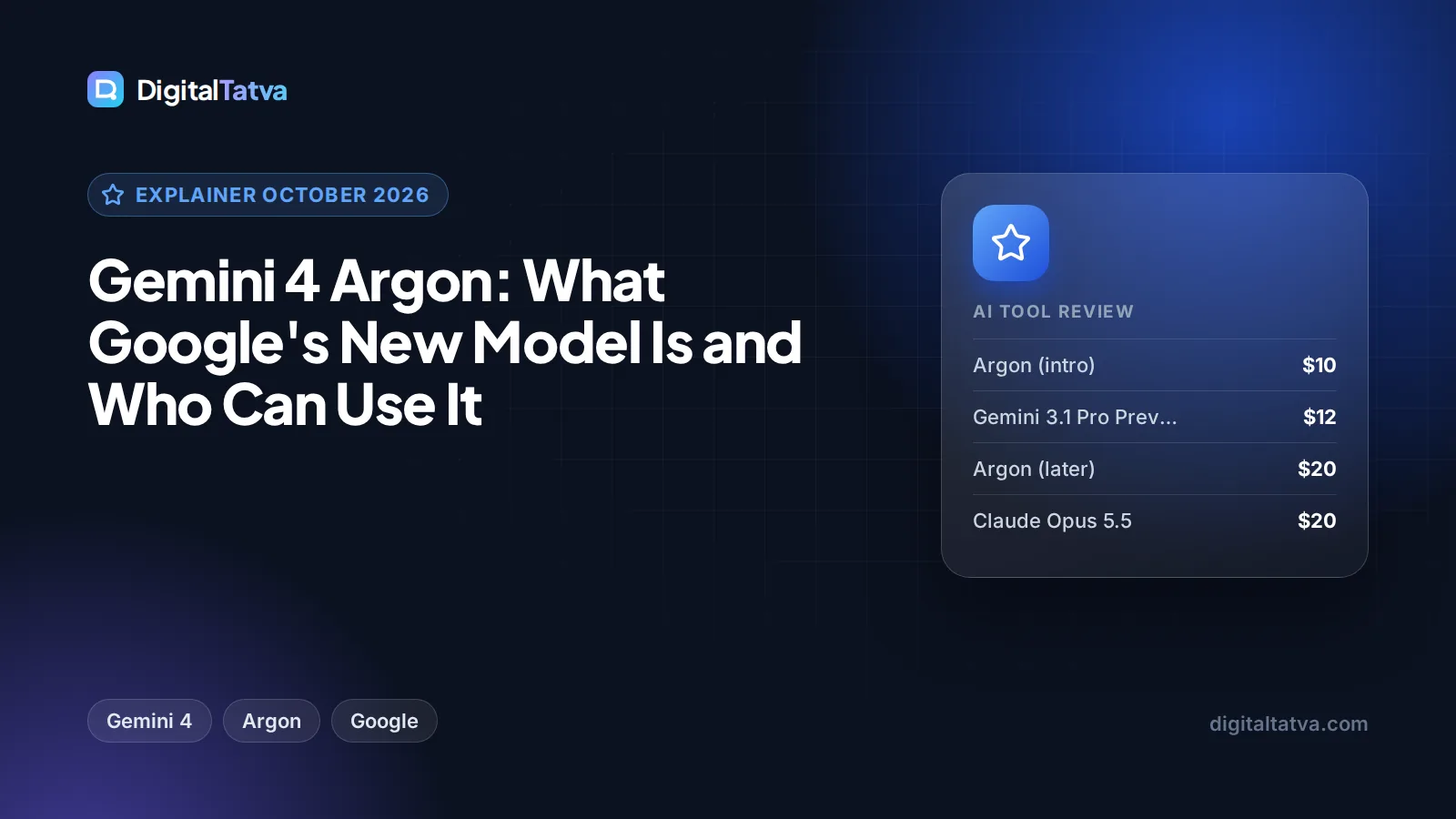
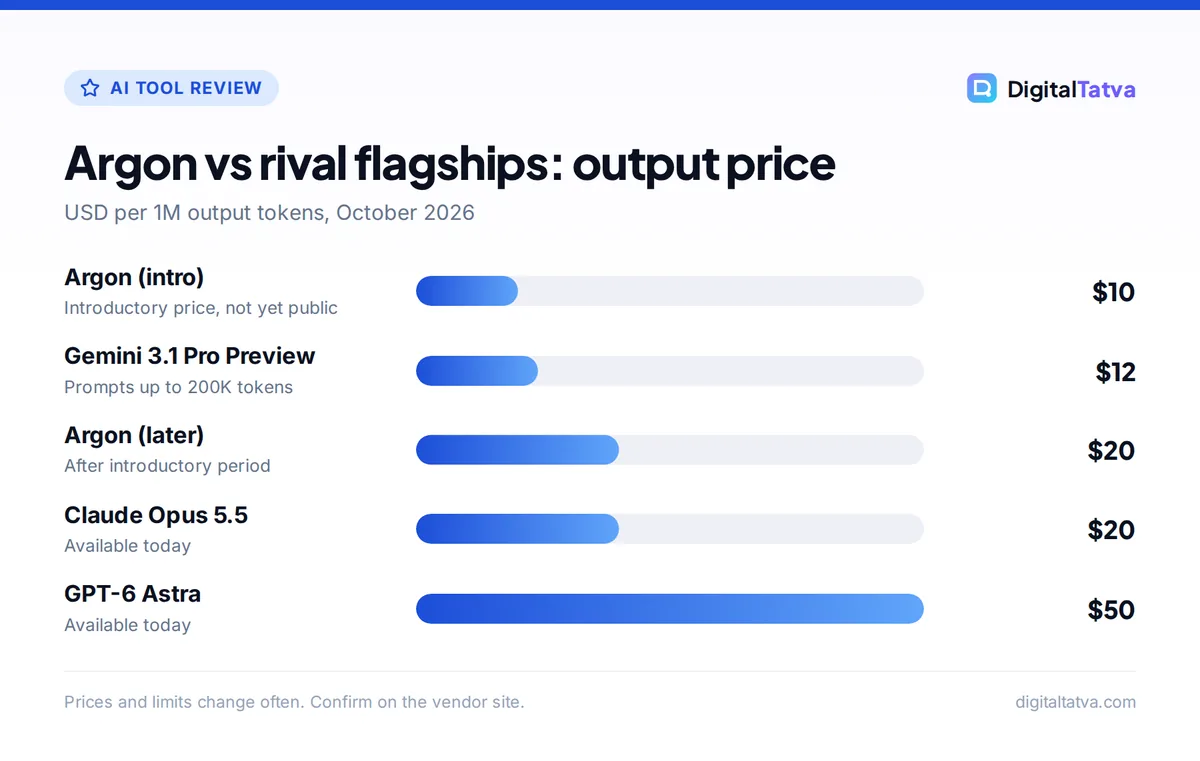
Unusually for a model nobody can use yet, Google has already published API prices. Argon “will launch at an introductory price” of $2 per million input tokens and $10 per million output tokens, with cached input tokens 95% off the input price. A footnote adds: “After the introductory period expires, the price of $4 per 1M input tokens and $20 per 1M output tokens will apply.” Google has not said how long the introductory period lasts.
| Model | Input per 1M tokens | Output per 1M tokens | Can you use it today? |
|---|---|---|---|
| Gemini 4 Argon (introductory) | $2.00 | $10.00 | No (limited partners only) |
| Gemini 4 Argon (after introductory period) | $4.00 | $20.00 | No |
| Gemini 3.1 Pro Preview (prompts up to 200K) | $2.00 | $12.00 | Yes, paid tier |
| Gemini 3.8 Flash (through 31 Dec 2026) | $0.75 | $3.75 | Yes |
| GPT-6 Astra | $10.00 | $50.00 | Yes |
| Claude Opus 5.5 | $4.00 | $20.00 | Yes |
| Claude Sonnet 5.5 | $2.00 | $10.00 | Yes |
For the full rate cards, see our guides to Gemini API pricing, OpenAI API pricing and Claude API pricing.
Worked example: a monthly coding agent bill
Say a small development team sends 10 million input tokens and receives 2 million output tokens a month through a coding agent. Here is what that would cost on each model, using standard rates and no caching:
- Argon introductory: 10 x $2 + 2 x $10 = $20 + $20 = $40 a month.
- Argon after the introductory period: 10 x $4 + 2 x $20 = $40 + $40 = $80 a month.
- Gemini 3.1 Pro Preview: 10 x $2 + 2 x $12 = $20 + $24 = $44 a month.
- Claude Opus 5.5: 10 x $4 + 2 x $20 = $40 + $40 = $80 a month.
- GPT-6 Astra: 10 x $10 + 2 x $50 = $100 + $100 = $200 a month.
So if Google’s quality claims hold up, Argon’s introductory price undercuts every rival flagship. Its long-term price matches Claude Opus 5.5 exactly and is well below GPT-6 Astra. Coding agents resend the same project files constantly, so the 95% cached input discount matters too: at the introductory rate, cached input would cost about $0.10 per million tokens. Our guide to prompt caching shows how to structure prompts to get those cache hits.
Save money: If Argon launches while the introductory price is still active, that is the cheapest time to build and test with it. Budget for the $4 and $20 rates from day one, though, so your margins do not break when the promotion ends.
Will Argon cost extra for Gemini app users?
Google has not said. The only consumer plan named is Google AI Ultra, which costs $99.99 a month for the 5x tier and $199.99 for the 20x tier in the US (Rs 6,500 and Rs 19,500 a month in India). Google AI Pro ($19.99, or Rs 1,950 a month in India) has not been mentioned. Our Gemini pricing guide explains what each plan includes today.
How Argon compares with GPT-6 and Claude Opus 5.5
On paper, Argon is positioned squarely against OpenAI’s GPT-6 Astra and Anthropic’s Claude Opus 5.5. Google’s announcement claims Argon leads or ties on several coding, agent, long video and security benchmarks. Without independent testing, we cannot say whether it is actually better in daily work. Benchmarks also tend to favor the company that picked them.
What we can compare is what is public:
- Availability: GPT-6 Astra and Claude Opus 5.5 are available today in paid apps and APIs. Argon is not.
- Price: Argon’s introductory API price is a fifth of GPT-6 Astra’s, and its later price equals Opus 5.5.
- Output length: Argon’s 1M output limit is far above the 128K maximum output that OpenAI lists for GPT-6 Astra and Anthropic lists for Opus 5.5.
- Ecosystem: If your work lives in Gmail, Docs and Drive, a Gemini model will eventually plug into tools you already use. See how Gemini fits today in our guide to using Gemini in Gmail, Docs and Sheets.
For the OpenAI side of the race, read our breakdown of GPT-6 Astra, Sol and Luna. For a broader view of how Google’s assistant compares today, see ChatGPT vs Gemini and Claude vs Gemini for writing, coding and research.
What to use while you wait for Argon
There is no reason to pause your projects. Pick the best model that is available now, and design your code so you can swap models later.
For developers on the Gemini API
- Use Gemini 3.1 Pro Preview for hard reasoning and coding. It is Google’s most capable model on the public API, at $2 input and $12 output per 1M tokens for prompts up to 200K tokens. It is a preview model with no free tier.
- Use Gemini 3.8 Flash for volume. At $0.75 and $3.75 per 1M tokens through 31 December 2026, it handles most chat, summarizing and extraction tasks at a fraction of the cost. Prices double from 1 January 2027.
- Keep the model name in a config setting. When Argon opens to paid API customers, you can test it by changing one value instead of rewriting code.
- Build an evaluation set now. Save 20 to 50 real prompts with known good answers. When Argon arrives, run them on both models and compare quality and cost before switching.
Our guide on model routing explains how to send easy tasks to cheap models and only hard ones to a frontier model, which will matter even more once Argon is live.
For Gemini app users
Google AI Pro already includes higher access to Gemini 3 Pro, Deep Search and a 1M token context window, while AI Ultra adds first access to Deep Think and the highest limits. If you were planning to upgrade to Ultra only for Argon, wait until Google confirms a date. Paying $99.99 or more a month for a model that is not there yet is a poor deal. For coding, a dedicated tool from our list of the best AI coding assistants will likely help you more today.
Our take on Gemini 4 Argon
Our verdict
Not rated yet
We cannot rate a model we cannot use. On paper, Argon looks like Google’s strongest model ever, with aggressive launch pricing and a uniquely large 1M output limit. But it is gated behind a cyber defense program today, and Google has not shared a public date, model ID or app availability. We will review it once paid API or Ultra access opens.
What looks promising
- Introductory price of $2 and $10 per 1M tokens undercuts rival flagships
- 95% discount on cached input
- 1M token output limit for very long responses
- Strong claimed coding and security results
What is missing
- No public access, no release date
- No published model ID or context window
- Benchmarks are Google’s own, not independently tested
- Introductory period length not disclosed
Who should care right now? Security teams should ask Google whether they qualify for Fairwind. Developers should budget for Argon and prepare evaluations. Everyone else can keep using current Gemini, ChatGPT or Claude plans; our full Gemini review covers what Google’s assistant does well today.
Frequently asked questions
Is Gemini 4 Argon available to the public?
No. As of 8 October 2026, Gemini 4 Argon is only rolling out to trusted cybersecurity defenders through Google’s Fairwind Program and to internal Google teams. Google says paid Gemini API customers and Google AI Ultra subscribers will get access first when it expands, but it has not published a date. It does not appear on the public Gemini API models page yet.
How much does Gemini 4 Argon cost?
Google lists an introductory API price of $2 per million input tokens and $10 per million output tokens, with cached input tokens 95% cheaper. After the introductory period ends, prices rise to $4 input and $20 output per million tokens. Google has not said how long the introductory pricing lasts or whether app users will pay anything extra.
Will Gemini 4 Argon be free in the Gemini app?
Google has not said. The only consumer plan named for early access is Google AI Ultra, which costs $99.99 a month and up in the US, or Rs 6,500 a month and up in India. There is no announcement about Free, Plus or Pro users getting Argon, so assume it will start on paid tiers.
Is Gemini 4 Argon better than GPT-6 or Claude Opus 5.5?
Google claims Argon leads several coding, agent and security benchmarks, including 77.9% on DeepSWE v1.1. These are vendor-reported results that have not been independently verified, and the model is not publicly available to test. Until it is, GPT-6 Astra and Claude Opus 5.5 remain the proven flagships you can actually use.
What Gemini model should I use until Argon launches?
On the API, use Gemini 3.1 Pro Preview for difficult reasoning and coding, and Gemini 3.8 Flash for high-volume everyday tasks because it is much cheaper. In the Gemini app, Google AI Pro gives the best balance of model access and price for most people. Keep your model name configurable so switching to Argon later is easy.
Next steps
Gemini 4 Argon is real, priced and impressive on paper, but it is not something you can buy today. Bookmark Google’s official Gemini 4 Argon announcement and the Gemini API pricing page for updates, keep building on Gemini 3.1 Pro or 3.8 Flash, and use our guide to estimating AI API costs to plan your budget at both the introductory and full prices. Pricing and access details change quickly, so confirm the latest terms on Google’s site before you commit.
Pricing and features are checked at the time of writing and can change. Some links may be affiliate links, which never affect our verdicts.