Palmata Review 2026: The AEO Platform From Contentful and Salesforce Explained
Palmata is an AEO solution that helps teams understand, measure and improve how AI answer engines represent their company. Features, engines, pricing, strengths and limits explained.
On this page
- Key takeaways
- What is Palmata?
- Why a tool like Palmata matters
- Palmata’s core features
- What a Palmata report includes
- Which AI engines does Palmata cover?
- How Palmata works: a typical workflow
- Pricing and access
- Who should use Palmata?
- Strengths and limitations
- Palmata vs other AI visibility tools
- How to get the most from Palmata
- Illustrative example: a B2B software company
- Palmata checklist
- How Digital Tatva can help
- Frequently asked questions
Last updated: 20 November 2026
Quick answer: Palmata is an answer engine optimization (AEO) solution that helps teams understand, measure and improve how AI answer engines represent their company. Built by Contentful and now presented by Salesforce as “Palmata from Salesforce”, it researches your market, competitors and buyer questions, then shows how engines such as ChatGPT and Gemini mention, cite and describe your brand. Instead of a single visibility score, it reports three separate signals: mention, citation and perception. Its standout features are Steering Control, Adaptive Deep Research, Recommended Actions and Simulated Impact, which tests proposed content changes against buyer prompts before you publish. It is CMS-agnostic, does not require Salesforce or Contentful, offers a free brand assessment and paid tiers, and provides a read-only MCP server for AI agents. Like every AEO tool, it cannot guarantee how AI engines will answer.
Key takeaways
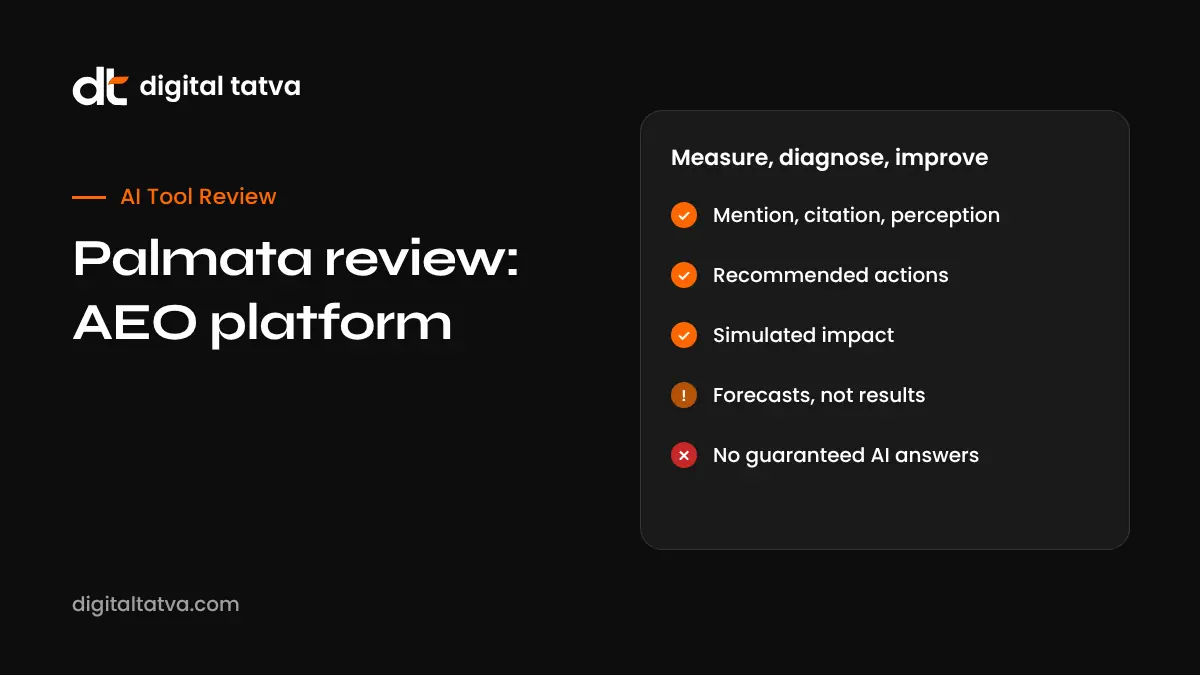
- Palmata focuses on why AI engines describe your brand the way they do, not just whether you appear.
- It separates mention, citation and perception rather than blending them into one score.
- Simulated Impact lets you test content changes before publishing, but simulations are forecasts, not results.
- You do not need to be a Salesforce or Contentful customer to use it.
- It works best alongside good content, technical SEO and off-site reputation work.
What is Palmata?
Palmata describes itself as an AI discovery intelligence platform. In practical terms, it is an AEO tool for marketing teams who want to know how AI assistants talk about their company, which sources shape those answers and what to change to improve them.
Contentful launched Palmata in June 2026, as reported by diginomica. Salesforce had announced it was acquiring Contentful, and Palmata now appears on Salesforce’s site as “Palmata from Salesforce”, with an FAQ stating it is natively integrated into Marketing Cloud. Palmata also remains available as a standalone product with its own sign-up, and it is described as CMS-agnostic.
If you are new to the topic, start with what is AEO and what is AI search visibility.
Why a tool like Palmata matters
Buyers increasingly ask ChatGPT, Gemini and other AI assistants questions such as “best CRM for small businesses” or “which agency should I hire for X” before they visit any website. The answer may name a few brands, cite a few sources and describe each option in a sentence or two. That creates three problems for marketing teams:
- Visibility: you may not be mentioned at all for important buyer questions.
- Attribution: AI may describe you using other sites’ content instead of your own.
- Accuracy and perception: AI may use outdated facts or frame you less favourably than competitors.
As Contentful’s CMO Elizabeth Maxson put it in diginomica’s launch coverage, a CMO no longer fully controls that strategic narrative. Tools like Palmata aim to show what is shaping it.
Palmata’s core features
| Feature | What it does | Why it helps |
|---|---|---|
| Steering Control | Focuses research on specific brands, products, audiences, regions, competitors and priorities | Reports reflect the questions and markets that matter to you |
| Adaptive Deep Research | Builds context about your business, category, competitors and audiences, generates realistic buyer prompts and studies the answers and their sources | Goes beyond a site crawl to understand how engines interpret your market |
| Recommended Actions | Turns findings into prioritised changes, such as strengthening claims, adding proof or updating influential pages | Gives teams a to-do list, not just a dashboard |
| Simulated Impact | Tests modified content against relevant prompts and compares resulting answers | Helps decide which changes are worth the effort before publishing |
| Connected Intelligence (MCP) | An optional read-only Model Context Protocol server gives compatible AI tools and agents access to report findings | Lets AI assistants and content workflows use Palmata’s research |
| Prompt library | Over 450 built-in buyer prompts plus custom prompts, per diginomica | Covers the buyer journey without writing every prompt yourself |
Mention, citation and perception
Palmata measures three signals separately:
- Mention: is your brand included in the answer?
- Citation: is your own content cited as a source?
- Perception: when you appear, is your business represented favourably and accurately?
Palmata deliberately avoids collapsing these into a single score. That matters because a brand can be mentioned often but described poorly, or described well using competitors’ or third-party content. For more on measuring these signals, see AEO KPIs.
“Considered but not cited” sources
One of Palmata’s most distinctive ideas is showing content that an engine looked at but did not use. Maxson described this as content that “was actually considered, but it wasn’t picked.” Vantage Point, a consultancy that sells Palmata implementation services, called this the most useful idea in its own audit, because pages that were retrieved but not cited are often the quickest to improve.
What a Palmata report includes
Based on Vantage Point’s October 2026 write-up of running Palmata on its own website, a report is organised into five views:
| View | What you see |
|---|---|
| Brand Perception | How AI engines summarise and frame your company |
| Topics and Prompts | Buyer questions grouped by topic, with where you appear |
| Sources | Pages that help, pages that hurt and pages that were read but left out |
| Actions | A ranked playbook of content, technical and third-party work |
| Strategic Analysis | Competitive context and bigger-picture recommendations |
In that example, the audit covered 450 buyer prompts across 15 topics and named 54 competitors. These numbers describe one company’s report, not typical results, and the author noted that simulated gains were forecasts that still needed a rerun to confirm.
Which AI engines does Palmata cover?
Salesforce’s Palmata page names ChatGPT and Gemini among the major AI assistants and search experiences it tracks. At launch, diginomica reported that Palmata was powered by Contentful’s Sounder Discovery Agent running on OpenAI and Google models, with Anthropic’s Claude on the roadmap. Coverage may have expanded since, so check the current list with Palmata before buying, especially if Perplexity, Copilot or Claude matter to your audience.
How Palmata works: a typical workflow
- Steer the research: define your brand, products, regions, audiences, competitors and priorities.
- Run deep research: Palmata builds context, generates buyer prompts and studies AI answers and sources.
- Review representation: check mention, citation and perception by topic and competitor.
- Review recommended actions: prioritise content, technical and third-party changes.
- Simulate impact: test proposed rewrites against relevant prompts before publishing.
- Implement changes: update content in your own CMS and tools; Palmata does not publish for you.
- Rerun and compare: rerun the same prompts to see how answers change over time.
Salesforce’s FAQ says setup takes minutes and first insights are available the same day.
Pricing and access
- Free option: Palmata offers a free AI brand assessment and a sample report.
- Paid tiers: diginomica described a tiered subscription with a free tier; detailed pricing was not listed on the pages we reviewed.
- No platform lock-in: you do not need to be a Salesforce or Contentful customer.
- Salesforce customers: Salesforce says Palmata is natively integrated into Marketing Cloud.
Check Palmata’s pricing page or speak to Salesforce for current plans.
Who should use Palmata?
| Team | How they can use it |
|---|---|
| Content and SEO | Find pages to strengthen, gaps to fill and sources that shape answers |
| Brand and communications | Spot outdated or unfavourable descriptions and fix the sources behind them |
| Product marketing and competitive intelligence | See how AI compares you with competitors on key buying criteria |
| Growth and demand generation | Prioritise the buyer questions that lead to pipeline |
| Marketing leaders | Get a strategic view of AI representation and track progress over time |
Strengths and limitations
| Strengths | Limitations |
|---|---|
| Goes beyond tracking to explain what shapes AI answers | Cannot control or guarantee AI answers |
| Separate mention, citation and perception signals | Simulations are forecasts and need real reruns to confirm |
| Shows sources that were considered but not cited | Engine coverage at launch focused on ChatGPT and Gemini |
| Prioritised actions with simulated impact | Relies on public content, so brands with little online presence may get less useful results |
| Works without Salesforce or Contentful; free assessment available | Pricing details are not fully public |
| MCP server for AI agents and workflows | Attributing changes to specific edits is not always possible |
Palmata itself is clear about several of these limits: it says it does not control AI answers, that simulation is evidence rather than a promise, and that answer engines change over time.
Palmata vs other AI visibility tools
Many AI visibility tools focus on tracking: running prompts, counting brand mentions and measuring share of voice over time. Palmata’s positioning is different: it emphasises diagnosing why answers look the way they do and recommending and simulating changes. Some teams will use both, a tracker for broad monitoring and Palmata for deeper research and action planning.
Compare the wider market in best AI visibility tools, and see how SEO suites are adding AI features in Semrush vs Ahrefs.
How to get the most from Palmata
- Steer carefully: focus on the products, regions and competitors that drive revenue.
- Fix facts first: outdated prices, services or locations are quick wins.
- Improve “considered but not cited” pages: make them clearer, more specific and easier to quote; see how to get cited by AI.
- Add proof: case studies, data, credentials and reviews strengthen perception; see original research for AEO.
- Work off-site too: third-party reviews, directories, media and communities shape AI answers.
- Rerun on a schedule: compare like for like and report trends, not single snapshots; see AEO reporting template.
- Assign ownership: diginomica noted that few organisations have decided who owns AEO internally; decide early.
Illustrative example: a B2B software company
This is an illustrative scenario, not a client story.
A mid-size HR software company runs a free Palmata assessment and finds it is mentioned for broad “HR software” questions but rarely for “HR software for remote teams”, its main growth segment. The Sources view shows that its remote-work feature page was considered but not cited, while a competitor’s comparison guide was cited often. The team rewrites its feature page with a clear answer-first summary, specific capabilities and customer proof, simulates the change in Palmata, then publishes it and pitches an updated profile to two review sites. It reruns the same prompts a month later and reports changes in mention, citation and perception separately to leadership.
Palmata checklist
- Run the free AI brand assessment.
- Define brands, products, regions, audiences and competitors to steer research.
- Review mention, citation and perception by topic.
- List considered-but-not-cited pages to improve.
- Prioritise recommended actions with your team.
- Simulate key content changes before publishing.
- Implement changes in your CMS and off-site channels.
- Rerun reports on a schedule and track trends.
- Assign an owner for AEO.
How Digital Tatva can help
Tools show you where the gaps are; closing them takes content, technical and reputation work. Digital Tatva helps brands turn AI visibility insights into action, from rewriting key pages and adding structured data to improving third-party mentions and tracking results. See what is inside a Digital Tatva AI visibility audit and our five elements of AI visibility.
Want help acting on your AI visibility data? Request an AEO audit or try the free AI visibility checker.
Frequently asked questions
What is Palmata?
Palmata is an answer engine optimization solution that helps teams understand, measure and improve how AI answer engines represent their company.
Who makes Palmata?
Palmata was launched by Contentful in 2026 and is now presented by Salesforce as “Palmata from Salesforce”.
Do I need Salesforce or Contentful to use Palmata?
No. Palmata works as a standalone product and is CMS-agnostic, though Salesforce says it is natively integrated into Marketing Cloud.
Which AI engines does Palmata track?
Salesforce names ChatGPT and Gemini. At launch, Claude support was on the roadmap. Check with Palmata for current coverage.
Is Palmata free?
Palmata offers a free AI brand assessment and a free tier, with paid tiers for more features. Check its pricing page for details.
What does Palmata measure?
It measures mention, citation and perception separately, rather than combining them into one visibility score.
What is Simulated Impact in Palmata?
It tests proposed content changes against relevant buyer prompts and compares the resulting answers, helping you prioritise. It is a forecast, not a guarantee.
Can Palmata guarantee my brand appears in ChatGPT?
No. No tool can control AI answers. Palmata helps you understand and improve the content and signals that influence them.
Does Palmata publish content changes for me?
No. Its MCP server is read-only. Your team or connected tools make and publish changes in your CMS.
How is Palmata different from other AI visibility tools?
Many tools focus on tracking mentions. Palmata emphasises explaining why answers look the way they do, recommending actions and simulating their impact.
Product details, prices and features are checked at the time of writing and can change. Sources are linked in the text so you can check them yourself.
How does your brand appear in AI answers?
We test the questions your buyers ask across the major AI assistants and search engines, then show you what to fix first.
Get an AI Visibility Audit