What Is AI Search Visibility? How to Measure and Improve It (2026 Guide)
A complete guide to AI search visibility: what it means, how it differs from SEO, the metrics to track, the factors that influence it and a step-by-step plan to improve it.
On this page
- Key takeaways
- What is AI search visibility?
- Why AI search visibility matters now
- AI search visibility vs SEO rankings
- Where AI search visibility happens
- How to measure AI search visibility
- What influences AI search visibility
- How to improve AI search visibility: a step-by-step plan
- AI search visibility by business type
- Common mistakes
- Illustrative example: a B2B software company in Ahmedabad
- AI search visibility checklist
- How Digital Tatva can help
- Frequently asked questions
Last updated: 20 November 2026
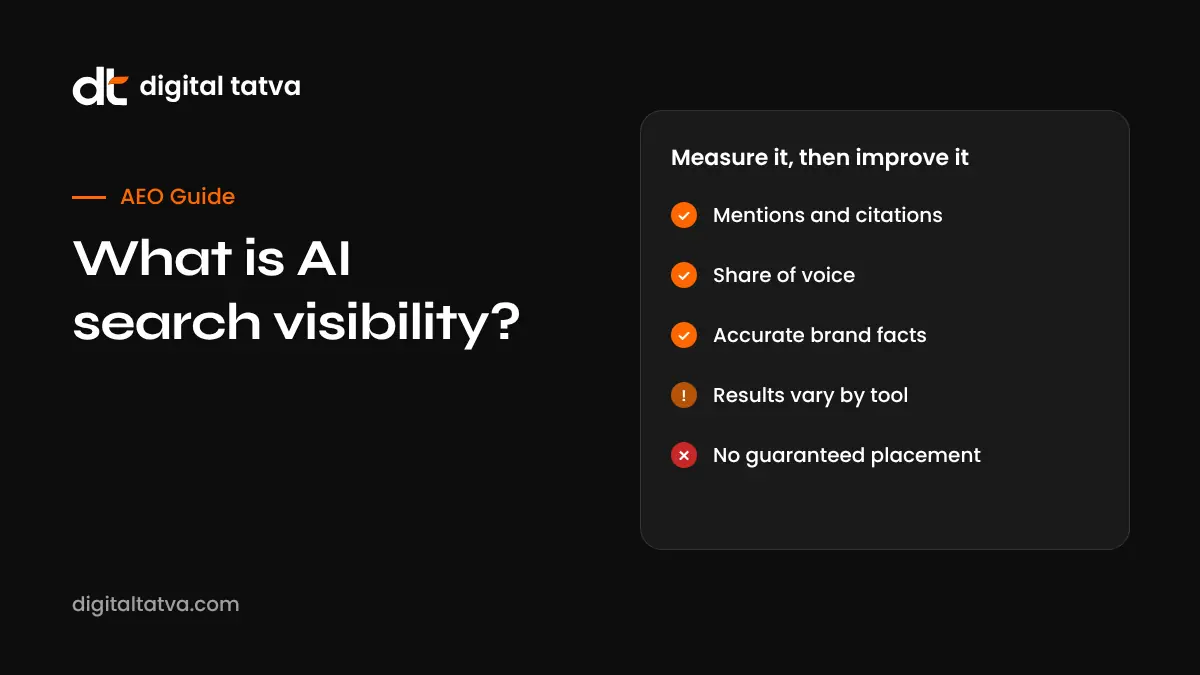
Quick answer: AI search visibility is how often, how prominently and how accurately your brand appears in answers from AI search tools such as ChatGPT, Google AI Overviews and AI Mode, Gemini, Perplexity, Copilot and Claude. It is measured with four main signals: mentions (is your brand named?), citations (is your website linked as a source?), share of voice (how often you appear compared with competitors across a set of prompts) and accuracy and sentiment (is what AI says about you correct and positive?). You improve it by publishing clear, answer-first content, keeping facts consistent across the web, earning mentions on trusted third-party sites, using structured data and making sure AI crawlers can read your pages. Nobody can guarantee a placement in AI answers, but these steps make your brand far easier for AI systems to find, trust and recommend.
Key takeaways
- AI search visibility is about being named, cited and described correctly in AI answers, not only ranking in blue links.
- Track mentions, citations, share of voice and accuracy across a fixed set of prompts, every month.
- AI tools draw on your site and on what others say about you, so off-site reputation matters as much as on-site content.
- Answer-first pages, consistent facts, structured data and crawler access are the foundations.
- Results vary between AI tools and change over time, so measure trends rather than single answers.
What is AI search visibility?
When someone asks ChatGPT “What is the best CRM for a small business in India?” or Google shows an AI Overview for “how to reduce cloud costs”, the answer usually names a handful of brands and links to a few sources. AI search visibility describes whether your brand is one of them.
It covers three questions:
- Presence: does the AI mention your brand, product or website at all?
- Prominence: are you the first recommendation, one of several, or a footnote?
- Accuracy: are your prices, features, locations and positioning described correctly?
The discipline of improving it is usually called Answer Engine Optimization (AEO) or Generative Engine Optimization (GEO). For background, read what is AEO.
Why AI search visibility matters now
People increasingly start research in AI tools instead of typing short keywords into a search box. During the 2026 holiday season, for example, Bain reported that 24% of US online shoppers planned to start holiday shopping on AI platforms, up from 17%, and Adobe forecast that traffic from AI tools to US retail sites would grow 130%. Google now shows AI Overviews and AI Mode answers above or instead of traditional results for many queries. For more numbers, see AEO statistics 2026.
That changes the game in three ways:
- Fewer clicks, more decisions inside the answer. Many users read the AI summary and act on it, so being named in the answer matters even when nobody clicks.
- Shortlists are shorter. An AI answer might name three to five options, compared with ten blue links and ads.
- Unbranded questions decide the shortlist. People often ask “best X for Y” without naming a brand. If you are missing there, you never enter the consideration set.
AI search visibility vs SEO rankings
| Aspect | Traditional SEO visibility | AI search visibility |
|---|---|---|
| Where you appear | Ranked list of links | Inside a written answer, as a mention, recommendation or cited source |
| Unit of success | Position for a keyword | Being named or cited for a prompt or question |
| Inputs | Mainly your pages and backlinks | Your pages plus reviews, forums, directories, news and other sites that describe you |
| Consistency | Rankings are fairly stable day to day | Answers can vary between runs, tools and users |
| Measurement | Rank trackers, Search Console | Prompt tracking, citation tracking, AI referral traffic and Search Console AI reports |
| Accuracy risk | Low: Google shows your own snippet | Higher: AI may summarise outdated or wrong information about you |
SEO still matters a great deal. Many AI tools retrieve pages from search indexes before writing an answer, so pages that rank well and are easy to read are more likely to be used. Think of AI search visibility as SEO plus reputation plus clarity. See AEO vs SEO for a full comparison.
Where AI search visibility happens
| Platform | How answers are built | What to watch |
|---|---|---|
| Google AI Overviews and AI Mode | Uses Google’s index and runs many related searches behind the scenes (query fan-out) | Whether your pages are cited as sources; see query fan-out explained |
| ChatGPT | Combines model knowledge with live web search for many questions | Brand mentions in recommendations and cited links |
| Gemini | Draws on Google Search and Google’s knowledge sources | Mentions and accuracy of business details |
| Perplexity | Searches the web for each question and shows numbered sources | Citations, which are very visible to users |
| Microsoft Copilot and Bing | Uses the Bing index | Bing indexing and citations; see Bing AI Mode |
| Claude | Uses model knowledge and web search when enabled | Mentions and descriptions |
To understand the full journey from question to answer, read how AI search engines work.
How to measure AI search visibility
There is no single official “AI rank”, so measurement relies on testing a consistent set of prompts and combining several signals.
The core metrics
| Metric | What it tells you | How to calculate it |
|---|---|---|
| Mention rate | How often your brand is named | Prompts where you are mentioned divided by total prompts tested |
| Citation rate | How often your website is linked as a source | Prompts citing your domain divided by total prompts |
| Share of voice | Your visibility compared with competitors | Your mentions divided by all brand mentions in the prompt set |
| Average position | How prominently you appear | Where you appear in lists or recommendations (first, second, and so on) |
| Accuracy score | Whether facts about you are correct | Share of answers with correct prices, features, locations and claims |
| Sentiment | How you are described | Positive, neutral or negative framing across answers |
| AI referral traffic | Visits from AI tools | Sessions from chatgpt.com, perplexity.ai, gemini.google.com and similar in analytics |
For a deeper list, see AEO KPIs: 9 metrics to measure your AI visibility.
Build a prompt set
- List your buyer questions. Use sales calls, support tickets, Search Console queries and “People also ask” boxes.
- Mix prompt types: unbranded category questions (“best payroll software for startups”), comparison prompts (“X vs Y”), problem prompts (“how to reduce employee turnover”) and branded prompts (“is X good?”).
- Add location and audience details where they matter, such as “in India” or “for D2C brands”.
- Keep 30 to 100 prompts depending on your size, and keep them fixed so trends are comparable.
- Test each prompt in several tools and, where possible, more than once, because answers vary.
- Record results in a sheet with columns for tool, prompt, mentioned, cited, position, competitors named and accuracy notes.
Tools that help
- Manual testing: free and insightful, but slow and inconsistent at scale.
- AI visibility trackers: run prompts automatically and chart mentions, citations and share of voice; see best AI visibility tools.
- SEO suites: several now include AI visibility features; see Semrush vs Ahrefs.
- Google Analytics 4: track referrals from AI tools; see how to track AI search traffic in GA4.
- Search Console: check AI-related performance reporting; see Search Console AI performance report.
- Free checks: start with the free AI visibility checker and free AEO tools.
What influences AI search visibility
AI systems do not publish ranking formulas, but research, platform documentation and testing point to a consistent set of factors. For a fuller breakdown, see AI search ranking factors.
| Factor | Why it matters |
|---|---|
| Crawlability and indexing | If search engines and AI crawlers cannot read your pages, they cannot use them |
| Answer-first content | Clear, direct passages are easier to quote and summarise |
| Topical depth | Covering a subject thoroughly signals authority; see topical authority in AI search |
| Entity clarity | Consistent name, description, category and location help AI understand who you are |
| Third-party mentions | Reviews, lists, news, forums and directories shape how AI describes and recommends you |
| Trust signals | Authors, credentials, sources and real experience; see E-E-A-T for AI search |
| Structured data | Schema markup clarifies organisations, products, FAQs and reviews; see schema markup for AEO |
| Freshness | Dated, updated pages are safer for AI to use for time-sensitive questions |
| Original data | Unique statistics give AI something worth citing; see original research for AEO |
Digital Tatva groups these into a simple model; read the five elements of AI visibility.
How to improve AI search visibility: a step-by-step plan
1. Fix the technical foundations
- Make sure important pages are indexed in Google and Bing.
- Check robots.txt does not block search engines or the AI crawlers you want to allow.
- Keep key content in HTML, not hidden in images, PDFs or scripts.
- Improve page speed and mobile usability.
- Use a crawler to find broken pages and duplicate content; see SEO crawlers for AI search readiness.
2. Make your brand facts clear and consistent
- Write a clear “about” description: who you are, what you offer, who you serve and where.
- Keep the same name, address, phone, prices and service list on your website, Google Business Profile, LinkedIn, directories and marketplaces.
- Add Organization, LocalBusiness or Product schema where relevant.
- Publish a facts or FAQ page for questions AI tools often get wrong.
3. Write answer-first content
- Start key pages with a short, direct answer to the main question.
- Use descriptive headings that match how people ask questions.
- Break content into self-contained passages that make sense when quoted alone; see content chunking for AI search.
- Use tables for comparisons, prices and specifications.
- Add FAQs that answer real buyer questions.
- Show dates and update time-sensitive pages.
4. Cover your topic in depth
- Build clusters: a main guide plus supporting pages for subtopics, comparisons and use cases.
- Create pages for “best X for Y” and “X vs Y” questions in your category, with honest comparisons.
- Link related pages together so both people and crawlers can follow the topic.
5. Earn mentions beyond your website
- Get listed and reviewed on trusted directories and review platforms in your industry.
- Contribute expert comments and data to industry publications.
- Take part genuinely in communities where your buyers ask questions; see Reddit for AEO.
- Use press releases for real news, not filler; see do press releases help AI visibility.
- Encourage happy customers to leave detailed reviews.
6. Correct inaccurate AI answers
- Find the outdated source the AI may be using, such as an old directory listing or article, and update or correct it.
- Publish clear, dated corrections on your own site.
- Use the feedback options inside AI tools to report wrong answers.
- Recheck the same prompts after a few weeks.
7. Measure, learn and repeat
- Run your prompt set monthly and compare trends.
- Note which pages are cited and which competitors appear most.
- Prioritise prompts where competitors appear and you do not.
- Report progress in a simple format; see AEO reporting template.
For more tactics on citations, read how to get cited by AI and how to rank in AI search.
AI search visibility by business type
| Business | Priority prompts | Biggest levers |
|---|---|---|
| B2B SaaS | “Best [category] software for [use case]”, “X vs Y”, “alternatives to X” | Comparison pages, review platforms, integration docs, clear pricing |
| Ecommerce and D2C | “Best [product] under [price]”, gift and use-case questions | Product data, reviews, return and delivery details; see ChatGPT shopping optimization |
| Local services | “Best [service] in [city]”, “near me” questions | Google Business Profile, local directories, reviews, consistent NAP details |
| Agencies and consultants | “Top [service] agency in [location]”, “how to choose a [service] partner” | Case studies, expert content, industry lists, LinkedIn presence |
| Healthcare, finance, legal | Informational and trust questions | Expert authors, credentials, accurate and compliant content |
Common mistakes
- Testing one prompt once. AI answers vary, so a single test can mislead you.
- Only tracking branded prompts. You will usually appear when users name you; the real gaps are unbranded questions.
- Ignoring off-site sources. AI often relies on reviews, lists and forums more than your homepage.
- Writing vague marketing copy. Phrases like “world-class solutions” give AI nothing specific to quote.
- Blocking crawlers by accident. Security tools and robots rules sometimes block legitimate bots.
- Letting facts go stale. Old prices and discontinued services can persist in AI answers.
- Expecting guarantees. No one controls AI answers; anyone promising guaranteed placement is overselling.
Illustrative example: a B2B software company in Ahmedabad
This is an illustrative scenario, not a client story.
A small HR software company in Ahmedabad notices that ChatGPT and Perplexity recommend three larger competitors for “best HR software for small businesses in India” but never mention it. The team builds a prompt set of 40 buyer questions, runs them across four AI tools and finds three problems: its pricing page is a PDF, its listing on a major review site is incomplete, and it has no comparison pages. Over the next quarter, it moves pricing into HTML with a clear table, completes its review profiles and asks customers for reviews, publishes honest comparison pages and an answer-first guide to HR software for Indian startups, and adds Organization and Product schema. It reruns the same prompts monthly and tracks whether its mention and citation rates move, knowing that results can vary and are not guaranteed.
AI search visibility checklist
- Key pages indexed in Google and Bing.
- Robots.txt reviewed for search and AI crawlers.
- Brand description consistent across all major profiles.
- Organization and relevant schema added.
- Answer-first introductions on key pages.
- Comparison and “best for” pages for your category.
- Reviews and directory listings complete and current.
- Prompt set of buyer questions created.
- Monthly tracking of mentions, citations, share of voice and accuracy.
- AI referral traffic tracked in analytics.
- Process for correcting inaccurate AI answers.
How Digital Tatva can help
Digital Tatva is an Answer Engine Optimization consultancy based in Ahmedabad. We help brands understand how ChatGPT, Gemini, Perplexity, Google AI Overviews and other AI tools describe them, then fix the content, technical and reputation gaps that hold them back. Learn more about our AI search visibility service, see what is inside an AI visibility audit, or explore our AEO services.
Want to know how visible your brand is in AI search? Request an AEO audit or try the free AI visibility checker.
Frequently asked questions
What is AI search visibility?
It is how often, how prominently and how accurately your brand appears in answers from AI tools such as ChatGPT, Google AI Overviews, Gemini, Perplexity and Copilot.
How is AI search visibility different from SEO?
SEO focuses on rankings in lists of links. AI search visibility focuses on being mentioned, recommended and cited inside AI-written answers, which also depend on third-party sources.
How do I check my AI search visibility?
Test a fixed set of buyer questions in several AI tools, record mentions and citations, or use an AI visibility tracker. You can also start with a free AI visibility checker.
What metrics measure AI search visibility?
Mention rate, citation rate, share of voice, average position, accuracy, sentiment and AI referral traffic.
Can I guarantee my brand appears in ChatGPT answers?
No. AI answers vary and no one controls them. You can improve your chances with clear content, consistent facts and strong third-party mentions.
How long does it take to improve AI search visibility?
It varies. Technical and content fixes can be done in weeks, while reputation and third-party mentions build over months. Track trends monthly.
Does schema markup help AI search visibility?
Schema helps search engines understand your organisation, products and FAQs, which supports AI understanding, but it works best alongside strong content and reputation.
Why does AI give wrong information about my business?
AI may rely on outdated or inconsistent sources. Update your own pages and profiles, correct third-party listings and use feedback tools in AI products.
Do small businesses need to care about AI search visibility?
Yes. Local and niche questions are common in AI tools, and smaller brands can win by being clear, specific and well reviewed.
Is AI search visibility the same as AEO or GEO?
AI search visibility is the outcome you measure. AEO and GEO are the practices used to improve it.
Product details, prices and features are checked at the time of writing and can change. Sources are linked in the text so you can check them yourself.
How does your brand appear in AI answers?
We test the questions your buyers ask across the major AI assistants and search engines, then show you what to fix first.
Get an AI Visibility Audit