Topical Authority in AI Search: Build Clusters That Get Cited
Topical authority is how search engines and AI assistants decide you are a go-to source on a subject. Learn how to plan, build and measure topic clusters that ChatGPT, Gemini and Google AI Overviews trust and cite.
On this page
- Key takeaways
- What is topical authority?
- Why topical authority matters in AI search
- What a topic cluster looks like
- How to build topical authority step by step
- How many pages does a cluster need?
- Topical authority mistakes to avoid
- How to measure topical authority
- Topical authority for small businesses
- Real example: building a cluster around one service
- How to write a strong pillar page
- Supporting pages that actually support
- Anchor text and link placement
- Topical authority beyond your website
- Keeping a cluster healthy over time
- How Digital Tatva can help
- Topical authority and AI recommendations
- Using AI tools to plan clusters, carefully
- A topical authority checklist
- Frequently asked questions
Last updated: 13 November 2026
Quick answer: Topical authority is the degree to which search engines and AI assistants see your website as a reliable, go-to source on a specific subject. You build it by covering a topic thoroughly through a cluster of connected pages: one comprehensive pillar page for the main subject, several supporting pages that answer the important sub-questions in depth, strong internal links between them, real expertise and evidence, and regular updates. In AI search, topical authority matters even more than before, because systems break questions into many sub-searches and prefer sources that can answer most of them well.
Key takeaways
- Topical authority is earned by depth and consistency within a subject, not by the number of posts on a site.
- Topic clusters, made of a pillar and supporting pages, are the most practical way to build it.
- AI search rewards topical depth because one question becomes many sub-searches.
- Internal linking tells both people and machines how your pages fit together.
- Narrow and deep beats broad and shallow, especially for smaller businesses.
What is topical authority?
Think about who you trust on a subject. If a friend is a cardiologist, you trust them on heart health, not necessarily on car repairs. Search engines and AI assistants work in a similar way. They form an impression of what each website knows well, based on how thoroughly and accurately it covers a subject and how others reference it on that subject.
A site with forty well-researched, interlinked articles about payroll compliance in India will usually be seen as more authoritative on payroll than a general business blog with three posts on the topic, even if the general blog is larger overall. That is topical authority in practice.
Why topical authority matters in AI search
Topical authority has been part of SEO for years, but AI search makes it more important for three reasons.
1. Questions fan out into many sub-searches
AI search engines such as Google AI Mode break one question into several related searches, a process called query fan-out. A site that covers the whole topic has a chance to be retrieved for many of those sub-searches. A site with one page has one chance.
2. AI prefers sources that agree with themselves and with others
When an AI system pulls passages from several pages on the same site and they are consistent, accurate and detailed, that site looks like a reliable source. Contradictions or thin coverage weaken that impression.
3. Recommendations follow perceived expertise
When someone asks “who is the best provider for X”, AI systems lean towards brands that are clearly associated with X across the web. Deep, consistent content on X is one of the strongest ways to build that association. Our guide to AI search ranking factors covers how this fits with the other signals.
What a topic cluster looks like
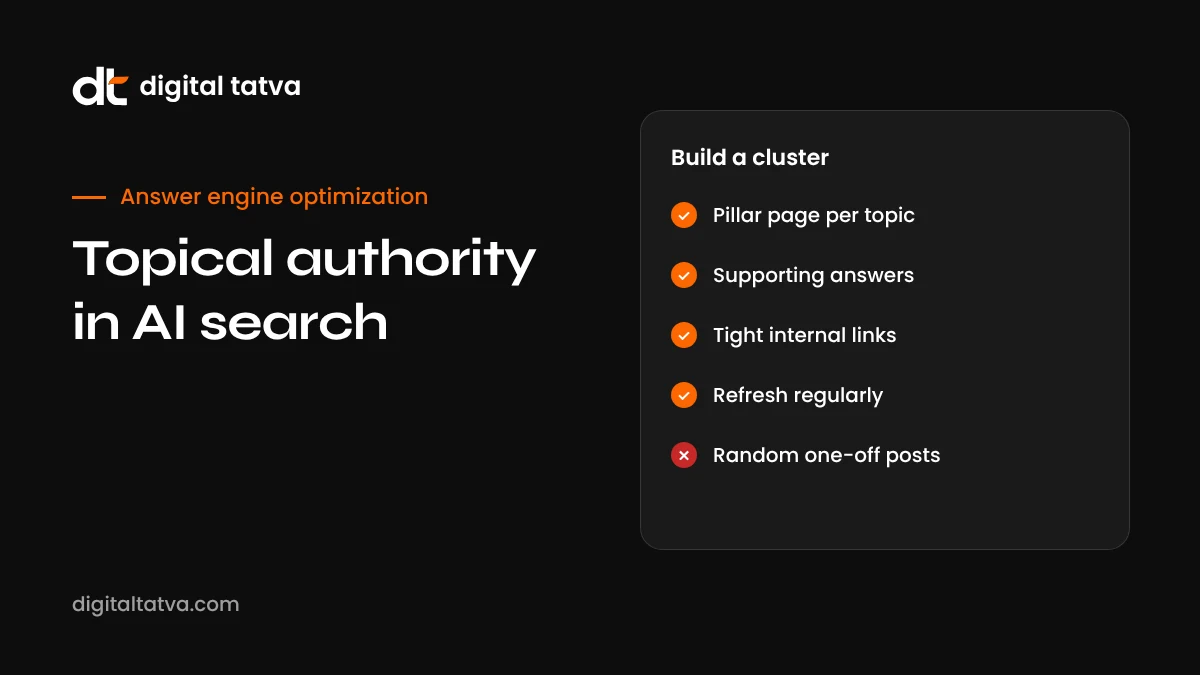
A topic cluster is a group of pages built around one subject. It has three parts:
| Part | Role | Example for “employee payroll in India” |
|---|---|---|
| Pillar page | Covers the whole subject at a high level and links to everything | Complete guide to payroll in India |
| Supporting pages | Answer important sub-questions in depth | PF contributions explained, TDS on salary, payslip format, payroll software comparison |
| Internal links | Connect pillar and supporting pages in both directions | Each supporting page links to the pillar and to related supporting pages |
Our own blog uses clusters. For example, our guide to what AEO is sits at the centre of a cluster that includes AEO vs SEO, AEO strategy, AEO audits and many more.
How to build topical authority step by step
Step 1: Choose topics you can genuinely own
Pick subjects that match your expertise and your business. A topic you can speak about with real experience is easier to cover well and more useful commercially. Smaller businesses should go narrow: “AEO for Indian SaaS companies” is far easier to own than “digital marketing”.
Step 2: Map the questions
List every important question someone researching the topic would ask, from beginner to expert. Use:
- AI answers and the sources they cite.
- Google People Also Ask boxes and related searches. See People Also Ask optimization.
- Sales calls, support tickets and customer emails.
- Forums and communities in your industry.
- Keyword research tools. See our list of the best keyword research tools.
Our guide to AEO prompt research explains how to turn these into a structured list.
Step 3: Group questions into pages
Closely related questions belong on the same page. Big sub-topics that need long answers deserve their own page. A good rule: if a sub-topic could fill 1,500 words of genuinely useful content, give it a page. If not, make it a section.
Step 4: Write the pillar page
The pillar should answer the main question directly, introduce each sub-topic briefly, and link to the supporting pages. It is a hub and a strong standalone guide at the same time.
Step 5: Write the supporting pages
Each supporting page goes deep on one sub-topic. Use answer-first sections, clear headings, tables and FAQs. Add real experience, data and examples. Our answer-first content guide and content chunking guide explain the writing approach.
Step 6: Link everything properly
Every supporting page should link to the pillar. The pillar should link to every supporting page. Related supporting pages should link to each other where it helps the reader. Use descriptive anchor text, such as “PF contribution rates”, rather than “click here”. Our internal linking guide for AEO has a full process.
Step 7: Add evidence and expertise
Named authors, original data, screenshots, case examples and expert review all strengthen the cluster. See E-E-A-T for AI search.
Step 8: Earn external references
Authority grows when others reference your cluster. Share your best pages, pitch your data to publications, answer questions in communities, and build relationships in your industry. See brand mentions for AEO.
Step 9: Keep it fresh
Review the cluster every few months. Update facts, add new sub-topics as the field changes, and merge or remove pages that are outdated or overlapping. Our content refresh guide gives a routine.
How many pages does a cluster need?
There is no magic number. A focused cluster might have one pillar and six supporting pages. A broad, competitive topic might need thirty or more. What matters is that the important questions are answered well. Here is a rough guide:
| Topic scope | Typical cluster size | Example |
|---|---|---|
| Narrow, niche topic | 1 pillar plus 4 to 8 pages | AEO for dental clinics |
| Medium topic | 1 pillar plus 10 to 20 pages | AI tools for real estate agents |
| Broad, competitive topic | 1 pillar plus 25 or more pages, often with sub-clusters | Answer engine optimization |
Topical authority mistakes to avoid
- Publishing many thin pages. Twenty 400-word posts that say the same thing add little. Depth and usefulness matter more than count.
- Keyword cannibalisation. Several pages competing for the same question confuse search engines. Combine them or give each a distinct angle.
- Straying off-topic. Publishing unrelated content to chase traffic can dilute what your site is known for.
- Orphan pages. Supporting pages with no links to them are hard to find and do not strengthen the cluster.
- Never updating. A cluster built in 2023 and never touched will lose to fresher sources on changing topics.
- Mass AI content without expertise. Generic AI-written clusters lack the experience signals that build trust.
How to measure topical authority
There is no official topical authority score, but you can track meaningful signals:
| Signal | Where to measure | What good looks like |
|---|---|---|
| Keywords ranking across the topic | Search Console, rank tracking tools | Growing number of related queries with impressions |
| AI citations for topic questions | Prompt tracking across AI engines | Your pages cited for more sub-questions over time |
| Brand mentions for the topic | AI answers, media monitoring | AI describes you as a specialist in the topic |
| External links and references | Backlink tools | Links from relevant, respected sites to cluster pages |
| Engagement | GA4 | Visitors moving between cluster pages |
For AI-specific measurement, see AI share of voice and AEO KPIs.
Topical authority for small businesses
Smaller businesses often assume big brands always win. In topic-focused AI search, that is not necessarily true. A specialist with deep, practical content on a narrow subject can be cited ahead of a large generalist that covers the subject in one thin page.
A practical plan for a small business:
- Pick one topic that matches your best service and your customers’ biggest questions.
- Write one excellent pillar page.
- Add one supporting page every two weeks for three months.
- Link everything properly and keep your Google Business Profile and directory listings aligned with the topic.
- Track a set of AI prompts monthly and expand to a second topic once the first is established.
Our guides to AEO for local businesses and AEO for startups give more tailored plans.
Real example: building a cluster around one service
Suppose you run a bookkeeping firm for online sellers in India. Instead of writing about “accounting” in general, you might build a cluster like this:
- Pillar: Bookkeeping for Amazon and Flipkart sellers in India: complete guide
- Supporting: GST for online sellers, TCS on marketplace sales, reconciling marketplace settlements, inventory accounting for ecommerce, best accounting software for online sellers, monthly bookkeeping checklist, common mistakes sellers make with GST returns.
Each supporting page answers a question sellers actually ask. Together they make the firm the obvious specialist. When a seller asks ChatGPT or Gemini “how do I handle TCS on Amazon sales”, there is a strong chance a passage from this cluster is relevant. And when they ask “who can help with bookkeeping for my Amazon store”, the firm is clearly associated with the topic.
How to write a strong pillar page
The pillar page carries more weight than any other page in a cluster, so it deserves extra care. A good pillar page does four jobs at once: it answers the main question fully, it introduces every important sub-topic, it routes readers to the right supporting page, and it stands alone as the best overview on the web for that subject.
A practical structure that works for most topics:
- Quick answer. Two to four sentences that answer the main question directly.
- Key takeaways. Five or six bullet points that summarise the guide.
- Definition and context. What the topic is, why it matters now and who it matters for.
- Sub-topic sections. One section per major sub-topic, each with a short answer and a link to the supporting page for depth.
- Comparison or decision table. Help readers choose between options.
- Step-by-step process. How to get started.
- Common mistakes. What to avoid.
- FAQ. Short answers to follow-up questions.
Avoid turning the pillar into a list of links. Each section should deliver real value on its own, with the link as an invitation to go deeper.
Supporting pages that actually support
A supporting page earns its place by answering one important sub-question better than anything else available. Some signs of a strong supporting page:
- It has a clear, specific focus that would not fit as a short section in the pillar.
- It includes detail the pillar cannot: examples, data, step-by-step instructions, edge cases.
- It links back to the pillar near the top and again at the end.
- It links sideways to two or three closely related supporting pages.
- It is written or reviewed by someone with real experience of that sub-topic.
Weak supporting pages are often too similar to each other. If two pages answer nearly the same question, merge them and redirect the weaker URL. That concentrates authority and avoids confusing search engines and AI systems.
Anchor text and link placement
Internal links tell machines how your pages relate. A few rules keep them useful:
| Practice | Good example | Weak example |
|---|---|---|
| Descriptive anchors | “how to calculate PF contributions” | “read more” |
| Contextual placement | Link inside the sentence that mentions the topic | A long list of links at the bottom only |
| Varied but accurate wording | “PF rates”, “employee provident fund guide” | The same exact phrase on every page |
| Reasonable number | Links where they genuinely help the reader | Dozens of links in every paragraph |
Our internal linking guide for AEO covers audits and fixes in more depth.
Topical authority beyond your website
Topical authority is not built only on your own domain. AI systems also learn what you are known for from what appears elsewhere:
- Guest articles and expert quotes on your topic in respected publications.
- Talks, podcasts and webinars that are transcribed or summarised online.
- Professional profiles that list your specialities clearly. See LinkedIn for AEO.
- Community answers on forums and Q&A sites. See Reddit for AEO.
- Video content that explains your topic. See YouTube for AEO.
When the same expert or brand shows up repeatedly across these places on the same subject, the association becomes strong. That is often what tips an AI recommendation in your favour.
Keeping a cluster healthy over time
Clusters decay if left alone. Facts go out of date, new sub-topics appear, and competitors publish better answers. A light maintenance routine keeps your authority intact:
- Monthly: check AI answers for your top cluster questions and note any new sources being cited.
- Quarterly: refresh the pillar page and the three most visited supporting pages; update dates and facts.
- Twice a year: review the question map, add pages for new sub-topics and merge or retire weak pages.
- After major updates: when Google runs a core update, review which cluster pages gained or lost and why. See our guide to the November 2026 core update.
How Digital Tatva can help
We map the questions in your category, design topic clusters around the services that matter most to your business, and help you write and link them in a way AI systems can use. We then track how often your pages are cited for topic questions across ChatGPT, Gemini, Perplexity, Copilot and Google AI. We cannot promise any AI system will cite you, but we can build the depth and structure that make you a natural choice.
Want a topic cluster plan for your business? Request an AEO audit and we will map the questions you need to own, or start with our free AI visibility checker.
Topical authority and AI recommendations
There is an important difference between being cited and being recommended. A strong cluster makes your pages likely to be cited as sources of information. Being recommended as a provider also requires evidence from outside your site: reviews, lists, comparisons and coverage that associate your brand with the topic.
The best clusters connect the two. They include pages that naturally attract references, such as original data, free tools and genuinely useful guides, so that the expertise on your site turns into mentions elsewhere. Over time, AI systems see both your depth and the independent confirmation, and recommendations follow more easily. See how to get cited by AI for practical tactics.
Using AI tools to plan clusters, carefully
AI assistants are useful for brainstorming cluster ideas. Ask them to list the questions someone would need answered to understand your topic, or to group a list of keywords into themes. Then apply judgment:
- Check suggestions against real data from Search Console, People Also Ask and customer conversations.
- Remove questions that are irrelevant to your business or audience.
- Add questions only your customers ask, which no AI will suggest.
- Prioritise by business value, not just by how interesting a question is.
AI can help with the map. The territory still needs your expertise.
A topical authority checklist
- One clearly defined topic that matches your expertise and business.
- A question map covering beginner to advanced questions.
- A pillar page that answers the main question and links to every supporting page.
- Supporting pages for each major sub-topic, written with real experience.
- Descriptive internal links between all cluster pages.
- Named authors, evidence and sources on every page.
- External mentions and references on the same topic.
- A refresh routine and monthly AI prompt tracking.
Frequently asked questions
What is topical authority in SEO?
It is how strongly search engines see your website as an expert source on a specific subject, based on how thoroughly and accurately you cover it and how others reference you on it.
How do I build topical authority?
Choose a topic you know well, map the questions people ask, create a pillar page and supporting pages that answer them in depth, link the pages together, add evidence and expertise, and keep them updated.
Does topical authority matter for AI search?
Yes. AI search engines split questions into sub-searches and prefer sources that answer many of them well, so topical depth increases your chances of being cited.
How many articles do I need for topical authority?
It depends on the topic. A narrow topic may need a pillar and five to eight supporting pages; a broad, competitive topic may need many more. Quality and coverage matter more than count.
What is a pillar page?
A pillar page is a comprehensive guide to a main topic that introduces each sub-topic and links to detailed supporting pages.
Can a small website build topical authority?
Yes. Narrow, deep coverage of a specific topic can let a small site compete with large generalist sites, especially in AI answers.
How long does it take to build topical authority?
Usually several months. Expect early signs in rankings and AI citations within two to three months of consistent publishing, with stronger results over six to twelve months.
Can Digital Tatva build a topic cluster for us?
Yes. We plan and help build topic clusters as part of our AEO service, tied to the questions your buyers ask AI.
How many articles do I need for topical authority?
There is no fixed number. Focus on covering the important questions in your topic thoroughly and linking them logically, rather than chasing a target count.
Can a small site build topical authority?
Yes. Small sites that go deep on a narrow topic often outperform larger sites with shallow coverage.
Product details, prices and features are checked at the time of writing and can change. Sources are linked in the text so you can check them yourself.
How does your brand appear in AI answers?
We test the questions your buyers ask across the major AI assistants and search engines, then show you what to fix first.
Get an AI Visibility Audit