Google November 2026 Core Update: What It Is and What to Do Now
Google started the November 2026 core update on 10 November. Here are the dates, how it overlaps with Black Friday, how to read your data and what to do if rankings or AI visibility change.
On this page
- Key takeaways
- What is the November 2026 core update?
- Key dates at a glance
- How it fits into 2026
- What Google has and has not said
- Why the Black Friday timing matters
- What to do during the rollout
- How to analyse the impact after it completes
- What to do if you lost visibility
- What to do if you gained
- How core updates affect AI Overviews and AI Mode
- A simple post-update checklist
- How Digital Tatva can help
- Frequently asked questions
Last updated: 12 November 2026
Quick answer: Google began rolling out the November 2026 core update on 10 November 2026 at about 10:06 a.m. Pacific time. It applies globally and to all languages, and Google says it may take up to two weeks, which points to completion around 24 November, just before Thanksgiving and Black Friday. It is the third core update of 2026. Google describes it as a regular update to better surface relevant, satisfying content, and it does not target specific sites. Do not make big changes mid-rollout. Wait until it completes, compare a full week afterwards with the week before 10 November, and adjust for holiday traffic before drawing conclusions.
Key takeaways
- Start: 10 November 2026. Expected window: up to two weeks, ending around 24 November.
- It is the third core update of 2026, after the March and May updates.
- Google named no specific systems, content types or industries.
- The post-rollout comparison week overlaps with Thanksgiving, Black Friday and Cyber Monday, so retailers need to adjust for seasonality.
- Core updates can also shift which pages appear as sources in AI Overviews and AI Mode, so track AI visibility alongside rankings.
What is the November 2026 core update?
A core update is a broad change to the main systems Google uses to rank search results. Unlike spam updates, which target specific tactics, core updates reassess how well pages meet searchers’ needs across the whole index. Some pages rise, some fall and many stay the same.
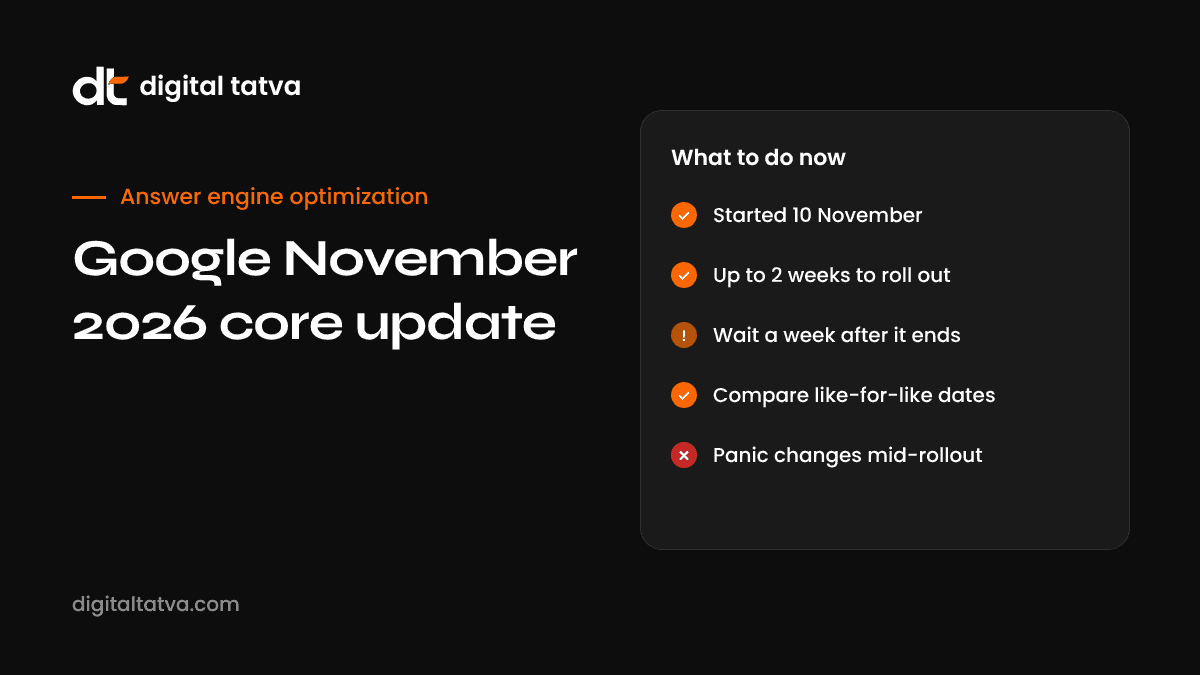
Google confirmed the November 2026 core update on its Search Status Dashboard, noting that it “applies globally and to all languages” and “may take up to 2 weeks to complete”. On LinkedIn, Search Central described it as “a regular update designed to better surface relevant, satisfying content”. At the time of writing, there was no Search Central blog post with further detail.
Key dates at a glance
| Event | Date |
|---|---|
| Rollout starts | Tuesday 10 November 2026, about 10:06 a.m. PT |
| Expected end of window | Around Tuesday 24 November 2026 |
| Thanksgiving (US) | Thursday 26 November 2026 |
| Black Friday | Friday 27 November 2026 |
| Cyber Monday | Monday 30 November 2026 |
| Earliest clean comparison point | About 1 December 2026, one full week after completion |
The two-week window is Google’s estimate. Recent rollouts have ranged from under a week to well over two weeks, so treat 24 November as a guide rather than a deadline.
How it fits into 2026
| Update | Dates | Duration |
|---|---|---|
| March 2026 core update | 27 March to 8 April | 12 days, 4 hours |
| May 2026 core update | 21 May to 2 June | 11 days, 21 hours |
| June 2026 spam update | 24 to 26 June | 2 days, 1 hour |
| August 2026 spam update | 18 to 21 August | 2 days, 16 hours |
| September 2026 spam update | 24 September to 8 October | 13 days, 16 hours |
| November 2026 core update | From 10 November | Up to 2 weeks (expected) |
The gap since the May core update is 173 days, longer than the gap between March and May. Confirmed core updates have become less frequent over the past few years, which means each one tends to carry more accumulated change.
What Google has and has not said
Google has said very little, which is normal for core updates. What we know:
- It applies to all countries and all languages.
- It is not aimed at specific sites or pages.
- It is meant to keep Google’s ranking systems current and surface relevant, satisfying content.
- Google will update its ranking release history when the rollout finishes.
What Google has not said: which ranking systems changed, which content types or industries are most affected, or whether the update involves AI Overviews or AI Mode specifically. Anyone claiming to know the exact targets this early is guessing.
Google’s general guidance on core updates still applies. Its documentation (last revised in December 2025) asks site owners to focus on helpful, reliable, people-first content. In 2026, Google also updated its helpful content guidance with sections on main content and warned against deceptive authorship information, and it said AI-generated content should be fact-checked and reviewed by people. Those updates are a reasonable signal of where Google’s attention sits.
Why the Black Friday timing matters
For retailers, this is awkward timing. If the rollout runs its full two weeks, rankings will be shifting until two days before Thanksgiving. And Google’s advice to compare a full week after completion with the week before the rollout means your “after” week will be Thanksgiving week, the busiest shopping period of the year.
That creates two risks:
- False alarms. A ranking drop on a product category could be hidden by the holiday traffic surge, and you might not notice until December.
- False confidence. A traffic jump during Black Friday week could look like an update win when it is just seasonal demand.
The fix is to compare like with like. Use the same days last year as a second baseline, look at average position and impressions as well as clicks, and segment by page type so seasonal pages do not distort the picture. If you also want to protect holiday visibility in AI search, read our guide to holiday AEO for Black Friday.
What to do during the rollout
The most useful thing to do during a rollout is to watch, not react.
- Avoid big structural changes. Site migrations, URL changes, mass deletions or large rewrites during a rollout make it impossible to know what caused a change.
- Annotate your analytics. Mark 10 November in GA4 and in your reporting tools so everyone reads the data in context.
- Keep normal publishing going. Planned content and holiday pages can go live as usual.
- Watch, but do not over-read, daily volatility. Rankings often move up and down several times during a rollout before settling.
- Be careful with rank trackers. Some trackers have reported unreliable results pages this autumn, so check movements in Search Console before acting.
How to analyse the impact after it completes
1. Confirm the timing
Check that your traffic change lines up with the rollout dates. A drop that started on 3 November is not this update. Use Search Console’s Performance report with a daily view and compare it with the dashboard dates.
2. Compare the right periods
Compare at least one full week after completion with the week before 10 November. For seasonal businesses, add a year-over-year comparison for the same dates. Look at clicks, impressions and average position together.
3. Find what moved
Export pages and queries that gained and lost. Group them by template (product, category, blog, guide, location page) and by topic. Patterns matter more than individual URLs.
4. Compare with who gained
For your biggest losing queries, look at which pages now rank above you. Ask honestly what they do better: more first-hand experience, clearer answers, better evidence, more up-to-date information or a better page experience.
5. Check AI surfaces too
Search Console now includes AI Overviews and AI Mode in its reporting. A page can keep its blue-link ranking but stop being cited in an AI Overview, or the reverse. Our guide to the Search Console AI performance report shows how to read these numbers, and our AI Overviews optimization guide covers how to earn citations.
What to do if you lost visibility
Google’s long-standing position is that a drop after a core update does not mean a site broke a rule. It means other pages were judged more useful for those queries. That makes recovery about improvement, not fixing a penalty.
| Symptom | Likely cause | What to try |
|---|---|---|
| Thin category or listing pages dropped | Little unique value beyond a product grid | Add buying guidance, comparisons, FAQs and original images |
| Blog posts lost to forums and experts | Generic content without first-hand experience | Add tested results, author expertise and specific examples |
| Older guides slipped | Outdated facts, prices or screenshots | Refresh with current information and a visible updated date |
| Comparison or affiliate pages fell | Similar to many other pages, limited proof | Show testing method, real data and clear recommendations |
| Whole site dropped evenly | Broad trust or quality signals | Audit authorship, about pages, reviews and content quality site-wide |
Some practical rules:
- Do not delete large amounts of content in a panic. Improve or consolidate it carefully.
- Do not disavow links by default. Links are rarely the cause of a core update drop.
- Do not buy “recovery” services that promise fast results. Core update recovery usually takes months and often shows up at the next core update.
- Do fix clear quality problems now, so the improvements are in place before Google reassesses.
Our content refresh guide gives a step-by-step process that works for both Google rankings and AI citations.
What to do if you gained
Gains after a core update are worth protecting. Note which pages and templates improved and why you think they did. Keep those pages current, avoid unnecessary changes to them during the holiday period, and use what you learned to improve weaker pages in the same style.
How core updates affect AI Overviews and AI Mode
Google has not said that this update changes AI Overviews or AI Mode directly. But AI Overviews now appear on a large share of Google searches, and they cite pages drawn from Google’s ranking systems. When a core update changes which pages Google trusts for a topic, the sources cited in AI answers often change too.
That makes AI visibility a second scoreboard to watch. Track:
- Which of your pages are cited in AI Overviews for your key queries, before and after.
- Whether competitors have replaced you as a cited source.
- Click-through from AI Overviews and AI Mode in Search Console.
Our guide to AI Mode vs AI Overviews explains how the two surfaces differ, and the Google AI optimization guide covers the full approach.
A simple post-update checklist
- Annotate 10 November and the completion date in analytics.
- Wait until Google confirms completion.
- Wait one more full week, then compare with the week before 10 November and with the same dates last year.
- Export winning and losing pages and queries, grouped by template and topic.
- Review the pages that replaced you and note what they do better.
- Check AI Overview and AI Mode citations for your top queries.
- Prioritise improvements on high-value pages first.
- Re-measure monthly, and again after the next core update.
How Digital Tatva can help
We help businesses understand ranking and AI visibility changes and turn them into a clear plan. That includes separating update effects from seasonal noise, finding which page types moved, checking how AI Overviews and AI Mode now cite you and prioritising the fixes most likely to matter. We do not promise recoveries or rankings, because no one controls Google’s systems, but we can make sure your effort goes where the evidence points.
Not sure how the update affected you? Request an AEO audit for a review of your Google rankings and AI visibility, or run our free AI visibility checker to test AI crawler access today.
Frequently asked questions
When did the Google November 2026 core update start?
Google started the rollout on 10 November 2026 at about 10:06 a.m. Pacific time, according to the Google Search Status Dashboard.
How long will the November 2026 core update take?
Google says it may take up to two weeks, which suggests completion around 24 November 2026. Actual rollouts can run shorter or longer.
Is this the third core update of 2026?
Yes. It follows the March 2026 and May 2026 core updates.
Which sites does the November 2026 core update target?
Google says core updates do not target specific sites or pages. It has not named any industries, content types or systems for this update.
Should I make changes during the rollout?
Avoid major structural changes until the rollout completes. Normal publishing is fine, but wait for the update to finish and settle before diagnosing any change.
How do I know if the update affected my site?
Compare a full week after completion with the week before 10 November in Search Console, then check whether changes line up with the rollout dates. Retailers should also compare with last year’s holiday dates.
Can I recover from a core update drop?
Often, yes, but it takes time. Improve the usefulness, accuracy and expertise of affected pages. Recovery commonly appears gradually or at a later core update.
Does the core update affect AI Overviews?
Google has not said so directly. Because AI Overviews cite pages from Google’s index, changes in which pages Google trusts can change which sources appear in AI answers, so it is worth tracking both.
Product details, prices and features are checked at the time of writing and can change. Sources are linked in the text so you can check them yourself.
How does your brand appear in AI answers?
We test the questions your buyers ask across the major AI assistants and search engines, then show you what to fix first.
Get an AI Visibility Audit