ChatGPT Business Hub: How to Claim Your Business in ChatGPT
OpenAI is reportedly testing a "Claim your business in ChatGPT" hub with mention and click charts. Here is what is confirmed, what is only reported, and how to prepare your business now.
On this page
- Key takeaways
- What is the ChatGPT Business Hub?
- What is confirmed and what is only reported
- Reported features in detail
- How it compares with tools you already know
- Who will be able to use it?
- Why this matters for answer engine optimization
- How to prepare your business now
- A preparation checklist
- How the hub relates to ChatGPT ads and Sponsored Agents
- Questions still unanswered
- What this means for ecommerce brands
- What this means for service businesses
- How Digital Tatva can help
- Frequently asked questions
Last updated: 12 November 2026
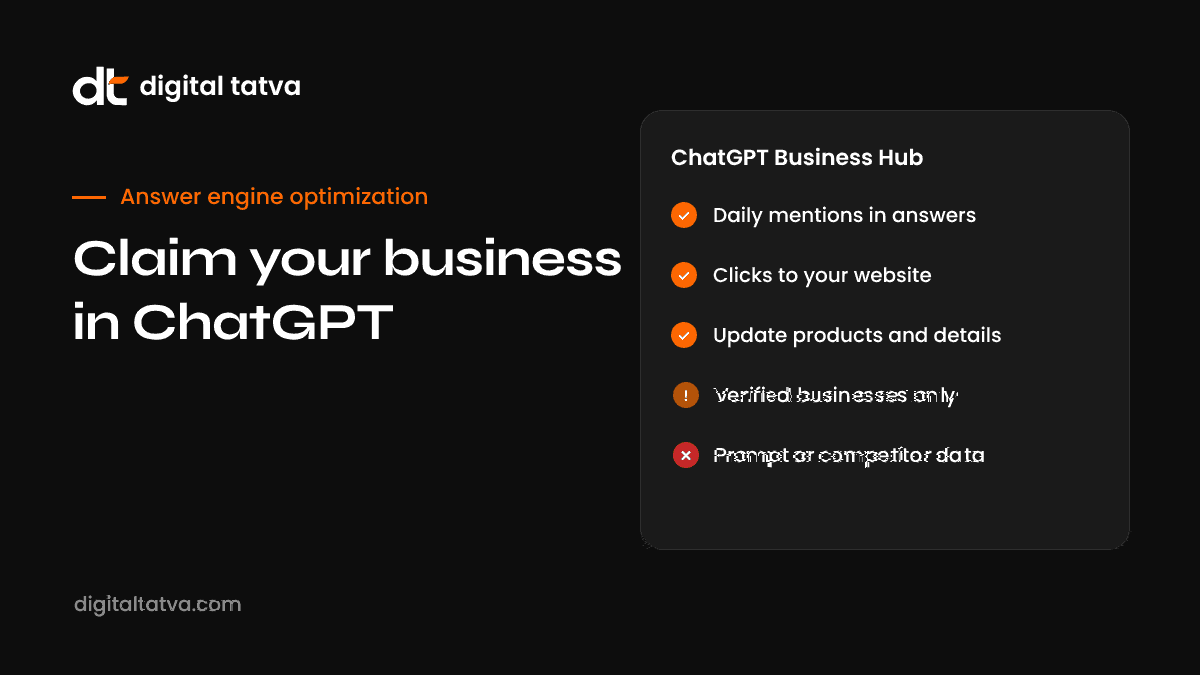
Quick answer: ChatGPT Business Hub is the name used for a reported OpenAI tool that would let verified businesses “claim” their presence in ChatGPT. Screenshots shared on 6 November 2026 show a page titled “Claim your business in ChatGPT” with a chart of daily impressions (how often the business appears in answers) and clicks to its website, plus a place to keep products and business information up to date. OpenAI has not announced it, so features, name and timing could change. The safe move today is to prepare: clean product and business data, consistent facts across the web, and a baseline of your current ChatGPT visibility and referral traffic.
Key takeaways
- The Business Hub is reported, not launched. It was spotted in testing and OpenAI has not commented.
- Reported features include mention tracking, an impressions and clicks chart, a business listing and a business agent that answers customer questions.
- The only verification route seen so far is connecting a Shopify store.
- It reportedly shows no prompt data, no user data and no competitor comparison, so it will not explain why your visibility changes.
- You can prepare now by fixing your data, tracking ChatGPT referrals in GA4 and running your own prompt monitoring.
What is the ChatGPT Business Hub?
For two years, businesses have asked the same question: how do I show up in ChatGPT, and how do I know if I do? Google has Search Console and Google Business Profile. Bing has Webmaster Tools. ChatGPT, with hundreds of millions of weekly users asking for product and service recommendations, has offered businesses almost nothing comparable.
The ChatGPT Business Hub looks like OpenAI’s first answer to that gap. Based on what has been reported, it is a dashboard for verified businesses that combines three ideas:
- A claimed business presence, similar in spirit to claiming a Google Business Profile, where a company confirms it owns its brand and keeps core information current.
- Visibility analytics, showing how often ChatGPT mentions the business in answers and how many people click through to its website.
- Business-controlled context, including up-to-date products and an agent that can answer customer questions using information the business supplies.
The phrase “Business Hub” is a working label used in coverage. The only product name actually seen on screen is the banner text “Claim your business in ChatGPT”.
What is confirmed and what is only reported
Because this feature is so relevant to anyone working on answer engine optimization, it is easy to treat early sightings as facts. Here is the honest split as of 12 November 2026.
| Item | Status | Detail |
|---|---|---|
| Official announcement | Not confirmed | OpenAI has not announced or commented on the feature. |
| Existence of a test | Reported | Juozas Kaziukėnas, founder of Marketplace Pulse, shared screenshots on LinkedIn on 6 November 2026. |
| Earlier versions | Reported | He said he first saw early versions in August 2026. |
| “Claim your business in ChatGPT” banner | Reported | Seen on 6 November, suggesting the feature may be close to launch. |
| Impressions and clicks chart | Reported | Daily appearances in answers and clicks to the business website. |
| Shopify verification | Reported | Connecting a Shopify store is the only verification method described. |
| Launch date, markets, pricing | Unknown | Nothing has been shared about timing, countries or cost. |
Search Engine Roundtable and PPC Land covered the sighting the same day. Treat every detail below as subject to change until OpenAI publishes documentation.
Reported features in detail
Mention tracking
The headline feature is a count of how often a business is mentioned in ChatGPT conversations. In the screenshots, this appears as daily impressions, meaning the number of times the business showed up in a response. That would be the first first-party measure of ChatGPT visibility. Today, every brand has to estimate it by running prompts manually or through third-party tools.
Click reporting
The same chart reportedly shows clicks, counted as clicks on links to the business website. You can already see part of this in analytics as referral traffic from chatgpt.com, but a first-party number would close gaps caused by stripped referrers, app traffic and privacy settings.
Business listing
Businesses would be able to add their latest products and keep business information current. For ecommerce brands this matters a great deal: ChatGPT shopping answers often show outdated prices, discontinued products or wrong stock status because they rely on whatever the model last saw.
Business agent
The reports mention a business agent that answers customer questions using context the business controls. Think of it as a brand-approved layer of information ChatGPT can draw on when someone asks about your returns policy, sizes, delivery times or service area.
What it reportedly does not include
- No prompt data. You would not see which questions triggered your mentions.
- No user data about the people who saw or clicked.
- No competitor benchmark or ranking.
- No link to ChatGPT ads. Coverage suggests it targets organic answers, separate from paid formats.
Kaziukėnas put the limitation plainly: the tool will not help you understand why mentions or clicks go up or down. That is an important point we return to below.
How it compares with tools you already know
| Tool | Platform | Shows queries? | Shows impressions and clicks? | Lets you edit business info? |
|---|---|---|---|---|
| ChatGPT Business Hub (reported) | ChatGPT | No (reported) | Yes (reported) | Yes (reported) |
| Google Search Console | Google Search, including AI Overviews and AI Mode | Yes | Yes | No |
| Google Business Profile | Google Search and Maps | Partial (search terms) | Yes (views and actions) | Yes |
| Bing Webmaster Tools AI Performance | Copilot and Bing AI answers | Grounding queries | Citations | No |
| Third-party AEO monitoring tools | Several AI engines | Your chosen prompts | Mentions, not clicks | No |
The Business Hub would fill a real gap, but it would not replace prompt-level monitoring. If you want to know which questions you win and lose, you still need your own prompt set. Our guide to tracking brand mentions in ChatGPT explains how to build one.
Who will be able to use it?
This is the biggest open question. Reports say the hub is limited to verified businesses, and the only verification example is connecting a Shopify store. That points to an ecommerce-first launch, which fits OpenAI’s broader shopping push.
It is not clear whether these businesses will be able to verify at launch:
- Service businesses with no online store, such as agencies, clinics, law firms or consultancies.
- Ecommerce brands on WooCommerce, Magento, BigCommerce or custom platforms.
- Publishers and content sites.
- Local businesses with physical locations.
- Businesses outside the United States.
If OpenAI follows the pattern of most new ChatGPT features, a US launch for a narrow group would come first, with wider access later. Plan for that, but do not wait for it.
Why this matters for answer engine optimization
Answer engine optimization (AEO) is the work of making your brand the one AI assistants mention, cite and recommend. Its biggest weakness has been measurement. Brands invest in content, PR and technical fixes, then struggle to prove the effect inside ChatGPT. A first-party mentions and clicks chart would change that conversation.
Three practical effects are likely:
- Visibility becomes a reported metric. Once ChatGPT impressions sit in a dashboard, leadership teams will ask for them in monthly reports, alongside Google clicks.
- Data accuracy becomes a direct lever. If businesses can feed products and facts into ChatGPT, the brands that keep this data clean will be described correctly more often.
- Verification becomes a competitive edge. Early adopters of Google Business Profile won local search for years. Early, well-maintained ChatGPT business listings may give a similar head start.
None of this guarantees that ChatGPT will recommend a business. Claiming a listing on any platform gives you control over facts, not control over rankings or recommendations.
How to prepare your business now
You do not need access to the hub to start. Everything below improves your ChatGPT visibility today and puts you in a strong position if and when the hub opens.
1. Get your product and business data clean
If you sell on Shopify, check that every product has an accurate title, description, price, availability and image, and that your store policies (shipping, returns, contact) are complete. If you are on another platform, the same rules apply to your product feed and structured data. Use Product, Offer and Organization schema so the facts are machine-readable.
2. Make your core facts consistent everywhere
ChatGPT builds its picture of your business from your website, product pages, directories, review sites and press coverage. Mismatched names, addresses, prices or founding dates confuse that picture. Audit your top listings and fix differences. Our guide to entity SEO for AEO covers how to make your brand a clear, consistent entity.
3. Make sure ChatGPT can reach your site
Check that your robots.txt and firewall allow OAI-SearchBot, the crawler ChatGPT search uses, and that key pages load without heavy JavaScript. The ChatGPT indexing guide and our AI crawlers list explain what to allow.
4. Set up a referral baseline in GA4
Create a channel group or exploration that isolates traffic from chatgpt.com and other AI assistants. Record sessions, conversions and revenue each month. If the hub launches, you will be able to compare its click numbers with your own and spot gaps. See how to track AI traffic in GA4.
5. Start prompt monitoring
Build a list of 20 to 50 real buyer questions in your category and check them monthly in ChatGPT. Record whether you are mentioned, how you are described, who else is named and which sources are cited. This tells you why your numbers change, which the hub reportedly will not.
6. Strengthen the sources ChatGPT cites
When ChatGPT searches the web, it leans on review sites, comparison articles, forums and trusted publications. Being present and well reviewed on those sources is still the strongest driver of mentions. Read review sites for AEO and how to get cited by AI for a plan.
7. Write answer-first content
Pages that answer a specific question clearly in the first lines, then expand with detail, are easier for AI systems to quote. Our answer-first content guide shows the format.
A preparation checklist
| Area | Action | Owner |
|---|---|---|
| Store data | Complete titles, prices, stock and policies for every product | Ecommerce team |
| Structured data | Product, Offer, Organization and FAQ schema validated | Developer or SEO |
| Crawler access | OAI-SearchBot allowed in robots.txt and firewall | Developer |
| Brand facts | Name, address, contact and key claims consistent on top 20 listings | Marketing |
| Analytics | AI referral channel in GA4 with monthly baseline | Analytics |
| Monitoring | 20 to 50 buyer prompts tracked monthly | SEO or AEO lead |
| Reviews | Active review collection on the platforms ChatGPT cites in your category | Customer team |
How the hub relates to ChatGPT ads and Sponsored Agents
OpenAI is building several commercial surfaces at once. ChatGPT ads started rolling out in 2026, and OpenAI began testing Sponsored Agents with select US advertisers on 16 September 2026. Coverage of the Business Hub says it appears separate from ads and aimed at organic answers. That separation matters: paying for ads should not, on OpenAI’s stated principles, change organic answers. If you are weighing paid options, our guide to ChatGPT ads covers what is available.
It is also worth separating the Business Hub from ChatGPT Business, which is OpenAI’s existing workplace subscription for teams. The names are similar, but they are different products for different purposes.
Questions still unanswered
- How an impression is defined, including whether repeat mentions in one conversation count once or several times.
- How clicks are attributed when someone copies a link or visits later.
- Whether data can be exported or accessed by API.
- How long data is kept and whether historical data will be available.
- Whether it will cost anything.
- Which countries and languages it will support.
We will update this guide when OpenAI publishes official details.
What this means for ecommerce brands
Ecommerce brands are likely to be first in line, given the Shopify verification route. They are also the brands most exposed to ChatGPT shopping answers. Shoppers increasingly ask ChatGPT for gift ideas, product comparisons and the best option under a price. If ChatGPT shows an old price or misses your newest range, you lose the sale before the shopper ever reaches your site.
Our AEO for ecommerce guide covers product page structure, feeds and review strategy in depth. If the hub launches with product editing, the brands that already follow those practices will need the least work to benefit.
What this means for service businesses
If you run a service business, you may not be able to verify at launch. That does not make the hub irrelevant. The underlying signals that drive ChatGPT mentions, such as clear service pages, consistent business facts, third-party reviews and expert content, are the same ones any future listing would draw on. Work on them now and you will be ready whichever verification routes OpenAI adds.
How Digital Tatva can help
We help businesses measure and improve how AI assistants describe them. That starts with a baseline: which prompts mention you, which competitors appear instead, which sources are cited and how much AI traffic you already receive. From there we fix the data, technical and content gaps that hold you back. We cannot guarantee that ChatGPT will mention or recommend any business, and nobody honestly can, but we can make sure your brand is accurate, accessible and well supported wherever AI looks.
Want to be ready before the Business Hub launches? Request an AEO audit for a measured baseline of your brand in ChatGPT and other AI engines, or run our free AI visibility checker to test AI crawler access in a minute.
Frequently asked questions
What is ChatGPT Business Hub?
It is the name used for a reported OpenAI tool that would let verified businesses claim their presence in ChatGPT, see how often they are mentioned and clicked, and keep products and business information up to date. OpenAI has not officially announced it.
Can I claim my business in ChatGPT today?
Not publicly. The “Claim your business in ChatGPT” page was seen in testing in November 2026. There is no public sign-up as of 12 November 2026.
How will businesses verify ownership?
The only method reported so far is connecting a Shopify store. Other verification routes may be added, but none have been described.
Will the Business Hub show which prompts mention my brand?
Reportedly not. Coverage says it shows impressions and clicks without prompt data, user data or competitor comparisons.
Will claiming my business make ChatGPT recommend me?
There is no indication of that. A claimed listing would give you control over your facts and products, not over whether ChatGPT recommends you. Recommendations still depend on relevance, reputation and the sources ChatGPT trusts.
Is the Business Hub the same as ChatGPT ads?
No. Reports say it is separate from ads and focused on organic answers. ChatGPT ads and Sponsored Agents are paid formats.
How can I measure ChatGPT visibility before the hub launches?
Track a fixed set of buyer prompts in ChatGPT each month and isolate chatgpt.com referral traffic in GA4. Together they show what ChatGPT says about you and whether it sends visitors.
Can Digital Tatva help me prepare?
Yes. Our AEO audit gives you a baseline of AI visibility and a prioritised list of data, technical and content fixes, so you are ready whenever OpenAI opens access.
Product details, prices and features are checked at the time of writing and can change. Sources are linked in the text so you can check them yourself.
How does your brand appear in AI answers?
We test the questions your buyers ask across the major AI assistants and search engines, then show you what to fix first.
Get an AI Visibility Audit