ChatGPT Ads: How Advertising in ChatGPT Works for Brands
How ChatGPT ads work in 2026: who sees them, CPM and CPC bidding, the self-serve Ads Manager, privacy rules, banned categories and how brands should test their first campaign.

On this page
- Key takeaways
- What are ChatGPT ads?
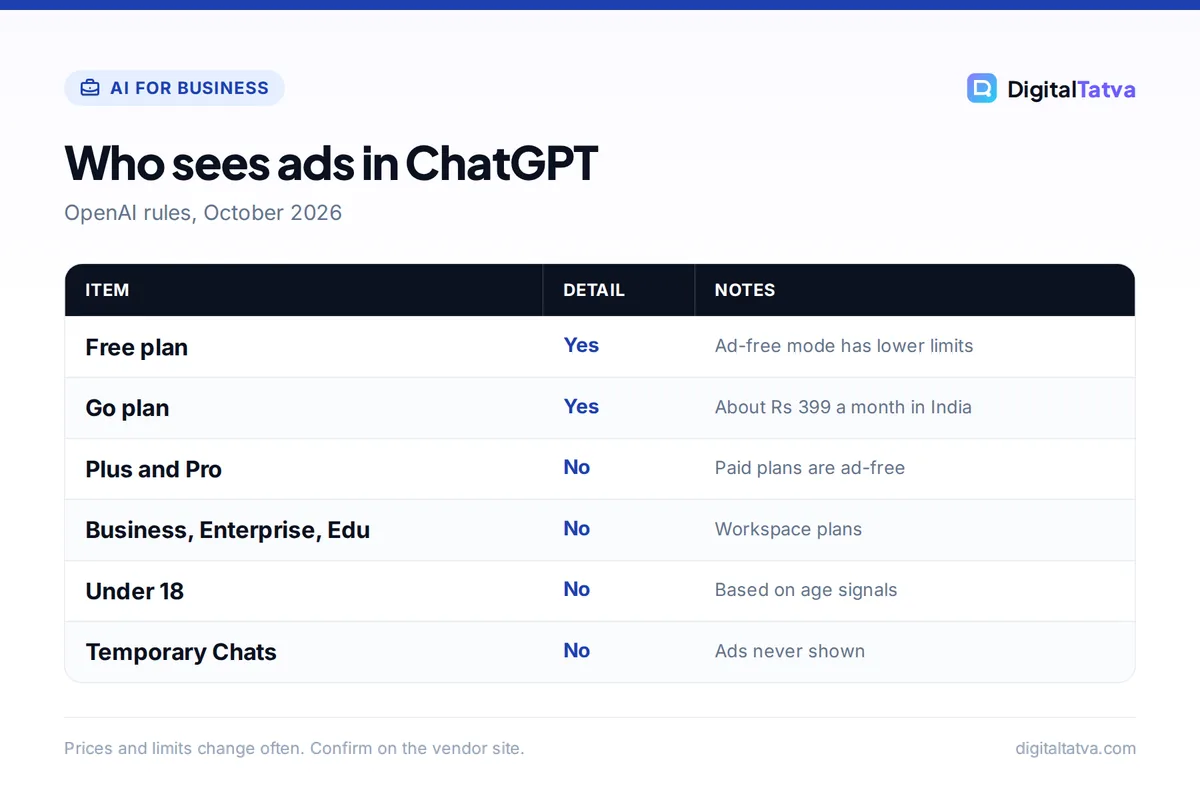
- Who sees ads in ChatGPT?
- How ChatGPT ads work for advertisers
- Privacy rules: what advertisers can and cannot see
- What is not allowed in ChatGPT ads
- How to prepare your first ChatGPT ad campaign
- Paid ads vs organic visibility in ChatGPT
- Is advertising on ChatGPT worth it?
- Frequently asked questions
- Next steps for brands
ChatGPT ads are sponsored placements that appear below ChatGPT’s answers for logged-in Free and Go users, while paid Plus, Pro, Business, Enterprise and Edu accounts stay ad-free. OpenAI started testing ads in the US on February 9, 2026, added cost-per-click bidding and a self-serve Ads Manager beta for US advertisers in May 2026, and is now testing visual ads inside image generation.
This guide explains how advertising in ChatGPT works for brands, who sees the ads, how targeting and bidding work, what data advertisers get, what is not allowed, and how to prepare a first campaign, plus how to win visibility in ChatGPT without paying for it.
Key takeaways
- Ads appear below the end of a ChatGPT response, clearly labeled as sponsored, and OpenAI says ads do not influence answers.
- Only Free and Go users see ads; under-18 accounts, Temporary Chats and paid plans do not.
- Advertisers can buy on CPM or CPC, through agency partners or a self-serve Ads Manager beta (US advertisers first).
- Brands get aggregated results only, never chats or personal details; no ads run near health, mental health or political conversations.
- Organic visibility in ChatGPT answers (AI SEO or GEO) still matters, because ads only show to part of the audience.
What are ChatGPT ads?
ChatGPT ads are paid placements shown inside the ChatGPT interface. According to OpenAI’s help center, they appear below the end of a response, are labeled as sponsored and are visually separated from the answer. One ad unit can feature one or more products from one or more advertisers. OpenAI states plainly that “Ads do not influence ChatGPT’s answers,” and that seeing an ad does not mean OpenAI endorses the advertiser.
If you are new to the product itself, start with what ChatGPT is and how it works. The idea behind ads is simple: people use ChatGPT to research purchases, compare options and plan trips, and ads appear in those moments, much like shopping ads appear on a search results page. OpenAI describes ads as showing up while users explore options, compare choices and make decisions.
Who sees ads in ChatGPT?
| User type | Sees ads? |
|---|---|
| Free plan (logged in) | Yes, during the rollout |
| Go plan | Yes |
| Plus and Pro | No |
| Business, Enterprise and Edu | No |
| Accounts identified as under 18 | No |
| Temporary Chats | No |
| Logged-out users | Only ads suitable for all audiences |
Free users can also switch to an ad-free mode that comes with lower message limits and reduced tool access. That is a key planning point for brands: the ad audience is mainly free and budget users, which in markets like India is a very large group, since ChatGPT Go costs about Rs 399 a month. See our ChatGPT Free vs Go vs Plus comparison for what each plan includes.
Testing began in the US and is expanding gradually. Personalized ads were not initially offered in the EEA or Switzerland. Always check OpenAI’s Ads Manager availability page for the current list of markets before planning a non-US campaign.
How ChatGPT ads work for advertisers
Buying options
OpenAI first sold ads on a CPM basis (cost per thousand impressions) to a small group of advertisers so it could study demand and delivery. In May 2026 it added cost-per-click (CPC) bidding and opened a self-serve Ads Manager in beta, which US advertisers can sign up for directly. Larger brands can also buy through agency partners Dentsu, Omnicom, Publicis and WPP, or through technology partners including Adobe, Criteo, Kargo, Pacvue and StackAdapt.
Targeting and context
Ads are matched to the conversation. If personalization is on, OpenAI can also use broader signals such as past chats, memory and ad interactions. If a user turns personalization off, ads still use the current chat’s context but not other conversations or ad history.
Measurement
OpenAI offers a Conversions API and pixel-based tracking to measure actions after an ad engagement, such as purchases, leads and sign-ups. In October 2026 it also listed conversion partners Hightouch, LiveRamp and Tealium, and began testing a visual ad format inside image generation with US Free and Go users.
| Element | What we know (October 2026) |
|---|---|
| Placement | Below the end of a response, labeled sponsored |
| Pricing models | CPM and CPC |
| Self-serve | Ads Manager beta for US advertisers |
| Measurement | Conversions API, pixel, aggregated reports |
| New formats | Visual ads in image generation (testing) |
| Minimum spend and typical CPCs | Not published by OpenAI |
Watch out: OpenAI has not published average CPCs, CPMs or minimum budgets. Treat any “average ChatGPT CPC” figure you see online as an estimate, and start with a small test budget you can afford to learn from.
Privacy rules: what advertisers can and cannot see
OpenAI’s rules are strict, and they shape what kind of campaigns work.
- Advertisers get only aggregated, non-identifying data such as total views and clicks.
- Advertisers never get chats, chat history, memories or personal details.
- If a user messages an advertiser through an ad, the advertiser only sees those messages.
- Ad interactions are not added to the user’s memory.
- Users can turn off “Personalize ads”, dismiss ads, see why an ad was shown, and clear ads data in Settings, under Ad Controls.
For users worried about data, our guide Is ChatGPT safe? covers the full privacy controls.
What is not allowed in ChatGPT ads
- No political advertising at the time of writing.
- No ads near sensitive conversations about personal health, mental health or politics.
- Regulated categories such as health and financial services may be eligible but cannot target sensitive conversations.
- Mature content ads are limited to eligible logged-in adults.
Advertisers are also verified before running ads, according to marketers who have signed up.
How to prepare your first ChatGPT ad campaign
- Check eligibility. Confirm your country and category are supported on OpenAI’s Ads Manager pages, or talk to one of the partner agencies.
- Pick conversational intents. List the questions buyers ask before choosing you: “best CRM for a 10 person agency”, “budget laptop for coding”, “weekend trip from Mumbai”. These are the moments ads appear.
- Prepare landing pages. Send clicks to pages that answer the exact comparison question, with clear prices and a strong call to action.
- Install measurement. Set up the pixel or Conversions API so you can track leads and sales, not only clicks.
- Start on a small test. Launch with a limited daily budget, compare CPC and conversion rates with Google Ads and Meta Ads, then scale what works.
- Write helpful copy. Ads sit right under a useful answer, so plain, specific offers beat hype.
Our guides to ChatGPT prompts for marketing and the best AI marketing tools can speed up ad copy and landing page drafts.
Paid ads vs organic visibility in ChatGPT
Ads reach only Free and Go users, and many high-value buyers use Plus or business plans with no ads at all. That is why organic visibility in AI answers, often called generative engine optimization (GEO) or AI SEO, stays important. When ChatGPT searches the web and cites sources, brands with clear, well-structured, trustworthy pages are more likely to be mentioned.
| Approach | Reach | Cost | Control |
|---|---|---|---|
| ChatGPT ads | Free and Go users only | Pay per impression or click | High: you choose copy and budget |
| Organic AI visibility (GEO) | All users, including paid plans | Content and SEO effort | Lower: the model chooses sources |
The strongest plan uses both. Learn the organic side in how to rank in AI search, how to use ChatGPT for SEO and our list of AI SEO tools that track AI visibility.
Is advertising on ChatGPT worth it?
It is worth testing for brands that sell products people research in conversation: software, consumer electronics, travel, education and ecommerce. It is early, though. Digiday reported in October 2026 that measurement gaps were keeping many advertisers at test-level spending seven months after launch. Small businesses with tight budgets should usually get Google and Meta campaigns working well first, then run a modest ChatGPT test. For a broader view of where AI fits a small marketing budget, read AI for small business and AI for marketing agencies.
Pros
- Reach people at the moment they compare options
- Clear sponsored labels build trust
- CPC bidding and conversion tracking available
- Less crowded than search ads, for now
Cons
- Only Free and Go users see ads
- No published benchmarks or minimums yet
- Limited markets during the rollout
- Strict rules on sensitive categories
Frequently asked questions
Does ChatGPT show ads?
Yes. Since February 2026 OpenAI has shown ads to logged-in Free and Go users, starting in the US and expanding gradually. Ads appear below responses and are labeled sponsored. Plus, Pro, Business, Enterprise and Edu accounts do not see ads, and neither do users under 18.
How do I advertise on ChatGPT?
US advertisers can sign up for OpenAI’s self-serve Ads Manager beta, or work with partner agencies such as Dentsu, Omnicom, Publicis and WPP, or tech partners such as Criteo and StackAdapt. You choose CPM or CPC bidding and can track conversions with OpenAI’s pixel or Conversions API.
Do ChatGPT ads change the answers?
OpenAI says ads do not influence ChatGPT’s answers. Ads are shown separately, below the response, with a sponsored label. Organic mentions of brands in answers come from the model and web sources, not from ad spend.
How much do ChatGPT ads cost?
OpenAI has not published average prices or minimum budgets. Ads are bought on CPM or CPC bids, so cost depends on competition for your topics. Start with a small test budget and compare cost per lead with your Google Ads and Meta Ads results.
How do I stop seeing ads in ChatGPT?
Upgrade to Plus or Pro, or switch the Free plan to its ad-free mode, which has lower message limits. You can also turn off ad personalization in Settings under Ad Controls, though ads will still appear, just less tailored to you.
Next steps for brands
If your buyers research in ChatGPT, list the questions they ask, build pages that answer them, set up conversion tracking and run a small CPC test once ads are available in your market. At the same time, invest in organic AI visibility so you appear for paid-plan users too. Ad formats, markets and rules are changing quickly, so confirm current details in OpenAI’s official ads help article before you launch.
Pricing and features are checked at the time of writing and can change. Some links may be affiliate links, which never affect our verdicts.