Will AI Replace Your Job? Jobs at Risk and Jobs That Are Safe
Which jobs will AI replace? See the jobs most at risk, the safest jobs, WEF and India data on AI and employment, new AI roles, and a practical plan to AI-proof your career.

On this page
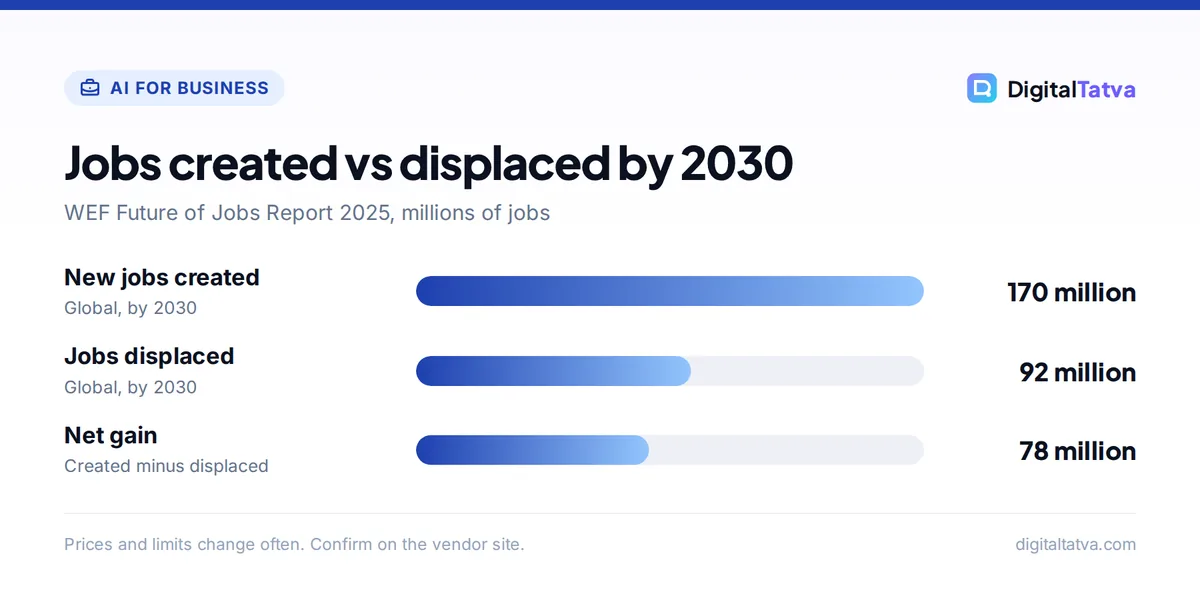
AI is most likely to replace or shrink jobs built on routine, repeatable tasks done at a screen, such as data entry, basic customer support, cashiers, administrative assistants and some entry-level writing and design work, while jobs that need physical skill, human care, judgment and relationships, such as nursing, skilled trades and teaching, are the safest. The World Economic Forum’s Future of Jobs Report 2025 expects 170 million new jobs and 92 million displaced by 2030, a net gain of 78 million, so for most people the real change is that AI reshapes jobs rather than ends them.
This guide lists the jobs most at risk, the jobs that are safest, what the data says for India, and a practical plan to make your own career AI-proof.
Key takeaways
- WEF expects 22% of jobs to be disrupted by 2030, with more created than lost globally.
- Fastest-declining roles include cashiers, administrative assistants and graphic designers; fastest-growing include farmworkers, delivery drivers, nurses, teachers and AI specialists.
- In India, Nomura counted about 2.6 AI-related hires for every AI-linked job lost, but entry-level roles are being squeezed.
- Nearly 40% of job skills are expected to change by 2030, so continuous learning matters more than any single job title.
- The safest strategy is to become the person in your field who uses AI best.
Will AI replace your job? The short answer
AI rarely replaces a whole job at once. It replaces tasks. If most of your day is tasks that follow clear patterns on a computer, such as copying data between systems, answering the same questions or producing standard documents, a large share of that work can now be automated. If your job mixes those tasks with judgment, physical work, persuasion or care, AI is more likely to make you faster than to make you unnecessary.
A useful test: list your ten most common weekly tasks. For each, ask whether a tool like ChatGPT or an AI agent could do 80 percent of it from clear instructions. The more yeses, the more your role will change, and the more urgent it is to move toward the tasks that remain hard to automate.
Jobs most at risk from AI
| Job | Why it is at risk | How to adapt |
|---|---|---|
| Data entry and back-office processing | AI reads documents and fills systems automatically | Move into process design, quality checks and automation |
| Basic customer support | Chatbots and voice agents handle common questions 24/7 | Handle complex cases, escalations and customer success |
| Cashiers and ticket clerks | Self-checkout and digital payments | Retail operations, sales and service roles |
| Administrative assistants | AI schedules, drafts emails and summarizes meetings | Executive operations, project coordination |
| Entry-level content writing | AI drafts generic articles and product descriptions | Expertise-led writing, editing, strategy, SEO and AI visibility |
| Basic graphic design | AI generates social posts, banners and simple layouts | Brand systems, art direction, motion and UX |
| Translation of routine text | Machine translation is now strong for common languages | Specialist, legal, creative and localization review |
| Junior coding tasks | Coding agents write boilerplate and fix simple bugs | System design, review, security and product thinking |
WEF lists cashiers, administrative assistants and graphic designers among the fastest-declining roles. Note that “at risk” does not mean “disappearing tomorrow”: demand falls gradually, and people who combine these skills with AI often become more productive and valuable.
Jobs that are safest from AI
| Job | Why it is resilient |
|---|---|
| Nurses and healthcare workers | Physical care, judgment and empathy; rising demand |
| Teachers, especially school teachers | Human mentoring, classroom management, motivation |
| Electricians, plumbers, technicians | Unpredictable physical environments; robotics is far behind |
| Construction and farm workers | Physical work with growing demand, per WEF |
| Delivery and logistics | Growing with ecommerce; among WEF’s fastest-growing by numbers |
| Therapists, social workers, counselors | Trust and human connection |
| Senior managers and leaders | Accountability, negotiation and decisions under uncertainty |
| AI, data and cybersecurity specialists | Demand rises as AI spreads |
The pattern is clear: jobs that need hands, hearts or high-stakes judgment are the hardest to automate. Many of them still benefit from AI for paperwork; see AI in healthcare and AI for teachers.
What the data says
Global: WEF Future of Jobs Report 2025
- 22% of jobs expected to be disrupted by 2030.
- 170 million new roles and 92 million displaced, a net gain of 78 million.
- Nearly 40% of the skills required on the job are set to change.
- 41% of employers plan workforce reductions due to AI, while 77% plan to upskill their staff.
- 59 out of every 100 workers will need some training by 2030.
India: entry-level jobs under pressure
A Nomura analysis reported in August 2026 counted 83,100 AI-related hires in India against 31,921 layoffs and attrition linked to AI between 2022 and August 2026, about 2.6 hires for every job lost. Over 90 percent of AI hires across Asia were in technology. The same analysis warned of a “two-tier labor market”: companies are hiring fewer freshers for mass training and prefer candidates who already have AI skills, while displaced support staff cannot easily move into AI engineering. Nomura notes its data covers reported corporate cases, not the whole labor market. For more numbers, see our AI in India statistics and global AI statistics.
How AI changes jobs that stay
For most professionals, the bigger story is not replacement but redesign. The job title stays the same while the daily work changes. Here is what that looks like in common roles.
| Role | Tasks AI takes over | Tasks that grow in importance |
|---|---|---|
| Marketer | First drafts, ad variations, reporting | Strategy, positioning, creative direction, testing |
| Accountant | Data entry, reconciliations, first-pass reviews | Advisory, tax planning, client relationships |
| HR professional | Job descriptions, scheduling, FAQs | Culture, coaching, fair decisions, sensitive conversations |
| Lawyer | Research summaries, contract first drafts | Judgment, negotiation, court work, client counsel |
| Software developer | Boilerplate code, tests, simple fixes | Architecture, code review, security, product decisions |
| Teacher | Lesson plan drafts, quizzes, grading support | Mentoring, motivation, classroom relationships |
In each case, the people who thrive are those who hand the repetitive tasks to AI and spend the time saved on the human parts of the job. Our industry guides on AI for HR, AI for accountants and AI for lawyers show this shift in detail.
Jobs AI is creating
- AI and machine learning specialists who build and fine-tune systems.
- AI operations and automation specialists who connect AI tools to business workflows.
- Data analysts and data engineers who prepare the data AI depends on.
- AI trainers and evaluators who test and improve model outputs.
- AI product managers who decide where AI adds value.
- AI visibility and GEO specialists who help brands appear in AI answers; see how to rank in AI search.
- Cybersecurity and AI governance roles that keep AI safe and compliant.
How to make your career AI-proof
- Audit your tasks. List what you do each week and mark which tasks AI can already do. Those are the tasks to automate first, yourself.
- Use AI daily. Become fluent with at least one assistant such as ChatGPT, Claude or Gemini. People who use AI well replace people who do not.
- Move up the value chain. Spend more time on judgment, client relationships, strategy and quality, the parts AI struggles with.
- Learn one technical skill. Data analysis, automation with Zapier or n8n, or prompt engineering are practical starting points.
- Build human skills. WEF highlights analytical thinking, resilience, leadership and collaboration as rising skills.
- Show proof. Build a portfolio of projects where you used AI to deliver results, and share them on LinkedIn.
Our guides to AI skills to learn, how to learn AI and free AI courses with certificates give you a concrete path. If you are job hunting, use ChatGPT prompts for your resume and AI interview prep prompts.
Tip: freelancers and small business owners can turn AI disruption into opportunity by offering AI-powered services; see AI tools for freelancers.
Frequently asked questions
Which jobs will AI replace first?
Jobs made mostly of routine screen-based tasks are most exposed: data entry, basic customer support, cashiers, administrative assistants, routine translation and entry-level content and design work. WEF lists cashiers, administrative assistants and graphic designers among the fastest-declining roles by 2030.
Which jobs are safe from AI?
Jobs that need physical skill, human care or high-stakes judgment are safest: nurses, teachers, electricians, plumbers, construction and farm workers, therapists and senior leaders. AI, data and cybersecurity specialists are also in growing demand as AI spreads.
Will AI create more jobs than it destroys?
The World Economic Forum’s Future of Jobs Report 2025 expects 170 million jobs created and 92 million displaced globally by 2030, a net gain of 78 million. In India, Nomura counted about 2.6 AI-related hires per AI-linked job lost, though entry-level roles face pressure.
Will AI replace software developers?
AI coding agents already write a lot of routine code, which reduces demand for purely junior tasks. Developers who design systems, review AI code, handle security and understand the product remain in demand, and many are more productive with AI. Learning to work with coding agents is now essential.
How can I protect my job from AI?
Learn to use AI tools in your daily work, automate your own routine tasks, focus on judgment, relationships and quality, build one technical skill such as data analysis or automation, and show results in a portfolio. Continuous learning matters because nearly 40% of job skills are expected to change by 2030.
The bottom line
AI will replace many tasks and shrink some job categories, especially routine office and entry-level work, but it is also creating new roles and making skilled people more productive. The most reliable protection is not choosing a “safe” job title but becoming the person in your field who uses AI best. You can read the full findings in the World Economic Forum’s Future of Jobs Report 2025 summary, and remember that forecasts are estimates that change as the technology evolves.
Pricing and features are checked at the time of writing and can change. Some links may be affiliate links, which never affect our verdicts.