AI in Healthcare: Real Uses, Tools and Risks in 2026
AI in healthcare explained: medical scribes, imaging AI, hospital operations, patient chatbots, the situation in India, benefits, risks, regulation and safe first steps for clinics.

On this page
- Key takeaways
- How AI is used in healthcare today
- AI medical scribes: the biggest change for doctors
- AI in medical imaging
- AI for hospitals and clinic operations
- AI in drug discovery and medical research
- AI chatbots and patients
- AI in healthcare in India
- Benefits and risks of AI in healthcare
- Rules and regulation
- How clinics can start using AI safely
- Frequently asked questions
- The bottom line
AI in healthcare means using artificial intelligence to help doctors, nurses, hospitals and patients: reading scans, writing clinical notes, predicting which patients need attention, speeding up drug discovery and answering routine health questions. In 2026 the most widely used tools are AI medical scribes that turn doctor-patient conversations into notes, imaging AI that flags problems on X-rays and CT scans, and patient-facing assistants, while diagnosis and treatment decisions stay with qualified clinicians.
This guide explains the real uses of AI in healthcare today, examples of tools, the situation in India, the benefits and risks, the rules that apply, and how clinics and patients can use AI safely.
Key takeaways
- The fastest-growing use is documentation: AI scribes listen to consultations and draft notes for the doctor to check.
- Medical imaging is the most mature clinical use, with AI tools that flag findings on X-rays, CT, MRI and retinal scans.
- AI chatbots can explain medical terms and help prepare questions, but they are not a substitute for a doctor.
- Main risks: errors, bias in training data, privacy breaches and over-reliance on AI output.
- In India, patient data is protected under the DPDP Act, 2023, and digital health records are growing through the Ayushman Bharat Digital Mission.
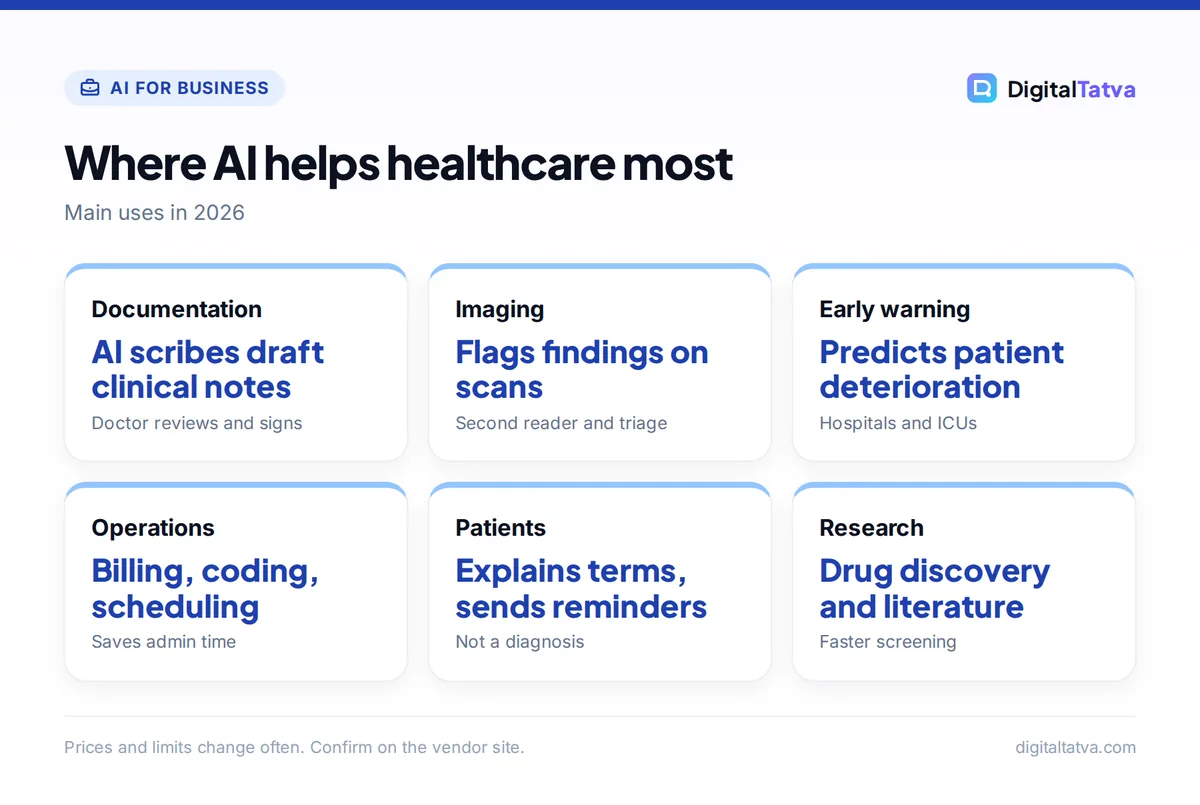
How AI is used in healthcare today
| Area | What AI does | Who uses it |
|---|---|---|
| Clinical documentation | Listens to visits and drafts notes, letters and summaries | Doctors, nurses |
| Medical imaging | Flags possible findings on X-rays, CT, MRI, mammograms and eye scans | Radiologists, screening programs |
| Triage and early warning | Predicts deterioration, sepsis risk or readmission | Hospitals, ICUs |
| Administration | Coding, billing, insurance pre-authorization, scheduling | Hospital operations teams |
| Patient communication | Answers FAQs, sends reminders, translates instructions | Clinics, pharmacies |
| Drug discovery and research | Predicts protein structures, screens molecules, summarizes literature | Pharma companies, researchers |
| Remote monitoring | Analyzes data from wearables and home devices | Chronic care programs |
AI medical scribes: the biggest change for doctors
Doctors spend a large part of their day typing notes. AI scribes, also called ambient clinical documentation tools, listen to the consultation (with the patient’s consent), then draft the clinical note, referral letter or discharge summary in the right format. The doctor reviews, edits and signs. Examples include Microsoft’s Dragon Copilot and Abridge, and many hospital record systems now include similar features.
The benefit is more eye contact with patients and less after-hours paperwork. The risk is that the AI can mishear or invent details, so every note must be checked. The same technology powers general meeting note takers; see our list of AI meeting assistants for how it works outside medicine, and AI transcription tools for speech-to-text options.
AI in medical imaging
Imaging is where clinical AI is most established. Algorithms trained on large sets of scans can flag possible tuberculosis on chest X-rays, bleeding on head CT scans, suspicious areas on mammograms or diabetic eye disease on retinal photos. They work best as a second reader or a triage tool that moves urgent cases to the top of the list.
India has a strong imaging AI sector. Qure.ai, for example, is an Indian company whose chest X-ray and CT tools are used in screening programs in many countries, including tuberculosis screening. AI screening is valuable where there are too few radiologists, but a qualified clinician still confirms findings and decides on care.
AI for hospitals and clinic operations
Much of AI’s near-term value is not clinical at all. Hospitals use it to predict bed demand, schedule staff, code diagnoses for billing, prepare insurance claims and answer patient calls. Small clinics use general assistants such as ChatGPT, Claude or Gemini to draft patient education leaflets, translate instructions into Hindi or regional languages, write policies and summarize long guidelines, without entering identifiable patient data.
If you run a clinic, our guides to AI for small business, AI customer support tools and WhatsApp AI for business cover appointment reminders and patient FAQs.
AI in drug discovery and medical research
AI is changing how new medicines are found. Protein structure prediction is the best-known example: Google DeepMind’s AlphaFold predicts the 3D shape of proteins from their sequence, work that earned its creators a share of the 2024 Nobel Prize in Chemistry. Knowing a protein’s shape helps scientists design drugs that fit it. Pharma companies also use AI to screen huge libraries of molecules, predict side effects early and find patients for clinical trials faster.
For researchers and students, AI speeds up literature work. Tools that search peer-reviewed papers, such as Consensus, and general assistants with deep research modes can summarize what studies say on a question in minutes. They still make mistakes, so researchers must read the key papers themselves. Our guides to AI research tools and deep research explain how to use them well.
| Research task | How AI helps |
|---|---|
| Target discovery | Finds proteins and pathways linked to a disease |
| Molecule design | Suggests and scores candidate compounds |
| Trial recruitment | Matches eligible patients to trials faster |
| Literature reviews | Summarizes thousands of papers for scientists to check |
AI chatbots and patients
Millions of people now ask AI chatbots about symptoms, test results and medicines. Used carefully, chatbots can help you understand medical words, prepare questions for your doctor or summarize a long report in plain language. Used carelessly, they can give wrong, outdated or overconfident answers.
Watch out: do not use an AI chatbot to diagnose yourself, change a medicine or decide whether to seek emergency care. If you have chest pain, difficulty breathing, signs of stroke or another emergency, call your local emergency number (112 in India) or go to the nearest hospital.
Safe ways to use AI as a patient:
- Ask it to explain terms in your report, then confirm with your doctor.
- Use it to write down your symptoms and questions before an appointment.
- Do not upload identity documents or full medical records to free consumer tools unless you understand the privacy terms; read Is ChatGPT safe? first.
AI in healthcare in India
India has several factors that make AI especially useful: a large population, a shortage of specialists in rural areas, many languages and a fast-growing digital health system. The Ayushman Bharat Digital Mission is building digital health IDs and interoperable records, which can make data available for care and, with consent, for research. Indian startups work on imaging, tuberculosis screening, eye care, maternal health and telemedicine.
Language is a big opportunity. AI translation and voice tools can explain instructions to patients in their own language; see our guide to AI tools for Indian languages. Data protection matters too: the Digital Personal Data Protection Act, 2023 sets rules on consent and how personal data, including health data, is processed.
Benefits and risks of AI in healthcare
Benefits
- Less paperwork and burnout for clinicians
- Faster triage of urgent scans and cases
- Screening where specialists are scarce
- Better patient communication in local languages
- Faster research and drug discovery
Risks
- Errors and invented details in AI output
- Bias if training data does not represent all patients
- Privacy breaches of sensitive health data
- Over-reliance on AI by busy staff
- Unclear responsibility when AI contributes to harm
Rules and regulation
AI that diagnoses or guides treatment is usually regulated as a medical device. In the US, the Food and Drug Administration reviews and authorizes many AI-enabled devices, most of them in radiology. In the European Union, the AI Act treats many medical AI systems as high-risk with extra requirements. In India, medical devices are regulated by the Central Drugs Standard Control Organisation, and health data falls under the DPDP Act. General chatbots are not approved medical devices, which is why their terms say they do not give medical advice.
Healthcare organizations should write clear internal rules on which AI tools are approved and what data may be used; our AI usage policy template and AI data privacy guide are good starting points.
How clinics can start using AI safely
- Start with non-clinical tasks. Patient leaflets, appointment reminders, policies and translations.
- Use business-grade tools. Choose plans that do not train on your data and offer proper data agreements.
- Remove identifiers. Do not paste names, phone numbers or ID numbers into consumer chatbots.
- Pilot one clinical tool. For example an AI scribe, with patient consent and clinician review of every note.
- Measure and audit. Track time saved, errors caught and patient feedback; review regularly.
Our guide to measuring AI ROI helps you decide whether a pilot is worth expanding.
Frequently asked questions
How is AI used in healthcare?
AI is used to draft clinical notes from consultations, flag findings on medical scans, predict which patients may deteriorate, automate billing and scheduling, answer patient questions, support remote monitoring and speed up drug research. Qualified clinicians remain responsible for diagnosis and treatment decisions.
Will AI replace doctors?
No. AI can take over paperwork and help with specific tasks such as reading certain scans, but medicine requires examination, judgment, communication and responsibility that AI cannot provide. Doctors who use AI well may spend more time with patients and less on documentation.
Is it safe to ask ChatGPT medical questions?
It can help you understand medical terms or prepare questions, but it can be wrong and is not a substitute for a doctor. Never use it to diagnose yourself, change medicines or decide about emergencies, and avoid sharing identifiable health records with free consumer tools.
What are examples of AI in healthcare in India?
Examples include AI screening of chest X-rays for tuberculosis by Indian companies such as Qure.ai, AI tools for diabetic eye screening, telemedicine platforms with AI triage, and translation tools that explain instructions in Indian languages, alongside the Ayushman Bharat Digital Mission’s digital health records.
What are the risks of AI in healthcare?
The main risks are incorrect or invented outputs, bias against groups underrepresented in training data, privacy breaches of sensitive health data, over-reliance by busy staff, and unclear responsibility when errors happen. Regulation, audits and human review reduce these risks.
The bottom line
AI is already making healthcare faster and less paper-heavy, especially through scribes, imaging and administration, but it works best as a careful assistant to clinicians, not a replacement. Patients should treat AI answers as a starting point for a conversation with a doctor. This article is for general information and is not medical advice. Rules and approved tools change, so check official sources such as the Ayushman Bharat Digital Mission and the US FDA list of AI-enabled medical devices for current details.
Pricing and features are checked at the time of writing and can change. Some links may be affiliate links, which never affect our verdicts.