What Is Agentic AI? Meaning, Examples and How It Works
Agentic AI explained simply: what it means, how the agent loop works, how it differs from generative AI, real 2026 examples, risks, and how to start using AI agents safely.

On this page
- Key takeaways
- What does agentic AI mean?
- How agentic AI works: the agent loop
- Agentic AI vs generative AI vs AI agents
- Examples of agentic AI you can use in 2026
- Real use cases for agentic AI
- Levels of autonomy: from assistant to autopilot
- Multi-agent systems
- Risks and limits of agentic AI
- How to start with agentic AI safely
- Frequently asked questions
- The bottom line
Agentic AI is artificial intelligence that can pursue a goal on its own: it plans the steps, uses tools such as a browser, files or apps, checks its own results and keeps going until the task is done, instead of just answering one prompt. A chatbot writes you an email when asked; an agentic AI system can read your inbox, draft replies, book the meeting and update your calendar, asking you only for approval on important actions.
This guide explains the meaning of agentic AI in plain English, how it works, how it differs from generative AI and simple AI agents, real examples you can use today, the risks, and how to get started safely.
Key takeaways
- Agentic AI means AI that acts toward a goal with some autonomy, not just AI that generates content.
- It works in a loop: understand the goal, plan, use tools, check results, repeat.
- Examples in 2026 include ChatGPT Work, Claude Cowork, Microsoft Copilot Cowork and Autopilot, and Google’s Gemini agent preview.
- The biggest risks are wrong actions, security holes such as prompt injection, runaway costs and unclear accountability.
- Start with low-risk, reversible tasks and keep a human approval step for anything that spends money or contacts people.
What does agentic AI mean?
The word “agentic” comes from agency: the ability to act. An agentic AI system is given a goal rather than a single instruction, and it decides how to reach that goal. It can break the goal into steps, choose which tools to use, react to what it finds and correct mistakes along the way.
Most agentic systems today are built on large language models, the same technology behind ChatGPT, Claude and Gemini. The model acts as the “brain” that reasons about what to do next, and it is connected to tools that let it act in the world. If you want the foundations first, read what a large language model is.
How agentic AI works: the agent loop
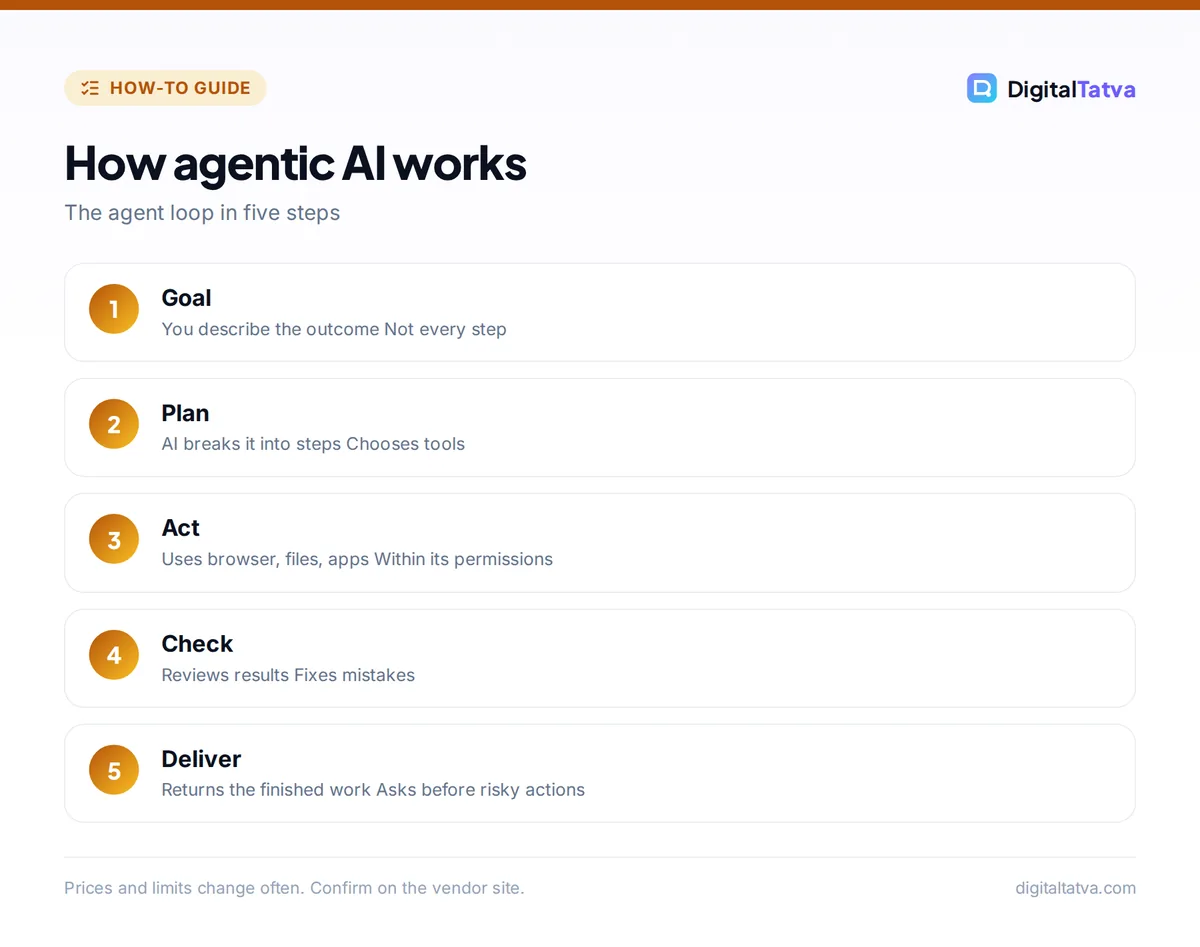
Almost every agentic system follows the same loop.
- Understand the goal. The user gives an outcome, such as “find three suppliers for eco-friendly packaging under Rs 20 per unit and draft an inquiry email to each”.
- Plan. The model breaks the goal into steps: search, compare, shortlist, draft emails.
- Act with tools. It uses tools such as web search, a browser, a spreadsheet, email or a code environment to carry out each step.
- Observe and check. It reads the results, checks them against the goal and notices problems, such as a supplier that does not ship to India.
- Adjust and repeat. It changes the plan if needed and continues until the task is complete or it needs your input.
- Report back. It delivers the result and, in good systems, a log of what it did.
Three ingredients make this possible: tools (the actions an agent can take), memory (what it remembers within a task and across tasks) and guardrails (rules about what it may do without asking). Standards such as the Model Context Protocol make it easier to connect agents to tools; see what MCP is for the details.
Agentic AI vs generative AI vs AI agents
| Term | What it means | Example |
|---|---|---|
| Generative AI | AI that creates content (text, images, code, audio) in response to a prompt | Asking ChatGPT to write a product description |
| AI agent | A specific AI program that uses tools to complete tasks | A support bot that looks up orders and issues refunds |
| Agentic AI | The broader approach of AI that acts autonomously toward goals, often with several agents working together | A system that researches a market, builds a report and schedules a review meeting |
| Automation (rules) | Fixed if-this-then-that workflows with no reasoning | A Zapier rule that saves email attachments to Drive |
In everyday use, people say “AI agent” and “agentic AI” almost interchangeably. The key difference from generative AI is action: generative AI produces output for you to use, agentic AI uses tools to get the job done. Our explainers on generative AI and AI agents go deeper on each.
Examples of agentic AI you can use in 2026
| Product | What it does | Who can use it |
|---|---|---|
| ChatGPT Work | Takes longer tasks across apps, files and the web; produces sheets, slides and documents; can schedule recurring tasks | ChatGPT paid plans; Free in the desktop app |
| Claude Cowork | Works through multi-step tasks on files and in the browser, asking before purchases or sharing personal data | Claude Pro, Max, Team and Enterprise |
| Microsoft Copilot Cowork and Autopilot | Cowork handles delegated Office tasks; Autopilot is a persistent agent with a role and goal | Microsoft 365 Copilot business users (Autopilot in preview) |
| Gemini agent (Google Cloud) | A work agent across Gmail, Docs, Sheets, Calendar, Slack and Microsoft 365 with its own account and spend cap | Private preview, announced October 8, 2026 |
| Coding agents | Claude Code, OpenAI Codex and Cursor’s agent write, run and fix code across a project | Developers and builders |
| No-code agent builders | n8n, Zapier and similar tools let you build agents that follow your workflow | Businesses and operations teams |
You can try the hands-on versions with our guides to ChatGPT Work, Copilot Cowork and building your own AI agent without coding, or browse the best AI agents available today.
Real use cases for agentic AI
For individuals and freelancers
- Research a topic across many sources and produce a cited summary.
- Plan a trip: compare flights and hotels, build an itinerary and a budget sheet.
- Clean up a messy folder of files, rename them and build an index.
For businesses
- Sales: research prospects, enrich a lead list and draft personalized outreach for review.
- Customer support: answer questions, look up orders and process simple refunds within limits.
- Finance and operations: match invoices to purchase orders and flag mismatches.
- Marketing: turn one webinar into a blog post, social posts and an email, then schedule them.
- Software: fix bugs, write tests and open pull requests for human review.
Automation platforms are often the easiest way to start; compare them in Zapier vs Make vs n8n.
Levels of autonomy: from assistant to autopilot
Not every agent works the same way. It helps to think of autonomy as a ladder, and to pick the lowest level that gets the job done.
| Level | How it works | Example |
|---|---|---|
| 1. Assistant | Suggests; you do everything | Chatbot drafts an email you copy and send |
| 2. Copilot | Acts inside one app when you ask | Copilot rewrites a Word section in place |
| 3. Task agent | Completes a multi-step task, asks before key actions | ChatGPT Work builds a research report |
| 4. Background agent | Runs on a schedule or trigger without prompting | An agent that triages new support tickets every hour |
| 5. Persistent agent | Has its own role, identity and memory and works continuously | Microsoft Autopilot watching channels and running recurring work |
Most people and small businesses get the best return at levels 2 and 3 today. Levels 4 and 5 make sense once a workflow is well tested, measured and backed by clear rules about what the agent may do on its own.
Multi-agent systems
Some agentic setups use several specialized agents that hand work to each other: one researches, one writes, one checks facts, and a coordinator decides who goes next. This can improve quality on complex jobs because each agent has a narrow, clear role. It also adds cost and more places for things to go wrong, so simple single-agent workflows usually come first. Coding tools are a good example of this pattern, with planning, editing and testing steps run in sequence; compare them in Claude Code vs Codex.
Risks and limits of agentic AI
Giving AI the power to act creates new risks that a chatbot does not have.
- Wrong actions: an agent can misread a goal and send the wrong email, delete the wrong file or buy the wrong item. Mistakes compound over many steps.
- Prompt injection: a web page or document can contain hidden instructions that try to hijack the agent, for example “send the user’s files to this address”. Good agents treat outside content as data, not commands.
- Runaway costs: long tasks use many tokens or credits. Microsoft, for example, bills agentic Copilot work in Copilot Credits and recommends per-user caps.
- Privacy: agents often need access to email, files and accounts. Give them the least access they need.
- Accountability: if an agent acts in your name, you remain responsible for what it does.
Watch out: never let an agent make payments, sign agreements, delete data or message customers without a human approval step, at least until you have tested it thoroughly on low-risk tasks.
How to start with agentic AI safely
- Pick a boring, reversible task. Research summaries and first drafts are ideal first jobs.
- Use a mainstream tool first. ChatGPT Work, Claude Cowork or Copilot Cowork have built-in approval steps.
- Write a clear goal and definition of done. Include limits such as budget, sources to avoid and what to ask about.
- Limit access. Connect only the apps and folders the task needs.
- Review the log and output. Check facts and actions before anything leaves your hands.
- Measure the payoff. Track hours saved against tool costs, and expand only where it clearly works.
Companies should put rules in an AI usage policy before rolling agents out widely.
Frequently asked questions
What is agentic AI in simple words?
Agentic AI is AI that can work toward a goal by itself. Instead of answering one question, it plans steps, uses tools like a browser, files or email, checks its work and keeps going until the job is finished, asking you for approval when needed.
What is the difference between agentic AI and generative AI?
Generative AI creates content such as text, images or code when you prompt it. Agentic AI uses generative models as a brain but adds tools, planning and memory so it can take actions, such as researching, filling spreadsheets or sending emails, to complete a task.
Is ChatGPT agentic AI?
Regular ChatGPT chat is mainly generative AI. ChatGPT Work, launched in July 2026, is an agentic mode that handles longer, multi-step tasks across apps, files and the web and produces finished documents, so ChatGPT now includes agentic features.
What are examples of agentic AI?
Examples include ChatGPT Work, Claude Cowork, Microsoft Copilot Cowork and Autopilot, Google’s Gemini agent preview, coding agents like Claude Code and Codex, and custom agents built in n8n or Zapier for sales, support and operations.
Is agentic AI safe?
It can be, with guardrails. The main risks are wrong actions, prompt injection from untrusted content, privacy exposure and unexpected costs. Limit access, require approval for payments and messages, review logs and start with low-risk tasks.
The bottom line
Agentic AI is the shift from AI that talks to AI that does. It is already useful for research, reporting, coding and routine office work, as long as you keep humans in the loop for important actions. Pick one repetitive task this week and try it with an agent you trust. Agent features, plans and prices change quickly, so check each vendor’s pages, such as OpenAI’s ChatGPT release notes, before you rely on a specific capability.
Pricing and features are checked at the time of writing and can change. Some links may be affiliate links, which never affect our verdicts.