Claude Code vs Codex: Which AI Coding Agent Is Better in 2026?
Claude Code vs OpenAI Codex compared: models, features, cloud tasks, code review, pricing and usage limits, plus which AI coding agent to choose for solo developers, teams and beginners.

On this page
- Key takeaways
- Claude Code vs Codex at a glance
- How each tool works
- Models and coding quality
- Features and workflow
- Pricing and usage limits
- A fair way to test both on your own project
- Which is better for beginners?
- Claude Code vs Codex vs Cursor and Copilot
- Choose Claude Code if, choose Codex if
- Frequently asked questions
- The bottom line
Quick verdict: Claude Code and OpenAI Codex are both excellent agentic coding tools in 2026, and the best choice usually depends on which subscription you already pay for. Claude Code is the favorite of many developers for working deeply inside a local codebase from the terminal or IDE, with strong planning, careful edits and a rich extension system. Codex stands out for running many tasks in parallel in the cloud from any device, built-in code review for pull requests, and inclusion in every ChatGPT plan, including Free.
This comparison explains how Claude Code and Codex work, their models, features, pricing and usage limits, where each one shines, and which one to choose for solo developers, teams and beginners building their first app.
Key takeaways
- Claude Code is included with Claude Pro ($20 a month) and higher plans; it is not on the Claude Free plan.
- Codex is included in all ChatGPT plans, from Free to Enterprise, with limits that grow on paid tiers. ChatGPT and Codex share usage limits.
- Claude Code runs on Anthropic’s Claude 5.5 models, such as Sonnet 5.5 and Opus 5.5; Codex runs on OpenAI’s GPT-6 family, including GPT-6 Astra and the cheaper GPT-6.1 Sol.
- Both work in the terminal, IDEs, desktop apps and the web, can edit files, run commands and tests, and open pull requests.
- Many professional developers use both: one as the main agent and the other for second opinions and code review.
Claude Code vs Codex at a glance
| Feature | Claude Code | OpenAI Codex |
|---|---|---|
| Made by | Anthropic | OpenAI |
| Models | Claude Sonnet 5.5, Opus 5.5, Haiku 5.5 | GPT-6 Astra, GPT-6.1 Sol, GPT-6 Luna and others |
| Where it runs | Terminal, VS Code and JetBrains, desktop app, web, mobile | CLI, IDE extension, Codex app, ChatGPT web and mobile, cloud |
| Cheapest access | Claude Pro, $20/month | Free ChatGPT plan, with limited Codex access |
| Cloud parallel tasks | Yes, on the web | Yes, a core strength |
| PR code review | Yes, via GitHub integration | Yes, Code Review for GitHub and GitLab on all plans |
| Extensibility | MCP servers, skills, hooks, subagents, plugins | MCP, agents, custom instructions |
| Usage pool | Shared with Claude chat | Shared with ChatGPT |
How each tool works
Claude Code
Claude Code is an agentic coding assistant that reads your project, plans changes, edits multiple files, runs commands and tests, and iterates until the task is done. You can use it in a terminal, inside VS Code or JetBrains, in the Claude desktop app or on the web, where tasks run in a cloud environment connected to your GitHub repository. Developers configure it with a CLAUDE.md file that describes project conventions, and extend it with MCP servers, custom slash commands, hooks, skills and subagents. Our Claude Code tutorial covers setup from scratch.
OpenAI Codex
Codex is OpenAI’s coding agent. It runs locally through the Codex CLI and IDE extension, and in the cloud, where you can start many tasks at once from the Codex app, ChatGPT on the web or your phone, then review the resulting changes as pull requests. Codex uses an AGENTS.md file for project instructions. In 2026, OpenAI added a refreshed CLI with voice, an agents view, Code Review for GitHub pull requests and GitLab merge requests on all plans, and Codex Security for paid business tiers.
Models and coding quality
Both tools run on frontier coding models. Claude Code defaults to Claude Sonnet 5.5, which Anthropic released in September 2026 with a 1 million token context window and strong results on agentic coding benchmarks such as Terminal-Bench. Opus 5.5 is available for the hardest tasks. Our Sonnet 5.5 review and Opus 5.5 guide have details.
Codex uses OpenAI’s GPT-6 family. GPT-6 Astra is the most capable, while GPT-6.1 Sol, launched at OpenAI DevDay, costs about one-fifth of Astra through the API and nearly matches it on several coding benchmarks, according to OpenAI. Read our GPT-6 models explainer and DevDay 2026 recap.
In practice, benchmark gaps between the top models are small and change with every release. Developers often describe Claude as careful and thorough with large refactors and explanations, and Codex as fast and strong at well-specified tasks running in parallel. The best test is your own codebase.
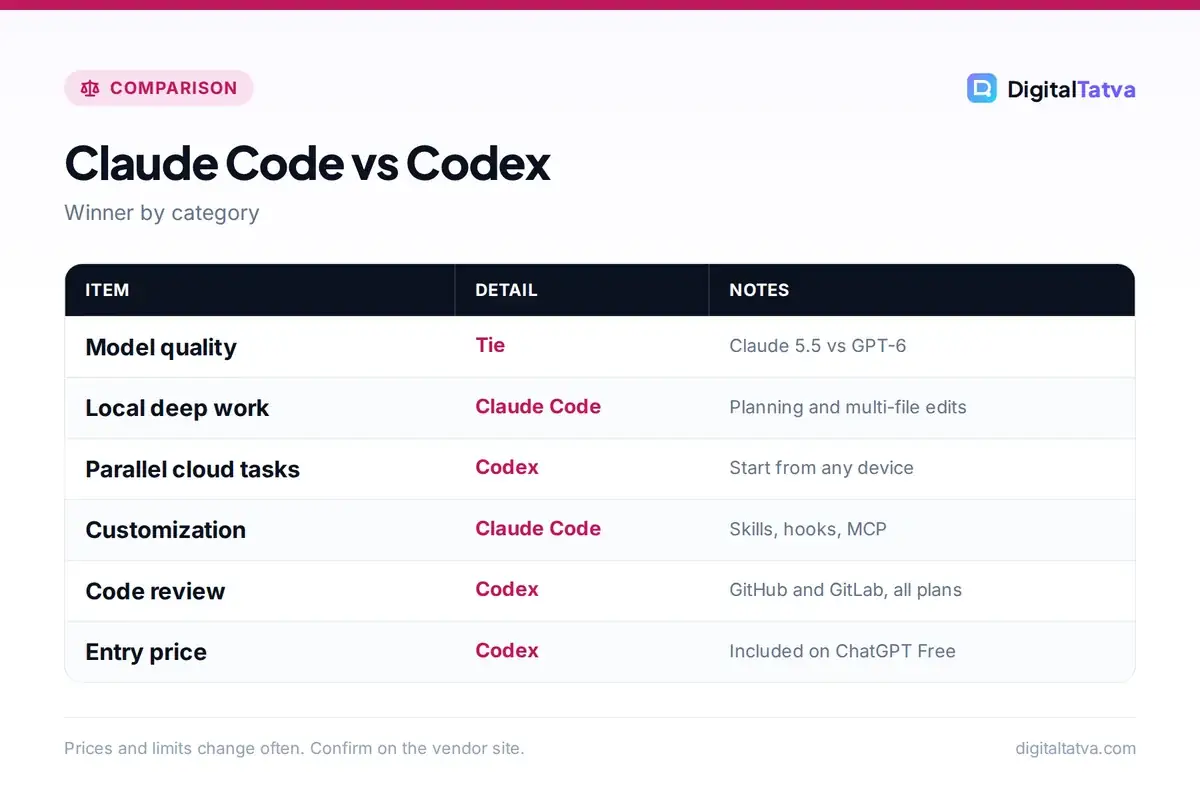
Winner: tie. Both are frontier-level.
Features and workflow
Where Claude Code shines
- Deep, interactive work in a local codebase with careful planning modes
- A rich ecosystem of MCP servers, hooks, skills and subagents for customization
- Long context for understanding large projects
- Strong at explaining code and working with non-developers step by step
Where Codex shines
- Running many cloud tasks in parallel and reviewing them as pull requests
- Starting tasks from anywhere, including your phone through ChatGPT
- Automatic code review on GitHub and GitLab
- Access for every ChatGPT user, including on the free plan
Both support the Model Context Protocol for connecting tools like databases, documentation and issue trackers.
Winner: Claude Code for local, deep work; Codex for parallel cloud tasks and review.
Pricing and usage limits
| Plan | Claude Code | Codex |
|---|---|---|
| Free | Not included | Included, limited |
| Entry | Claude Pro $20/month ($17 annual) | ChatGPT Go $8/month (US), Plus $20/month |
| Heavy use | Max 5x $100, Max 20x $200 | ChatGPT Pro tiers |
| Teams | Claude Team Premium seats for developers | ChatGPT Business, Enterprise |
| Pay as you go | Anthropic API credits | OpenAI API credits |
Both tools use rolling usage windows. On ChatGPT Plus, OpenAI estimates roughly 5 to 45 GPT-6 Astra messages, 15 to 160 GPT-6.1 Sol messages, or far more on lighter models, per five-hour window in Work and Codex, plus a weekly limit. Claude plans also use five-hour sessions with possible weekly caps, and Anthropic raised Claude Code session limits for Pro, Max and Team by 20% in September 2026. Choosing lighter models for simple tasks stretches either plan. See our guides on reducing Claude Code costs, Claude usage limits and Claude Pro vs Max, plus OpenAI’s Codex usage help article.
Winner: Codex on entry price, since it starts free.
A fair way to test both on your own project
Benchmarks only tell part of the story. The quickest way to decide is a one-week trial on real work. Pick three tasks from your backlog: a small bug fix, a feature that touches several files, and a refactor or test-writing job. Give each tool the same written brief, the same repository and the same instruction file content (copy your CLAUDE.md into AGENTS.md or the other way round). Then compare:
- Correctness: did the change work and pass tests on the first try?
- Code quality: would you merge it without major edits?
- Communication: did it explain what it changed and flag risks?
- Speed and limits: how long did it take and how much of your plan allowance did it use?
Keep notes in a simple table. Most developers find a clear favorite within a week, and often discover that each tool is better at different kinds of tasks.
Which is better for beginners?
If you have never coded, both tools can build simple apps from plain-English descriptions, but you still need to understand basics like running a project, using Git and reading error messages. Codex is easier to try because it is available on the free ChatGPT plan. Claude Code is often praised for explaining what it is doing, which helps beginners learn. If you just want a website or app without touching code, an AI app builder may be simpler; compare options in Lovable vs Bolt and our list of the best AI app builders.
Claude Code vs Codex vs Cursor and Copilot
Claude Code and Codex are agent-first tools: you describe a task and the agent does the work. Cursor and GitHub Copilot started as AI features inside an editor and now include agents too. Many developers combine an editor like Cursor with Claude Code or Codex running in the terminal. Read Claude Code vs Cursor, Cursor vs GitHub Copilot and our best AI coding assistants roundup for the full picture.
Claude Code pros
- Excellent at deep, multi-file work
- Highly customizable with skills, hooks and MCP
- Clear explanations and planning
- Works across terminal, IDE, desktop and web
Codex pros
- Included even on ChatGPT Free
- Strong parallel cloud tasks
- Built-in code review on GitHub and GitLab
- Start tasks from your phone
Choose Claude Code if, choose Codex if
Choose Claude Code if you already pay for Claude, do a lot of deep work in one codebase, want extensive customization with skills and hooks, or value detailed explanations alongside the code.
Choose Codex if you already pay for ChatGPT, want to try an AI coding agent for free, like running many tasks in parallel in the cloud, or want automatic pull request reviews for your team.
Frequently asked questions
Is Claude Code better than Codex?
Neither is clearly better for everyone. Claude Code is often preferred for deep, interactive work in a local codebase and customization, while Codex excels at parallel cloud tasks, code review and access from any device. Both use frontier models, so test them on your own projects.
Is Codex free?
Codex is included in all ChatGPT plans, including Free, with limited access. Paid plans such as Go, Plus, Pro, Business and Enterprise offer much higher limits and access to stronger models like GPT-6 Astra. ChatGPT and Codex share usage limits.
How much does Claude Code cost?
Claude Code is included with Claude Pro at $20 a month, or $17 a month billed annually, and with Max plans at $100 and $200 a month for heavier use. Team plans include it for business users. You can also pay per use with Anthropic API credits.
Can I use Claude Code and Codex together?
Yes. Many developers use one as their main coding agent and the other to review changes or solve problems where the first gets stuck. Both can work in the same repository using their own instruction files, CLAUDE.md and AGENTS.md.
Do I need to know how to code to use Claude Code or Codex?
You can build simple projects by describing them in plain English, but basic knowledge of running projects, Git and reading errors helps a lot. For no-code app building, tools like Lovable or Bolt may be easier starting points.
The bottom line
Claude Code and Codex are both top-tier AI coding agents. Start with the one included in the subscription you already have. If you are paying for neither, try Codex on the free ChatGPT plan, then test Claude Code with a month of Claude Pro on the same real project. Many serious developers end up keeping both.
Pricing and features are checked at the time of writing and can change. Some links may be affiliate links, which never affect our verdicts.