Claude Opus 5.5 Review: What’s New, Pricing and Benchmarks
Our Claude Opus 5.5 review: $4 / $20 per million tokens, 1M context, Terminal-Bench lead over GPT-6 Astra, breaking API changes and which Claude plan you need.


On this page
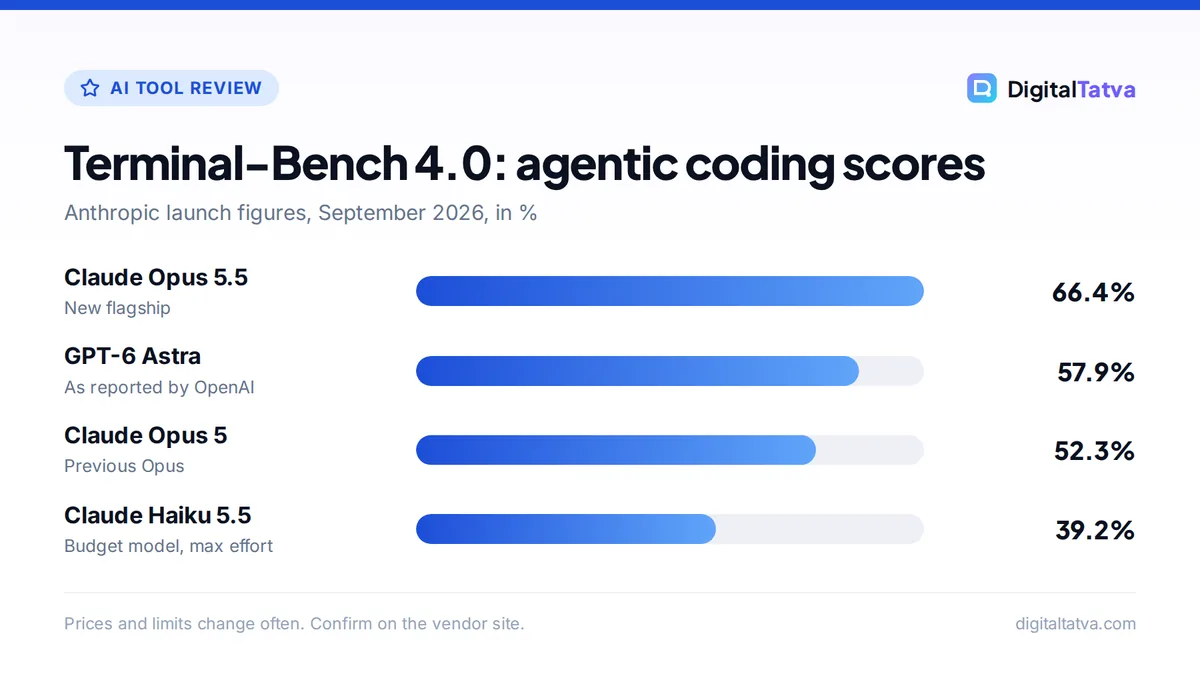
Claude Opus 5.5 is Anthropic’s flagship model for coding, agents and hard reasoning, released on September 22, 2026. It costs $4 per million input tokens and $20 per million output tokens, 20% less per token than Opus 5, and it leads OpenAI’s GPT-6 Astra on agentic coding tests such as Terminal-Bench 4.0 (66.4% vs 57.9%). In the Claude apps it is available on Pro, Max, Team and Enterprise plans, not on the free plan.
In our view, Claude Opus 5.5 is the best value frontier model for serious coding and long agent work right now, with a few catches: thinking is always on, some API features from Opus 5 now return errors, and independent tests show small regressions in a few specialist areas. This review covers what’s new, pricing, benchmarks, how it compares with GPT-6 Astra and Fable 5.1, and who should use it.
Our verdict
9.0/10
Opus 5.5 is a strong upgrade at a lower price. Pick it for coding agents, complex documents and multi-step planning. Use Sonnet 5.5 or Haiku 5.5 for everyday and high-volume tasks.
Key takeaways
- Claude Opus 5.5 launched September 22, 2026 at $4 input and $20 output per million tokens, down from $5 and $25 on Opus 5. Cache reads dropped 60% to $0.20.
- It has a 1M token context window, 128K output (300K on the Batch API with a beta header) and a June 2026 knowledge cutoff.
- Anthropic reports 66.4% on Terminal-Bench 4.0 and 57.8% on CursorBench 4.0, both ahead of Opus 5 and every rival model Anthropic compared.
- Thinking cannot be switched off, forced tool use returns an error, and the old computer use tool is rejected, so developers must update code.
- In the apps, Opus 5.5 needs a Pro plan ($20 a month) or higher.
What is Claude Opus 5.5?
Opus is Anthropic’s largest generally available model family. Opus 5.5 sits above Claude Haiku 5.5 and Sonnet 5.5, and below Claude Fable 5.1, Anthropic’s premium Mythos-class model that costs $10 input and $50 output per million tokens. Anthropic’s own advice on its models page is to “start with Claude Opus 5.5 for most workloads”, which tells you where it expects developers to land.
It was released on September 22, 2026, and its API model ID is claude-opus-5-5. Here are the core specs next to Opus 5.
| Spec | Claude Opus 5.5 | Claude Opus 5 |
|---|---|---|
| Input / output price per 1M | $4 / $20 | $5 / $25 |
| Cache read per 1M | $0.20 | $0.50 |
| Batch input / output | $2 / $10 | $2.50 / $12.50 |
| Context window | 1M tokens | 1M tokens |
| Max output | 128K (300K on Batch beta) | 128K |
| Thinking | Adaptive, always on, default effort medium | Configurable |
| Guaranteed availability | Not retired before September 22, 2027 | Still available |
What’s new in Claude Opus 5.5
Better coding and agent performance
The biggest gains are in agentic coding, where the model works in a terminal, edits many files and runs tests on its own. Anthropic reports Terminal-Bench 4.0 rising from 52.3% on Opus 5 to 66.4%, and CursorBench 4.0 from 46.6% to 57.8%. For Claude Code users, Anthropic also raised session limits by 20% from September 22 and says Opus 5.5 goes about 25% further within them. Our guide to how to use Claude Code shows how to put this to work, and how to reduce Claude Code costs keeps the bill in check.
Always-on adaptive thinking
Opus 5.5 always thinks before it answers, and you control how deeply with an effort setting. The default is medium. Anthropic’s “40% cheaper” claim compares Opus 5.5 at medium effort with Opus 5 at high effort on typical workloads, so you only get that saving if medium is good enough for your task.
Fast mode
A research preview on the Claude API offers up to 2.5 times faster output at double the price ($8 input, $40 output per million tokens). It is useful for interactive coding where waiting is the bottleneck, not for bulk jobs.
Stronger safeguards
Biology safeguards now match Fable 5.1, with a Life Sciences Verification Program for vetted organizations, and a Cyber Verification Program is being extended to Opus 5.5. Most business users will not notice, but some security and biology research prompts may be refused without verification.
Claude Opus 5.5 pricing
For app users, Opus 5.5 comes with any paid plan. Pro costs $20 a month ($17 a month billed annually), Max 5x costs $100 and Max 20x costs $200, and Team standard seats cost $25 per member per month billed monthly. Free accounts get Sonnet and Haiku only. Our Claude pricing guide and Claude Pro vs Max comparison help you pick the right plan, and Claude usage limits explains how much Opus you get per five-hour session.
For developers, here is what a typical long agent request costs. Assume 1M tokens of input and 100K tokens of output.
- Opus 5 at list price: 1 x $5 = $5 input, plus 0.1 x $25 = $2.50 output. Total: $7.50.
- Opus 5.5 at list price: 1 x $4 = $4 input, plus 0.1 x $20 = $2 output. Total: $6.00.
- Opus 5.5 with 900K tokens cached: 0.9 x $0.20 = $0.18, plus 0.1 x $4 = $0.40 fresh input, plus $2 output. Total: $2.58.
Agent loops resend the same context again and again, so caching does most of the saving. Our explainer on prompt caching shows how to structure prompts to hit the cache, and the full rate card is in our Claude API pricing breakdown.
Watch out: Changing the effort level in the middle of a session invalidates the prompt cache. Pick an effort level per task and keep it steady.
Claude Opus 5.5 benchmarks
These are Anthropic’s launch figures at max effort unless noted. Anthropic’s own footnotes say several margins are within noise.
| Benchmark | Opus 5.5 | Opus 5 | Best rival |
|---|---|---|---|
| Terminal-Bench 4.0 (agentic coding) | 66.4% | 52.3% | 57.9% (GPT-6 Astra) |
| FrontierCode v1.1 Main | 54.4% | 48.0% | 53.3% (GPT-6 Astra) |
| CursorBench 4.0 | 57.8% | 46.6% | 51.8% (Fable 5.1) |
| GDPval-AA v2.1 (knowledge work, Elo) | 1846 | 1708 | 1735 (Fable 5.1) |
| AutomationBench | 40.0% | 26.9% | 41.4% (GPT-6 Astra) |
| Humanity’s Last Exam (with tools) | 67.7% | 63.6% | 65.6% (Fable 5.1) |
| OSWorld 2.0 partial (computer use) | 81.8% | 74.0% | 80.7% (Fable 5.1) |
Independent results are a little more mixed. Vals AI measured Terminal-Bench 4.0 at 61.6% (up from 45.5% for Opus 5), but its broad index ranked Opus 5.5 fourth of 60 models, just below Opus 5, with regressions on a medical coding test and several legal and tax tests. The takeaway: Opus 5.5 is a clear step up for coding and agents, but if your work is specialist legal, tax or medical coding, test it on your own cases first.
Opus 5.5 vs GPT-6 Astra vs Fable 5.1
| Model | Price per 1M (in / out) | Where it wins |
|---|---|---|
| Claude Opus 5.5 | $4 / $20 | Agentic coding, knowledge work, value |
| GPT-6 Astra | $10 / $50 | Science tasks, AutomationBench |
| GPT-6.1 Sol | $2 / $10 | Cheaper OpenAI option near Astra on coding |
| Claude Fable 5.1 | $10 / $50 | Anthropic’s premium tier for the hardest work |
On price alone, Opus 5.5 costs less than half of GPT-6 Astra per token, and Anthropic claims it uses about 20% of Astra’s cost per task on FrontierCode at default effort. OpenAI’s newer GPT-6.1 Sol is cheaper still at $2 and $10, which makes it the main value rival. For the bigger picture, read our GPT-6 vs Claude vs Gemini comparison, our GPT-6 models explainer and our coverage of everything OpenAI announced at DevDay 2026.
Breaking changes for developers
If you are moving from Opus 5, budget time for these changes, listed in Anthropic’s migration notes.
- Thinking cannot be disabled. Sending a disabled thinking setting or a manual token budget returns a 400 error. Use adaptive thinking or omit the field and set effort.
- No forced tool use. A tool choice of “any” or a specific tool returns a 400. Use “auto” with strict schemas, or structured outputs.
- Thinking blocks are tied to the conversation. Replaying a thinking block after you change the system prompt, tools or earlier messages returns an error on newer accounts.
- New computer use tool. The old
computer_20251124tool is rejected on the Claude API and Google Cloud; move tocomputer_toolset_20260801. - Check your loop logic. Opus 5.5 can end a turn with a short progress report instead of a tool call, which can stop agent loops that treat any end of turn as “done”.
See Anthropic’s models overview and pricing page for the latest details.
Pros and cons
Pros
- Top published scores on agentic coding tests, ahead of GPT-6 Astra.
- 20% lower per-token price and 60% cheaper cache reads than Opus 5.
- 1M context and up to 300K output on Batch.
- Included in every paid Claude plan, including Claude Code.
Cons
- Several breaking API changes from Opus 5.
- Thinking is always on, which adds output tokens.
- Independent tests show regressions in some legal, tax and medical coding tasks.
- Not available on the free Claude plan.
Who should use Claude Opus 5.5?
- Developers and coding teams: yes. It is the strongest model we have covered for long, multi-file coding tasks. Compare it with other tools in our Claude Code vs Cursor guide and our list of the best AI coding assistants.
- Agencies and analysts: yes for complex documents, research synthesis and planning, where its knowledge work score leads.
- Writers and everyday users: Sonnet 5.5 is usually enough and stretches your usage further. Our ChatGPT vs Claude comparison covers everyday use.
- High-volume pipelines: use Haiku 5.5 for the bulk work and keep Opus 5.5 as the planner and checker.
Frequently asked questions
Is Claude Opus 5.5 free?
No. Opus models are not included on the free Claude plan, which offers Sonnet and Haiku. You need Pro at $20 a month ($17 a month billed annually), Max at $100 or $200, or a Team or Enterprise plan. On the API, Opus 5.5 costs $4 per million input tokens and $20 per million output tokens.
When was Claude Opus 5.5 released?
Anthropic released Claude Opus 5.5 on September 22, 2026. Sonnet 5.5 followed about a week later, and Haiku 5.5 arrived on October 7, 2026. Anthropic says it will not retire Opus 5.5 before September 22, 2027.
Is Claude Opus 5.5 better than GPT-6 Astra?
For agentic coding, Anthropic’s figures say yes: 66.4% vs 57.9% on Terminal-Bench 4.0. GPT-6 Astra leads on AutomationBench and a science benchmark. Opus 5.5 is also much cheaper per token, at $4 and $20 against Astra’s $10 and $50, so for most coding work it is the better value.
What is the context window of Claude Opus 5.5?
Opus 5.5 supports a 1M token context window and up to 128K tokens of output per response. On the Batch API, a beta header raises output to 300K tokens. Its knowledge cutoff is June 2026, so pair it with web search for anything more recent.
How much cheaper is Opus 5.5 than Opus 5?
Per token, 20% cheaper: $4 and $20 versus $5 and $25 per million input and output tokens, with cache reads down 60% to $0.20. Anthropic’s 40% saving figure compares Opus 5.5 at medium effort with Opus 5 at high effort on typical workloads.
Final verdict
Claude Opus 5.5 is a meaningful upgrade: better at coding and agents, cheaper per token, and much cheaper when you use caching. It earns our 9 out of 10 for anyone doing serious technical or analytical work, with the honest caveats that developers must update their code and specialist users should test it on their own tasks. If you already pay for Claude Pro, it is the best model you can switch to today. Prices and plans change often, so confirm the latest rates on Anthropic’s pricing page before you commit.
Related reading: our full Claude review and Claude vs Gemini.
Pricing and features are checked at the time of writing and can change. Some links may be affiliate links, which never affect our verdicts.