
What Is a Large Language Model (LLM)? A Plain English Guide
What is an LLM? A plain-English guide to large language models: how they are trained, how they write answers, tokens and context windows, the main LLMs of 2026 and their limits.

On this page
- Key takeaways
- What is a large language model, simply?
- How LLMs are trained
- How an LLM generates an answer
- The main LLMs in 2026
- What LLMs are good and bad at
- How businesses use LLMs
- Small vs large models: which do you need?
- How to start using an LLM today
- LLM vs generative AI vs AI
- Frequently asked questions
- The bottom line
A large language model (LLM) is an AI system trained on huge amounts of text to understand and generate language. It works by predicting the next small piece of text, called a token, over and over, which lets it answer questions, write, translate, summarize and write code. ChatGPT, Claude, Gemini, Meta AI and DeepSeek are all chat apps built on LLMs, such as OpenAI’s GPT-6, Anthropic’s Claude Sonnet 5.5 and Google’s Gemini models.
This plain-English guide explains what an LLM is, how it is trained, how it produces answers, key terms like tokens, parameters and context windows, the main LLMs in 2026, what they are good and bad at, and how businesses use them. No maths or coding knowledge is needed.
Key takeaways
- An LLM is a neural network trained on large amounts of text to predict the next token, which lets it generate human-like language.
- Training happens in stages: pre-training on broad text, then fine-tuning and feedback from people to make it helpful and safe.
- Key terms: tokens (pieces of text), parameters (the model’s learned settings) and the context window (how much text it can consider at once, now up to about 1 million tokens).
- Leading LLMs in 2026 include OpenAI’s GPT-6 family, Anthropic’s Claude 5.5 family, Google’s Gemini, Meta’s Muse, xAI’s Grok and DeepSeek.
- LLMs can be wrong with confidence, so important answers need checking, ideally with sources.
What is a large language model, simply?
Imagine a system that has read an enormous library and learned how words, facts and ideas usually connect. When you give it the start of a sentence or a question, it predicts what should come next, one small step at a time, until it has written a full answer. That is an LLM.
“Large” refers to the size of the model and its training data. “Language model” means it models language: it learns the probability of which words follow others. Modern LLMs are built on the transformer architecture, introduced in 2017, which lets the model weigh how every word in your message relates to every other word. The same idea now powers models that also understand images, audio and video, often called multimodal models.
| Term | Plain meaning |
|---|---|
| Token | A small chunk of text, often part of a word. LLMs read and write in tokens and APIs bill per token. |
| Parameters | The internal numbers the model learned during training. Bigger models have more. |
| Context window | How much text the model can consider at once, including your conversation and files. |
| Training data | The text and other content the model learned from. |
| Inference | Using the trained model to generate an answer. |
| Hallucination | A confident but false answer. |
For more definitions, our AI glossary covers 60 terms in plain English, and our explainer on tokens shows why they matter for cost.
How LLMs are trained
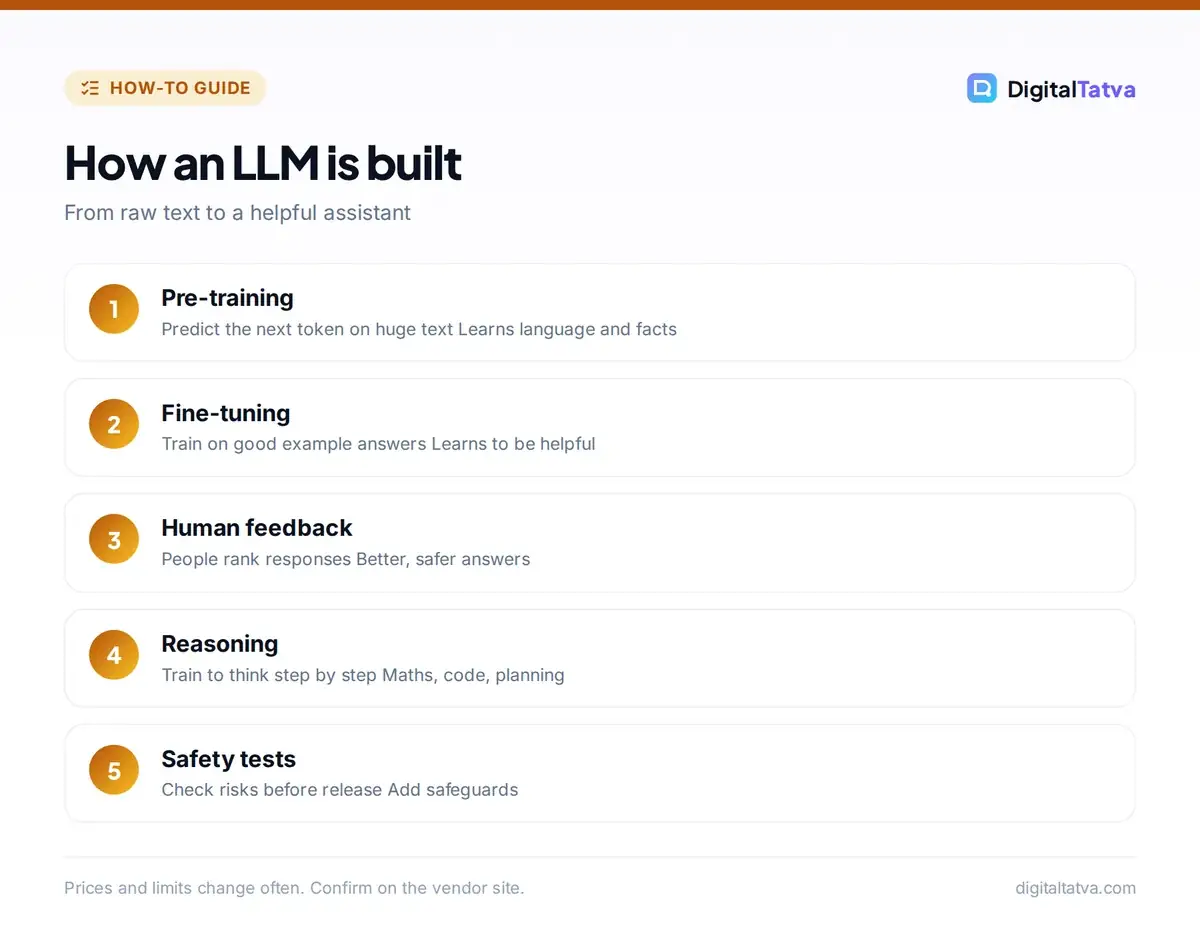
- Pre-training. The model reads a massive collection of text and repeatedly guesses the next token. Each wrong guess slightly adjusts its parameters. Over trillions of examples it learns grammar, facts, styles and patterns of reasoning.
- Fine-tuning. The general model is trained further on curated examples of good conversations, such as clear answers and helpful explanations.
- Feedback from people. Human reviewers rank answers, and the model is tuned to prefer the better ones. This makes it more helpful and less likely to produce harmful content.
- Reasoning training. Newer “thinking” models are trained to work through problems step by step before answering, which improves maths, coding and planning.
- Safety testing. Labs test models for risks before release and add safeguards.
Training a frontier LLM takes huge computing power, which is why companies are spending heavily on data centers. Using a trained model is far cheaper, especially for smaller models.
How an LLM generates an answer
When you send a message, the model converts it to tokens, works out how each token relates to the others, and calculates the probability of every possible next token. It picks one, adds it to the text, and repeats. A 300-word answer might involve a few hundred of these steps, which happen in seconds.
Two things shape the answer beyond the model itself:
- The context window. Everything the model can “see” right now: your instructions, the chat history and any documents you attached. Leading 2026 models such as Claude Sonnet 5.5 and GPT-6 handle about 1 million tokens. Our context window explainer covers why bigger is not always better.
- Tools and retrieval. Many apps let the LLM search the web, read your files or run code, then use the results. This approach, called retrieval-augmented generation, reduces made-up answers; see what RAG is.
The way you phrase a request also matters. Clear instructions, examples and a defined format lead to better output, which is the idea behind our prompt engineering guide.
The main LLMs in 2026
| Model family | Company | Where you use it | API price example (per 1M tokens, in / out) |
|---|---|---|---|
| GPT-6 (Astra, Sol, Luna) and GPT-5.6 | OpenAI | ChatGPT, Codex, API | GPT-6.1 Sol $2 / $10 |
| Claude 5.5 (Opus, Sonnet, Haiku) and Fable 5.1 | Anthropic | Claude apps, Claude Code, API | Sonnet 5.5 $2 / $10 |
| Gemini 3.x and Gemini 4 Argon | Gemini app, Search AI Mode, API | Gemini 3.8 Flash $0.75 / $3.75 (until Dec 31, 2026) | |
| Muse Spark and Muse Wonder | Meta | Meta AI, Muse, Meta Model API | Muse Wonder $4 / $20 |
| Grok 4.x | xAI | Grok app, X, API | Grok 4.7 $2 / $6 |
| DeepSeek V4.1 | DeepSeek | DeepSeek app, API | V4.1 Flash from $0.15 / $0.60 off-peak |
Prices from each provider’s pricing page in October 2026; our LLM API pricing comparison lists every model. For details on the leaders, read our GPT-6 models explainer and Claude Sonnet 5.5 review.
Open vs closed LLMs
Closed models such as GPT-6 and Claude are available only through apps and APIs. Open-weight models, which publish their trained parameters, can be downloaded and run on your own hardware, giving more control and privacy at the cost of setup. Our guides to open source AI models and running an LLM locally explain the options.
What LLMs are good and bad at
Good at
- Writing, rewriting and summarizing in many styles and languages
- Explaining concepts at any level
- Writing and debugging code
- Extracting information from documents
- Brainstorming and planning
Weak at
- Guaranteed factual accuracy without sources
- Very recent events beyond their training cutoff
- Exact arithmetic without a calculator or code tool
- Knowing what they do not know
- Private information they were never given
Watch out: An LLM’s fluency is not proof of accuracy. Ask for sources, use tools that search or read your documents, and verify anything with legal, medical or financial consequences.
How businesses use LLMs
- Customer support: chatbots that answer from a company’s help articles.
- Content: drafts for blogs, ads, product descriptions and emails.
- Internal knowledge: searching policies, contracts and past projects.
- Software: coding agents that write and test code.
- Operations: extracting data from invoices, routing tickets and summarizing calls.
- Agents: systems that plan and complete multi-step tasks using tools; see what AI agents are.
Smart teams mix models: a cheap, fast LLM for simple tasks and a stronger one for hard reasoning. Our guide to model routing shows how.
Small vs large models: which do you need?
Not every task needs the biggest model. LLM families usually come in sizes, such as Claude Haiku, Sonnet and Opus, or GPT-6 Luna, Sol and Astra. Smaller models are faster and much cheaper per token, which makes them ideal for classification, short replies, extraction and high-volume chatbots. Larger models reason better across long documents, tricky code and multi-step plans, but they cost more and take longer to answer.
| Task | Model size that usually fits | Why |
|---|---|---|
| Tagging tickets or emails | Small | Simple pattern, high volume, low cost matters |
| Writing a blog draft | Mid-size | Good writing quality at a sensible price |
| Summarizing a 200-page contract | Mid or large with a big context window | Needs to hold the whole document in view |
| Complex coding or research | Large reasoning model | Benefits from step-by-step thinking |
| Private data on your own server | Open-weight model | Data never leaves your hardware |
A practical approach is to start with a mid-size model, measure quality on twenty or thirty real examples, then move simple tasks down to a smaller model and only the hardest ones up. This is how most teams keep AI bills under control while still getting strong answers where it matters. Our guide to the cheapest AI model for each task explains the numbers in detail.
How to start using an LLM today
You do not need any technical setup. Open a free chat app such as ChatGPT, Claude or Gemini, describe your task in plain language and add the context the model would need, like your audience, tone and length. Paste in a document if the answer should be based on it. Then refine: ask it to shorten, change the format into a table, or explain its reasoning. Within a week of daily use, most people find a handful of tasks, such as emails, meeting summaries and first drafts, where an LLM saves real time. Developers can go further through the API, connecting a model to their own apps and data.
LLM vs generative AI vs AI
Artificial intelligence is the broad field. Generative AI is AI that creates new content, such as text, images, audio and video. LLMs are the generative AI models specialized in language, though many now handle images and audio too. So every LLM is generative AI, but image generators like Midjourney are generative AI without being LLMs. Our explainers on generative AI and ChatGPT fill in the picture.
Frequently asked questions
What does LLM stand for?
LLM stands for large language model. It is an AI model trained on very large amounts of text to understand and generate language by predicting the next token. ChatGPT, Claude and Gemini are popular apps built on LLMs.
Is ChatGPT an LLM?
ChatGPT is an app, and it runs on OpenAI’s LLMs, currently the GPT-5.6 and GPT-6 families. The LLM is the model that generates text; ChatGPT adds the chat interface, memory, tools such as web search and image creation, and features like ChatGPT Work.
How do large language models learn?
They learn by reading huge amounts of text and repeatedly predicting the next token, adjusting internal parameters each time they are wrong. They are then fine-tuned on high-quality examples and feedback from people to be more helpful, accurate and safe.
Why do LLMs make mistakes?
LLMs generate the most likely text based on patterns, not by checking facts in a database. When information is missing, rare or recent, they can produce confident but wrong answers, called hallucinations. Giving them sources through search or your documents reduces this.
Can I run an LLM on my own computer?
Yes, with open-weight models. Tools like Ollama let you download and run smaller LLMs locally, which keeps data on your machine. Larger frontier models such as GPT-6 and Claude are available only through apps and APIs.
The bottom line
A large language model is a powerful text predictor that has learned enough about language and the world to write, explain, analyze and code on request. Understanding tokens, context windows and hallucinations helps you use LLMs better and spot their limits. The model landscape changes fast, with new versions every few months, so check providers’ official pages for the latest models and prices.
Pricing and features are checked at the time of writing and can change. Some links may be affiliate links, which never affect our verdicts.



