Claude Sonnet 5.5 Review: Features, Pricing and Benchmarks
Our Claude Sonnet 5.5 review: $2 / $10 per million tokens, free in the Claude apps, 70.6% on Terminal-Bench 4.0, scores by effort level, vs Opus 5.5 and GPT-6 Sol.

On this page
Claude Sonnet 5.5 is Anthropic’s mid-size model for coding, writing and everyday work, released on September 28, 2026. It costs $2 per million input tokens and $10 per million output tokens, the same as Sonnet 5, yet Anthropic reports a jump on Terminal-Bench 4.0 from 10.3% to 70.6% at max effort, slightly above Opus 5.5. It is also the model free Claude users chat with, so for most people Sonnet 5.5 is the Claude they actually use.
Our short verdict: Claude Sonnet 5.5 is the best price-to-quality model in Anthropic’s lineup and the default we recommend for developers and content teams. The catch is that its headline scores come from max effort, which costs far more per task than the default settings. This review covers what’s new, pricing, benchmarks by effort level, how it compares with Opus 5.5 and GPT-6 Sol, and the API changes developers must make.
Our verdict
9.0/10
Sonnet 5.5 gives near-Opus quality at half the price, and it is free to try in the Claude apps. Use Opus 5.5 for the hardest open-ended work and Haiku 5.5 for bulk jobs.
Key takeaways
- Claude Sonnet 5.5 launched September 28, 2026 at $2 input and $10 output per million tokens, unchanged from Sonnet 5, with 50% off on the Batch API.
- It has a 1M token context window, 128K output, a June 2026 knowledge cutoff and five effort levels from low to max.
- Anthropic reports 70.6% on Terminal-Bench 4.0 at max effort, but only 28.8% at medium, the default in the Claude apps.
- Opus 5.5 still leads on most benchmarks, but Sonnet 5.5 comes within a few points at half the token price.
- Temperature settings, thinking budgets, assistant prefill and forced tool choice now return errors, so API code needs updating.
Claude Sonnet 5.5 at a glance
| Spec | Claude Sonnet 5.5 |
|---|---|
| Release date | September 28, 2026 |
| Model ID | claude-sonnet-5-5 (anthropic.claude-sonnet-5-5 on Amazon Bedrock) |
| Price per 1M tokens | $2 input, $10 output |
| Batch API | $1 input, $5 output |
| Prompt caching | 5-minute write $2.50, 1-hour write $4, cache reads cut to $0.10 on October 7 |
| Context window | 1M tokens |
| Max output | 128K tokens (300K on Batch with a beta header) |
| Knowledge cutoff | June 2026 |
| Inputs | Text and images |
| Default effort | High on the API, medium in the Claude apps and Claude Code |
| Guaranteed availability | Not retired before September 28, 2027 |
It is available on the Claude API, Amazon Bedrock, Google Cloud and Microsoft’s cloud, and through routers such as OpenRouter. If you want the whole family in one place, see our reviews of Claude Opus 5.5 and Claude Haiku 5.5.
What’s new in Claude Sonnet 5.5
Faster and more token-efficient
Anthropic says Sonnet 5.5 generates output more than 30% faster than Sonnet 5 and costs up to 30% less per task because it uses fewer tokens and tool calls. That saving comes from efficiency, not a lower price. Partner reports range widely, from about 12% to about 75% depending on the workload, so measure it on your own tasks.
Much stronger agentic coding
The biggest change is in coding agents that work in a terminal. Terminal-Bench 4.0 rose from 10.3% on Sonnet 5 to 70.6% at max effort, and CursorBench 4.0 from 34.1% to 55.5%. For developers using Claude Code or Cursor, this is the upgrade that matters most.
Clearer writing
Anthropic also highlights clearer writing. In everyday use, Sonnet has long been our pick for drafts that need fewer edits, and our Claude prompts for writing work well with it.
Cheaper caching
The minimum prompt that can be cached dropped from 1,024 to 512 tokens, and on October 7 Anthropic cut Sonnet 5.5 cache reads from $0.20 to $0.10 per million tokens. Agents and chatbots that resend the same instructions benefit most. Our guide to prompt caching explains how to set it up.
New safeguards
Sonnet 5.5 is the first Sonnet launched with cybersecurity safeguards. Fixing bugs in your own code works as normal, but some higher-risk security requests fall back visibly to Sonnet 5. Verified security and life sciences teams can apply for broader access.
Claude Sonnet 5.5 benchmarks
These are Anthropic’s launch figures at max effort unless noted, reported through third-party summaries. Treat them as vendor results until independent labs publish more.
| Benchmark | Sonnet 5.5 | Sonnet 5 | Opus 5.5 |
|---|---|---|---|
| Terminal-Bench 4.0 (agentic coding) | 70.6% | 10.3% | 66.4% |
| CursorBench 4.0 | 55.5% | 34.1% | 57.8% |
| FrontierCode 1.1 (xhigh) | 52.1% | 42.4% | 54.4% |
| GDPval-AA v2.1 (knowledge work, Elo) | 1844 | 1449 | 1846 |
| Humanity’s Last Exam (with tools) | 64.5% | 54.9% | 67.7% |
| OSWorld 2.1 partial (computer use) | 80.1% | 57.0% | 81.8% |
| Chartography (no tools) | 61.6% | 15.6% | 64.4% |
Sonnet 5.5 beats Sonnet 5 on every row and edges Opus 5.5 only on Terminal-Bench. Against OpenAI, GPT-6 Sol posts 49.3% on FrontierCode and 1487 on GDPval-AA, so Sonnet 5.5 leads on knowledge work by a wide margin.
Effort level changes everything
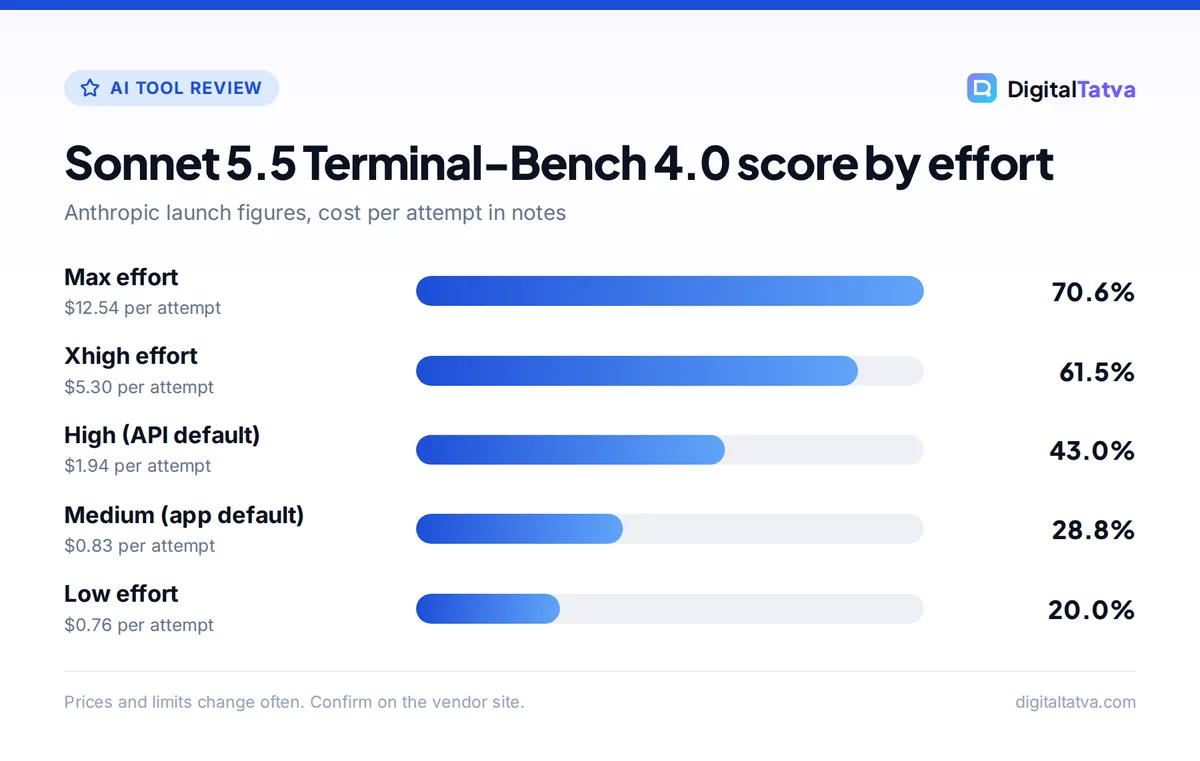
The headline 70.6% comes from max effort. Here is how the same test scores at each level, with Anthropic’s cost per attempt.
| Effort | Terminal-Bench 4.0 | Cost per attempt | Where it is the default |
|---|---|---|---|
| Max | 70.6% | $12.54 | None |
| Xhigh | 61.5% | $5.30 | None |
| High | 43.0% | $1.94 | Claude API |
| Medium | 28.8% | $0.83 | Claude apps and Claude Code |
| Low | 20.0% | $0.76 | None |
Going from medium to max multiplies the cost per attempt by about 15 ($12.54 / $0.83) and more than doubles the score. For hard agent tasks, raising effort is worth it. For quick edits and chat, medium is fine and saves a lot of usage.
Tip: In Claude Code, raise effort only for large refactors or failing test suites. Keep everyday prompts on medium so your usage limits last longer.
Claude Sonnet 5.5 pricing
In the Claude apps
Sonnet 5.5 is available on the free Claude plan, with usage limits. Pro costs $20 a month ($17 a month billed annually) and adds more usage, Claude Code and Opus models. Max costs $100 or $200 a month. Our Claude pricing guide and Claude Pro vs Max comparison help you pick a plan.
On the API
Here is a worked example for a support chatbot that handles 20,000 conversations a month, each with 3,000 input tokens (mostly a shared system prompt) and 500 output tokens. That is 60M input and 10M output tokens.
- No caching: 60 x $2 = $120 input, plus 10 x $10 = $100 output. Total: $220 a month.
- With 2,500 of the 3,000 input tokens cached: 50M cached at $0.10 = $5, plus 10M fresh at $2 = $20, plus $100 output. Total: about $125 a month, ignoring the small cost of cache writes.
- Same job on Opus 5.5 without caching: 60 x $4 = $240, plus 10 x $20 = $200. Total: $440.
The full rate card is in our Claude API pricing breakdown, and our guide on estimating AI API costs shows how to model your own traffic. Official prices are on Anthropic’s pricing page.
Sonnet 5.5 vs Opus 5.5 vs GPT-6 Sol
| Question | Sonnet 5.5 | Opus 5.5 | GPT-6 Sol |
|---|---|---|---|
| Price per 1M (in / out) | $2 / $10 | $4 / $20 | $2 / $10 |
| Context window | 1M | 1M | About 1.05M |
| Knowledge work (GDPval-AA) | 1844 | 1846 | 1487 |
| Best for | Coding agents, writing, everyday work | Hard reasoning, long open-ended tasks | OpenAI workflows at the same price |
| Free in its chat app | Yes | No, Pro and up | No, runs in ChatGPT Work and Codex |
Anthropic itself says Opus 5.5 remains clearly stronger on complex, open-ended work. In practice, start every new project on Sonnet 5.5 and switch to Opus only where Sonnet fails. Our GPT-6 vs Claude vs Gemini comparison and model routing guide go deeper on mixing models.
Breaking changes for developers
- Remove sampling parameters. Sending temperature or similar settings returns a 400 error.
- Replace thinking budgets with effort. Manual thinking budgets and disabled thinking are rejected. To limit thinking, use the between_tools thinking type, which works only at low, medium and high effort.
- Drop assistant prefill and forced tool choice. Both now return errors; use structured outputs or strict tool schemas instead.
- Update computer use. Move to the computer_toolset_20260801 toolset on the Claude API and Google Cloud.
- Keep effort steady in a session. Effort cannot change mid-conversation at xhigh or max.
Anthropic’s models overview has the latest migration notes.
Pros and cons
Pros
- Huge coding gains over Sonnet 5 at the same price.
- Within a few points of Opus 5.5 at half the cost.
- Free to use in the Claude apps.
- Cheaper caching from 512 tokens and $0.10 reads.
Cons
- Headline scores need max effort, which costs about 15 times more per attempt than medium.
- Several breaking API changes.
- Some security requests fall back to Sonnet 5.
- Still behind Opus 5.5 on hard open-ended tasks.
Frequently asked questions
Is Claude Sonnet 5.5 free?
Yes, in the Claude apps. Free accounts can chat with Sonnet 5.5 within the free plan’s usage limits, and Pro at $20 a month gives more usage. On the API it costs $2 per million input tokens and $10 per million output tokens, or half that on the Batch API.
When was Claude Sonnet 5.5 released?
Anthropic released Claude Sonnet 5.5 on September 28, 2026, six days after Opus 5.5 and nine days before Haiku 5.5. Anthropic says it will not retire Sonnet 5.5 before September 28, 2027.
Is Sonnet 5.5 better than Opus 5.5?
Not overall. Sonnet 5.5 edges Opus 5.5 on Terminal-Bench 4.0 (70.6% vs 66.4%), but Opus leads on most other benchmarks and on complex open-ended work. Sonnet costs half as much, so it is the better value for most coding, writing and analysis.
Is Claude Sonnet 5.5 better than GPT-6 Sol?
On Anthropic’s published numbers, yes for knowledge work: 1844 vs 1487 on GDPval-AA, and 52.1% vs 49.3% on FrontierCode at xhigh effort. Both cost $2 input and $10 output per million tokens. Test both on your own tasks, since results vary by workload.
What is the context window of Sonnet 5.5?
Sonnet 5.5 has a 1M token context window and up to 128K tokens of output per response, or 300K on the Batch API with a beta header. Its knowledge cutoff is June 2026, so use web search for newer facts.
Final verdict
Claude Sonnet 5.5 is the model most people should use by default in 2026. It brings near-flagship coding and knowledge work at $2 and $10 per million tokens, it is free in the Claude apps, and cheaper caching makes high-volume apps affordable. Raise effort only when a task is genuinely hard, and keep Opus 5.5 for the problems Sonnet cannot crack. Prices and limits change, so confirm current rates on Anthropic’s pricing page before you commit.
Related reading: our full Claude review and ChatGPT vs Claude.
Pricing and features are checked at the time of writing and can change. Some links may be affiliate links, which never affect our verdicts.