Claude Pro vs Max: Which Plan Fits Your Usage?
Claude Pro costs $20 and suits most users. Max costs $100 or $200 for 5x or 20x usage. Learn how limits work and when upgrading to Max pays off.

On this page
Claude Pro at $20 a month is enough for most writers, marketers and students, while Claude Max ($100 for 5x usage or $200 for 20x usage) is built for people who hit Pro’s five-hour limit several times a week, especially heavy Claude Code users. The only real difference is how much you can use Claude per session and per week; the core models and features are largely the same.
This guide explains how the usage limits work, what each plan costs in USD and INR, and a simple test for deciding whether you should upgrade. Every price and limit here was checked against Anthropic’s pricing page and help center in September 2026.
Key takeaways
- Pro costs $20/month, or $17/month on annual billing ($200 paid up front).
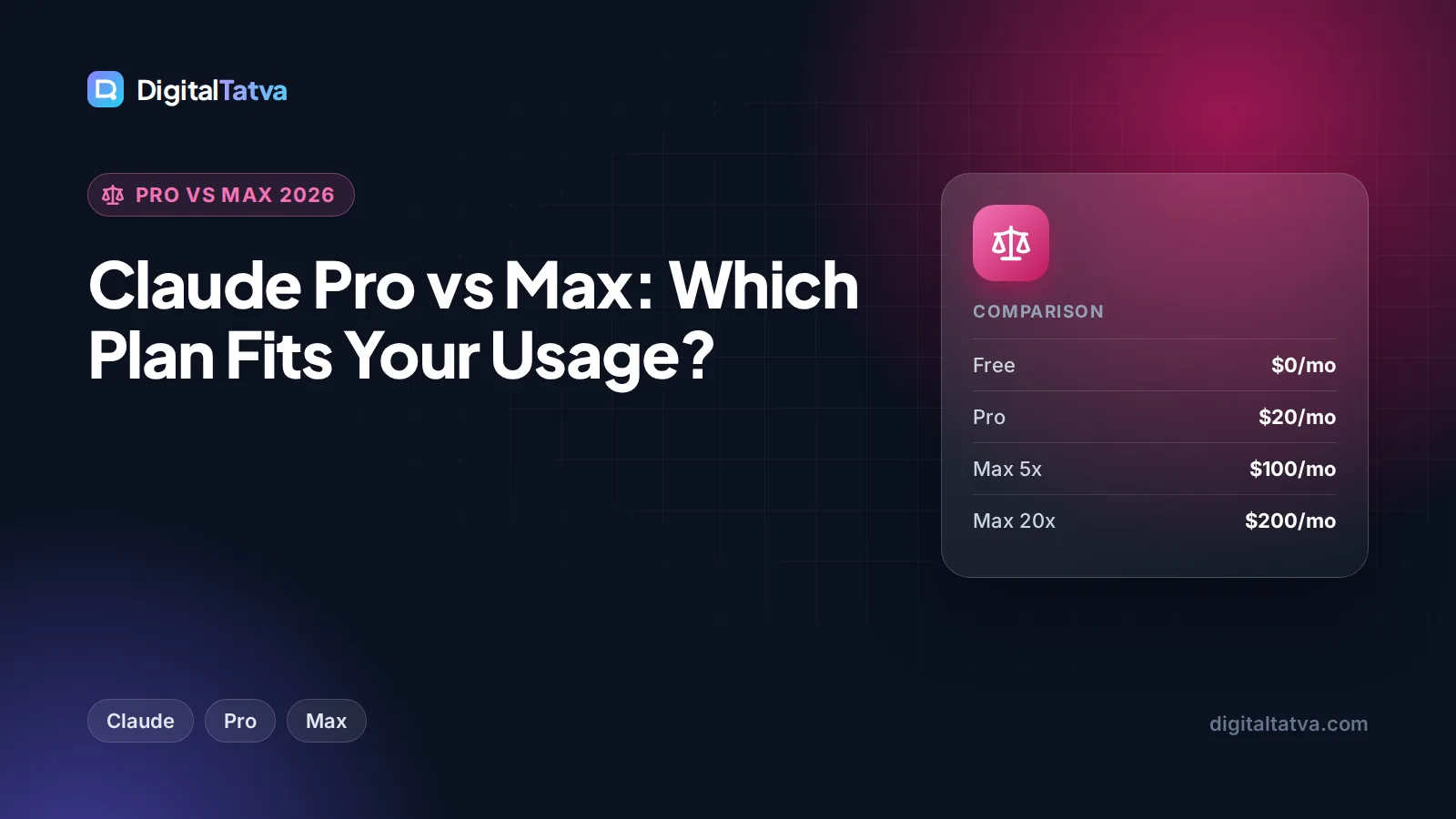
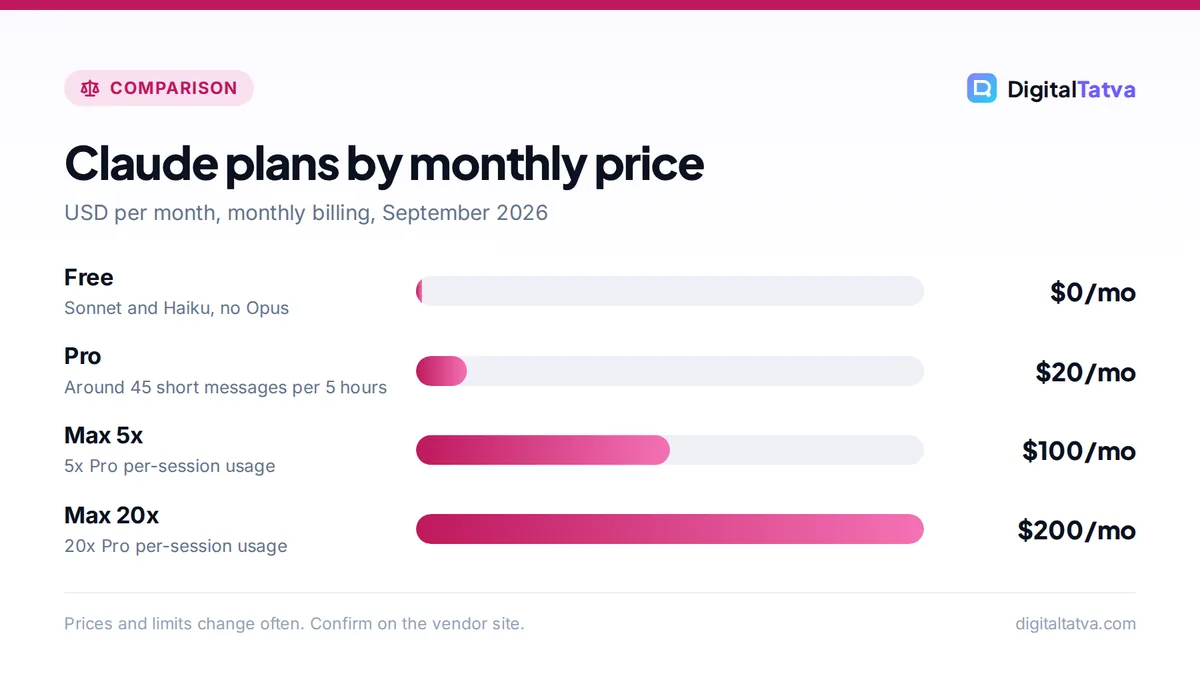
- Max 5x costs $100/month and Max 20x costs $200/month, giving 5x or 20x Pro’s per-session usage.
- Both plans reset usage every five hours, and Max also has a weekly limit across all models.
- Claude chat and Claude Code share one usage pool, so coding eats into your chat allowance.
- Start on Pro. Upgrade only when you hit limits often enough that the lost time costs more than $80 a month.
Claude Pro vs Max at a glance
Max is best understood as more of Pro rather than a different product. You get the same apps, the same Opus and Sonnet models and the same tools such as Projects and Claude Code. What changes is capacity, plus a few extras like higher output limits, early access to new features and priority during peak traffic.
| Feature | Pro | Max 5x | Max 20x |
|---|---|---|---|
| Monthly price | $20 | $100 | $200 |
| Annual price | $17/mo ($200/yr) | Not listed | Not listed |
| Usage per 5-hour session | Baseline (1x) | 5x Pro | 20x Pro |
| Rough messages per session | Around 45 short messages | At least about 225 | At least about 900 |
| Weekly limit | May apply | Yes, across all models | Yes, across all models |
| Opus models | Yes | Yes | Yes |
| Claude Code | Yes (shared limits) | Yes (shared limits) | Yes (shared limits) |
| Higher output limits | No | Yes | Yes |
| Priority at peak times | No | Yes | Yes |
| Early access to new features | No | Yes | Yes |
The message counts are Anthropic’s own rough estimates, not guarantees. Real numbers depend on message length, attachments, how long the conversation is and which model you use. For a deep dive into how limits are calculated, see our guide to Claude usage limits and how to make them last.
How Claude usage limits actually work
The five-hour session window
On both Pro and Max, your usage allowance resets every five hours. Anthropic’s help center estimates “around 45 messages every five hours” on Pro for short conversations on less compute-heavy models. On Max, the estimate is at least 225 messages per session on the 5x tier and about 900 on the 20x tier.
The key word is “short”. Claude rereads the whole conversation each time you send a message, so a long thread with big file uploads uses far more of your allowance than a fresh chat. Our plain-English guide to what tokens are in AI explains why length matters so much.
The weekly cap
Max plans “also have a weekly usage limit that applies across all models”. Anthropic says Pro may also face weekly or monthly caps, or limits on specific models or features. In practice, this means Max 20x is not unlimited: someone running Claude Code all day, every day, can still reach the weekly ceiling.
Claude Code shares the same pool
Claude and Claude Code draw from one allowance on every plan. If you spend the morning on an agentic coding task, you will have less left for chat in that session. This is the main reason developers upgrade to Max. You can also switch Claude Code to pay-as-you-go API credits through the Console if you would rather not change plans.
Tip: Start a new chat when you change topics, and put reference files into a Project instead of pasting them into every conversation. Both habits stretch Pro limits a long way. Learn more in our guide to using Claude Projects to organize your work.
What Claude Pro includes
Pro is Anthropic’s main individual plan. On top of the Free plan’s chat, web search, file creation, code execution, memory, connectors and Artifacts, Pro adds more usage, Claude Code, Projects, task scheduling, Claude Design, Slides and Docs, Claude Science, Opus models, and the Chrome and Microsoft 365 extensions. Fable is available on usage credits.
The Free plan does not include Opus, so Pro is the cheapest way to use Claude Opus 5.5, Anthropic’s recommended model for most work. Paid plans get a 200K-token base context window for chat, rising to 1M tokens on models including Opus 5.5 and Sonnet 5.5. That is enough to work with long reports, contracts and research papers in one go.
Pro is best for: writers, marketers, consultants, students and part-time coders who use Claude daily but in focused bursts. If you rarely see a limit warning, stay here.
What Claude Max includes
Max keeps everything in Pro and multiplies your per-session usage by 5 or 20. It adds higher output limits (useful for long documents and big code changes), early access to new features and priority during peak traffic, which means fewer slowdowns when demand is high.
Max 5x ($100)
The 5x tier is the sweet spot for people who hit Pro limits once or twice a day. Think full-time content teams of one, consultants drafting long reports, or developers who use Claude Code for a few hours at a time.
Max 20x ($200)
The 20x tier is for people who work in Claude all day, run parallel Claude Code sessions, or process large documents constantly. At twice the price of 5x, it gives four times the per-session usage, so it is better value per unit if you truly need that much. Anthropic does not list annual pricing for either Max tier.
Watch out: Max 20x is not unlimited. The weekly limit applies across all models, so even the top plan can run out during an intense week. Plan heavy batch work around your reset times.
Pricing in USD and INR
| Plan | USD monthly | USD annual | INR monthly (press reports, incl. GST) |
|---|---|---|---|
| Free | $0 | $0 | Rs 0 |
| Pro | $20 | $17/mo ($200/yr) | About Rs 2,000 |
| Max 5x | $100 | Not listed | From about Rs 11,999 |
| Max 20x | $200 | Not listed | Not reported |
| Team Standard | $25/seat | $20/seat | About Rs 2,999 (Rs 2,399 annual) |
| Team Premium | $125/seat | $100/seat | About Rs 14,999 (Rs 11,999 annual) |
Anthropic introduced rupee pricing in July 2026, according to Business Today and Open Magazine. We could not confirm the INR figures on Anthropic’s own site, which showed USD when checked, so treat them as approximate and confirm at checkout. For the full picture of every plan, read our Claude pricing guide for 2026.
Save money: Annual Pro billing works out to $17 a month instead of $20, saving $40 a year. It only makes sense if you are sure you will use Claude every month. Our guide to annual vs monthly AI plans shows how to decide.
Should you upgrade from Pro to Max?
- Count your limit hits. For two weeks, note each time Claude tells you to wait for a reset. If it is fewer than two or three times a week, stay on Pro.
- Fix wasteful habits first. Start fresh chats, use Projects for reference files, and use Sonnet 5.5 for lighter tasks. These changes often stretch Pro further than an upgrade would.
- Put a price on the wait. If a five-hour lockout costs you billable time or delays client work, estimate what that is worth each month.
- Compare against the $80 difference. Max 5x costs $80 more than Pro. If lost time is worth more than that, upgrade to 5x.
- Go to 20x only if 5x still caps you. The jump is another $100, so reserve it for all-day, heavy use.
A worked example
Imagine a freelance developer billing $50 an hour who hits Pro’s limit three times a week and waits about an hour each time. That is roughly 12 hours a month, or $600 of idle time. Paying $80 extra for Max 5x is an easy call. A blogger who hits the limit once a week and simply switches to other work loses little, so Pro remains the better deal.
Alternatives to Claude Max
Team Premium seats
If two or more people need heavy access, Claude Team may beat individual Max plans. Premium seats cost $125 a month ($100 annual) and include 6.25x Pro’s per-session usage plus a weekly limit, along with admin controls and shared knowledge bases. Standard seats at $25 ($20 annual) give 1.25x Pro usage. Teams need at least 2 seats. See our guide to AI team plans for when business seats save money.
The Claude API
For bursty or automated work, pay-as-you-go can be cheaper. Claude Opus 5.5 costs $4 per million input tokens and $20 per million output tokens, and Sonnet 5.5 costs $2 and $10. A long session with 200,000 input tokens and 30,000 output tokens on Opus 5.5 costs $0.80 plus $0.60, or $1.40. You would need around 57 such sessions a month to match the $80 gap between Pro and Max 5x. Details are in our Claude API pricing guide.
Other assistants
ChatGPT Pro and Google AI Ultra sit at similar price points. If you are weighing the ecosystems, read our ChatGPT vs Claude comparison or ChatGPT Plus vs Pro for the OpenAI side of the same decision.
Max pros
- 5x or 20x Pro’s per-session usage
- Higher output limits for long work
- Priority during peak traffic
- Far more room for Claude Code
Max cons
- 5x to 10x the price of Pro
- Weekly limit still applies
- No annual discount listed
- Same models as Pro, so no quality jump
Frequently asked questions
Is Claude Max worth it?
Claude Max is worth it if you hit Pro’s five-hour limit several times a week and those waits cost you real work, which is common for Claude Code users. It does not give you better models, only more usage and priority. If you rarely see limit warnings, Pro at $20 is the better value.
What is the difference between Max 5x and Max 20x?
Max 5x costs $100 a month and gives five times Pro’s per-session usage, while Max 20x costs $200 and gives twenty times. Anthropic estimates at least 225 and 900 messages per five-hour session respectively. Both tiers share a weekly limit across all models and include the same features.
Does Claude Pro include Claude Code?
Yes. Claude Code is included on Pro, Max, Team and Enterprise, but not on the Free plan. It shares one usage allowance with the Claude chat app, so long coding sessions reduce the chat usage left in that five-hour window. You can switch Claude Code to API credits if you need more.
How much does Claude Max cost in India?
Press reports say Anthropic launched rupee pricing in July 2026, with Pro at about Rs 2,000 a month and Max from about Rs 11,999 a month, including GST. The Max 20x rupee price was not reported separately, and we could not confirm INR prices on Anthropic’s own site, so check at checkout.
Can I switch from Pro to Max and back?
Anthropic lets you change plans from your account settings, so you can upgrade for a busy month and drop back later. Check the billing terms shown when you switch, since proration and timing can vary. Because Max has no listed annual option, monthly flexibility is the norm.
Verdict: Pro for most, Max for heavy users
Choose Claude Pro if you are a writer, marketer, student or occasional coder. At $20 (or $17 on annual billing) it unlocks Opus, Projects and Claude Code, and good habits keep you under the limits. Choose Max 5x if you hit limits daily or use Claude Code for hours at a stretch, and Max 20x only if Claude is your main work tool all day. For a full overview of the product, read our Claude review for 2026.
Check plan details on the official Claude pricing page and the Max plan help article. Prices and usage limits change, so confirm the current terms on Anthropic’s site before you upgrade.
Pricing and features are checked at the time of writing and can change. Some links may be affiliate links, which never affect our verdicts.