AI Statistics 2026: Key Facts on Usage, Adoption and Business
The key AI statistics for 2026 with sources: ChatGPT's 1 billion weekly users, Google AI usage, business adoption, productivity gains, investment, public opinion and AI fraud risk.

On this page
- Key takeaways
- AI statistics at a glance
- Consumer AI usage statistics
- Business AI adoption statistics
- AI at work and productivity statistics
- Global AI adoption statistics
- AI investment and infrastructure statistics
- Public opinion on AI
- AI risk and security statistics
- AI search and marketing statistics
- How to cite these AI statistics
- Frequently asked questions
- Summary
The most important AI statistics for 2026 are these: ChatGPT passed 1 billion weekly active users in August 2026, Google’s AI Overviews reach more than 2.5 billion people a month, 88% of organizations now use AI in at least one business function, and generative AI reached 53% population-level adoption within three years, faster than the PC or the internet. At the same time, only about 6% of companies report significant profit impact from AI, and fewer than 1 in 5 working-age people worldwide use AI tools.
This page collects the most useful AI statistics of 2026 in one place, grouped by consumer usage, business adoption, work and productivity, investment, public opinion and risk. Every figure lists its source and date so you can cite it with confidence. We update this page as major reports are released.
Key takeaways
- ChatGPT crossed 1 billion weekly active users in August 2026, up from 800 million in October 2025.
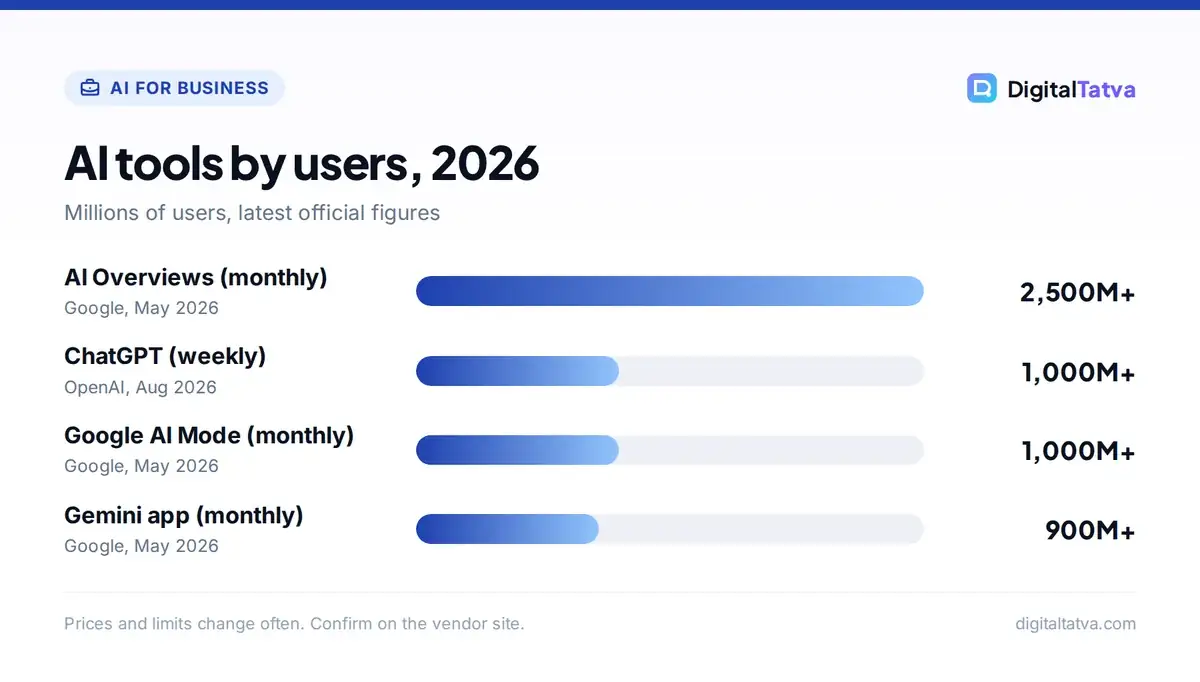
- Google reported 2.5 billion+ monthly users for AI Overviews, 1 billion+ for AI Mode and 900 million+ for the Gemini app at I/O 2026.
- McKinsey found 88% of organizations use AI regularly, and generative AI use jumped from 33% in 2024 to 72% in 2026, but only about 6% are “high performers”.
- Stanford’s AI Index 2026 found AI raises productivity by 14% to 15% in customer support, 26% in software development and up to 50% in marketing.
- Microsoft estimates 17.8% of the world’s working-age population uses AI, with a 12-point gap between richer and poorer regions.
AI statistics at a glance
| Statistic | Figure | Source and date |
|---|---|---|
| ChatGPT weekly active users | 1 billion+ | OpenAI, reported August 2026 |
| AI Overviews monthly users | 2.5 billion+ | Google I/O, May 2026 |
| Google AI Mode monthly users | 1 billion+ | Google I/O, May 2026 |
| Gemini app monthly users | 900 million+ | Google I/O, May 2026 |
| Organizations using AI in at least one function | 88% | McKinsey State of AI, 2026 |
| Organizations using generative AI | 72% (up from 33% in 2024) | McKinsey State of AI, 2026 |
| Population adoption of generative AI after 3 years | 53% | Stanford AI Index 2026 |
| Working-age people using AI worldwide | 17.8% | Microsoft, Q1 2026 data |
| US private AI investment | $285.9 billion (2025) | Stanford AI Index 2026 |
| ChatGPT share of chatbot market | About 79% | StatCounter, August 2026 |
Consumer AI usage statistics
ChatGPT
- ChatGPT launched on November 30, 2022 and reached 100 million monthly users within about two months, one of the fastest adoption curves for any app.
- It had 800 million weekly active users in October 2025, about 900 million in February 2026, and crossed 1 billion weekly active users in an OpenAI announcement reported on August 6, 2026.
- StatCounter put ChatGPT’s share of chatbot traffic at about 79% in August 2026.
- OpenAI began testing ads on the free US tier in January 2026, and ChatGPT ad revenue was reported at $1 billion by August 2026.
Today most users are on the free plan, which runs GPT-5.6 Luna. See our ChatGPT Free vs Plus comparison for what each plan includes.
Google Gemini, AI Overviews and AI Mode
- AI Overviews in Google Search reach more than 2.5 billion monthly users (Google I/O, May 19, 2026).
- AI Mode passed 1 billion monthly users about a year after launch.
- The Gemini app has more than 900 million monthly users.
Source: Google’s I/O 2026 keynote recap. Learn how to use the chat-style search in our Google AI Mode guide.
Meta
- Meta’s apps (Facebook, Instagram, WhatsApp, Messenger) reached 3.60 billion daily active people in June 2026, the audience Meta AI is built into.
- Meta expects 2026 capital expenditure of $130 billion to $145 billion, largely for AI infrastructure.
Our guide on how to use Meta AI covers it on WhatsApp and Instagram.
Business AI adoption statistics
- 88% of organizations use AI regularly in at least one business function (McKinsey, 2026, 1,719 respondents).
- 72% use generative AI, up from 33% in 2024 (McKinsey).
- About 6% are AI high performers that attribute significant company-wide profit to AI (McKinsey).
- 70% of organizations use AI in at least one function, while autonomous AI agent deployment remains in single digits (Stanford AI Index 2026).
- One-third of surveyed organizations expect AI-driven workforce reductions within a year (Stanford AI Index 2026).
The gap between using AI and profiting from it is the big business story of 2026. Our guides to measuring AI ROI and AI for small business show how to close it, and our explainer on AI agents covers the next wave.
AI at work and productivity statistics
| Area | Productivity gain from AI |
|---|---|
| Customer support | 14% to 15% |
| Software development | 26% |
| Marketing | Up to 50% |
Source: Stanford AI Index 2026. The report notes gains shrink for tasks that need deeper reasoning.
- 58% of surveyed employees use AI at work semi-regularly or regularly, and the share is above 80% in India, China, Nigeria, the UAE and Saudi Arabia (Stanford).
- Employment of US software developers aged 22 to 25 fell nearly 20% since 2024, while older developer headcount rose (Stanford).
- Four in five US university and high school students use generative AI for schoolwork, but only half of middle and high schools have AI policies (Stanford).
- Estimated US consumer surplus from generative AI reached $172 billion a year by early 2026 (Stanford).
Want to stay ahead? See our list of AI skills to learn in 2026.
Global AI adoption statistics
- Generative AI reached 53% population-level adoption within three years of mass-market launch, faster than the PC or the internet (Stanford).
- Microsoft estimates 17.8% of the world’s working-age population (15 to 64) used AI in Q1 2026, up from 16.3%.
- The UAE leads Microsoft’s ranking at 70.1%; the US is 21st at 31.3%.
- Adoption is 27.5% in the Global North versus 15.4% in the Global South, a widening 12.1-point gap (Microsoft).
- Stanford ranks the US 24th at 28.3% adoption, with Singapore at 61% and the UAE at 54%.
See Microsoft’s global AI diffusion report and Meta’s Q2 2026 results for the underlying data.
Note: Adoption figures differ because each study measures something different, such as working-age users of AI tools (Microsoft) or survey-based population adoption (Stanford). Always cite the specific source and definition.
For India-specific numbers, see our dedicated page on AI in India statistics.
AI investment and infrastructure statistics
- US private AI investment reached $285.9 billion in 2025 (Stanford).
- The US hosts 5,427 AI data centers, more than 10 times any other country (Stanford).
- Meta guided $130 billion to $145 billion in 2026 capital expenditure (Meta, July 2026).
- China leads in AI research publication volume, citations and patent grants (Stanford).
Competition is pushing model prices down fast; our LLM API pricing comparison shows budget models now cost as little as $0.10 per million input tokens.
Public opinion on AI
- 59% of people said AI offers more benefits than drawbacks in 2025, while 52% said AI products make them nervous (Stanford).
- 73% of AI experts expect AI to have a positive impact on jobs, versus 23% of the US public (Stanford).
- Experts predict AI will assist with 80% of US work hours by 2030; the public estimates 10% (Stanford).
- Only 31% of Americans trust their government to regulate AI responsibly, against a 54% global average (Stanford).
AI risk and security statistics
- 84% of organizations hit by ransomware said attackers used AI somewhere in the attack (Semperis survey, October 2026).
- Deloitte forecasts generative AI could push US fraud losses to $40 billion by 2027, up from $12.3 billion in 2023.
- McAfee reported that about three seconds of audio can be enough for an 85% voice clone match.
Our guide on spotting deepfake and voice clone scams turns these numbers into practical protection.
AI search and marketing statistics
- AI search tools draw on web pages they can quote. A KDD 2024 study found that adding quotations, statistics and citations raised visibility in AI answers by up to about 40%, while keyword stuffing lowered it.
- With billions of people seeing AI Overviews, being cited in AI answers matters as much as ranking. See our guide to ranking in AI search.
How to cite these AI statistics
Cite the original source, not this page, where you can, and include the date. For example: “ChatGPT has more than 1 billion weekly active users (OpenAI, August 2026).” If you use this page as your reference, link to it so readers can find the full list. For context on the technology itself, see our explainer on what generative AI is and our roundup of the best AI tools in 2026.
Frequently asked questions
How many people use AI in 2026?
Hundreds of millions to billions, depending on the measure. ChatGPT alone passed 1 billion weekly active users in August 2026, and Google’s AI Overviews reach more than 2.5 billion monthly users. Microsoft estimates 17.8% of the world’s working-age population actively uses AI tools.
What percentage of companies use AI?
McKinsey’s 2026 survey found 88% of organizations use AI regularly in at least one business function, and 72% use generative AI, up from 33% in 2024. Only about 6% report significant company-wide profit impact from AI.
How many users does ChatGPT have?
ChatGPT crossed 1 billion weekly active users in August 2026, according to an OpenAI announcement. It had 800 million weekly users in October 2025 and about 900 million in February 2026.
Does AI improve productivity?
Yes, in many tasks. Stanford’s AI Index 2026 reports gains of 14% to 15% in customer support, 26% in software development and up to 50% in marketing, with smaller gains on tasks that need deeper reasoning.
How fast is AI being adopted compared with the internet?
Faster. Stanford’s AI Index 2026 found generative AI reached 53% population-level adoption within three years of its mass-market launch, a faster rate than the personal computer or the internet achieved.
Summary
AI in 2026 is mainstream for consumers and near-universal in large companies, but real financial returns are still concentrated in a small group of leaders, and adoption is uneven across countries. Use these statistics with their sources and dates, and check back as new reports land. Figures change quickly, so confirm the latest numbers with each original publisher before you publish them.
Pricing and features are checked at the time of writing and can change. Some links may be affiliate links, which never affect our verdicts.