How to Spot AI Deepfake and Voice Clone Scams, and What to Do
How AI voice cloning and deepfake scams work, the warning signs, a 30-second verification routine, what to do in India (1930, cybercrime.gov.in, Chakshu) and business safeguards.

On this page
- Key takeaways
- How AI voice cloning and deepfake scams work
- Common types of deepfake scams in 2026
- Warning signs of an AI voice or video scam
- The 30-second verification routine
- What to do if you have been scammed in India
- How to protect your voice and face online
- Deepfake protection for businesses
- Can AI detect deepfakes?
- Frequently asked questions
- The bottom line
An AI voice cloning scam uses a few seconds of someone’s voice, often taken from social media, to fake a call from a family member, boss or official who urgently needs money. The safest way to spot one is not to judge the voice at all: hang up, call the person back on a number you already have, and ask a family code word. In India, if you have been cheated, call the national cyber crime helpline 1930 or report at cybercrime.gov.in immediately, and report suspicious calls and messages on Sanchar Saathi’s Chakshu facility.
Deepfake video calls and cloned voices are now good enough that most people cannot tell them apart from the real thing. This guide explains how these scams work, the warning signs, a verification routine for families and businesses, what to do in the first hour if you paid, and how to protect your voice and face online.
Key takeaways
- Scammers need only a short voice sample; ICICI Bank warns 5 to 10 seconds from a public video or voice note can be enough.
- The scam always pairs a familiar voice or face with urgency, secrecy and an instant payment request by UPI, QR code or bank transfer.
- Do not try to detect fakes by ear. Verify through a separate channel: call back on a saved number or ask a pre-agreed code word.
- If you paid, call 1930 or report at cybercrime.gov.in right away and inform your bank; speed improves the chance of freezing funds.
- Businesses need a two-person approval rule for payments; one firm lost about US$25.6 million after a deepfake video call with fake colleagues.
How AI voice cloning and deepfake scams work
AI voice tools can now copy how a person sounds from a short recording. Security firm McAfee reported that about three seconds of audio can be enough for a voice clone with an 85% match. Video deepfakes go further, putting a real person’s face on a live video call. The tools themselves are legitimate, the same technology behind AI voice generators and voice cloning for creators, but scammers misuse them.
ICICI Bank’s advisory describes the typical sequence:
- Collect a voice sample. From school performance videos, birthday reels, vlogs or forwarded voice notes.
- Create panic. A fake kidnapping, accident, arrest or medical emergency, often with crying or a stern “officer” in the background.
- Hide the source. Calls come from masked, spoofed, internet or foreign numbers.
- Play the cloned voice at the peak moment. A few words in a loved one’s voice override doubt.
- Demand instant payment. UPI, wallet or QR code, right now.
- Disappear. The money is split across accounts within minutes.
Common types of deepfake scams in 2026
| Scam type | What happens | Red flag |
|---|---|---|
| Family emergency call | “Mom, I’ve been in an accident, send money” | Unknown number, panic, secrecy |
| Fake boss or CFO | Video or voice call asking finance to pay a vendor urgently | Bypasses normal approval process |
| Fake officials | “Police”, “customs” or “courier” calls threatening arrest | Demands payment to “settle” a case |
| Celebrity investment videos | Deepfake of a famous person promoting a scheme | Guaranteed returns, urgency |
| Romance and sextortion | Fake video identity, later blackmail | Moves fast to private apps and money |
| Customer support impersonation | Fake bank or app support on WhatsApp | Asks for OTP, PIN or screen sharing |
The business risk is real. In a widely reported 2024 case, an employee at engineering firm Arup in Hong Kong transferred HK$200 million (about US$25.6 million) across 15 transactions after a video call in which the “colleagues” were deepfakes. Deloitte has forecast that generative AI could push US fraud losses to $40 billion by 2027, up from $12.3 billion in 2023.
Warning signs of an AI voice or video scam
- Urgency plus secrecy: “Don’t tell anyone, I need it in 10 minutes.”
- Unusual payment method: UPI to an unknown name, gift cards, crypto or a “new” bank account.
- Unknown or masked number claiming to be someone you know.
- Refusal to verify: they will not let you call back or put someone else on.
- Odd details: they cannot answer a personal question, or the story changes.
- On video: blurry edges around the face, odd lighting, lips slightly out of sync, a stiff or blank expression, or a “bad connection” excuse when you ask them to turn their head.
Watch out: Do not rely on spotting glitches. In an iProov study, only 0.1% of participants correctly identified all the real and fake media they were shown. Modern fakes can look and sound perfect. Verification beats detection.
The 30-second verification routine
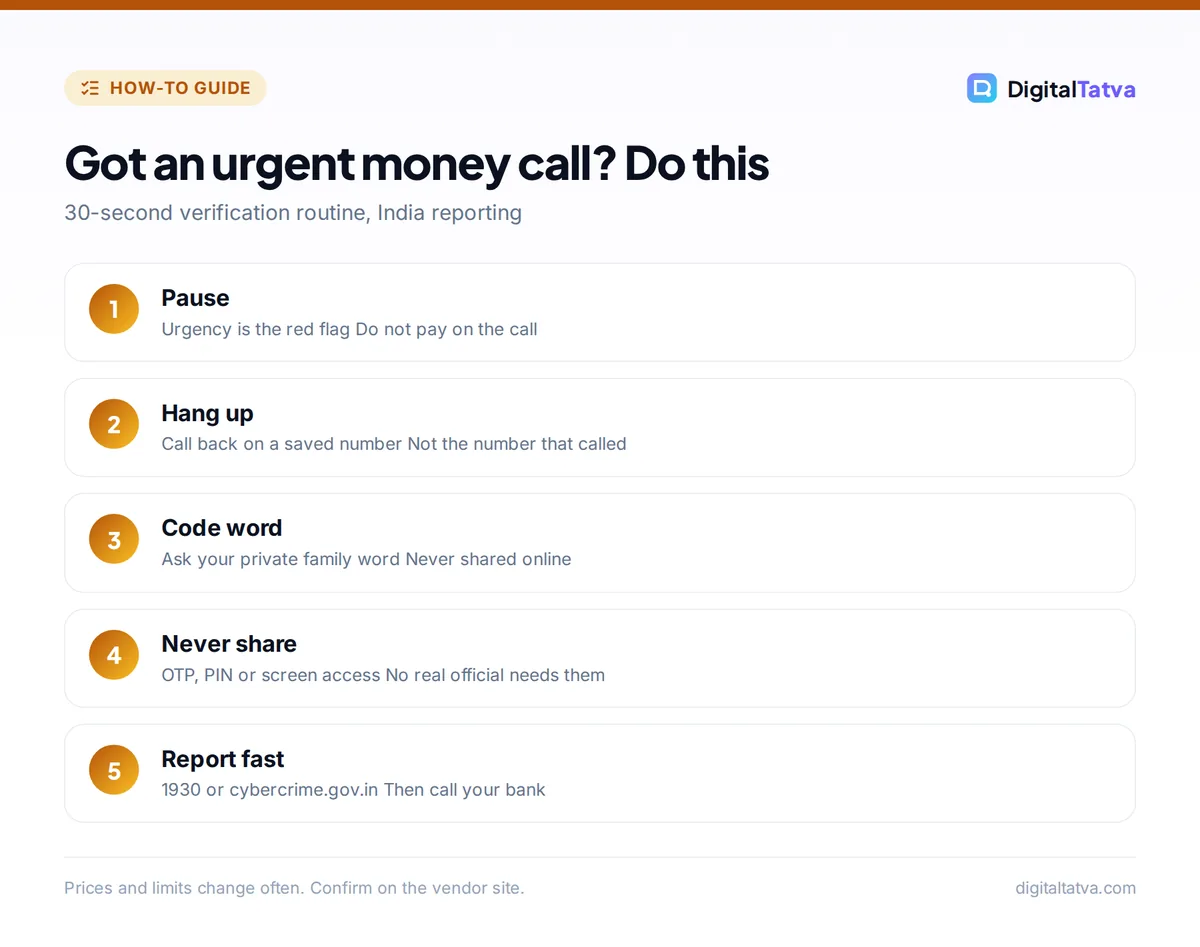
- Pause. Any request for urgent money is a reason to slow down, not speed up.
- Hang up and call back. Use the number saved in your phone, not the one that called you or one they give you.
- Ask the code word. Agree a family or office code word in advance that never appears online.
- Check with someone else. Call another family member or colleague who would know.
- Never share OTPs, PINs or screen access. No real bank, police officer or company needs them over a call.
Tip: Set your family code word this week, especially with parents and grandparents, who are frequent targets. Pick something memorable but private, like a childhood pet’s nickname.
What to do if you have been scammed in India
- Call 1930 immediately. This is the national cyber crime helpline. Reporting quickly gives the best chance of freezing the money in the scammer’s account.
- Report online at cybercrime.gov.in. File a complaint with transaction IDs, screenshots, phone numbers and times.
- Call your bank. Block cards or UPI if details were shared, and dispute the transaction. Under RBI rules, reporting an unauthorized transaction quickly, ideally within three working days, protects your rights.
- Report the number. Use Chakshu on the Sanchar Saathi portal (sancharsaathi.gov.in) to report suspected fraud calls, SMS and WhatsApp messages.
- Save evidence. Keep call logs, voice notes, chats and payment screenshots. Do not delete the conversation.
- Warn others. If your voice or face was cloned, tell family and colleagues so they do not fall for the same trick.
ICICI Bank’s voice-cloning scam advisory lists the same reporting channels. Outside India, contact your local police and your bank right away.
How to protect your voice and face online
- Limit public voice and video. Set personal social accounts to private, especially children’s videos and long voice notes.
- Think before posting greetings. Clear, long clips of your voice saying names and phrases are ideal training data for scammers.
- Do not answer unknown calls with long sentences. Scammers sometimes record your voice by keeping you talking.
- Use strong account security. Two-factor authentication stops scammers taking over your WhatsApp or email to message your contacts. Our guide to AI account safety covers similar settings.
- Be careful with AI apps. Only upload your voice or face to reputable services with clear deletion policies. Our guide to AI data privacy lists what to check.
Deepfake protection for businesses
Ransomware and fraud are increasingly AI-assisted: in an October 2026 survey by security firm Semperis, 84% of ransomware victims said attackers used AI somewhere in the attack. Every business, including small ones, should adopt a few simple controls.
- Two-person approval for new payees, changed bank details and urgent transfers above a set amount.
- Call-back rule: verify any payment request from a “senior” by calling them on a known number, even if the request came by video.
- Code phrases for finance teams and executives.
- Training: show staff real examples once a quarter and make it safe to question the boss.
- Customer warnings: tell customers you will never ask for OTPs or payments over WhatsApp, a common target for impersonation. See our guide to WhatsApp for business.
- Write it down: add these rules to your company AI and security policy; our AI usage policy template is a starting point.
Can AI detect deepfakes?
Deepfake detection tools exist, and some vendors report high accuracy in lab tests, but real-world performance is lower and new fakes keep improving. They are useful for companies screening media at scale, not as a family’s main defense. The same is true of text: our review of AI detectors shows how unreliable detection can be. For individuals, verification through a trusted channel remains the most reliable protection.
To understand how these fakes are made, read our explainer on what generative AI is and see how easily photos become video in our image to video AI guide.
Frequently asked questions
How do I know if a call is an AI voice clone?
You often cannot tell by listening, because good clones sound real. Treat any urgent request for money or secrecy as suspicious, hang up, and call the person back on a number you already have saved. Ask a pre-agreed family code word that has never been shared online.
How much voice do scammers need to clone someone?
Very little. ICICI Bank warns that 5 to 10 seconds from a public video or voice note can be enough, and McAfee reported that about three seconds of audio can produce a convincing match. Longer, clear recordings make clones more accurate.
Where do I report a deepfake scam in India?
Call the national cyber crime helpline 1930 or file a complaint at cybercrime.gov.in as soon as possible, then contact your bank to block or dispute transactions. Report suspicious numbers and messages through the Chakshu facility on the Sanchar Saathi portal.
Can I get my money back after a UPI scam?
Sometimes, if you act fast. Reporting immediately to 1930 and your bank can help freeze funds before they move. Banks follow RBI rules on unauthorized transactions, and quick reporting strengthens your claim, but recovery is not guaranteed once money has been moved on.
How can families protect elderly parents from voice scams?
Agree a family code word, save everyone’s correct numbers in their phone, and explain that no family member will ever ask for urgent money from a new number. Ask them to call you before paying anyone who claims to be in trouble.
The bottom line
AI voice cloning and deepfakes have made “I recognized the voice” worthless as proof. Protect yourself with habits, not detection: pause on urgent money requests, call back on a saved number, use a code word, and report fast through 1930 and cybercrime.gov.in if something goes wrong. Share this guide with your family and team today. Scam tactics and reporting systems change, so check official cyber crime and bank advisories for the latest guidance.
Related reading: AI voice changers explained and AI for small business.
Pricing and features are checked at the time of writing and can change. Some links may be affiliate links, which never affect our verdicts.