
How to Rank in AI Search: A GEO Guide for ChatGPT, Perplexity and AI Overviews
Generative engine optimization explained: what Google and OpenAI say, what the GEO research shows works, a practical checklist, crawler settings and how to track AI visibility.

On this page
- Key takeaways
- What is generative engine optimization?
- How AI search engines choose sources
- What Google and OpenAI officially say
- What the research says works
- A practical GEO checklist
- How to track your AI search visibility
- Common GEO myths
- GEO for small businesses and agencies
- Frequently asked questions
- The bottom line
Generative engine optimization (GEO) is the practice of making your content easy for AI search tools such as ChatGPT search, Perplexity, Google AI Overviews and AI Mode to find, trust and cite. The short answer to “how do I rank in AI search?” is: keep doing solid SEO, let AI crawlers in, and write pages that contain clear answers, real statistics, quotes and cited sources. Google says there are no extra requirements to appear in AI Overviews or AI Mode, and a peer-reviewed GEO study found that adding quotations, statistics and citations raised visibility in AI answers by up to about 40%.
This guide explains how AI search picks sources, what Google and OpenAI officially say, what the research shows works (and what backfires), a practical GEO checklist, how to track AI visibility and common myths. It is written for marketers, founders and agencies who want their brand mentioned when customers ask an AI instead of typing into a search box.
Key takeaways
- Generative engine optimization builds on SEO: AI Overviews and AI Mode only cite pages that are indexed and eligible for a snippet in normal Google Search.
- Google says no special schema, AI text files or other special optimizations are needed for its AI features.
- To appear in ChatGPT search, allow OpenAI’s OAI-SearchBot in robots.txt. Blocking GPTBot only stops training, not search visibility.
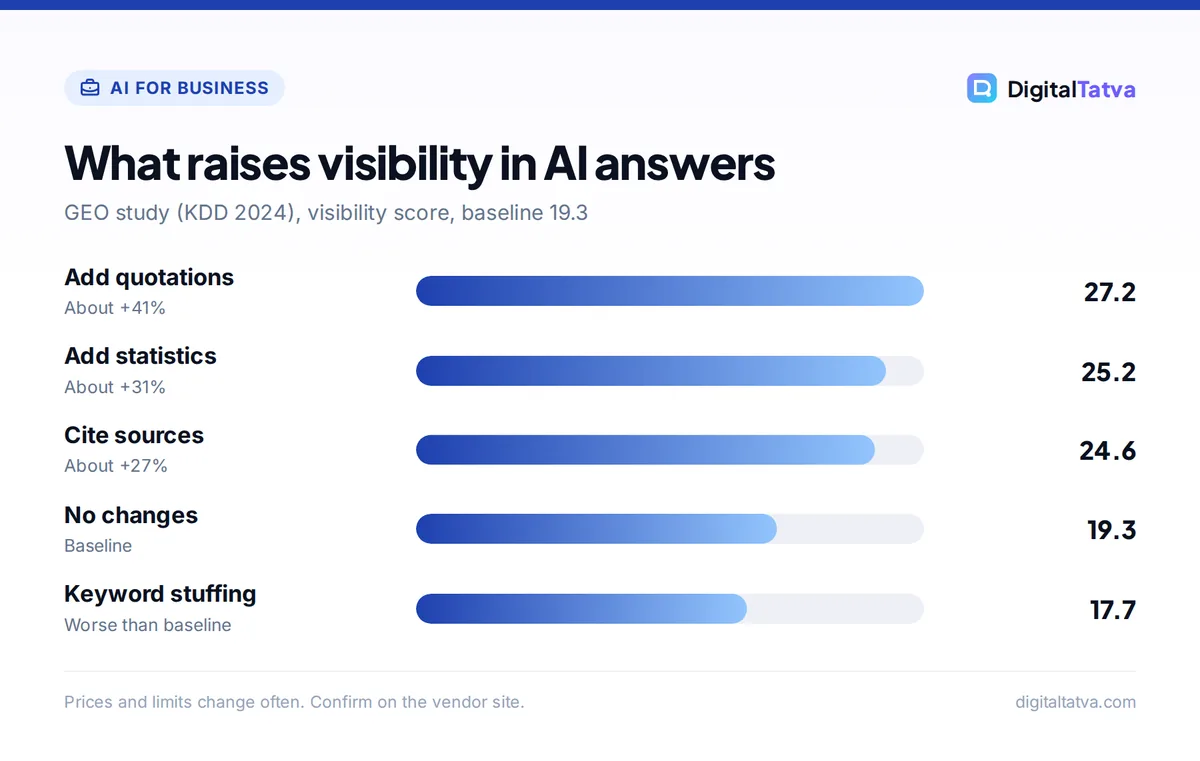
- In the KDD 2024 GEO study, adding quotations (about +41%), statistics (about +31%) and cited sources (about +27%) worked best; keyword stuffing made visibility worse.
- Track AI visibility by asking the AI tools your customers’ real questions every month and logging when your brand is cited.
What is generative engine optimization?
Traditional SEO aims to rank a page in a list of links. Generative engine optimization aims to get your brand, facts or page quoted inside an AI-written answer. The term comes from a 2023 research paper by authors from IIT Delhi and Princeton University, presented at the KDD 2024 conference, which defined GEO and built a benchmark to test it.
You will also hear AEO (answer engine optimization) and “AI visibility”. They describe the same goal from slightly different angles. In practice, the work overlaps heavily with good SEO and content strategy, which is why our guide to using ChatGPT for SEO and our list of the best AI SEO tools are useful companions to this one.
| Question | Classic SEO | Generative engine optimization |
|---|---|---|
| Goal | Rank a page in search results | Be cited or mentioned in AI answers |
| Where it shows | Google and Bing results pages | ChatGPT, Perplexity, AI Overviews, AI Mode, Gemini, Copilot |
| Main signals | Relevance, links, page experience | Same foundations, plus clear, quotable, well-sourced answers |
| How you measure | Rankings, clicks, impressions | Citations, brand mentions, referral traffic from AI tools |
How AI search engines choose sources
Most AI search tools follow a similar pattern. They take your question, run one or more searches behind the scenes, read the top results, then write an answer and link to the pages they used. Google calls this “query fan-out”: AI Mode and AI Overviews issue several related searches across subtopics to gather a wider set of sources.
That has two big implications. First, if a page cannot be crawled and indexed, it cannot be cited. Second, pages that answer one specific sub-question cleanly have more chances to be pulled in than one long page that buries the answer. Our guide to Google AI Mode shows how this looks from the user’s side.
What Google and OpenAI officially say
Google AI Overviews and AI Mode
Google’s Search Central guidance is unusually direct: “There are no additional requirements to appear in AI Overviews or AI Mode.” It says there is no special schema to add and no new machine-readable or AI text files to create. A page must be indexed and eligible to show with a snippet in normal Search. Google’s recommended practices are the usual ones: allow crawling, use internal links, offer a good page experience, keep important content in text, support it with quality images and video, make structured data match visible text, and keep Merchant Center and Business Profile details current.
Google also gives you controls. The nosnippet, data-nosnippet, max-snippet and noindex settings limit what is shown, and AI feature traffic appears in Search Console’s Performance report under the “Web” search type. Read the full Google guidance on AI features.
ChatGPT search
OpenAI uses separate crawlers for separate jobs. OAI-SearchBot finds pages for ChatGPT search, and OpenAI says sites that block it will not be shown in ChatGPT search answers. GPTBot collects data for training and does not control search visibility. ChatGPT-User visits a page only when a user asks ChatGPT to, and robots.txt rules may not apply to it. You can allow OAI-SearchBot while blocking GPTBot, and changes take about 24 hours to apply, per OpenAI’s crawler documentation.
User-agent: OAI-SearchBot
Allow: /

User-agent: GPTBot
Disallow: /
The example above lets your pages appear in ChatGPT search while opting out of training. Delete the GPTBot block if you are happy for your content to be used for training.
Perplexity
Perplexity runs its own crawler, PerplexityBot, and cites sources heavily in every answer. Make sure your robots.txt, CDN and firewall do not block it if you want Perplexity citations. Our Perplexity review explains how its answers are built.
What the research says works
The GEO study tested nine ways of rewriting web content and measured how much more often each page appeared in AI-generated answers. Scores below are the paper’s position-adjusted visibility measure, where the unchanged baseline scored 19.3.
| Method | Score | Change vs baseline |
|---|---|---|
| Add quotations from relevant experts | 27.2 | About +41% |
| Add statistics | 25.2 | About +31% |
| Fluency optimization (clearer writing) | 24.7 | About +28% |
| Cite sources | 24.6 | About +27% |
| Unchanged content (baseline) | 19.3 | None |
| Keyword stuffing | 17.7 | About 8% worse |
The lesson is simple: AI engines reward content that is specific, evidence-backed and easy to quote, and they do not reward old-school keyword repetition. The authors also found results varied by topic, so test changes in your own niche. You can read the GEO paper on arXiv.
A practical GEO checklist
- Fix the technical basics. Check that Googlebot, OAI-SearchBot and PerplexityBot are not blocked in robots.txt, your CDN or your firewall, and that key pages are indexed in Search Console.
- Answer the question in the first two sentences. Put a direct, quotable answer near the top, then expand. AI tools often lift exactly this kind of passage.
- Add real numbers. Prices, dates, limits and your own data make a page more citable. Every number needs a source or a clear method.
- Quote and cite. Include short quotes from credible experts or official documents and link to primary sources.
- Cover sub-questions. Use clear H2 and H3 headings for each related question your buyer asks, plus an FAQ section.
- Use tables and lists. Comparison tables and step lists are easy for both people and models to extract.
- Keep content in text. Do not hide key facts in images, PDFs or scripts that crawlers cannot read.
- Build brand mentions. AI answers draw on many sites. Reviews, directories, partner pages and press coverage help your brand appear even when your own page is not cited.
- Update regularly. AI search favors current facts for fast-changing topics. Add a visible “updated” date and refresh prices and figures.
Tip: Rewrite your top 10 money pages first. For each, add a two-sentence answer, one comparison table, three sourced statistics and a short FAQ. That covers most of what the research rewards. Our guide to writing blog posts with AI helps speed up the drafts.
How to track your AI search visibility
There is no single “AI rank” report yet, so combine three checks.
- Manual prompt tracking: list 20 to 50 real questions customers ask, such as “best CA firm for startups in Ahmedabad”. Each month, ask them in ChatGPT, Perplexity, Gemini and Google AI Mode, and log whether your brand is mentioned or cited.
- Search Console: AI Overviews and AI Mode clicks are included in the Performance report under “Web”. Watch pages that gain impressions without clicks, a sign you appear in AI answers.
- Analytics referrals: check traffic from chatgpt.com, perplexity.ai, gemini.google.com and copilot.microsoft.com in your analytics referral report.
Several SEO platforms now add AI visibility tracking; compare them in our AI SEO tools roundup.
Common GEO myths
- “You need an llms.txt file to rank in AI search.” Google says you do not need new AI text files for AI Overviews or AI Mode. It will not hurt, but it is not a ranking requirement there.
- “Special schema makes AI cite you.” Google says there is no special schema for AI features. Use normal structured data that matches your visible content.
- “Blocking GPTBot hides you from ChatGPT.” GPTBot is for training. Search visibility depends on OAI-SearchBot.
- “Stuff in more keywords.” The GEO study found keyword stuffing lowered visibility.
- “GEO replaces SEO.” AI features rely on the same index and quality signals. Weak SEO usually means weak AI visibility.
GEO for small businesses and agencies
Local and service businesses should start with the basics Google already uses: a complete Business Profile, consistent name and contact details, genuine reviews and pages that answer local questions. Agencies can package GEO as an add-on to SEO retainers: technical crawler checks, answer-first rewrites of key pages and a monthly AI visibility report. Our guides to AI for marketing agencies and AI for small business cover the wider toolkit, and our list of the best AI marketing tools helps with content production.
Frequently asked questions
What is generative engine optimization?
Generative engine optimization, or GEO, means shaping your content so AI search tools like ChatGPT, Perplexity and Google AI Overviews find, trust and cite it in their answers. It builds on SEO and focuses on clear answers, statistics, quotes and sources that are easy for AI models to quote.
Is GEO different from SEO?
It is an extension of SEO, not a replacement. Google says pages must be indexed and snippet-eligible to appear in AI Overviews and AI Mode, so SEO foundations still matter most. GEO adds answer-first writing, evidence and brand mentions across the web, and it measures citations rather than only rankings.
How do I get my website cited by ChatGPT?
Allow OpenAI’s OAI-SearchBot crawler in robots.txt and your firewall, make sure pages load as readable text, and publish clear, well-sourced answers to the questions your customers ask. Blocking GPTBot does not affect ChatGPT search, because GPTBot is only used for training.
Do I need llms.txt or special schema for AI Overviews?
No. Google’s Search Central guidance says there are no additional requirements, no special schema and no new AI text files needed to appear in AI Overviews or AI Mode. Use normal structured data that matches what is visible on the page.
How long does GEO take to work?
Crawler changes can apply within about a day for ChatGPT search, but citations depend on how often AI tools retrieve and trust your pages. Most businesses should expect to judge results over a few months of monthly prompt tracking, as with SEO.
The bottom line
Generative engine optimization is good SEO plus content that AI can quote with confidence. Let the right crawlers in, answer questions directly, back claims with numbers and sources, and track how often AI tools mention you. Skip the shortcuts: special files, special schema and keyword stuffing do not help, and stuffing hurts. AI search changes quickly, so recheck Google’s and OpenAI’s official guidance every few months.
Related reading: ChatGPT vs Google Search and how to use Perplexity.
Pricing and features are checked at the time of writing and can change. Some links may be affiliate links, which never affect our verdicts.



