AI for Marketing Agencies: Tools, Workflows and Pricing Models
How marketing agencies use AI in 2026: the tool stack worth paying for, five time-saving workflows, a worked monthly cost for 10 people, and pricing models that protect margin.

On this page
- Key takeaways
- Where AI actually helps an agency
- The AI tool stack for marketing agencies
- 5 AI workflows that save agencies real hours
- What an agency AI stack costs: a worked example
- Pricing models for AI-assisted agency work
- Policies, contracts and client trust
- Frequently asked questions
- Next steps for your agency
Marketing agencies get the most from AI by using it to speed up research, first drafts, creative variations, reporting and admin, while keeping strategy, client judgment and final quality control human. A practical AI stack for a small agency costs a few hundred dollars a month: a team plan for Claude or ChatGPT, a design tool, an SEO platform, an automation tool and a meeting notetaker. The harder question is pricing: if AI makes the work faster, hourly billing quietly shrinks your revenue, so many agencies move toward retainers, packages or value-based pricing.
This guide covers the tools worth paying for, five workflows that save real hours, a sample monthly cost for a 10-person agency, how to price AI-assisted services, and the policies you need before staff paste client data into any AI tool.
Key takeaways
- Start with one team AI assistant. Claude Team and ChatGPT Business both cost $25 per seat per month, or $20 billed annually, with a two-seat minimum.
- Specialist tools earn their place only where they beat a general assistant: Canva for design, Semrush or Ahrefs for SEO data, Zapier or Make for automation, Fireflies or Otter for meetings.
- A lean stack for a 10-person agency can run around $540 a month on annual billing, before AI API usage.
- Hourly billing and AI do not mix well. Retainers, productized packages and value-based pricing let you keep the efficiency gains.
- Write an AI usage policy and check client contracts before anyone uploads client data or publishes AI-assisted work.
Where AI actually helps an agency
AI is strongest on tasks that are repetitive, text heavy or variation heavy. It is weakest where the job depends on knowing the client, the market and what has failed before. Use this split to decide where to start.
| Agency task | AI role | Human role |
|---|---|---|
| Research and competitor scans | Collect and summarize sources fast | Judge relevance, spot the insight |
| Content and copy | Outlines, first drafts, variations | Angle, brand voice, fact-check, final edit |
| Ad creative | Headline and visual variations for testing | Concept, brand fit, compliance |
| SEO | Keyword clustering, briefs, meta drafts | Strategy, prioritization, link building |
| Reporting | Summaries of performance data | Explaining why, next actions |
| Meetings and admin | Transcripts, summaries, task lists | Decisions, client relationships |
The AI tool stack for marketing agencies
1. A team AI assistant (the foundation)
Every agency needs one shared assistant with business-grade data terms. Both leading options cost the same per seat:
- Claude Team: Standard seat $25 per member per month, or $20 billed annually; Premium seat $125, or $100 annually; 2 to 150 seats. Includes Projects and knowledge bases, which work well for keeping each client’s brand guide and briefs in one place.
- ChatGPT Business: Standard seat $25 per user per month, or $20 billed annually; Premium seat $125, or $100 annually; minimum 2 seats. Includes custom GPTs, Projects, deep research and agent features, and OpenAI does not train on workspace data.
Pick one as the default to keep prompts, projects and training consistent. Our guide to AI team plans explains when business seats save money versus individual plans, and our breakdown of Claude pricing covers the seat types in detail.
2. Content and brand voice tools
Agencies writing for many brands sometimes add Jasper, whose Pro plan costs $69 per seat per month or $59 billed annually and includes Brand Voices, Knowledge assets and Audiences. Pro allows only 2 Brand Voices, so multi-client agencies usually need the custom Business plan. Copy.ai has moved toward go-to-market automation for sales teams, with workflow plans from $1,000 a month. Our comparison of Jasper vs Copy.ai covers which fits, and many small agencies find a team assistant with a well-maintained project per client is enough.
3. Design and creative
Canva Business costs US$250 per person per year and includes 100 Brand Kits, which suits agencies managing many client identities, plus a larger AI allowance than Pro. In India, Business is listed at Rs 6,800 per person per year. See our full guide to Canva pricing. For video ads and explainers, compare options in our list of the best AI video generators.
4. SEO and AI search visibility
SEO data still comes from dedicated platforms. Semrush SEO costs $139 a month, or $117.33 billed annually, and its higher tiers include AI visibility tracking. Ahrefs Lite costs $129 a month, and Brand Radar AI for tracking mentions in AI answers starts at $199 a month. Surfer’s Discovery plan is $49 a month billed annually for content optimization. Our ranking of the best AI SEO tools compares them, and our guide to writing blog posts with AI that rank gives your writers a repeatable process.
5. Automation
Automation connects the stack: new lead to CRM, form to brief, report data to summary. Zapier Professional starts at $19.99 a month billed annually, Make Core is $12 a month for 10,000 credits, and n8n’s Starter is EUR 20 a month billed annually, with a free self-hosted edition. Our comparison of Zapier vs Make vs n8n shows which is cheapest for your workflows.
6. Meeting notes
Client calls generate action items that often get lost. Fireflies Pro costs $10 per seat per month billed annually ($18 monthly), and Otter Pro costs $8.33 per user per month billed annually ($16.99 monthly). See Otter vs Fireflies for the differences, and always tell clients when a notetaker is recording.
5 AI workflows that save agencies real hours
- Client onboarding pack. Feed the client’s website, past campaigns and kickoff call transcript into a dedicated project. Ask the assistant for a draft brand voice guide, audience summary and competitor list. A strategist reviews and corrects it, and the result becomes the reference for every future prompt on that account.
- Content production line. Keyword research in your SEO tool, then an AI-drafted brief, then section-by-section drafting, then human editing and fact-checking. This keeps quality high while cutting time on the blank page. Our prompt engineering guide covers the brief and chaining techniques that make this reliable.
- Ad variation testing. Write one strong concept, then ask AI for 10 to 20 headline and description variations within platform character limits. A human picks the shortlist and checks claims. More variations mean faster learning in paid campaigns.
- Monthly reporting. Export performance data, paste it into your assistant with last month’s report, and ask for a plain-English summary of changes and likely causes. The account manager adds the real explanation and next steps. Clients get clearer reports; your team saves hours of writing.
- Meeting to tasks. A notetaker records the call, an automation sends the summary to your project tool, and AI drafts the follow-up email. The account lead edits and sends it the same day.
For more ready-to-use prompts across these workflows, see our 75 ChatGPT prompts for marketing and the best AI tools for social media marketing.
What an agency AI stack costs: a worked example
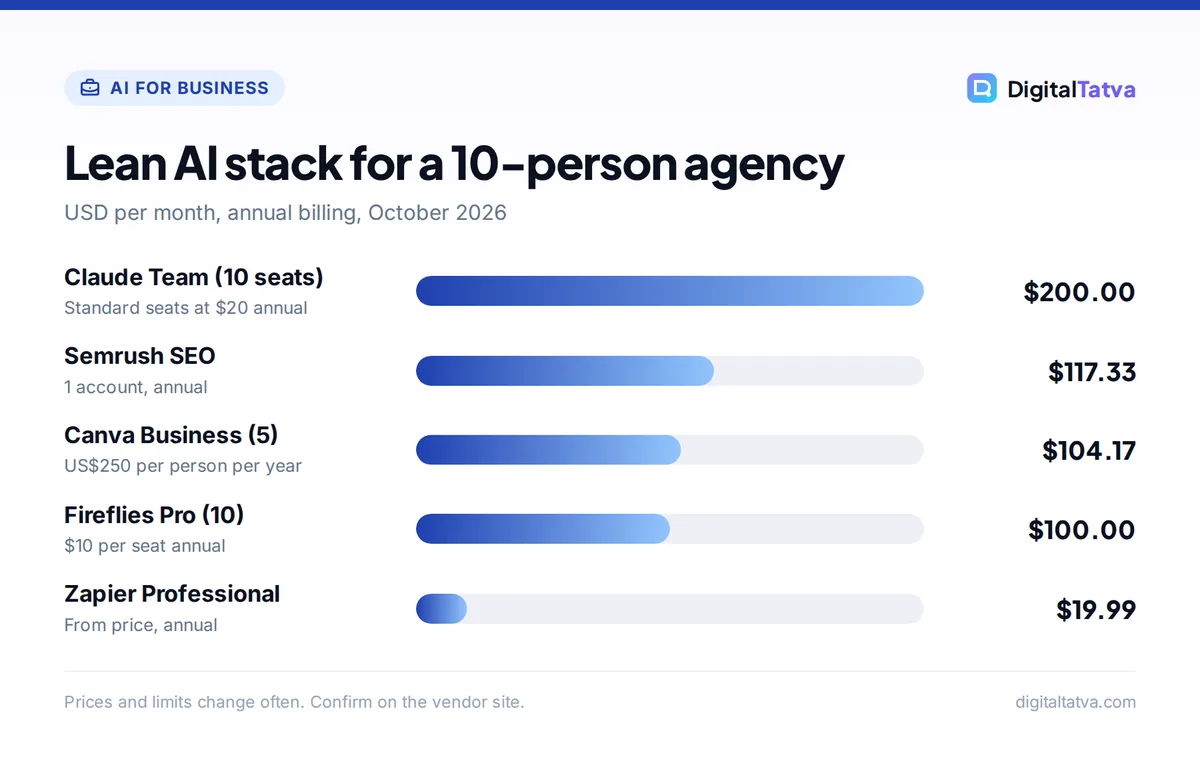
Here is a lean stack for a 10-person agency, using annual billing where it is offered. Your mix will differ, but the arithmetic shows how costs build up.
| Tool | Plan | Seats | Monthly cost |
|---|---|---|---|
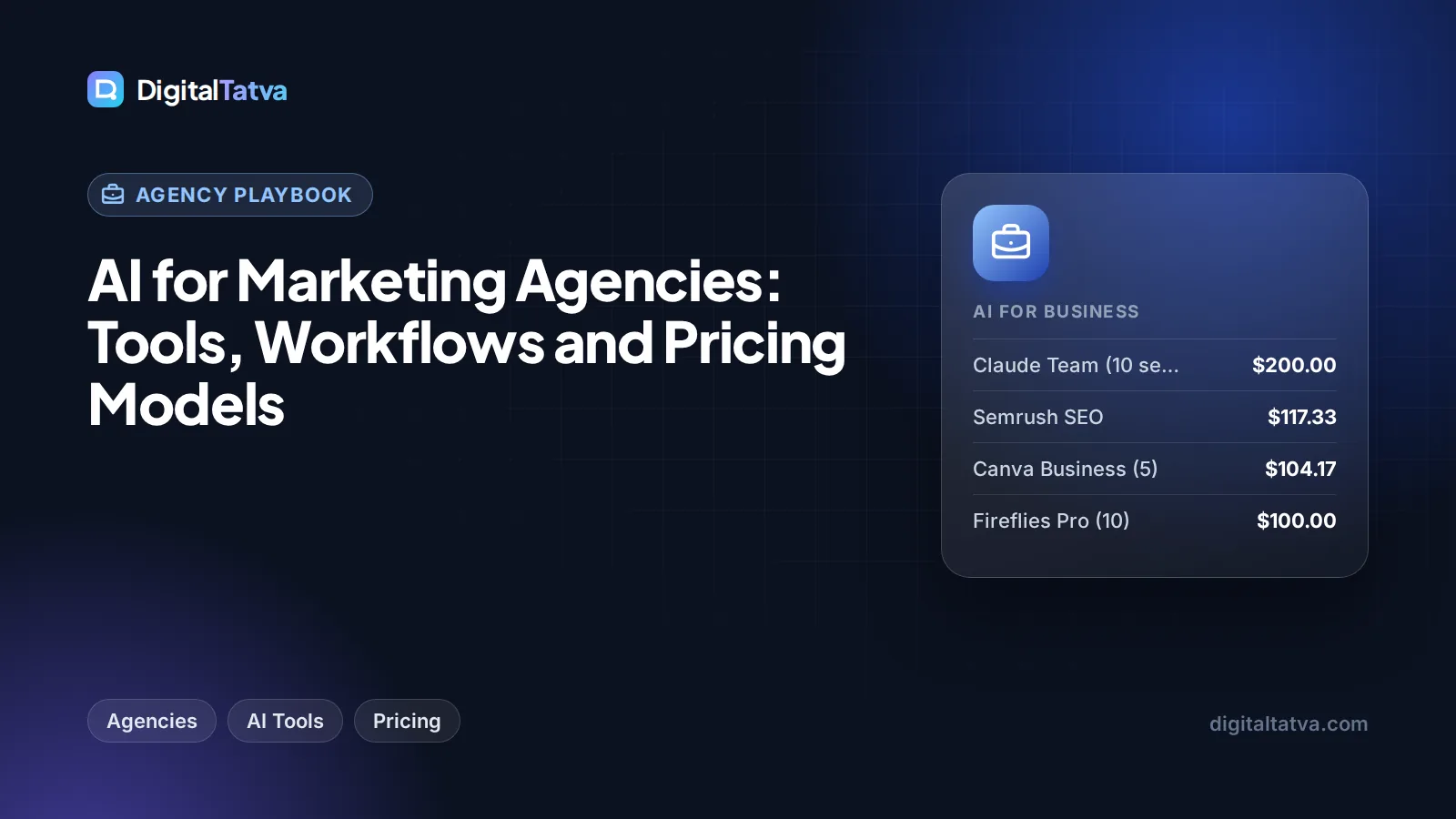
| Claude Team (or ChatGPT Business) | Standard, annual | 10 x $20 | $200.00 |
| Canva Business | US$250/person/year | 5 designers and account leads | $104.17 ($1,250/yr) |
| Semrush | SEO, annual | 1 account | $117.33 |
| Zapier | Professional, annual | 1 account | $19.99 |
| Fireflies | Pro, annual | 10 x $10 | $100.00 |
| Total | About $541.49 a month |
That is about $54 per person per month. If AI saves each person even a few hours a month, the stack pays for itself. Track it properly with our guide to measuring ROI from AI tools. Prices are from each vendor’s official page, such as the Claude pricing page and the Semrush pricing page; add GST and forex fees if you pay from India.
Save money: Audit seats every quarter. Agencies often pay for tools that only one person uses, or keep both ChatGPT and Claude seats for everyone. Standardize on one assistant and give a second one only to the people who need it.
Watch out: If you build client tools on AI APIs, such as chatbots or automated content, token costs are billed separately from subscriptions. Estimate them before you quote a fixed price.
Pricing models for AI-assisted agency work
When a task that took six hours now takes two, hourly billing cuts your revenue by two thirds for the same output. Agencies are rethinking how they price. Here are the main models and when each works.
| Pricing model | How it works | AI effect | Best for |
|---|---|---|---|
| Hourly | Bill time spent | Faster work means lower invoices | Consulting, unclear scopes |
| Monthly retainer | Fixed fee for an agreed scope | Efficiency raises your margin | Ongoing SEO, social, ads management |
| Productized packages | Fixed price per deliverable (for example 4 blog posts) | Efficiency raises margin; easy to sell | Content, design, audits |
| Value or performance based | Fee tied to outcomes such as leads or revenue | AI lets you test more and improve results | Paid media, CRO, lead generation |
| Tool pass-through plus fee | Client pays AI tool or API costs, plus management | Transparent, covers variable usage | Chatbots, AI automations |
Should you charge less because you use AI?
Clients pay for results, judgment and accountability, not keystrokes. If AI lets you deliver the same quality faster, you can keep prices steady and reinvest the time in strategy, or lower prices to win volume. Whatever you choose, do not hide AI use. Many clients now ask, and some contracts restrict it.
Selling AI services directly
Some agencies now sell AI work as its own service line: AI search visibility audits, chatbot setup, workflow automation and team training. These work best as fixed-scope projects followed by a monthly management retainer.
Policies, contracts and client trust
Before rolling AI out across client work, put three things in writing:
- An internal AI usage policy: which tools are approved, what data may be uploaded, who reviews AI output and how it is fact-checked. Our AI usage policy template gives you a starting point.
- Client contract terms: how you use AI, who owns the output, and confidentiality. Some clients will want to approve tools or exclude AI from certain work.
- Data settings: use business plans whose terms exclude training on your data, and check each tool’s retention and admin controls.
Disclose AI use honestly, keep a human accountable for everything you publish, and never let AI invent facts, reviews or testimonials for a client.
Frequently asked questions
What AI tools do marketing agencies use?
Most agencies start with a team assistant such as Claude Team or ChatGPT Business, at $25 per seat per month or $20 billed annually. They add Canva for design, Semrush or Ahrefs for SEO data, Zapier, Make or n8n for automation, and Fireflies or Otter for meeting notes. Some add Jasper for brand voice management across many clients.
How much does an AI tool stack cost for an agency?
A lean stack for a 10-person agency can cost around $540 a month on annual billing: a team assistant for everyone, Canva Business for five people, Semrush SEO, Zapier Professional and Fireflies Pro. Costs rise with premium seats, extra SEO tools and API usage for client projects, so audit seats every quarter.
Should agencies tell clients they use AI?
Yes. Transparency builds trust, many clients ask directly, and some contracts restrict AI use or require approval of tools. Explain where AI helps (research, drafts, variations, reporting) and that a named person reviews and is accountable for every deliverable. Put the policy in your contract so expectations are clear from the start.
Will AI replace marketing agencies?
AI replaces tasks, not the judgment clients pay agencies for. Strategy, creative concepts, knowing what works in a specific market and being accountable for results remain human work. Agencies that use AI to deliver faster and focus on outcomes tend to become more competitive; those billing hours for tasks AI now does quickly face the most pressure.
How should agencies price AI-assisted services?
Move away from pure hourly billing, which shrinks revenue as work gets faster. Monthly retainers, productized packages and value-based or performance fees let you keep efficiency gains. For AI builds like chatbots or automations, charge a setup fee plus a monthly management fee, and pass through variable API costs transparently.
Next steps for your agency
Pick one workflow from this guide, such as monthly reporting or the content production line, and run it with AI for one client for a month. Track hours before and after, then decide which tools to roll out to the whole team. Standardize on one assistant, write your AI usage policy, and review your pricing model so efficiency shows up as margin. Small agencies just starting out can also borrow ideas from our guide on using AI without a big budget. Tool prices change often, so confirm current plans on each vendor’s site before you commit.
Pricing and features are checked at the time of writing and can change. Some links may be affiliate links, which never affect our verdicts.