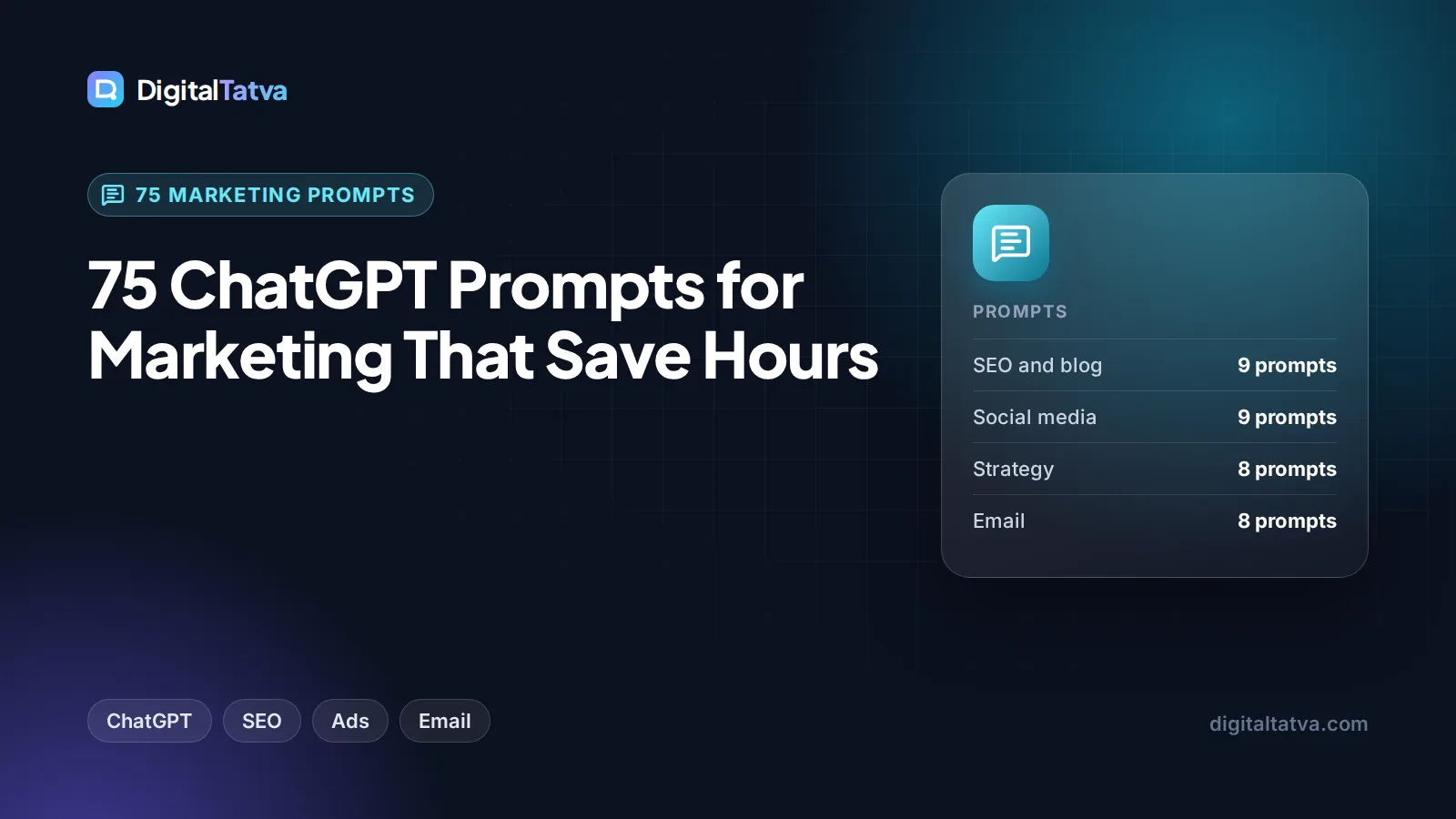
75 ChatGPT Prompts for Marketing That Save Hours
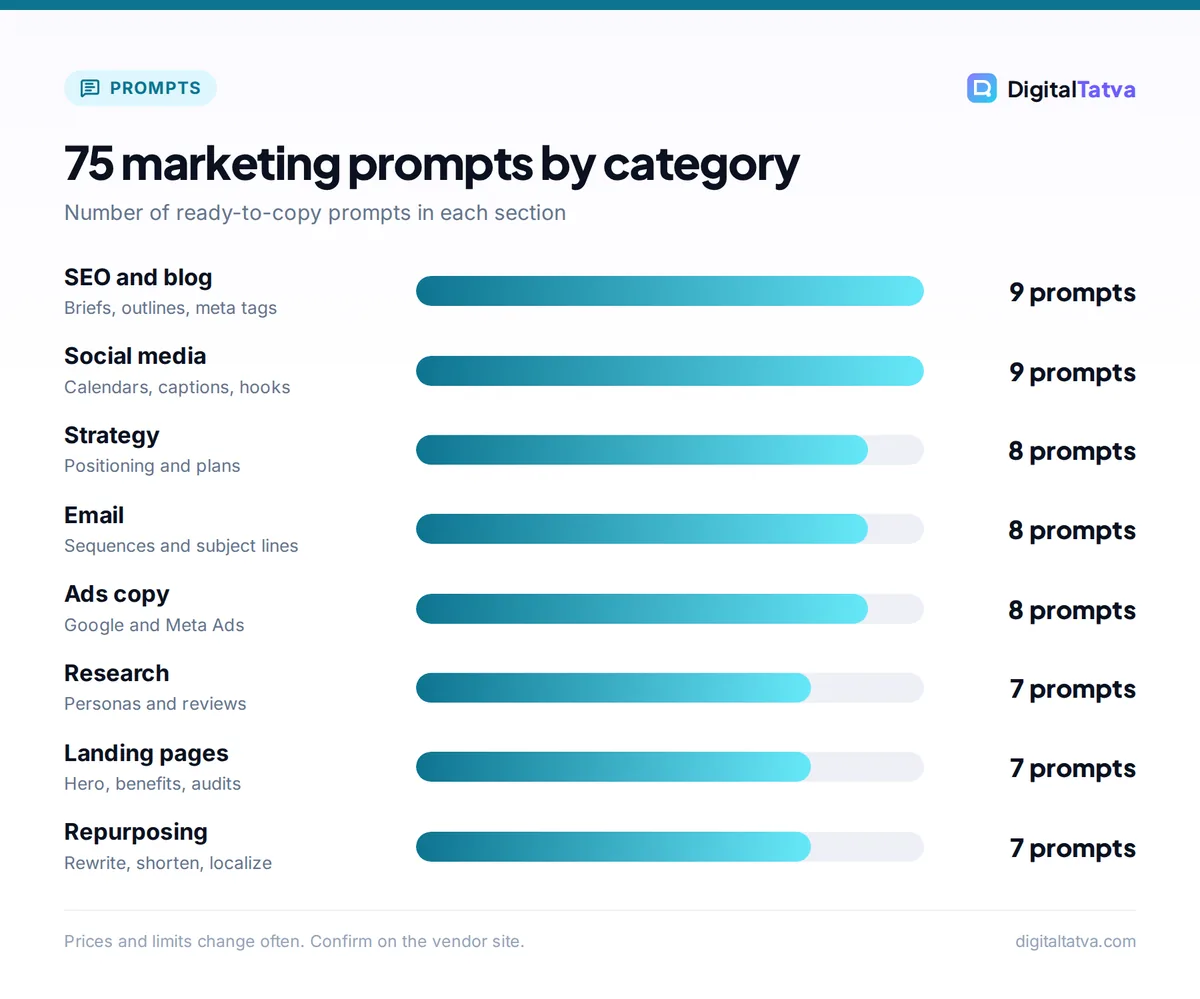
75 ready-to-copy ChatGPT prompts for marketing, grouped by strategy, SEO, social, email, ads, landing pages, video, reporting and repurposing, with tips to adapt them.

On this page
- Key takeaways
- How to use these marketing prompts
- Marketing strategy and positioning prompts (1 to 8)
- Audience research and persona prompts (9 to 15)
- SEO and blog content prompts (16 to 24)
- Social media prompts (25 to 33)
- Email marketing prompts (34 to 41)
- Google Ads and Meta Ads copy prompts (42 to 49)
- Landing page and website copy prompts (50 to 56)
- Video and podcast script prompts (57 to 62)
- Analytics and reporting prompts (63 to 68)
- Repurposing and editing prompts (69 to 75)
- Which ChatGPT plan works best for marketing prompts?
- Frequently asked questions
- Next steps: build your marketing prompt library
The best ChatGPT prompts for marketing give the model three things: context about your business and audience, one specific task, and a clear output format. Below are 75 ready-to-copy prompts grouped by job (strategy, research, SEO, social, email, ads, landing pages, video, reporting and repurposing). Replace the words in [brackets], paste in a short brand brief first, and you will get usable drafts instead of generic filler.
Every prompt works on the free plan, though longer research and file analysis tasks run better on paid plans with stronger models.
Key takeaways
- Start each session with a short brand brief (product, audience, voice, goal). It improves every prompt that follows.
- Ask for a specific format: a table, a numbered list, word counts or character limits.
- Ask ChatGPT to question you first when the brief is thin. It reduces generic output.
- Save your best prompts in a ChatGPT project or custom GPT so your team reuses them.
- Always fact check claims, prices and statistics before you publish AI drafts.
How to use these marketing prompts
Paste this brand brief at the start of a chat, or save it in a project’s instructions. Every prompt below assumes ChatGPT already has it.
BRAND BRIEF
Business: [name], [what you sell], [price range]
Audience: [who buys, where they live, their main problem]
Voice: [3 adjectives, e.g. clear, warm, expert]. Avoid: [words or tones to avoid]
Goal this month: [e.g. more demo bookings, more WhatsApp inquiries]
Proof points: [real results, awards, client names you may mention]
Spelling: [US or UK English]
Three habits make the prompts work better:
- Iterate in the same chat. Follow up with “make it shorter”, “more specific to Indian SMBs” or “rewrite option 2 in a bolder tone.”
- Ask for options. Five headlines to choose from beat one headline you have to rewrite.
- Feed it real inputs. Paste reviews, sales call notes or analytics exports. Specific inputs produce specific outputs.
If you are new to the tool, our ChatGPT beginner guide covers the basics, and our prompt engineering guide explains why techniques like role, examples and output format work.
Marketing strategy and positioning prompts (1 to 8)
1. Positioning statement: Using my brand brief, write 3 positioning statements in the format “For [audience] who [problem], [brand] is the [category] that [benefit], unlike [alternative].” Explain the trade-off of each.
2. Unique value proposition: List 10 possible unique value propositions for [product]. Rank them by how hard they are for competitors to copy, and explain your ranking in one line each.
3. Competitor gap analysis: Here are descriptions of 3 competitors: [paste]. Build a table comparing their audience, main promise, pricing approach and weaknesses. Then suggest 3 gaps we could own.
4. 90-day marketing plan: Create a 90-day marketing plan for [business] with a budget of [amount]. Split it into 3 monthly phases with goals, channels, weekly tasks and one KPI per phase. Output as a table.
5. Channel prioritization: Given my audience and budget, score these channels from 1 to 5 for reach, cost and fit: SEO, Instagram, LinkedIn, Google Ads, Meta Ads, WhatsApp, email, partnerships. Recommend the top 2 and explain why.
6. Messaging hierarchy: Write a messaging hierarchy for [product]: one core message, 3 supporting pillars, and 2 proof points under each pillar. Keep each line under 15 words.
7. Pricing page objections: List the 10 most likely objections a [audience] has before buying [product] at [price]. For each, write a one-sentence reply and suggest where on the site it should appear.
8. Campaign concept ideas: Pitch 5 campaign concepts for [launch or season, e.g. Diwali sale]. For each give a name, a one-line big idea, the main channel and a sample headline.
How to adapt: Strategy prompts improve most when you paste real material: competitor homepages, sales notes and customer reviews. Without inputs, ChatGPT falls back on general advice.
Audience research and persona prompts (9 to 15)
9. Buyer persona: Create 2 buyer personas for [product]. Include job, goals, frustrations, buying triggers, objections, preferred channels and a typical quote in their own words. Mark anything that is an assumption.
10. Review mining: Here are 30 customer reviews: [paste]. Group them into themes, quote the exact phrases customers use most, and list 5 messages we should use in our ads.
11. Jobs to be done: Describe the main “jobs to be done” for someone buying [product]: the functional job, the emotional job and the social job. Give 2 marketing angles for each.
12. Survey questions: Write a 10-question customer survey to learn why people chose us over competitors. Mix multiple choice and open questions. Keep it under 3 minutes to complete.
13. Interview script: Write a 20-minute customer interview script for recent buyers of [product]. Focus on the moment they decided to buy and what nearly stopped them.
14. Audience language bank: List 30 words and phrases a [audience] would use to describe [problem], from casual to technical. Group them by awareness stage.
15. Segment comparison: Compare these 3 customer segments: [list]. Build a table with their main need, budget sensitivity, best channel and best offer. Recommend which to target first.
SEO and blog content prompts (16 to 24)
16. Topic cluster: Build a topic cluster around [main keyword]. Give one pillar page and 12 supporting articles, each with a working title, search intent (informational, commercial or transactional) and the internal link it should point to.
17. Content brief: Write an SEO content brief for the keyword [keyword]. Include search intent, a suggested title, H2 and H3 outline, questions to answer, entities to mention and a target word count range.
18. Blog outline from notes: Turn these rough notes into a blog outline with an answer-first introduction, 6 to 8 H2 sections and an FAQ section: [paste notes].
19. Section draft: Write the section “[H2 heading]” for a blog post aimed at [audience]. 250 to 300 words, short paragraphs, one practical example, no hype words.
20. Meta titles and descriptions: Write 5 meta titles (under 60 characters) and 5 meta descriptions (under 155 characters) for a page about [topic]. Put the keyword [keyword] near the start.
21. FAQ for AI answers: List 8 questions people ask about [topic]. Answer each in 40 to 60 words, starting with a direct answer in the first sentence.
22. Refresh an old post: Here is an older blog post: [paste]. Identify outdated sections, missing subtopics and weak headings. Suggest a revised outline and a new introduction.
23. Internal link suggestions: Here is my list of blog URLs and titles: [paste]. For the article below, suggest 5 internal links with natural anchor text and where to place each: [paste article].
24. Local SEO page: Write a service page for [service] in [city]. Include local details I provide here: [areas served, landmarks, hours]. Add an FAQ and a clear call to action.
How to adapt: ChatGPT cannot see your real keyword volumes unless you paste them. Pair these prompts with data from an SEO tool, as covered in our list of the best AI SEO tools, and follow our process for writing a blog post with AI that actually ranks.
Social media prompts (25 to 33)
25. Monthly content calendar: Create a 30-day social media calendar for [brand] on [platforms]. Include date, content pillar, format (reel, carousel, post), hook and call to action. Output as a table.
26. Content pillars: Suggest 5 content pillars for [brand] that balance education, proof, behind the scenes, community and offers. Give 3 post ideas for each.
27. Instagram captions: Write 5 Instagram captions for this post: [describe image or reel]. Each under 150 words, with a strong first line, one question and 5 relevant hashtags.
28. LinkedIn post from an idea: Turn this idea into a LinkedIn post: [idea]. Start with a one-line hook, use short lines, share one specific lesson and end with a question. No emojis.
29. Carousel script: Write a 7-slide carousel on [topic]. Slide 1 is a hook under 10 words, slides 2 to 6 give one tip each in under 25 words, slide 7 is a call to action.
30. Reel hooks: Give me 15 hooks for short videos about [topic], each under 12 words. Mix curiosity, mistakes, numbers and bold opinions.
31. Comment replies: Here are 10 comments on our post: [paste]. Write a friendly, on-brand reply to each. Flag any that should be handled privately.
32. X thread: Write a thread of 6 posts on [topic] for [audience]. Each under 280 characters. Post 1 must stand alone as a hook.
33. Festival campaign posts: Write 5 posts for [festival or event] that connect it to [product] without sounding pushy. Include one image idea for each.
For scheduling, design and analytics tools that pair with these prompts, see our roundup of AI tools for social media marketing.
Email marketing prompts (34 to 41)
34. Welcome sequence: Write a 5-email welcome sequence for new subscribers who downloaded [lead magnet]. For each email give the send day, subject line, preview text, body under 150 words and one call to action.
35. Subject lines: Write 15 subject lines for an email about [offer]. Mix curiosity, benefit and urgency. Keep each under 50 characters and avoid spam trigger words.
36. Newsletter from links: Turn these 4 links and notes into a weekly newsletter with a short intro, one paragraph per item and a sign-off: [paste].
37. Abandoned cart email: Write 3 abandoned cart emails for [store], sent at 1 hour, 24 hours and 72 hours. Address one objection in each: price, trust, timing.
38. Re-engagement email: Write a re-engagement email for subscribers who have not opened in 90 days. Be honest, offer a reason to stay and a one-click way to leave.
39. Cold outreach: Write a cold email to [role] at [type of company] offering [service]. Under 120 words, one specific observation about their business, one clear ask. Give 2 follow-ups.
40. Launch announcement: Write a launch email for [product or feature]. Lead with the customer problem, show 3 benefits, include one proof point and a deadline if relevant.
41. A/B test ideas: Suggest 8 A/B tests for our email program, covering subject lines, send time, layout and call to action. For each, state the hypothesis and the metric to watch.
Google Ads and Meta Ads copy prompts (42 to 49)
42. Google search ads: Write 15 headlines (max 30 characters) and 4 descriptions (max 90 characters) for a Google search ad promoting [product] for the keyword [keyword]. Count characters and show the count.
43. Meta ad variations: Write 5 Meta ad variations for [offer], each with primary text under 125 characters, a headline under 40 characters and a call to action button suggestion.
44. Angle testing: Give me 6 different ad angles for [product]: pain, gain, social proof, fear of missing out, comparison and story. Write one short ad for each.
45. Negative keywords: List 30 likely negative keywords for a Google Ads campaign selling [product], grouped by reason (job seekers, free seekers, wrong intent, irrelevant).
46. Ad copy critique: Critique this ad as a senior performance marketer: [paste]. Score clarity, relevance and urgency from 1 to 10, then rewrite it twice.
47. Retargeting ads: Write 3 retargeting ads for people who visited our pricing page but did not buy. Address hesitation without discounts in two of them.
48. UGC ad script: Write a 30-second user-generated style video ad script for [product]. Include a hook in the first 3 seconds, a problem, a demo moment and a call to action.
49. Keyword grouping: Group these keywords into tightly themed ad groups and suggest a headline for each group: [paste keyword list].
Watch out: ChatGPT often miscounts characters. Always check ad lengths in the ad platform itself, and never let AI invent claims like “No. 1 in India” or discounts you do not offer.
Landing page and website copy prompts (50 to 56)
50. Landing page wireframe: Write landing page copy for [offer] in this order: headline, subheadline, 3 benefits, how it works in 3 steps, social proof placeholder, FAQ with 5 questions, final call to action.
51. Hero section options: Write 5 hero section options (headline under 10 words plus subheadline under 25 words) for [product]. Make each one lead with a different benefit.
52. Feature to benefit: Convert these features into customer benefits, using the format “Feature, so you can benefit”: [paste features].
53. About page: Write an About page for [business] using these facts: [founder story, year started, values]. Keep it human and specific, under 350 words.
54. Product descriptions: Write product descriptions for these items: [paste name and specs]. Each 80 to 120 words, with one sensory detail, 3 bullet benefits and care or usage info.
55. Call to action buttons: Suggest 12 call to action button labels for [goal, e.g. booking a free audit]. Under 4 words each. Avoid “Submit” and “Click here”.
56. Conversion audit: Review this landing page copy as a conversion specialist: [paste]. List the 5 biggest issues in order of impact and suggest a fix for each.
Video and podcast script prompts (57 to 62)
57. YouTube script: Write an 8-minute YouTube script on [topic] for [audience]. Include a 15-second hook, chapter markers, one story, and a call to action at the end.
58. YouTube title and description: Write 10 YouTube titles under 60 characters and one description with timestamps for this video: [summary].
59. Explainer video: Write a 60-second explainer video script for [product] with columns for narration and on-screen visuals.
60. Webinar outline: Plan a 45-minute webinar on [topic] that ends with a soft pitch for [offer]. Give section timings, key points and 3 poll questions.
61. Podcast questions: Write 12 interview questions for a podcast guest who is a [role]. Start broad, then get specific and practical.
62. Testimonial request: Write a short message asking a happy customer for a video testimonial, with 4 guiding questions they can answer in under 2 minutes.
Analytics and reporting prompts (63 to 68)
63. Campaign summary: Here is campaign data: [paste table]. Summarize performance in 5 bullets, highlight the best and worst ad sets, and suggest 3 next actions.
64. Monthly client report: Turn these metrics into a client-friendly monthly report with an executive summary, wins, issues, and next month’s plan: [paste metrics].
65. KPI framework: Suggest a KPI framework for [business] across awareness, consideration and conversion, with one leading and one lagging metric per stage.
66. UTM naming: Create a consistent UTM naming convention for our campaigns across Google, Meta, email and WhatsApp, with 5 examples.
67. Funnel diagnosis: Our funnel numbers are: [visitors, leads, calls, sales]. Identify the weakest step and list 5 experiments to improve it.
68. Spreadsheet formulas: Write a Google Sheets formula that calculates cost per lead by channel from columns [list columns], and explain how it works.
For larger exports, use ChatGPT’s data analysis on a paid plan. Our guide to using ChatGPT for Excel and data analysis shows how to upload files and check the results.
Repurposing and editing prompts (69 to 75)
69. Blog to social: Turn this blog post into 1 LinkedIn post, 3 tweets, 1 Instagram caption and 1 email teaser: [paste post].
70. Webinar to blog: Turn this webinar transcript into a structured blog post with headings and key takeaways. Remove filler and repeated points: [paste transcript].
71. Brand voice rewrite: Rewrite this text in our brand voice ([3 adjectives]). Keep the meaning and length. Show changed sentences in a table with before and after: [paste].
72. Shorten without losing meaning: Cut this text by 40% while keeping every key point. Then list what you removed: [paste].
73. Readability edit: Edit this for a reader with basic English. Short sentences, no jargon, explain any technical term once: [paste].
74. Localization: Adapt this campaign copy for an Indian audience. Adjust examples, currency references and tone, but keep the offer the same: [paste].
75. Final proofread: Proofread this copy. Fix grammar and spelling only. List each change, and flag any claim that needs a source: [paste].
Which ChatGPT plan works best for marketing prompts?
| Plan | Price (USD) | Main model access | Good for |
|---|---|---|---|
| Free | $0 | GPT-5.6 Luna | Trying these prompts, short copy and ideas |
| Go | $8/month | GPT-5.6 Luna, higher limits | Solo marketers who want projects and custom GPTs on a budget |
| Plus | $20/month | GPT-5.6 Sol with deeper thinking, GPT-6 Astra in some tools | Daily content work, research and data analysis |
| Business | $25/user/month ($20 annual), 2 seats minimum | GPT-5.6 Sol plus GPT-6 Pro | Teams sharing prompt libraries, no training on workspace data |
Our full breakdown of ChatGPT pricing covers limits and Pro tiers. If you write a lot of long-form copy, compare options in our ChatGPT vs Claude comparison and try our Claude prompts for writing and editing.
Tip: Turn your 10 most used prompts plus your brand brief into a custom GPT. Our guide on how to create a custom GPT shows the setup step by step, and agencies can find more workflow ideas in AI for marketing agencies.
Frequently asked questions
What is the best ChatGPT prompt for marketing?
There is no single best prompt, but the best ones share a pattern: business context, a specific task, constraints and a clear output format. A brand brief pasted at the start, followed by a focused request such as “write 5 Meta ad variations under 125 characters”, will beat any clever one-line prompt. Iterating in the same chat improves results further.
Can I use ChatGPT for marketing for free?
Yes. The Free plan offers unlimited text chats with GPT-5.6 Luna, which handles most copywriting, ideas and email prompts in this list. Limits apply to file uploads, image creation and deep research. Go at $8 per month adds higher limits, projects and custom GPTs, which help if you reuse prompts daily.
Is AI-written marketing copy bad for SEO?
Not by itself. Search engines care about helpful, accurate content, not whether a tool helped draft it. Problems come from thin, generic or wrong content published without editing. Use ChatGPT for outlines and first drafts, then add your own examples, data and expertise before publishing.
How do I make ChatGPT sound like my brand?
Give it a brand brief with your audience, three voice adjectives and words to avoid, plus two or three examples of copy you like. Ask it to match the examples. For consistent results, save the brief in a project or custom GPT so it applies to every chat without pasting it again.
Should I trust statistics ChatGPT gives me?
No, not without checking. ChatGPT can produce plausible but wrong numbers and sources. Treat any statistic, price or claim as a placeholder until you verify it from the original source. Prompt 75 in this list asks ChatGPT to flag claims that need a source, which is a useful final check.
Next steps: build your marketing prompt library
Copy the brand brief, pick five prompts from the section you work in most, and test them on a real task this week. Keep the versions that produce usable drafts, refine the rest, and store them in a shared project or custom GPT. A small, tested prompt library saves more time than a long list nobody uses. For more ideas aimed at owners rather than marketers, see our AI prompts for small business owners.
For plan details, see OpenAI’s ChatGPT pricing page and the ChatGPT Go help article. Plans and prices change often, so confirm current details on OpenAI’s site before you upgrade.
Pricing and features are checked at the time of writing and can change. Some links may be affiliate links, which never affect our verdicts.