AI vs Machine Learning vs Deep Learning: The Difference Explained
AI vs machine learning vs deep learning explained simply: how they relate, real examples, where generative AI and LLMs fit, common myths, and which one to learn first.

On this page
- Key takeaways
- AI vs machine learning vs deep learning at a glance
- What is artificial intelligence?
- What is machine learning?
- What is deep learning?
- Where generative AI and LLMs fit
- Everyday examples: which is which?
- AI vs machine learning: which should you learn?
- How a machine learning model is built, step by step
- Common misconceptions
- Frequently asked questions
- The bottom line
Artificial intelligence (AI) is the broad goal of making computers do tasks that normally need human intelligence; machine learning (ML) is the main way we achieve AI today, by letting computers learn patterns from data instead of following hand-written rules; and deep learning is a type of machine learning that uses large neural networks with many layers. Think of them as nested circles: all deep learning is machine learning, and all machine learning is AI, but not all AI is machine learning.
This guide explains AI vs machine learning vs deep learning in plain English, with everyday examples, a comparison table, where generative AI and large language models fit, and which one to learn first for your career.
Key takeaways
- AI is the big umbrella; machine learning is a subset; deep learning is a subset of machine learning.
- Traditional AI can follow rules written by people; machine learning learns rules from examples.
- Deep learning powers most modern breakthroughs: speech recognition, image recognition and chatbots.
- Generative AI tools like ChatGPT, Claude and Gemini are built on deep learning models called large language models.
- To start a career, learn to use AI tools first, then Python and machine learning basics if you want to build models.
AI vs machine learning vs deep learning at a glance
| Artificial intelligence | Machine learning | Deep learning | |
|---|---|---|---|
| What it is | Any technique that makes machines act intelligently | Systems that learn patterns from data | Machine learning with many-layered neural networks |
| How it works | Rules, search, logic or learning | Algorithms trained on examples | Neural networks trained on very large datasets |
| Data needed | Varies; rule-based AI needs none | Moderate amounts of structured data | Huge amounts of data and computing power |
| Human effort | Experts may write rules by hand | People choose features and models | The network learns features itself |
| Examples | Chess engines, route planners, expert systems | Spam filters, fraud detection, price prediction | Face unlock, voice assistants, ChatGPT, image generators |
What is artificial intelligence?
Artificial intelligence is the field of building computer systems that can perceive, reason, learn, make decisions or use language in ways we would call intelligent. The term dates back to a 1956 workshop at Dartmouth College, and for decades much of AI was rule-based: experts wrote thousands of “if this, then that” rules into so-called expert systems, for example to help diagnose machinery faults.
Rule-based AI still exists. A GPS app finding the fastest route uses search algorithms, and a chess engine uses search plus evaluation. But rules break down for messy real-world problems such as recognizing a face or understanding a sentence, which is where machine learning took over.
People also talk about narrow AI (systems good at specific tasks, which is all AI that exists today) and artificial general intelligence (a hypothetical AI as capable as humans across most tasks). Every tool you use, from Google Translate to ChatGPT, is narrow AI, even when it seems very general.
What is machine learning?
Machine learning is a way of building AI where, instead of writing rules, you give the computer examples and let it find the patterns. Show a spam filter thousands of emails labeled “spam” or “not spam” and it learns which words, senders and patterns predict spam. Show a model years of house prices and features and it learns to predict the price of a new house.
The three main types of machine learning
- Supervised learning: learns from labeled examples. Used for spam detection, loan approval risk, medical image classification and sales forecasts.
- Unsupervised learning: finds structure in unlabeled data, such as grouping customers into segments by behavior.
- Reinforcement learning: learns by trial and error with rewards, used in game-playing systems, robotics and to fine-tune chatbots with human feedback.
Classic machine learning algorithms include linear regression, decision trees, random forests and gradient boosting. They are still the workhorses of business analytics because they are fast, cheap and work well on spreadsheet-style data.
What is deep learning?
Deep learning is machine learning using artificial neural networks with many layers, loosely inspired by how neurons connect in the brain. Each layer learns features at a different level: in an image model, early layers detect edges, middle layers detect shapes such as eyes or wheels, and later layers recognize faces or cars.
Deep learning took off in the 2010s, when three things came together: huge datasets from the internet, powerful graphics processors (GPUs) and better training methods. It now powers speech recognition, translation, face unlock, self-driving research, medical image analysis and generative AI.
The trade-off is cost: deep learning models need large amounts of data and computing power, and they are harder to interpret than a simple decision tree. For a deeper look at the biggest deep learning models, read what a large language model is.
Where generative AI and LLMs fit
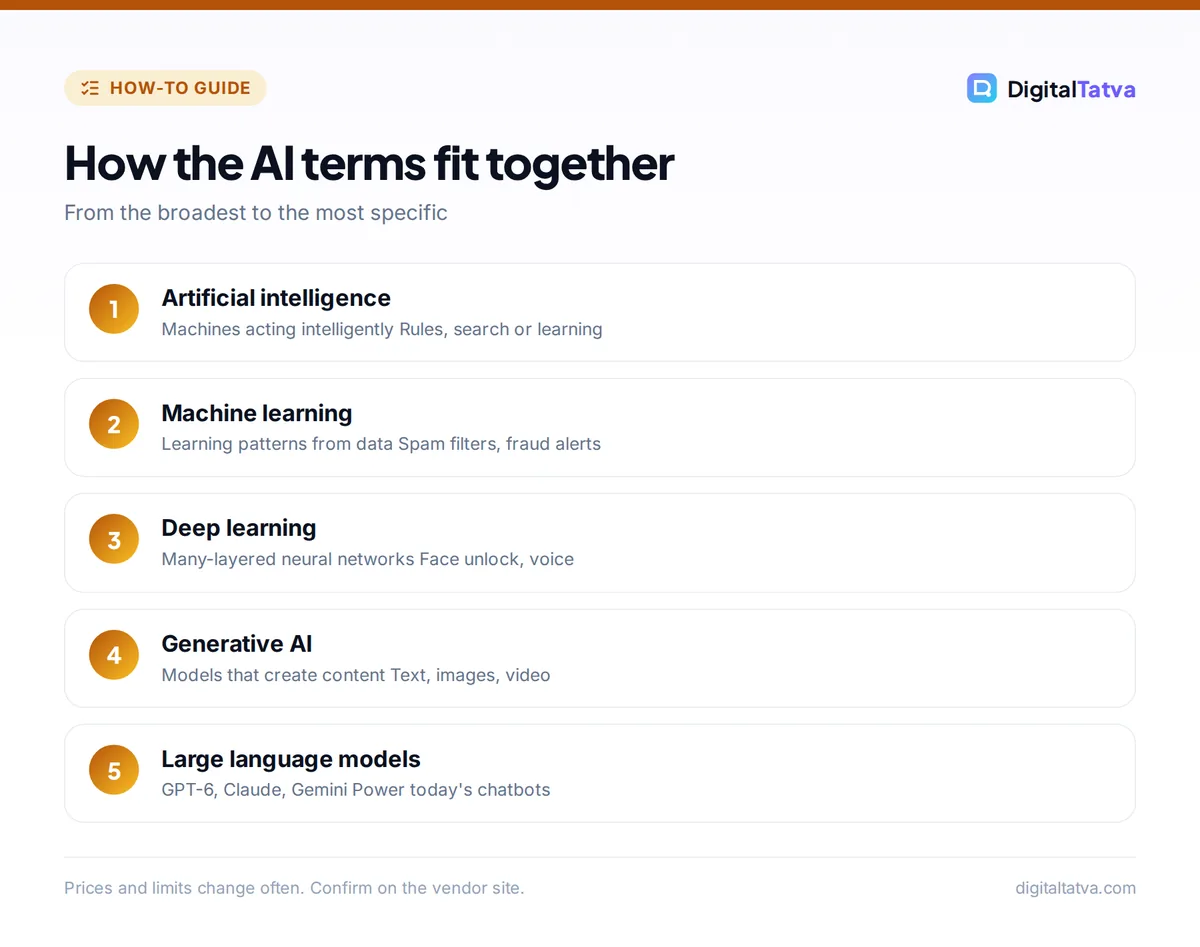
Generative AI is AI that creates new content: text, images, audio, video or code. Today it is almost always built with deep learning. Large language models (LLMs), such as the models behind ChatGPT, Claude and Gemini, are deep learning models trained on huge amounts of text to predict the next token, which lets them write, summarize, translate and reason.
| Layer | Example |
|---|---|
| Artificial intelligence | The whole field |
| Machine learning | Learning from data |
| Deep learning | Neural networks with many layers |
| Generative AI | Deep learning models that create content |
| Large language models | GPT-6, Claude Opus 5.5, Gemini |
Newer systems add another layer on top: agentic AI, where LLMs use tools to take actions. Our explainers on generative AI, tokens and RAG cover the rest of the modern AI stack, and the AI glossary defines 60 common terms.
Everyday examples: which is which?
| Everyday tool | What powers it |
|---|---|
| Email spam filter | Machine learning |
| Netflix or YouTube recommendations | Machine learning and deep learning |
| UPI and bank fraud alerts | Machine learning |
| Phone face unlock | Deep learning |
| Voice assistants like Alexa and Google Assistant | Deep learning |
| Google Maps route finding | Classic AI search algorithms plus machine learning for traffic |
| ChatGPT, Claude, Gemini | Deep learning (large language models) |
| AI image generators | Deep learning (diffusion and similar models) |
AI vs machine learning: which should you learn?
It depends on your goal.
- Use AI at work (most people): learn to use AI tools well, write good prompts and check outputs. No coding required. Start with our prompt engineering guide.
- Analyst or business role: learn spreadsheet analysis, basic statistics and how to use AI for data work.
- Build AI products: learn Python, then machine learning fundamentals, then deep learning and how to build on LLM APIs.
- Research careers: deep mathematics, statistics and advanced deep learning.
Our free roadmap in how to learn AI, the list of AI skills to learn and the free AI courses with certificates give you a step-by-step path.
Tip: you do not need to master machine learning maths to benefit from AI. Most jobs in 2026 reward people who can apply AI tools to real problems and judge the results.
How a machine learning model is built, step by step
Seeing the process makes the difference from rule-based AI clear. Here is how a team would build a model to predict which customers might cancel a subscription.
- Define the question. “Which customers are likely to cancel in the next 30 days?”
- Collect data. Past customers with features such as plan, logins per week, support tickets and whether they cancelled.
- Prepare the data. Clean missing values, convert text to numbers and split data into training and test sets.
- Train a model. An algorithm such as gradient boosting learns how the features relate to cancellations.
- Evaluate. Check accuracy on the test set the model never saw, and look for bias against any customer group.
- Deploy and monitor. Use predictions to trigger retention offers, and retrain as customer behavior changes.
A rule-based approach would instead have a person write rules like “flag customers who have not logged in for 14 days”. That can work, but a trained model usually spots combinations of signals people miss. Deep learning would only be worth it with very large or unstructured data, such as support call recordings or chat transcripts.
Common misconceptions
- “AI and machine learning are the same.” Machine learning is one approach to AI, though it is the dominant one today.
- “Deep learning is always better.” For small, structured datasets, simpler machine learning often works as well and is cheaper and easier to explain.
- “AI understands like humans.” Models learn statistical patterns; they can be impressive and still make confident mistakes.
- “You need a PhD to work in AI.” Many AI jobs, from AI operations to prompt design and AI product management, need practical skills, not research degrees.
Frequently asked questions
What is the difference between AI and machine learning?
AI is the broad field of making machines act intelligently, using any method including hand-written rules. Machine learning is a subset of AI where systems learn patterns from data instead of following explicit rules. Most modern AI, including chatbots, is built with machine learning.
Is deep learning the same as machine learning?
Deep learning is a type of machine learning. It uses neural networks with many layers that learn features automatically from large amounts of data. All deep learning is machine learning, but classic machine learning methods such as decision trees are not deep learning.
Is ChatGPT AI or machine learning?
Both. ChatGPT is an AI product built on large language models, which are deep learning models, a type of machine learning. It is also called generative AI because it creates new text, images and code.
Which is better to learn, AI or machine learning?
For most people, learning to use AI tools well is the most valuable first step. If you want to build AI systems, learn Python and machine learning fundamentals next, then deep learning. The right path depends on whether you want to use AI or build it.
What are examples of machine learning in daily life?
Spam filters, product and video recommendations, bank and UPI fraud alerts, credit scoring, delivery time estimates, search ranking, face unlock and voice assistants all use machine learning. Many of the most advanced, such as face unlock and voice assistants, use deep learning.
The bottom line
AI is the goal, machine learning is the main method, and deep learning is the powerful version of that method behind today’s chatbots, voice assistants and image generators. Understanding the difference helps you read AI news critically, choose the right tools and plan what to learn next. For reference, Google’s free Machine Learning Crash Course is a solid next step if you want to go deeper.
Pricing and features are checked at the time of writing and can change. Some links may be affiliate links, which never affect our verdicts.