Best AI Tools for Lawyers in 2026: India and Global Guide
The best AI tools for lawyers in 2026, including SCC Online AI, Manupatra, CaseMine, Harvey and ChatGPT, with Indian pricing, court rules on AI hallucinations, confidentiality and a safe workflow.

On this page
The best AI tools for lawyers in 2026 fall into three groups: legal research platforms with built-in AI, such as SCC Online AI, Manupatra, CaseMine AMICUS, Lexis+ AI and Westlaw with CoCounsel; legal AI platforms for drafting and review, such as Harvey; and general assistants like ChatGPT, Claude and Gemini for summarizing, drafting first versions and explaining documents. Used well, they save hours on research, contract review and drafting. Used carelessly, they can invent case law, and Indian courts have made clear that lawyers are fully responsible for every citation they file.
This guide covers how lawyers and law firms use AI, the best tools for Indian and international practice with pricing, safe workflows, prompts, the rules on AI hallucinations in court, client confidentiality, and how small firms can get started.
Key takeaways
- Use legal research tools built on verified databases for case law; use general chatbots for drafting, summarizing and explaining, never as a source of citations.
- In India, SCC Online AI Pro is listed at Rs 51,500 per user per year plus GST, Manupatra AI search starts from about Rs 6,000 a year, and CaseMine AMICUS starts with a free tier and paid plans from about $49 a month.
- The Supreme Court of India has reportedly signalled zero tolerance for unverified AI-generated precedents, and a High Court has imposed costs for citing a judgment that could not be traced.
- Client confidentiality means using business or enterprise plans with clear data protections, and removing identifying details when possible.
- The best gains come in research summaries, contract review, due diligence, first drafts and client communication.
How lawyers use AI today
| Task | How AI helps | Best tool type |
|---|---|---|
| Legal research | Natural-language search, case summaries, related judgments | Legal research platform with AI |
| Contract review | Flag risky clauses, compare to standard terms, summarize obligations | Legal AI platform or general assistant |
| Drafting | First drafts of notices, agreements, petitions and letters | General assistant or legal AI |
| Due diligence | Review hundreds of documents and extract key terms | Legal AI platform |
| Case preparation | Chronologies, summaries of pleadings and evidence | General assistant with long context |
| Client communication | Plain-language explanations and updates | General assistant |
| Translation | Translate documents between English and Indian languages | General assistant, translation tools |
| Practice management | Meeting notes, time entries, intake forms | Meeting assistants, automation |
Best AI tools for lawyers in India
SCC Online AI
SCC Online is one of India’s most widely used legal research databases, and its AI features let you search in natural language, get summaries of judgments and find related authorities within its verified database. SCC Online AI Pro is listed at Rs 51,500 per user per year plus GST, with corporate and enhanced versions priced higher, according to a 2026 Indian legal tech pricing guide. SCC Online also announced a partnership with Harvey in early 2026.
Manupatra
Manupatra offers AI search on its Indian legal database, with plans reported from about Rs 6,000 a year for AI search and research plans from roughly Rs 14,250 to Rs 55,460 a year. Its Manuworks tools add pay-as-you-go drafting and analysis. It is a strong value option for independent advocates and smaller firms.
CaseMine and AMICUS
CaseMine’s AMICUS assistant answers legal questions with links to judgments in its database and offers a freemium model, with paid plans reported from about $49 to $149.99 a month. Many young lawyers start here because of the free tier.
Lexis+ AI and Westlaw with CoCounsel
LexisNexis and Thomson Reuters offer AI research and drafting tools built on their global databases. LexisNexis added AI case analysis for India in 2026. These suit firms with international practice and larger budgets.
Harvey
Harvey is a legal AI platform used by large law firms and in-house teams for research, drafting, contract analysis and due diligence. Pricing is enterprise and custom.
ChatGPT, Claude and Gemini
General assistants are excellent for summarizing long documents, drafting first versions, rewriting in plain language, translating and building chronologies. Claude is especially good with very long documents, and ChatGPT and Gemini offer deep research features. Use business plans for client work. Compare them in ChatGPT vs Claude and ChatGPT vs Gemini, and see ChatGPT for business for plan details.
| Tool | Best for | Pricing (approx.) |
|---|---|---|
| SCC Online AI Pro | Indian case law research | Rs 51,500/user/year + GST |
| Manupatra AI | Value research for advocates | From about Rs 6,000/year |
| CaseMine AMICUS | Free start, AI answers with citations | Free; about $49 to $149.99/month |
| Lexis+ AI, Westlaw CoCounsel | International research | Custom |
| Harvey | Large firms, due diligence | Enterprise |
| ChatGPT, Claude, Gemini | Drafting, summaries, explanations | Free to about $20 to $25/user/month |
Prices come from vendor and third-party sources in 2026 and change frequently; confirm directly on the SCC Online website, Manupatra or CaseMine before buying.
AI hallucinations and the courts
General chatbots can produce case names, citations and quotes that look real but do not exist. Courts around the world have sanctioned lawyers for filing such material, and Indian courts are taking the issue seriously. In July 2026, the Supreme Court of India, in a judgment reported as 2026 INSC 668, was reported to have taken a zero-tolerance stance on unverified AI-generated precedents and asked for professional norms, according to legal-tech summaries. Earlier in 2026, the Bombay High Court reportedly imposed costs of Rs 50,000 after a party cited a judgment that could not be traced. A Supreme Court committee has also circulated draft rules that would require disclosure of AI-assisted filings.
Golden rule: never file or rely on any citation, quote or statute reference produced by AI until you have read it yourself in an official or verified source. You remain professionally responsible for everything you submit.
To reduce risk, use research tools grounded in verified databases, ask general assistants to work only from documents you upload, and keep a checklist for verifying every authority. Our guide to AI research tools explains how citation-based tools differ from general chat.
Client confidentiality and data security
Lawyers owe clients strict confidentiality. Before using any AI tool on client matters:
- Use business or enterprise plans that do not train on your data and offer admin controls, retention settings and security certifications.
- Remove names, case numbers and identifying details where you can, especially on consumer plans.
- Check where data is stored and processed and whether the vendor’s terms meet your obligations under the Digital Personal Data Protection Act, 2023.
- Get client consent where required and tell clients how you use AI.
- Write a firm-wide AI policy; our AI usage policy template is a starting point.
Read more in AI data privacy for business and is ChatGPT safe.
A safe AI workflow for legal work
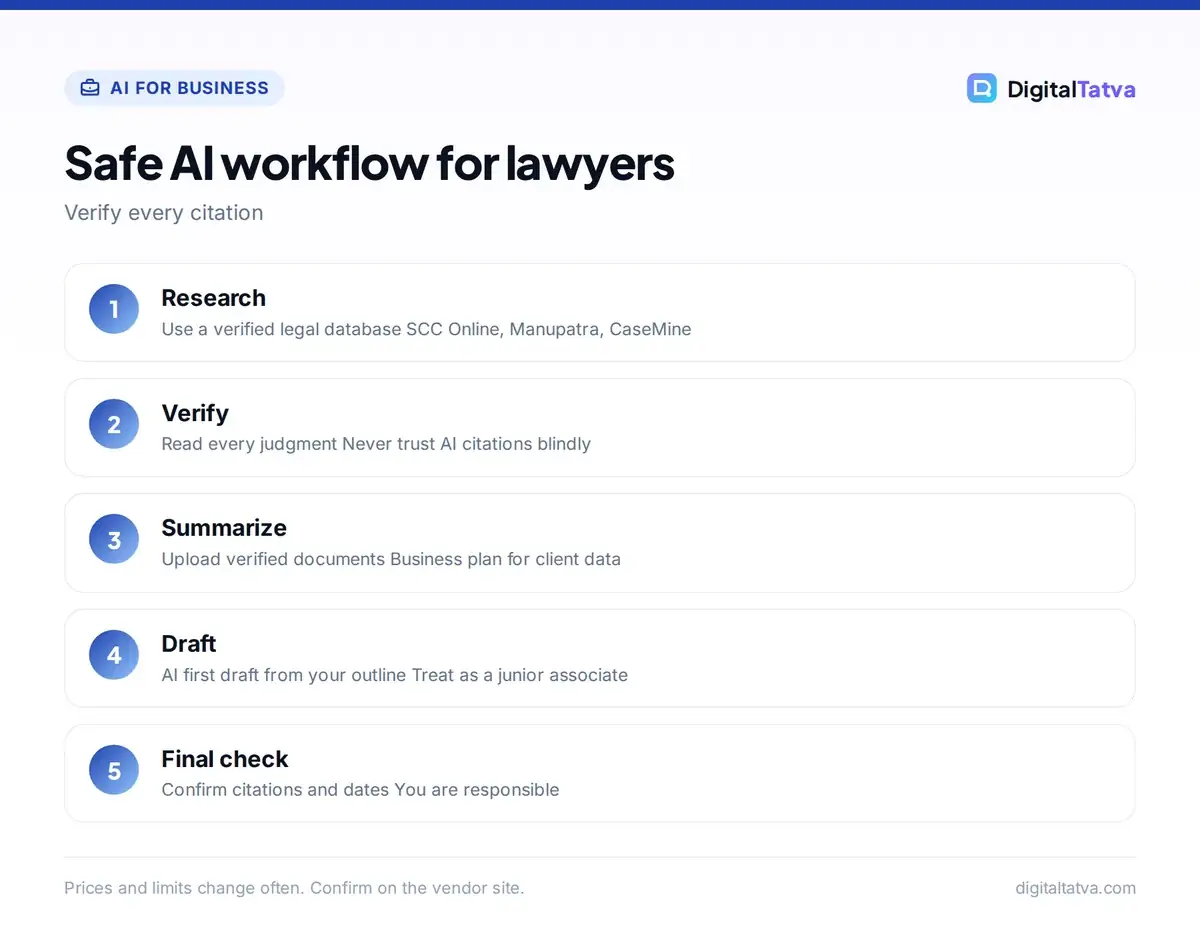
- Research: start in a legal database with AI, such as SCC Online, Manupatra or CaseMine, to find authorities.
- Read and verify: open and read every judgment you plan to rely on.
- Summarize: upload the verified judgments and facts to a business-plan assistant and ask for summaries and an argument outline based only on those documents.
- Draft: generate a first draft from your outline and templates.
- Review: edit for accuracy, local practice, tone and strategy. AI is a junior associate, not a senior partner.
- Final check: verify every citation, quote and date before filing or sending.
Useful AI prompts for lawyers
- “Summarize this judgment in 300 words: facts, issues, holding, reasoning and key paragraphs with paragraph numbers.”
- “From the attached contract, list all termination, indemnity, limitation of liability and governing law clauses with page references, and flag anything unusual compared to a standard services agreement.”
- “Create a chronology of events from these documents as a table with date, event, source document and page.”
- “Draft a legal notice for non-payment of Rs [amount] under [agreement], firm but professional, leaving placeholders for facts I must confirm.”
- “Explain this clause to a client who is not a lawyer, in simple English and in Hindi.”
- “Using only the judgments I uploaded, outline arguments for and against [position]. Do not cite any case that is not in the uploaded documents.”
More prompt technique is in our prompt engineering guide, and tools for working with long PDFs are covered in our AI PDF tools roundup.
Getting started as a small firm or solo advocate
You do not need an enterprise budget. A practical starter setup is one Indian legal research subscription with AI search, a business plan of ChatGPT or Claude for drafting and summaries, and a meeting assistant for client calls with consent. Start with two tasks, such as judgment summaries and first drafts of notices, track the hours saved for a month and expand from there. Our guides to AI summarizers, AI translation tools and AI for small business cover supporting tools.
Benefits
- Hours saved on research and review
- Faster first drafts
- Better client explanations
- Quicker due diligence
- Small firms compete with larger ones
Risks
- Fake citations from general chatbots
- Confidentiality breaches
- Over-reliance and weaker legal reasoning
- Costs of enterprise tools
- Professional conduct exposure
Frequently asked questions
What is the best AI tool for lawyers in India?
For legal research, SCC Online AI, Manupatra and CaseMine AMICUS are the most popular choices because they work on Indian legal databases. For drafting and summaries, ChatGPT and Claude on business plans are widely used. Many lawyers combine one research tool with one general assistant.
Can lawyers use ChatGPT for legal research?
Lawyers can use ChatGPT to understand concepts, summarize documents and draft, but should not rely on it for case citations. General chatbots can invent cases. Use verified legal databases for authorities and read every judgment before citing it.
Is it ethical for lawyers to use AI?
Yes, if lawyers protect client confidentiality, verify all output, remain responsible for their work and follow court and bar rules on disclosure. Many bar bodies and courts are issuing guidance, so check the latest rules in your jurisdiction.
Will AI replace lawyers?
AI will automate parts of legal work such as document review, research summaries and first drafts, but legal judgment, strategy, advocacy, negotiation and client trust remain human. Lawyers who use AI effectively are likely to replace those who do not.
How much do legal AI tools cost?
Costs range from free tiers like CaseMine’s to around Rs 6,000 a year for Manupatra AI search and Rs 51,500 per user per year plus GST for SCC Online AI Pro. Enterprise platforms like Harvey use custom pricing. General assistants cost about $20 to $25 per user per month on business plans.
The bottom line
AI can make legal work faster and more affordable, but only with discipline. Use verified legal databases for research, general assistants for drafting and summaries, business plans for client data, and a strict verification habit for every citation. Treat AI as a capable junior who drafts quickly but whose work you always check.
Pricing and features are checked at the time of writing and can change. Some links may be affiliate links, which never affect our verdicts.