How to Get Your Website Cited by ChatGPT, Perplexity and Google AI
AI answers increasingly show the pages they relied on. How to make your website one of those sources, on your own pages and on the sites engines already trust.
On this page
- Key takeaways
- What counts as an AI citation
- How engines choose what to cite
- Step 1: Make sure engines can reach you
- Step 2: Write passages worth citing
- Step 3: Add evidence
- Step 4: Earn mentions where engines already look
- Step 5: Build pages that match citation patterns
- Step 6: Measure citations
- Differences between engines
- Common mistakes
- A citation audit workflow
- An honest outreach template
- Keep cited pages fresh
- Examples by industry
- Citation checklist
- Track citations and mentions together
- Frequently asked questions
- Sources
Last updated: 31 October 2026
Quick answer: To get cited by AI assistants, make sure their search crawlers can reach your pages, answer specific questions clearly near the top of a page, back claims with evidence such as data, named experts and sources, and appear on the third-party pages engines already cite for your topic. Then track the same prompts monthly to see which of your pages are cited and for which questions.
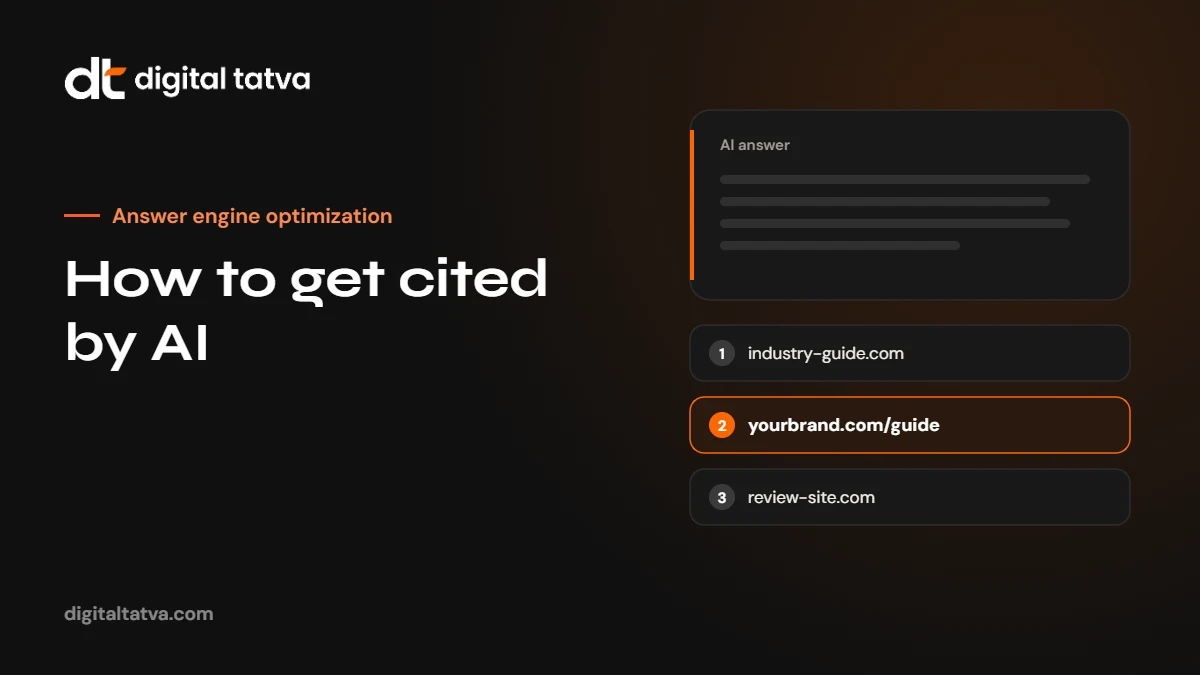
When Perplexity, Microsoft Copilot, Google AI Overviews or ChatGPT search answer a question, they often show the pages they relied on. Those citations matter more than the small amount of traffic they send. They tell the reader, and the engine, that your page is a trusted source on the topic, and they influence which brands get named in future answers.
This guide explains how AI citations work, the six steps that make your pages easier to cite, page templates for the most common question types, how to earn citations on other people’s sites and how to measure progress.
Key takeaways
- A citation is a link to a page shown alongside an AI answer.
- Engines can only cite pages they can crawl, render and index.
- Short, specific, well-sourced passages are the easiest to cite.
- Many citations go to third-party pages, so earn mentions there too.
- Different engines cite different sources; test each one.
- Track citations per prompt and per engine over time.
What counts as an AI citation
A citation is a reference to a source shown with an AI-generated answer: a numbered link in Perplexity, a source card in Copilot, a link in a Google AI Overview or a source list when ChatGPT searches the web. Citations are separate from mentions. An engine can name your brand without linking to you, or cite your page without naming your brand in the text. Both matter, and the best outcome is being named and cited together.
How engines choose what to cite
When an assistant answers with live search, it typically runs one or more searches, retrieves a set of candidate pages, extracts passages that fit the question and writes a summary, linking to the pages that contributed. Pages are more likely to be chosen when they are easy to retrieve, clearly relevant to the exact question, current and specific. Pages that bury the answer, repeat generic advice or hide content behind scripts are easy to skip.
Research on generative engines found that adding citations, quotations and statistics to content improved how often it appeared in generated answers. That matches what we see in practice: concrete, sourced facts are easier for a model to reuse than general claims.
Step 1: Make sure engines can reach you
- Allow the search crawlers in robots.txt: OAI-SearchBot for ChatGPT search, PerplexityBot, Bingbot (which feeds Copilot and other services) and Googlebot for AI Overviews.
- Check that your CDN, firewall or security plugin is not blocking them. Server logs show whether they are being refused.
- Put the main content in the HTML, not only after JavaScript runs. See JavaScript rendering for AI crawlers.
- Keep pages indexable and eligible for snippets; avoid nosnippet on pages you want quoted.
The full list is in our technical AEO checklist.
Step 2: Write passages worth citing
- Answer first. Put the direct answer in the first one or two sentences of the page and of each section.
- Use question headings. Phrase H2s the way people ask: “How much does X cost in India?” rather than “Pricing”.
- Be specific. Numbers, dates, ranges, named methods, examples and conditions (“for teams under 50 people”).
- One idea per paragraph. Short, self-contained passages can be lifted without losing meaning.
- Keep it current. Show a “last updated” date and update facts when they change.
Our guide to answer-first content covers the writing style in detail.
Before and after: a citable passage
| Before | After |
|---|---|
| “We offer world-class payroll solutions tailored to your unique needs, helping businesses of all sizes thrive.” | “Payroll outsourcing in India usually covers salary processing, PF, ESI and TDS filings, and payslips. For a 50-person company, setup typically takes two to four weeks.” |
The second version answers a real question, contains checkable facts and can be quoted on its own.
Step 3: Add evidence
Evidence makes a page more useful and more citable. Publish original data where you can, such as survey results, pricing benchmarks or anonymised findings from your own work. Add named authors with real credentials (see author pages), quote experts and link to primary sources such as regulations, official documentation and studies.
Step 4: Earn mentions where engines already look
For many commercial questions, engines cite review sites, comparison articles, directories, forums, news and industry associations more than brand websites. Map those domains for your prompts, then work on being included honestly:
- Accurate, complete directory and marketplace listings.
- Reviews from real customers on the platforms engines cite for your category. See review sites for AEO.
- Expert commentary for journalists and industry publications.
- Inclusion in genuine roundups and comparisons, with accurate facts.
- Helpful, disclosed participation in communities such as Reddit. See Reddit for AEO.
More on this in brand mentions for AEO.
Step 5: Build pages that match citation patterns
| Question type | Page that tends to be cited | Must include |
|---|---|---|
| “What is X” | Definition page | One-sentence definition, examples, how it differs from similar terms |
| “X vs Y” | Comparison page | Table of differences, who each option suits, honest trade-offs |
| “Best X for Y” | Buying guide | Criteria, shortlist with reasons, who should choose what |
| “How much does X cost” | Pricing page | Real ranges or the factors that drive price, what is included |
| “How do I X” | Step-by-step guide | Numbered steps, requirements, common mistakes |
| “Is X worth it” | Pros and cons page | Balanced view, situations where it is and is not worth it |
See also the page types AI assistants cite most.
Step 6: Measure citations
Re-run a fixed prompt set monthly and record which URLs are cited, by engine and by prompt group. Track three numbers: how many prompts cite any of your pages, how many cite third-party pages that mention you, and how many cite competitors. Watch for which of your pages earn citations, then improve similar pages in the same way. This is the core of our AI Citation Optimization service.
Differences between engines
- Perplexity cites sources for almost every answer and tends to favour clear, current pages. See Perplexity SEO.
- Google AI Overviews draw on Google’s index; pages must be indexed and snippet-eligible. See AI Overviews optimization.
- Copilot relies on Bing, so Bing indexing and Bing Webmaster Tools matter. See Copilot SEO.
- ChatGPT cites sources when it searches; OAI-SearchBot access is essential. See ChatGPT SEO.
Common mistakes
- Blocking OAI-SearchBot or Bingbot while trying to block AI training.
- Writing for keywords instead of answering the question asked.
- Publishing claims without numbers or sources.
- Ignoring the third-party sites that engines actually cite.
- Checking citations once and never again.
A citation audit workflow
- Export cited URLs. From your prompt tests, list every cited URL with its prompt and engine.
- Group by domain type. Your site, competitors, review sites, directories, media, forums, reference sites.
- Count frequency. The domains cited most often across your prompts are your priority targets.
- Check your presence. For each priority domain, are you listed? Accurately? Favourably?
- Plan actions. Claim and complete listings, request reviews, pitch updates to articles, or create a better page of your own for the question.
An honest outreach template
When an article that engines cite leaves you out, a short, useful email works better than a link request:
Hi [name], I read your guide to [topic], which is one of the clearest on the subject. One thing readers often ask us about is [specific gap]. We published [data or example] on this here: [link]. If it is useful for a future update, you are welcome to use it. Either way, thanks for the guide. [Your name, role, company]
Offer something genuinely useful, such as data, an example or an expert quote, and accept that many editors will not reply.
Keep cited pages fresh
Pages that earn citations can lose them when they go out of date. Review your most-cited pages every quarter: update figures, dates, prices and examples, check that links still work and add answers to new questions buyers are asking. Show the updated date clearly.
Examples by industry
| Industry | Question | Page that earns citations |
|---|---|---|
| Healthcare clinic | “How much does a dental implant cost in Ahmedabad?” | Cost guide with ranges and what affects price |
| Software | “Tool A vs Tool B for small teams” | Fair comparison with a feature table |
| Manufacturing | “What grade of steel is best for food processing equipment?” | Technical guide by an engineer |
| Education | “Is an MBA from India worth it in 2026?” | Data-led guide with outcomes and sources |
| Real estate | “Best areas to buy an apartment in Ahmedabad for families” | Area guide with schools, transport and price ranges |
Citation checklist
- Search crawlers allowed and content in HTML.
- Answer in the first two sentences of each page and section.
- Specific facts, with sources and dates.
- Named author with credentials.
- Pages for definition, comparison, cost, how-to and “best” questions.
- Presence on the third-party domains engines cite.
- Monthly tracking of cited URLs by engine.
Track citations and mentions together
A simple monthly scorecard keeps both in view:
| Measure | How to calculate |
|---|---|
| Mention rate | Prompts where your brand is named, divided by total prompts |
| Own-page citation rate | Prompts where one of your URLs is cited, divided by total prompts |
| Third-party citation rate | Prompts citing a page that mentions you, divided by total prompts |
| Competitor citation rate | Prompts citing a competitor’s page, divided by total prompts |
Report each by engine. Over time you want all three of your own rates to rise relative to competitors.
Want to know which pages AI engines cite for your category? Request an AI visibility audit.
Frequently asked questions
Does ChatGPT cite websites?
Yes, when it searches the web it shows source links. Answers given only from what the model learned in training usually do not include links.
Do I need backlinks to be cited by AI?
Not in the traditional sense, but mentions on trusted third-party pages help, because engines often cite those pages or use them to confirm facts about you.
Can blocking GPTBot stop ChatGPT citing me?
GPTBot is used for training. ChatGPT search uses OAI-SearchBot. Blocking OAI-SearchBot can stop your pages appearing in ChatGPT search results.
Which pages on my site are most likely to be cited?
Pages that answer one clear question with specific facts: pricing explanations, comparisons, how-to guides, definitions and original data.
How long before new pages get cited?
Once a page is crawled and indexed it can be cited quickly, but earning consistent citations for competitive questions usually takes months.
Is being cited the same as being recommended?
No. A citation shows your page was used as a source. A recommendation names your brand as an option. Aim for both.
Sources
- Overview of OpenAI crawlers, OpenAI
- Perplexity crawlers, Perplexity
- AI features and your website, Google Search Central
- GEO: Generative Engine Optimization, Aggarwal et al., arXiv, 2023
Product details, prices and features are checked at the time of writing and can change. Sources are linked in the text so you can check them yourself.
How does your brand appear in AI answers?
We test the questions your buyers ask across the major AI assistants and search engines, then show you what to fix first.
Get an AI Visibility Audit