AEO for B2B Companies: How to Get Named When Buyers Ask AI
B2B buyers now shortlist vendors by asking AI assistants. How manufacturers, service firms and B2B tech companies can get named in those answers, step by step.
On this page
- Key takeaways
- Why AEO matters more in B2B
- The questions B2B buyers ask AI
- A step-by-step B2B AEO plan
- Page types that work in B2B
- Gated content and PDFs
- Proof that engines and buyers trust
- An illustrative example
- How to measure B2B AEO
- Common B2B mistakes
- Account-level and RFP prompts
- Distributors, partners and group websites
- Trade shows, associations and awards
- Align sales and marketing
- A 90-day B2B AEO plan
- Frequently asked questions
- Sources
Last updated: 31 October 2026
Quick answer: B2B buyers increasingly ask AI assistants to explain options, compare vendors and draft shortlists before they talk to sales. AEO for B2B means making sure those answers include you: clear pages for each product, service, industry and use case, specifications and pricing factors in plain HTML, consistent company facts, proof such as case studies and certifications, and mentions on the directories, reviews and trade sites that engines cite.
B2B buying has always involved research. A plant head looking for an automation partner, a CFO comparing payroll providers or an IT manager shortlisting cybersecurity firms will read, compare and ask peers long before filling in a contact form. What has changed is where that research starts. More of it now begins with a question to ChatGPT, Gemini, Perplexity or Copilot, and the assistant’s answer shapes the first shortlist.
This guide covers why AEO matters more in B2B, the questions buyers ask at each stage, a step-by-step plan, the page types that work, how to handle gated content and PDFs, what proof engines look for, how to measure progress and the mistakes we see most often.
Key takeaways
- B2B research is long and detailed, which suits AI assistants.
- Engines need specifics: capabilities, industries served, certifications, locations and pricing factors.
- Technical PDFs and gated content are often invisible to AI crawlers.
- Industry directories, review platforms and trade media shape vendor shortlists.
- Track category, comparison and “supplier for” prompts, not just your brand name.
Why AEO matters more in B2B
B2B purchases involve several people, long research and many questions: which approach fits, which vendors are credible, what to ask in a request for proposal and what a fair price looks like. AI assistants are good at exactly this kind of research. They summarise options, explain trade-offs and suggest names. If your company is missing from those answers, you may never see the enquiry, and you will not know you lost it.
B2B companies also tend to have the weakest websites for AI. Expertise sits in sales teams, brochures and PDFs rather than on clear web pages. That is a problem, but also an opportunity: modest improvements can make a large difference. See what AEO is for the basics.
The questions B2B buyers ask AI
| Buying stage | Example question | Page that answers it |
|---|---|---|
| Problem | “How do we reduce downtime on packaging lines?” | Guide or solution page |
| Approach | “Should we automate or outsource quality inspection?” | Comparison of approaches |
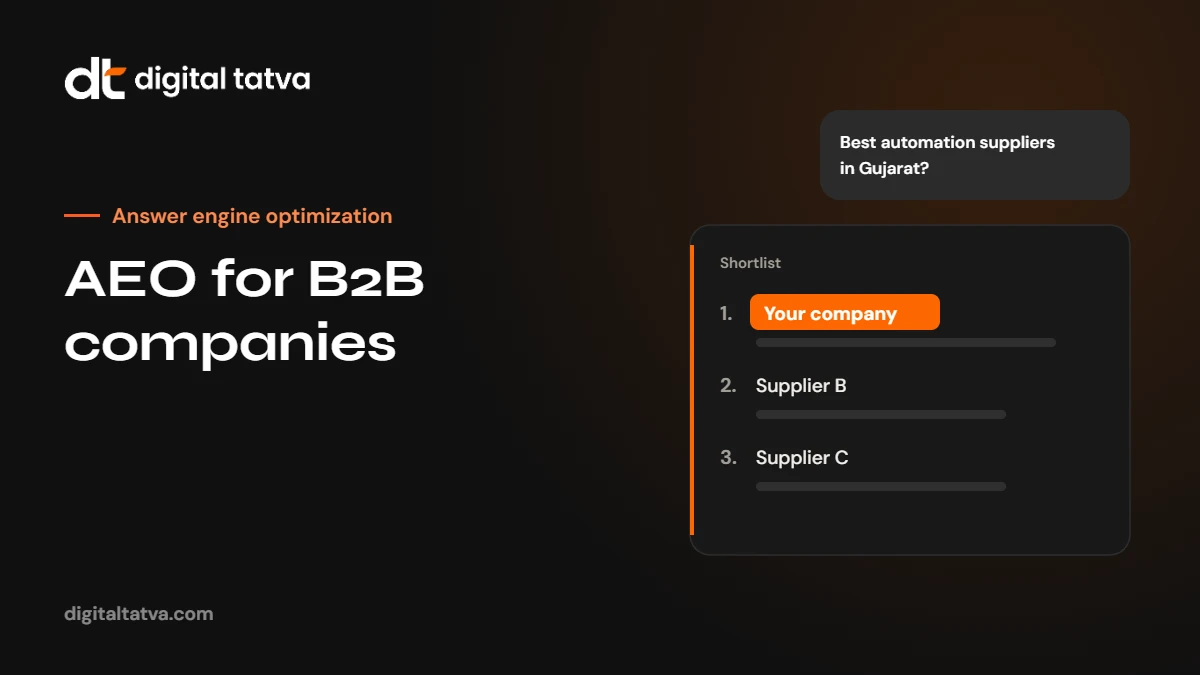
| Category | “Best industrial automation suppliers in Gujarat” | Service, industry and location pages |
| Comparison | “Vendor A vs Vendor B for mid-size plants” | Comparison page |
| Evaluation | “What certifications should a supplier have?” | Quality and certification page |
| Cost | “How much does a SCADA upgrade typically cost?” | Pricing factors page |
| Risk | “What can go wrong when switching suppliers?” | Onboarding or migration page |
A step-by-step B2B AEO plan
- Build a buyer prompt set. Interview sales and pre-sales, read past RFPs, enquiry forms and support tickets, and list the questions buyers ask at each stage. Our guide to prompt research shows how.
- Baseline every engine. Run an AI visibility audit across ChatGPT, Gemini, Perplexity, Copilot and Google AI Overviews. Note who is named, what is said and which sources are cited.
- Fix technical access. Check robots.txt, rendering and indexing with the technical AEO checklist.
- Unlock hidden content. Move key specifications, capabilities and FAQs out of PDFs and gated forms into HTML pages.
- Build one page per offer and industry. Separate pages for each product line, service and industry served, each answering its main question in the first lines.
- Show proof. Named case studies, certifications, standards, client logos where permitted and named experts.
- Fix company facts. Consistent name, description, locations and capabilities across your site, group sites, LinkedIn, trade directories and Google Business Profile. See Entity SEO.
- Earn industry mentions. Trade directories, B2B review platforms, association listings, trade media and event coverage. See review sites for AEO.
- Measure monthly. Track mentions, accuracy and cited sources by prompt group, and connect AI referral traffic to enquiries.
Page types that work in B2B
- Capability pages: what you make or do, specifications, tolerances, capacities, standards met.
- Industry pages: how you serve automotive, pharma, textiles or food processing, with industry-specific examples.
- Use case pages: a specific problem and how you solve it.
- Pricing factors pages: what drives cost and typical ranges where you can share them.
- Comparison pages: approaches, technologies or (carefully and fairly) vendors.
- Case studies: named client, situation, what you did, measured outcome and dates, with permission.
- Location pages: plants, offices and service areas, with consistent addresses.
Gated content and PDFs
Many B2B sites keep their most useful information in downloadable brochures, datasheets and whitepapers behind forms. Crawlers cannot fill in forms, and while some engines can read PDFs, the content is often poorly structured and rarely cited. A practical approach:
- Put the answers to common questions, key specifications and capabilities on HTML pages.
- Keep deeper assets, such as detailed reports or calculators, gated if they generate qualified leads.
- For PDFs you keep public, add an HTML summary page that links to the file.
Proof that engines and buyers trust
AI assistants tend to favour claims they can confirm in more than one place. For B2B companies that means:
- Certifications listed on your site and on the certifying body’s directory.
- Case studies that name clients and are referenced elsewhere, such as in trade media.
- Reviews on B2B platforms relevant to your sector.
- Named experts with profiles, talks and articles. See author pages.
- Original data, such as benchmark reports. See original research for AEO.
An illustrative example
An industrial automation company in Gujarat finds that assistants name two national integrators and one international brand for “best PLC automation companies in Gujarat”. Its own site has one “Solutions” page, a brochure PDF and no case studies online. The plan: create pages for each industry it serves, move capability details out of the PDF, publish three case studies with client permission, correct its listings in two trade directories and ask clients for reviews on a B2B platform engines cite. The same prompts are re-tested monthly. This is an illustration of the method, not a client result.
How to measure B2B AEO
- Share of prompts where you are named, by stage and engine.
- Accuracy of how you are described.
- Which of your pages and which third-party pages are cited.
- AI referral sessions in analytics, and enquiries that mention AI tools. See tracking AI traffic in GA4.
Common B2B mistakes
- Product details only in downloadable brochures.
- One generic “Solutions” page covering every industry.
- No pricing information at all, so engines quote competitors’ ranges.
- Different company descriptions across group sites, distributor sites and profiles.
- Case studies without names, dates or outcomes.
Software companies should also read AEO for SaaS. To have us run the programme, see Answer Engine Optimization.
Account-level and RFP prompts
In B2B, some of the most valuable prompts are the ones buyers use when preparing a purchase, not just discovering options. Add prompts like these to your set:
- “What should we include in an RFP for [service]?”
- “What questions should we ask [type of supplier] before signing?”
- “What are the risks of switching [type of supplier]?”
- “What certifications should a [type of supplier] in India have?”
If engines answer these using your guides, your criteria shape the buyer’s evaluation, which is a strong position to be in.
Distributors, partners and group websites
Many B2B companies are described on distributor, partner, parent-company and marketplace sites. These pages often carry old product names, outdated specifications or different company descriptions, and engines may cite them. Audit the main ones, send corrected descriptions and specifications, and ask partners to link to your official pages.
Trade shows, associations and awards
Industry associations, trade show exhibitor lists, award pages and conference speaker pages are often treated as trusted, independent sources. Make sure your listings on them are complete and consistent, and publish recaps of talks and exhibitions on your own site with links to the event pages.
Align sales and marketing
- Ask sales to record which prospects mention AI tools during research.
- Turn common sales questions into answer-first web pages.
- Give sales links to these pages for follow-up emails, which also earns them more visits.
- Review the prompt set with sales every quarter to add new questions.
A 90-day B2B AEO plan
- Days 1 to 20: sales interviews, prompt set and baseline audit.
- Days 20 to 40: technical fixes, company fact sheet, listing and partner clean-up.
- Days 40 to 70: capability, industry and pricing factors pages; two case studies.
- Days 60 to 90: trade directory and review platform work, association listings, outreach to trade media.
- Day 90: re-test the prompt set and plan the next quarter.
Are you on the shortlist AI gives your buyers? Request an AI visibility audit.
Frequently asked questions
Do B2B buyers really use ChatGPT to find suppliers?
Many use AI assistants during research to understand options and build shortlists, alongside search, peers, trade shows and sales conversations.
Should B2B companies ungate content for AEO?
Ungate the content that answers buyer questions, such as capabilities, specifications and FAQs. Keep deeper assets gated if they generate qualified leads.
Does AEO work for manufacturers?
Yes. Manufacturers often have strong expertise but thin web pages, so clear capability, industry and certification pages can make a large difference.
Should we publish prices?
If exact prices are not possible, publish the factors that drive cost and typical ranges. Otherwise engines will use competitors’ figures.
How long does B2B AEO take?
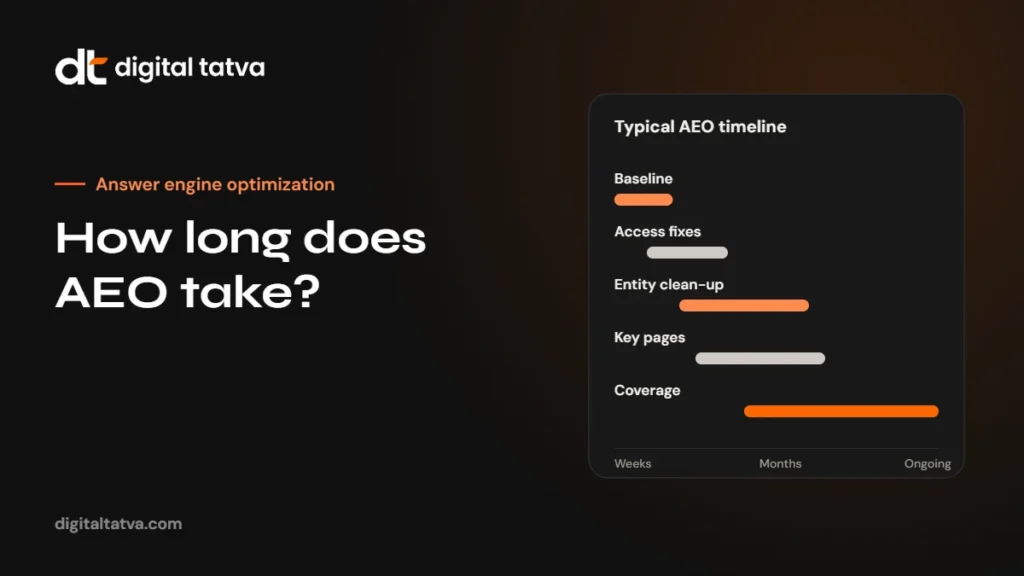
Technical and content fixes can show up within weeks to a few months; building citations in trade sources takes longer. See how long AEO takes.
How do we measure B2B AEO?
Track a fixed prompt set across engines for mentions, accuracy and cited sources, and connect AI referral traffic to enquiries in analytics.
Sources
- AI features and your website, Google Search Central
- Overview of OpenAI crawlers, OpenAI
Product details, prices and features are checked at the time of writing and can change. Sources are linked in the text so you can check them yourself.
How does your brand appear in AI answers?
We test the questions your buyers ask across the major AI assistants and search engines, then show you what to fix first.
Get an AI Visibility Audit