How Long Does AEO Take to Work? A Realistic Timeline
Some AEO fixes show up within weeks; changing how AI assistants recommend you takes longer. A realistic timeline, stage by stage, and what speeds things up or slows them down.
On this page
- Key takeaways
- Why there is no single answer
- A stage-by-stage timeline
- What a realistic first six months looks like
- What speeds AEO up
- What slows it down
- Quick wins you can see sooner
- How to judge progress
- Setting expectations with your team
- Timelines by type of business
- How each engine tends to react
- Early signs that AEO is working
- A monthly review agenda
- Why AEO compounds over time
- What you control and what you do not
- If nothing changes after three months
- Frequently asked questions
- Sources
Last updated: 31 October 2026
Quick answer: Technical fixes such as allowing AI crawlers or putting content in HTML can be picked up within weeks of the next crawl. New or rewritten pages can start being cited within weeks to a few months. Changing how often AI assistants recommend you for competitive category questions usually takes several months of consistent work on content, brand facts and third-party coverage, and needs ongoing maintenance after that.
“How long until we see results?” is the most common question we hear about answer engine optimization, and the honest answer is “it depends on what you mean by results”. Some changes show up quickly. Others take months, and a few depend on things nobody controls, such as when an AI company releases a new model. This guide breaks AEO down into stages, explains what affects the speed of each, shows what a realistic first six months looks like and explains how to judge progress without overreacting to week-to-week noise.
Key takeaways
- AEO results arrive in stages, not all at once.
- Engines must recrawl and re-index pages before changes count.
- Answers that use live search react faster than answers from model training data.
- Competitive categories and weak starting points take longer.
- Measure monthly against a fixed baseline and look at trends, not single checks.
Why there is no single answer
AI assistants answer in two broad ways. Some answers come from live search: the assistant searches the web, reads pages and writes a summary. Others come from what the model learned during training. Live-search answers can reflect your changes soon after pages are recrawled. Knowledge from training only changes when a new model version is trained and released, on a schedule you do not control. Most commercial questions, such as “best”, “near me”, pricing and comparison queries, trigger live search, which is where AEO has the most direct effect.
Speed also depends on your starting point. A well-known brand with a technically sound site may see changes quickly. A new brand with little coverage starts further back.
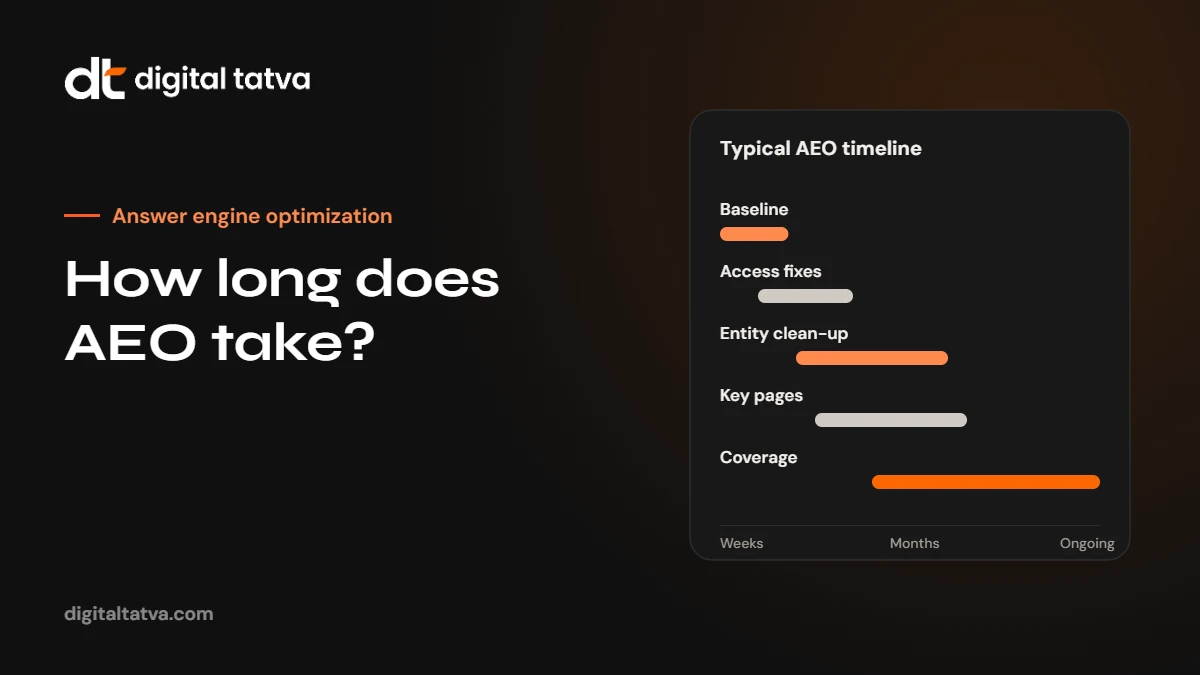
A stage-by-stage timeline
| Stage | Work | When you may see change | What change looks like |
|---|---|---|---|
| Baseline | Prompt set, engine tests, audit | Weeks 1 to 3 | A clear picture of where you stand |
| Access fixes | Robots.txt, rendering, indexing | Weeks after recrawl | Pages start appearing as sources |
| Entity clean-up | Consistent facts, schema, profiles | One to three months | Fewer errors in brand descriptions |
| Key page rewrites | Answer-first service, pricing and comparison pages | Weeks to a few months | Citations for specific questions |
| Third-party coverage | Reviews, directories, mentions, PR | Three to six months and ongoing | More mentions in category answers |
| Model updates | None directly | Unpredictable | Changes in answers without live search |
These are typical ranges, not promises. Results depend on your starting point, your category and how consistently the work is done.
What a realistic first six months looks like
- Month 1: baseline completed, technical issues fixed, brand fact sheet written. Little visible change yet.
- Month 2: listings and profiles corrected, structured data in place, first key pages rewritten. Brand prompts become more accurate.
- Month 3: more pages rewritten, comparison and pricing pages published. First citations for specific questions often appear.
- Months 4 to 6: reviews, directory inclusion and outreach build up. Mentions in category answers start to increase, unevenly across engines.
What speeds AEO up
- A site that is already indexed and trusted in Google and Bing.
- Clear, specific expertise that competitors do not cover.
- Existing reviews, press and partnerships you can build on.
- Fast internal sign-off on fixes and content.
- A focused prompt set, rather than trying to win everything at once.
What slows it down
- JavaScript-heavy sites where content is not in the HTML.
- Inconsistent brand names, addresses or descriptions across the web.
- A recent rebrand or domain change.
- Very competitive categories dominated by large brands and publishers.
- Stopping and starting the work, or changing direction every month.
Quick wins you can see sooner
- Unblocking AI search crawlers that were blocked by mistake.
- Correcting wrong facts on the listings engines cite.
- Adding a clear answer to the top of an important page that already ranks.
- Publishing a pricing factors page when none existed.
More ideas in our list of AEO quick wins.
How to judge progress
AI answers vary between runs and engines change often, so week-to-week checks are noisy. Judge progress monthly, on the same prompts, using a few clear measures:
- Mention rate: share of prompts where you are named, by engine and group.
- Accuracy: how many answers describe you correctly.
- Citations: how often your pages, or third-party pages about you, are cited.
- Traffic and enquiries: AI referral sessions and enquiries that mention AI tools. See tracking AI traffic in GA4.
Our guide to AEO KPIs covers how to report these.
Setting expectations with your team
- Agree the prompt set and baseline before work starts.
- Agree which measures matter and how often you will review them.
- Expect uneven progress across engines.
- Plan for ongoing work; visibility can fall if you stop.
- Be wary of anyone promising fixed results by a fixed date.
To see where you are starting from, use the AI visibility audit checklist, or see how we run Answer Engine Optimization programmes.
Timelines by type of business
The same AEO work moves at different speeds depending on the business. These are typical patterns we see, not promises:
| Business type | What tends to move first | What takes longest |
|---|---|---|
| Local service business | Accurate details in “near me” answers once listings and Google Business Profile are fixed | Being recommended over long-established local competitors |
| B2B company | Citations for specific capability and pricing questions | Inclusion in broad “best suppliers” answers |
| Ecommerce brand | Product facts in shopping-style answers once product pages and feeds are clean | Recommendations in “best product for” answers dominated by review sites |
| SaaS company | Accurate feature and pricing descriptions | Inclusion in “alternatives to” and comparison answers |
| New brand | Correct answers to brand questions | Any category recommendation, until coverage builds |
How each engine tends to react
- Perplexity searches the web for almost every answer, so improvements to clear, current pages can show up relatively quickly once they are crawled.
- Google AI Overviews and AI Mode draw on Google’s index, so changes follow the pace of Google crawling and indexing.
- Copilot relies on Bing, so Bing indexing speed matters; submitting sitemaps in Bing Webmaster Tools helps.
- ChatGPT mixes search-based answers with model knowledge. Search answers can change soon after OAI-SearchBot recrawls; model knowledge changes with new releases.
- Gemini draws on Google’s systems and can reflect changes in Google’s index and Knowledge Graph.
Early signs that AEO is working
Before mention rates rise, you will often see smaller signals that the foundations are in place:
- AI crawlers appearing in your server logs after being unblocked.
- Brand questions answered more accurately, with the right services and location.
- Your pages appearing as cited sources for narrow, specific questions.
- A few AI referral visits in analytics from ChatGPT, Perplexity or Copilot.
- Sales calls where prospects mention they found you through an AI assistant.
A monthly review agenda
A short, consistent monthly review keeps everyone focused on trends rather than single answers. A 30-minute agenda that works:
- Headline numbers. Mention rate, accuracy and citations by engine, compared with last month and the baseline.
- Biggest movers. Prompts where you gained or lost visibility, and why that might be.
- Work completed. Fixes, pages and outreach done since the last review.
- Problems found. New errors in descriptions, new competitors or lost citations.
- Next month. The three most important tasks, with owners.
Why AEO compounds over time
Each piece of AEO work makes the next one more effective. Clean technical access means new pages are found faster. Consistent brand facts mean new mentions reinforce the same picture of who you are. Every genuine review, citation and media mention adds to the evidence engines can draw on. That is why visibility often grows slowly at first and faster later, and why stopping the work tends to let competitors catch up gradually rather than suddenly.
What you control and what you do not
| You control | You influence | You do not control |
|---|---|---|
| Crawler access, site speed and rendering | Reviews and ratings from real customers | When engines recrawl your site |
| Your pages, structured data and facts | Coverage in media and industry sites | When new AI models are released |
| Your listings and official profiles | How often you are mentioned in communities | How engines weigh sources |
| How consistently the work is done | Inclusion in roundups and comparisons | What competitors do |
Focus effort on the first two columns, and measure long enough to see past the third.
If nothing changes after three months
- Re-check access. Confirm in server logs that AI search crawlers are reaching your key pages and getting 200 responses.
- Check indexing. Make sure new and updated pages are indexed in Google and Bing.
- Review the prompts. Are they realistic buyer questions, or too broad for a business your size? Add narrower, more specific prompts.
- Look at the sources. Which domains do engines cite for your prompts? If you are absent from all of them, shift effort towards third-party coverage.
- Compare with competitors. What do the brands that are named have that you do not: reviews, comparison pages, media coverage, pricing information?
- Get a second opinion. An outside audit often spots issues that are easy to miss from inside.
Want a timeline for your own site? Request an AI visibility audit.
Frequently asked questions
Can AEO show results in a month?
Some technical and on-page fixes can show up within weeks. Broader changes in recommendations usually take longer.
Is AEO faster than SEO?
Sometimes. Live-search AI answers can react quickly to clear, well-sourced pages, but competitive categories take time in both.
Why do results go up and down?
AI answers vary between runs, and engines and models update often. Look at trends over several months rather than single checks.
Why does ChatGPT still show old information about us?
If the answer does not use live search, it may come from older training data. Fixing your sources helps live-search answers now and future model versions later.
How long should we commit to AEO before judging it?
Give a focused programme at least three to six months, measured monthly against a fixed baseline.
Do I need to keep doing AEO after it works?
Yes. Competitors, sources and engines keep changing, so ongoing monitoring and updates protect your visibility.
Sources
- AI features and your website, Google Search Central
- Overview of OpenAI crawlers, OpenAI
Product details, prices and features are checked at the time of writing and can change. Sources are linked in the text so you can check them yourself.
How does your brand appear in AI answers?
We test the questions your buyers ask across the major AI assistants and search engines, then show you what to fix first.
Get an AI Visibility Audit