AI Visibility Audit Checklist: 20 Checks Before You Invest in AEO
Before you spend on answer engine optimization, find out where you stand. A 20-point checklist for auditing how ChatGPT, Gemini, Perplexity, Copilot and Google AI Overviews see your brand.
On this page
- Key takeaways
- Why an audit comes first
- What you need before you start
- Part 1: Prompts (checks 1 to 4)
- Part 2: Engines and results (checks 5 to 9)
- Part 3: Accuracy and sentiment (checks 10 to 12)
- Part 4: Sources (checks 13 to 16)
- Part 5: Technical and entity (checks 17 to 20)
- A spreadsheet template you can copy
- Scoring and prioritising the findings
- Common audit mistakes
- After the audit
- How to read the results: five common patterns
- Audits for multiple locations or markets
- Presenting the audit to leadership
- Tools that help
- Audit checklist summary
- Frequently asked questions
- Sources
Last updated: 31 October 2026
Quick answer: An AI visibility audit measures how AI assistants describe and recommend your brand today. It covers five parts: a prompt set based on real buyer questions, results across the main engines, the accuracy of what they say, the sources they cite, and the technical and entity issues that keep you out. Run it before any AEO work so you know what to fix first and can measure progress later.
Most businesses start answer engine optimization by guessing. They add an llms.txt file, publish a few FAQ pages or buy a tool, without knowing where they stand. An AI visibility audit replaces guesswork with a baseline: a clear record of when assistants mention you, what they say, who they name instead and which sources shape those answers.
This guide walks through the 20 checks we use, grouped into five parts, with templates you can copy into a spreadsheet, examples of what to look for and a simple way to turn the findings into a prioritised plan.
Key takeaways
- Build prompts from real buyer questions, not keywords alone.
- Test the same prompts across ChatGPT, Gemini, Perplexity, Copilot and Google AI Overviews.
- Record accuracy as well as mentions: wrong facts are one of the most common problems.
- List the domains that get cited, because those are your citation targets.
- Check crawler access and entity consistency, because they often explain the gaps.
- Finish with a fix list ranked by effort and likely impact.
Why an audit comes first
AI answers are not a single ranking you can look up. They vary by engine, by the wording of the question, by location and sometimes between runs. Without a fixed set of prompts and a recorded baseline, you cannot tell whether a change helped, whether a competitor is gaining or whether a problem is technical or content-related. The audit also tells you which engines matter most for your buyers, so you do not spread effort evenly across all of them.
What you need before you start
- A spreadsheet with one tab per engine, or a tool that tracks prompts (see AEO tools).
- A list of 3 to 5 competitors you lose deals to.
- Your brand fact sheet: official name, description, services, locations, founders, founding year and key links.
- Access to your website’s robots.txt, server logs or CDN settings and analytics.
- Two to four hours for a small audit, or more for larger prompt sets.
Part 1: Prompts (checks 1 to 4)
- Collect real questions. Use sales call notes, enquiry forms, support tickets, reviews, Google Search Console queries and “People also ask” boxes. Ask your sales team which questions buyers ask before they choose. Our guide to AEO prompt research shows how.
- Group by intent. Category (“best X for Y”), comparison (“X vs Y”, “alternatives to X”), problem (“how do I fix Z”), cost (“how much does X cost”) and brand (“is [you] any good”).
- Include location where it matters. “In Ahmedabad”, “in India” or “near me” change answers significantly for local and regional businesses.
- Keep the set stable. Agree 30 to 100 prompts you will re-test every month. Add new prompts in a separate group so your trend lines stay comparable.
A starter set for a B2B service firm might look like this:
| Group | Example prompt |
|---|---|
| Category | What are the best payroll outsourcing companies in India for startups? |
| Comparison | Payroll outsourcing vs in-house payroll for a 50-person company |
| Problem | How do I stay compliant with PF and ESI as a small company? |
| Cost | How much does payroll outsourcing cost per employee in India? |
| Brand | Is [your brand] a good payroll provider? |
Part 2: Engines and results (checks 5 to 9)
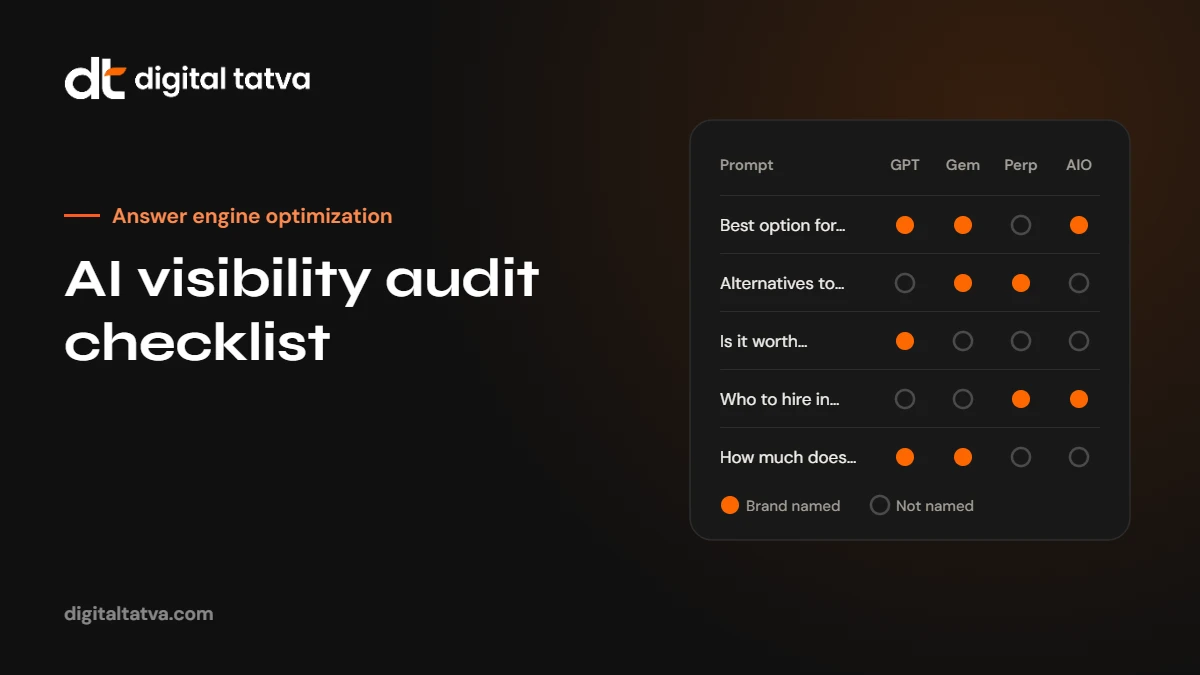
- Test each engine. ChatGPT, Gemini, Perplexity, Microsoft Copilot and Google AI Overviews or AI Mode. Note whether each engine searched the web for the answer.
- Record mentions. Is your brand named? In what position? Is it recommended, simply listed or mentioned with a caveat?
- Record competitors. Who is named instead of you, and how often? This becomes your share of voice.
- Use clean sessions. Logged out, a fresh account or a temporary chat, so memory and history do not skew results. Avoid testing from accounts that have discussed your brand before.
- Repeat key prompts. Answers vary between runs. Run your most important 10 to 20 prompts two or three times and record how often you appear.
Part 3: Accuracy and sentiment (checks 10 to 12)
- Check facts. Services, prices, locations, founders, founding year and contact details. Note every error and where it might come from.
- Check tone. Is the description positive, neutral or negative? Does the engine repeat an old complaint or a competitor’s framing?
- Check brand questions. Ask engines directly “What is [your brand]?” and “Who founded [your brand]?”. Brand prompts reveal entity problems quickly, such as being confused with a similarly named company.
In our audits, inaccurate facts are often caused by outdated directory listings, old press coverage or inconsistent descriptions across the brand’s own website and profiles.
Part 4: Sources (checks 13 to 16)
- List cited domains. Perplexity, Copilot and AI Overviews show sources; ChatGPT shows them when it searches. Record every cited URL against its prompt.
- Find your own pages. Which of your URLs are cited, if any, and for which questions?
- Find third-party pages. Directories, review sites, news, listicles, forums and comparison articles that shape answers in your category.
- Spot gaps. Cited pages where competitors appear and you do not. These become targets for citation work.
Part 5: Technical and entity (checks 17 to 20)
- AI crawler access. Check robots.txt and firewall or CDN rules for GPTBot, OAI-SearchBot, ChatGPT-User, PerplexityBot, ClaudeBot and Bingbot. A blocked search crawler can explain why you are never cited. See robots.txt for AI crawlers.
- Rendering. View the page source of key pages. Is the main content in the HTML, or only after JavaScript runs? See the technical AEO checklist.
- Structured data. Organization, Service, Product, LocalBusiness, Article and FAQ markup where relevant, tested for errors.
- Entity consistency. Name, description, address, phone and links the same on your website, Google Business Profile, LinkedIn, directories and social profiles.
A spreadsheet template you can copy
| Column | Example entry |
|---|---|
| Prompt ID and group | C-04, Category |
| Prompt | Best payroll outsourcing companies in India for startups |
| Engine and date | Perplexity, 31 Oct 2026 |
| Searched the web? | Yes |
| Brand mentioned / position | No / not listed |
| Competitors named | Competitor A, Competitor B |
| Description accuracy | n/a |
| Cited URLs | review-site.com/payroll, competitor-a.com/pricing |
| Notes | Review site list does not include us |
Scoring and prioritising the findings
Turn each finding into a task and score it for effort (low, medium, high) and likely impact (low, medium, high). Then work in this order, because each layer depends on the one before:
- Access problems. Blocked crawlers or content missing from HTML. Nothing else works until these are fixed.
- Brand facts. Inconsistent or wrong information across your site and profiles.
- Content gaps. Missing pages for important questions, or pages that bury the answer.
- Citations. Third-party sources where competitors appear and you do not.
Common audit mistakes
- Testing only brand prompts, which makes visibility look better than it is.
- Testing once from a logged-in personal account.
- Recording mentions but not accuracy or sources.
- Changing the prompt set every month, so trends become meaningless.
- Skipping the technical checks because “the site ranks fine in Google”.
After the audit
Re-run the same prompts monthly and run a full audit every six to twelve months or after major site changes. If you prefer, we can run the audit and monitoring for you as part of AI Search Visibility. To check one engine quickly first, see how to check if ChatGPT recommends your brand.
How to read the results: five common patterns
| Pattern | What it usually means | First action |
|---|---|---|
| Strong on brand prompts, absent on category prompts | Engines know you but do not link you to the category | Category, comparison and pricing pages; third-party coverage |
| Present in Perplexity, absent in ChatGPT | Possible OAI-SearchBot block or weak presence in sources ChatGPT uses | Check robots.txt and firewall; review cited sources |
| Absent in Copilot only | Bing indexing gap | Verify in Bing Webmaster Tools, submit sitemap |
| Named but described wrongly | Inconsistent or outdated facts | Brand fact sheet and listing clean-up |
| Competitors win via the same review site | That site shapes the category answer | Complete your profile and earn genuine reviews there |
Audits for multiple locations or markets
If you operate in several cities or countries, run the same core prompts with each location added (“in Ahmedabad”, “in Pune”, “in Dubai”), and test from the relevant region where possible. Record results per location. You will often find that visibility is strong in your home city and weak elsewhere, usually because location pages, local listings and local coverage are thinner outside headquarters. For multiple languages, translate prompts naturally rather than word for word, using the phrases local buyers actually use.
Presenting the audit to leadership
Leaders rarely need every prompt. A one-page summary works better:
- Headline: “We are named in X% of buyer questions across five AI engines; our top competitor is named in Y%.”
- Accuracy: the most important errors in how we are described.
- Why: the three main causes, such as blocked crawlers, inconsistent listings or missing pages.
- Plan: the first ten fixes, ranked by effort and impact, with owners.
- Measurement: how and when we will re-test.
Tools that help
- Prompt tracking tools automate testing across engines and calculate share of voice. Compare options in best AEO tools and free AEO tools.
- Google Search Console and Bing Webmaster Tools show indexing problems and the queries you already rank for.
- Analytics shows AI referral traffic. See tracking AI traffic in GA4.
- Schema validators test your structured data.
- Server or CDN logs confirm whether AI crawlers are reaching your pages.
Audit checklist summary
- Prompt set of 30 to 100 real buyer questions, grouped by intent.
- Tests in clean sessions across five engines, with repeats for key prompts.
- Mentions, position, recommendation strength and competitors recorded.
- Accuracy and tone of descriptions checked.
- Cited domains and your own cited pages listed.
- Crawler access, rendering, schema and entity consistency checked.
- Findings scored and turned into a ranked plan.
Want us to run the audit for you? Request an AI visibility audit.
Start with a free check: run your site through our free AI visibility checker to see robots.txt, firewall, content and schema results in under a minute.
Frequently asked questions
How long does an AI visibility audit take?
A focused audit for one market usually takes one to three weeks, depending on the number of prompts, engines and competitors.
Can I do an AI visibility audit myself?
Yes, a basic version. Build a prompt list, test it in each engine in clean sessions and record mentions, accuracy, competitors and cited sources in a spreadsheet. Tools can help automate tracking.
Which AI engines should an audit cover?
At minimum ChatGPT, Gemini, Perplexity, Microsoft Copilot and Google AI Overviews, since buyers use all of them.
How many prompts do I need?
Thirty is enough to see patterns for a small business. Larger brands with several products or markets often track 100 to 300.
How often should I repeat the audit?
Re-test your core prompts monthly and run a full audit every six to twelve months or after major site changes.
What is the difference between an AI visibility audit and an SEO audit?
An SEO audit focuses on rankings and site health. An AI visibility audit measures mentions, accuracy and citations in AI answers, and checks the technical and entity factors behind them.
Sources
- AI features and your website, Google Search Central
- Overview of OpenAI crawlers, OpenAI
- Perplexity crawlers, Perplexity
Product details, prices and features are checked at the time of writing and can change. Sources are linked in the text so you can check them yourself.
How does your brand appear in AI answers?
We test the questions your buyers ask across the major AI assistants and search engines, then show you what to fix first.
Get an AI Visibility Audit