
Comparison Pages for AEO: How to Write “X vs Y” Pages AI Engines Cite
Buyers ask AI to compare options. If you have no honest comparison page, the answer is built from someone else's. A structure and checklist for comparison pages that get cited.
On this page
Last updated: 30 October 2026
Quick answer: Write comparison pages that answer the buyer’s actual question in the first lines, compare options on the same criteria in a table, state who each option suits, and are fair to competitors. AI engines build “X vs Y” and “best X for Y” answers from pages like these, and they prefer clear tables, specific facts and balanced trade-offs over sales copy.
Comparison questions are some of the most valuable prompts in any market, because the person asking is close to a decision. “Is Shopify or WooCommerce better for a small brand in India?” “What are the alternatives to HubSpot for a 20 person team?” If the only pages that answer these are written by affiliates or competitors, those pages shape what the AI says about you.
Key takeaways
- Answer the comparison in the first two sentences, then prove it.
- Use one table with the same criteria for every option.
- Say who each option is best for, including when it is not you.
- Use facts you can source: prices, limits, features, dates.
- Update the page when prices or features change, and show the date.
The three page types worth building
| Page type | Example prompt | What it must include |
|---|---|---|
| X vs Y | “Brand A vs Brand B for small agencies” | A direct verdict, a criteria table, who each suits |
| Alternatives | “Alternatives to Brand A” | Why people switch, 3 to 7 options, honest fit for each |
| Best for | “Best CRM for real estate agents in India” | Selection criteria, a ranked or grouped list, methodology |
A structure that engines can quote
- Heading that matches the question. “Brand A vs Brand B: which is better for small agencies?”
- Two sentence verdict. Who should choose which, and why, before any detail.
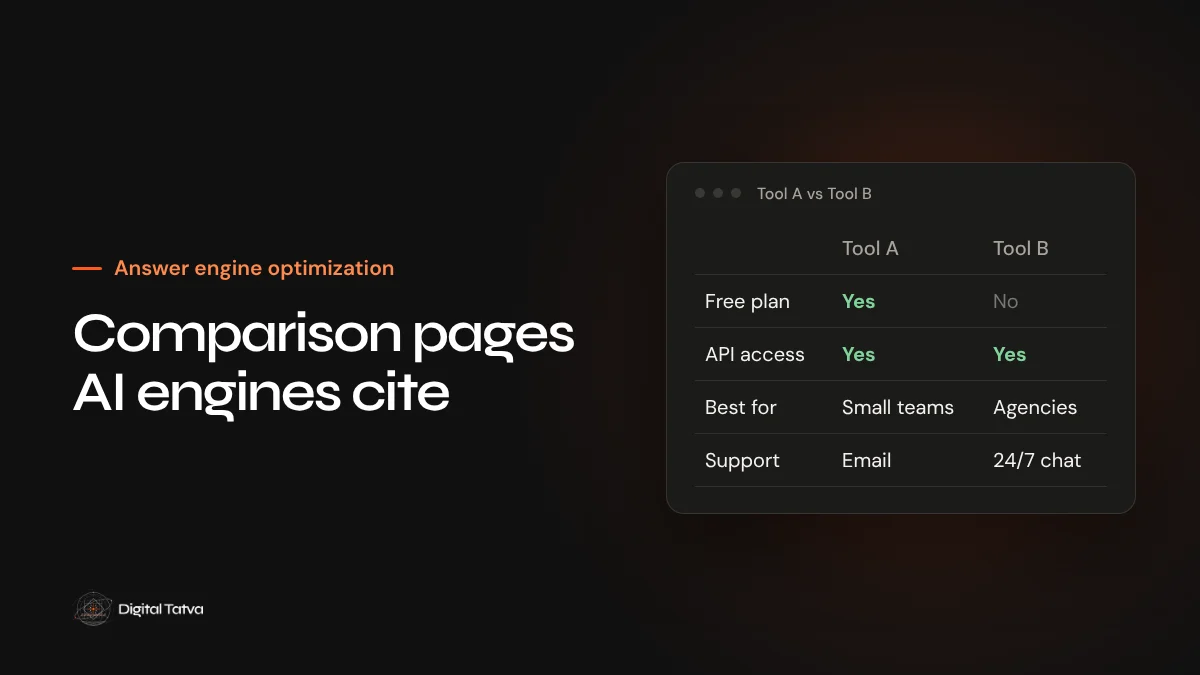
- Comparison table. Price, key limits, main features, support, best for. Same rows for every option.
- Section per criterion. Short paragraphs that explain each row of the table with specifics.
- Who should not choose each option. This is the part most pages skip and the part engines find most useful.
- FAQ. The follow-up questions buyers ask, each answered in two or three sentences.
- Method and date. How you compared, when you last checked, and links to official pricing pages.
Honesty rules that protect your credibility
- Never invent competitor weaknesses or outdated prices. Link to their official pages.
- Disclose that you are one of the options being compared.
- Admit where a competitor is the better choice. It makes the rest of the page believable.
- Avoid claims such as “the best” unless you state the criteria that make it so.
Engines cross-check claims against other sources. A page that contradicts everything else on the web is easy to ignore.
Common mistakes
- Comparison content hidden in images or tabs that load by script.
- Tables with different criteria for each product.
- No date, so the engine cannot tell whether prices are current.
- One page trying to compare twelve tools with two lines each.
A comparison page outline you can reuse
This is the outline we start from for “X vs Y” pages. Adjust the criteria to what your buyers actually weigh.
- H1: “X vs Y: which is better for [audience] in [year]?”
- Verdict paragraph: “X suits teams that need A and B. Y is the better choice if C matters more.”
- At a glance table: price, free plan or trial, key limit, standout feature, support, best for.
- H2 per criterion: pricing, ease of use, features, integrations, support, data and security.
- H2 “Who should choose X” and “Who should choose Y” with three bullet points each.
- H2 “Alternatives to consider” with two or three short entries.
- FAQ with four to six real follow-up questions.
- Method note: how you tested, when, and links to official sources.
Where comparison pages fit on your site
Link comparison pages from the relevant service or product page, from your pricing page and from related guides. Use consistent anchor text such as “X vs Y comparison” so both people and crawlers understand the page’s purpose. If you compare several options often, create a hub page that lists all your comparisons by category.
How to tell whether they are working
- Your comparison URL starts appearing in the citations for comparison prompts.
- AI answers repeat your criteria or your verdict wording.
- Search Console shows impressions for “vs”, “alternative” and “best for” queries.
- Sales calls mention that prospects read your comparison before getting in touch.
Want comparison pages written for AI answers? See our Generative Engine Optimization service.
Frequently asked questions
Is it risky to mention competitors by name?
Fair, factual comparisons are common and generally acceptable. Stick to verifiable facts, avoid disparaging claims, and check local advertising rules for your sector.
How long should a comparison page be?
Long enough to answer the decision. Most good pages are 1,200 to 2,500 words with one clear table.
Should I add Product or Review schema?
Only markup that reflects what is visibly on the page. Do not add review ratings you have not collected.
How often should I update comparison pages?
Check prices and features at least every quarter, and whenever a major product changes.
Sources
- Creating helpful, reliable, people-first content, Google Search Central
- GEO: Generative Engine Optimization, Aggarwal et al., arXiv, 2023
Product details, prices and features are checked at the time of writing and can change. Sources are linked in the text so you can check them yourself.
How does your brand appear in AI answers?
We test the questions your buyers ask across the major AI assistants and search engines, then show you what to fix first.
Get an AI Visibility Audit