Google Says AEO and GEO Are Still SEO: What Its AI Optimization Guide Means
Google's official AI optimization guide says optimizing for AI Overviews and AI Mode is still SEO, and that llms.txt, special markup and content chunking are not needed. Here is what it says, what it leaves out and how to apply it.
On this page
- Key takeaways
- What Google published
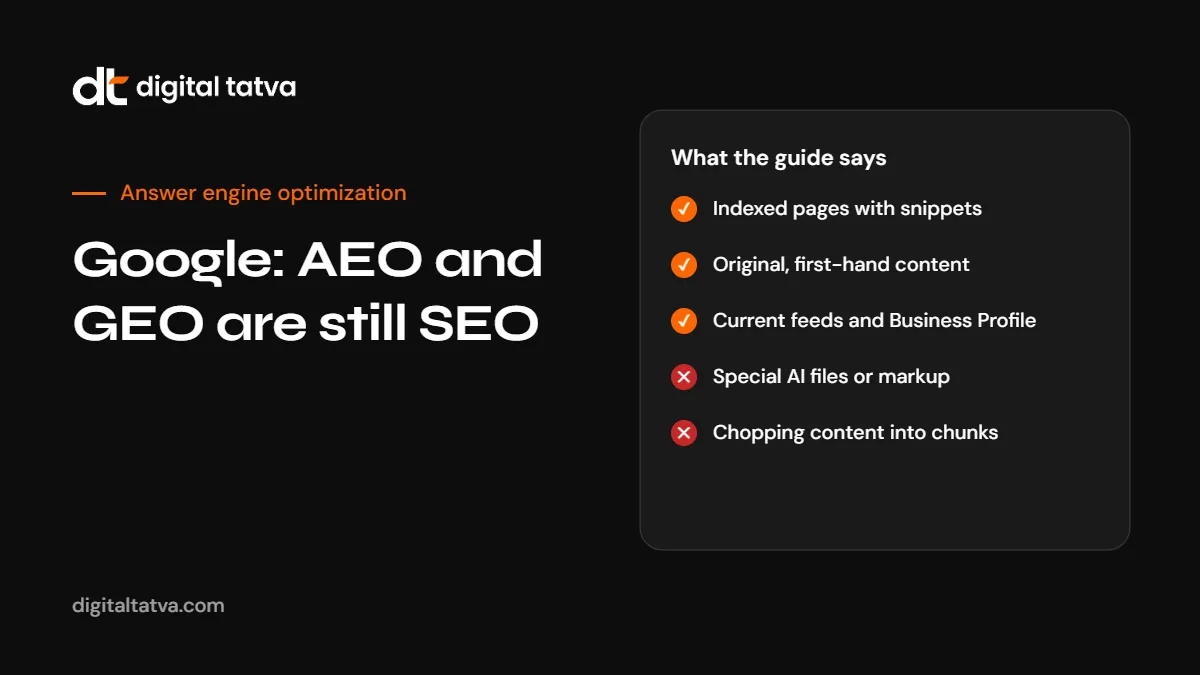
- What the guide says you do not need
- What the guide says does matter
- What the guide does not cover
- So is AEO just SEO?
- Tactics the guide quietly retires
- How to apply the guide: a 30-day plan
- What this means for businesses buying AEO services
- A commodity content test you can run today
- Turning commodity pages into original ones
- What to tell your team or clients
- How Digital Tatva can help
- Frequently asked questions
Last updated: 9 November 2026
Quick answer: In May 2026 Google published an official guide to optimizing for its generative AI search features, AI Overviews and AI Mode. Its message is that this work is still SEO: the AI features are rooted in Google’s core ranking and quality systems, so pages must be crawlable, indexed and eligible for a snippet. Google says you do not need llms.txt or other AI text files, special markup, Markdown versions, special schema or content broken into small chunks. What it says matters most over time is non-commodity content with first-hand expertise and a real point of view, plus sound technical SEO and current Merchant Center and Business Profile data. The guide covers Google only. ChatGPT, Perplexity, Claude and Copilot work differently, which is why answer engine optimization still has work beyond Google SEO.
Key takeaways
- Google’s guide answers “Is SEO still relevant for generative AI search?” with “In short, yes!”
- No special AI files, markup, Markdown pages or schema are required to appear in AI Overviews or AI Mode.
- Google says there is no requirement to break content into tiny pieces and no ideal page length.
- Non-commodity content, meaning original expertise rather than recycled information, is what Google says will matter most in the long run.
- The guide is about Google’s AI features. Other AI engines use other crawlers and sources.
What Google published
On 15 May 2026 Google announced a new resource on its Search Central blog: a guide to optimizing for generative AI features in Google Search. It was the first time Google put its long-standing conference message into official documentation: the work people call AEO or GEO is, for Google, still search engine optimization. The guide mentions AEO and GEO as terms “you may see used”, and treats them as part of SEO.
In November 2026 Google repeated a related point publicly, saying technical SEO remains important for AI search. The guide has become a reference point in a year when many vendors sell AI-specific shortcuts.
What the guide says you do not need
| Tactic | Google’s position | What to do instead |
|---|---|---|
| llms.txt or other AI text files | Not needed. Google may crawl them like any file, but they are not treated in a special way. | Put your effort into indexable, useful pages. See our llms.txt guide |
| Special AI markup or Markdown versions | Not needed | Normal, well-structured HTML |
| Special schema for AI | Not required, and there is no special schema.org type for AI search | Keep structured data that fits your content, for rich results and clarity. See schema markup for AEO |
| Breaking content into tiny chunks | Not required. Google’s systems understand multiple topics on one page, and there is no ideal page length. | Organise pages for readers, with clear headings |
| Rewriting for AI phrasing | Not needed. Google handles synonyms and intent. | Write naturally and clearly |
| Manufactured brand mentions | Not as helpful as it may seem | Earn genuine coverage and reviews |
What the guide says does matter
1. Non-commodity content
Google says this is likely to influence your presence in generative AI search more than anything else in the guide over the long run. Non-commodity content is content that could not be produced by summarising what already exists: first-hand experience, original data, expert judgement and a real point of view. If an AI system can generate the same page from other sources, there is little reason for it to cite yours.
Examples of non-commodity content:
- A clinic explaining recovery timelines based on its own patients’ experience.
- A software company publishing anonymised usage data from its customers.
- An agency sharing a real before-and-after audit with method and limits.
- A retailer’s buying guide built from testing products, with photos and measurements.
See original research for AEO for practical formats.
2. Technical eligibility
Pages must be indexed and eligible to show in Google Search with a snippet. That means crawlable content, sound JavaScript handling, good page experience and low duplication. A page blocked from snippets cannot be shown in AI features. See our technical AEO checklist.
3. Business and product details
For local and ecommerce businesses, keeping Google Business Profile and Merchant Center feeds current helps. These are direct inputs Google already trusts. See AEO for local business and Google AI Mode direct checkout.
What the guide does not cover
The guide is honest about its scope: it explains Google’s own AI surfaces. It does not tell you how other AI engines choose sources. That gap is where much of answer engine optimization lives.
| Engine | Main way it finds pages | What Google’s guide does not tell you |
|---|---|---|
| ChatGPT | OAI-SearchBot and third-party search providers, with Bing widely reported among them | Whether OpenAI’s crawlers can reach you and how you rank in Bing. See ChatGPT indexing |
| Perplexity | PerplexityBot and its own index | Perplexity’s crawler rules and freshness preferences. See Perplexity SEO |
| Microsoft Copilot | Bing | Bing indexing and Webmaster Tools |
| Claude | Anthropic’s crawlers and search partners | Claude-SearchBot and Claude-User access |
Also, generative engines in general have been found to favour independent third-party sources over brand-owned content in research on GEO. Your reputation on review sites, forums and publications matters across engines, even if Google’s guide focuses on your own pages. See brand mentions for AEO.
So is AEO just SEO?
For Google, mostly yes, and that is good news. Strong SEO foundations serve AI Overviews and AI Mode. But AEO as a practice includes things classic SEO programmes often skip:
- Measuring answers, not rankings. Tracking whether you are named and cited across AI engines. See AI share of voice.
- Managing non-Google crawlers. OAI-SearchBot, PerplexityBot, Claude-SearchBot and others. See AI crawlers list.
- Entity accuracy. Making sure AI systems describe your brand correctly. See entity SEO for AEO.
- Answer-first writing. Not chunking for machines, but putting clear answers where readers and systems can find them. See answer-first content.
- Off-site reputation in the sources AI engines cite.
We compare the terms in AEO vs SEO and GEO vs AEO.
Tactics the guide quietly retires
Several popular “AI SEO” tactics look weak in light of Google’s guide:
- Publishing an llms.txt and expecting results. Harmless, but not a ranking factor for Google.
- Splitting long guides into dozens of thin pages “for AI chunking”.
- Adding FAQ blocks to every page purely for AI, without real questions behind them.
- Mass-producing AI-written pages that summarise other sources. That is commodity content by definition.
- Buying mentions on low-quality sites to “train” AI.
How to apply the guide: a 30-day plan
- Week 1: technical eligibility. Check indexing, snippet controls, JavaScript rendering and duplication on your most important pages.
- Week 1: business data. Update Google Business Profile and Merchant Center so hours, products, prices and policies are current.
- Week 2: commodity audit. For your ten most important pages, ask: could an AI write this from other websites? If yes, it needs original input.
- Weeks 2 to 3: add first-hand value. Add your data, examples, photos, process details, expert quotes and clear opinions.
- Week 3: clarity. Make headings match real questions and put direct answers near the top of sections, for readers first.
- Week 4: other engines. Check OpenAI, Perplexity and Bing access, since Google’s guide does not cover them.
- Week 4: measure. Set a baseline of AI visibility for your priority questions and review monthly.
What this means for businesses buying AEO services
Google’s guide is useful when you evaluate agencies and tools. Be cautious of anyone who:
- Sells llms.txt, special markup or “AI schema” as the main deliverable.
- Promises guaranteed AI placement.
- Recommends splitting content into many thin pages for AI.
- Offers to manufacture mentions or reviews.
Good AEO work looks like good SEO plus measurement across engines, entity accuracy and genuine reputation building. See how to choose an AEO agency.
A commodity content test you can run today
For each important page, score it against these questions. One point for each yes:
- Does it include information from your own experience, data or work?
- Does it name a real expert or author with relevant experience?
- Does it give a clear opinion or recommendation, not just a list of options?
- Does it include specific numbers, dates, examples or photos you produced?
- Would a reader learn something they could not get from the top three search results?
- Is it up to date, with a visible updated date?
Pages scoring two or less are likely commodity content. Improve them before writing new ones.
Turning commodity pages into original ones
| Commodity version | Non-commodity version |
|---|---|
| “10 tips to reduce energy bills” | “What we found after auditing 40 small offices’ energy bills in Ahmedabad”, with your data and photos |
| “What is GST registration?” | “GST registration: the five documents that cause most delays, from our filings this year” |
| “Best CRM software” | “We tested four CRMs with a 10-person sales team for a month: here is what each did well and badly” |
| “How to choose a dentist” | “Questions our dentists say patients should ask before an implant”, written and reviewed by named dentists |
The examples are illustrative. The point is to add what only you know.
What to tell your team or clients
Google’s guide is useful for cutting through hype. A simple summary to share internally:
- Good SEO is the foundation for Google’s AI features.
- No special AI files or markup are required for Google.
- Original, expert content is the biggest long-term lever.
- Other AI engines need their own access checks and measurement.
- No one can guarantee AI placement.
How Digital Tatva can help
Digital Tatva’s answer engine optimization service follows the same principles Google describes: technical eligibility, original content and accurate business data, then adds what Google’s guide does not cover: access and visibility across ChatGPT, Perplexity, Copilot and Claude, entity accuracy and monthly measurement. We never promise AI placement.
See how your site performs across Google AI and other engines. Request an AI visibility audit or run our free AI visibility checker.
Frequently asked questions
Does Google say AEO and GEO are SEO?
Yes. Google’s AI optimization guide treats optimizing for AI Overviews and AI Mode as SEO, rooted in its core ranking and quality systems.
Do I need llms.txt for Google AI Overviews?
No. Google says you do not need AI text files, and such files are not treated in a special way.
Should I break my content into small chunks for AI?
Google says there is no requirement to do so and no ideal page length. Organise content for readers with clear headings.
Is schema needed for AI search?
Not for Google’s AI features, and there is no special AI schema. Structured data is still useful for rich results and understanding.
What does Google mean by non-commodity content?
Content with first-hand expertise, original information and a real point of view that cannot be produced by summarising existing pages.
Does the guide apply to ChatGPT and Perplexity?
No. It covers Google’s AI features only. Other engines have their own crawlers and sources.
Is AEO still worth doing?
Yes, as SEO plus cross-engine access, measurement, entity accuracy and reputation. See our guide to whether AEO is worth it.
Can Digital Tatva audit my site against Google’s guide?
Yes. Our AI visibility audit covers Google’s recommendations and the other AI engines it does not address.
Product details, prices and features are checked at the time of writing and can change. Sources are linked in the text so you can check them yourself.
How does your brand appear in AI answers?
We test the questions your buyers ask across the major AI assistants and search engines, then show you what to fix first.
Get an AI Visibility Audit