Google AI Mode Direct Checkout: What UCP Means for Online Stores
Shoppers can now buy from some retailers inside Google AI Mode and the Gemini app. Here is how the Universal Commerce Protocol works, who can use it, how to get ready and what it means for ecommerce visibility.
On this page
- Key takeaways
- What is the Universal Commerce Protocol?
- How direct checkout works for shoppers
- Where direct checkout is available
- What stays with the merchant
- Requirements for retailers
- How to get ready, step by step
- What this means for ecommerce AEO
- Direct checkout and Google ads
- Risks and open questions
- What Indian and other non-launch retailers should do now
- Product data that helps AI shopping answers
- Testing how AI shopping answers see your products
- Questions to raise with your ecommerce platform
- How Digital Tatva can help
- Frequently asked questions
Last updated: 9 November 2026
Quick answer: Google’s Universal Commerce Protocol (UCP) is an open standard that lets shoppers buy products directly inside Google’s AI surfaces, AI Mode in Search and the Gemini app, without visiting the retailer’s website. Shoppers pay with Google Pay, and the retailer stays the merchant of record, handling the order, fulfilment, returns and support. Checkout is live for select retailers in the US and, since 4 November 2026, in Canada. To prepare, keep your Merchant Center feed complete and accurate, make sure your payment provider supports Google Pay, and watch for Google’s simplified Merchant Center integration, which Google says is coming in 2027. Even before checkout reaches your market, accurate product data is what makes you visible in AI shopping answers.
Key takeaways
- UCP was announced on 11 January 2026 at NRF and co-developed by Google with Shopify, Etsy, Wayfair, Target and Walmart.
- On 4 November 2026 Google brought UCP-powered direct checkout to Canadian shoppers in AI Mode and the Gemini app.
- The merchant remains the seller of record. Google handles the conversation and the payment flow through Google Pay.
- Only listings flagged as checkout-eligible in Merchant Center show a buy option.
- India and most other markets do not have direct checkout yet. Product data quality still decides whether AI shopping answers show your products.
What is the Universal Commerce Protocol?
UCP is a shared language for agentic commerce: the idea that an AI assistant can help someone find a product and then complete the purchase for them. Without a standard, every AI surface would need a custom connection to every store. UCP standardises how an AI agent and a store exchange product details, cart contents, checkout information and post-purchase updates.
Google announced UCP on 11 January 2026 at the National Retail Federation’s Big Show. It was co-developed with Shopify, Etsy, Wayfair, Target and Walmart, and more than 20 companies endorsed it, including payment companies such as Adyen, American Express, Mastercard, Stripe and Visa, and retailers such as Best Buy and Home Depot. It is designed to work alongside other agent protocols, including A2A, AP2 and the Model Context Protocol. If you are new to MCP, see what is MCP.
How direct checkout works for shoppers
- A shopper asks AI Mode or Gemini for help, for example “comfortable running shoes for flat feet under $120”.
- Google’s AI shows product options from Merchant Center data, often with reasons and comparisons.
- For eligible products from participating retailers, a buy option appears.
- The shopper pays with Google Pay, using payment and shipping details saved in Google Wallet, without leaving the conversation.
- The retailer receives the order, ships it and handles returns and support as usual.
Shoppers need to be signed in and 18 or older, and some regulated categories that need ID checks, such as alcohol and tobacco, are excluded.
Where direct checkout is available
| Market | Status as of November 2026 | Notes |
|---|---|---|
| United States | Live for select retailers | Onboarding is gradual. UCP checkout has also appeared on standard Search product listings since May 2026. |
| Canada | Live for a launch group from 4 November 2026 | Initial partners include lululemon, Shoppers Drug Mart, Simons and select Shopify merchants |
| Australia | Listed for product eligibility | Check Google’s merchant documentation for current status |
| India and other markets | Not live | No announced date. Focus on product data and AI shopping visibility now. |
Google says it plans a simplified UCP integration inside Merchant Center starting in 2027, which will let retailers turn on direct checkout from their accounts. It has not given a specific date, eligibility rules for retailers outside the launch group, or details of how direct checkout orders will be reported in Google Ads.
What stays with the merchant
A common worry is that Google takes over the customer relationship. Under UCP, the retailer stays the merchant of record. That means you:
- Receive and process the order.
- Get the customer data needed to fulfil it.
- Settle the payment through your own payment service provider.
- Ship the product and handle returns, refunds and support.
- Can customise the integration.
What changes is where the decision happens. The shopper may never see your product page, your upsells or your brand story before buying. That makes your product data, reviews and reputation inside Google’s systems more important.
Requirements for retailers
Based on Google’s merchant guidance and platform partners’ documentation, retailers that want direct checkout need:
| Requirement | What it involves |
|---|---|
| Merchant Center account in good standing | No suspensions or unresolved policy issues |
| Complete product feeds | Accurate titles, GTINs, prices, availability, shipping, returns policy and a support contact |
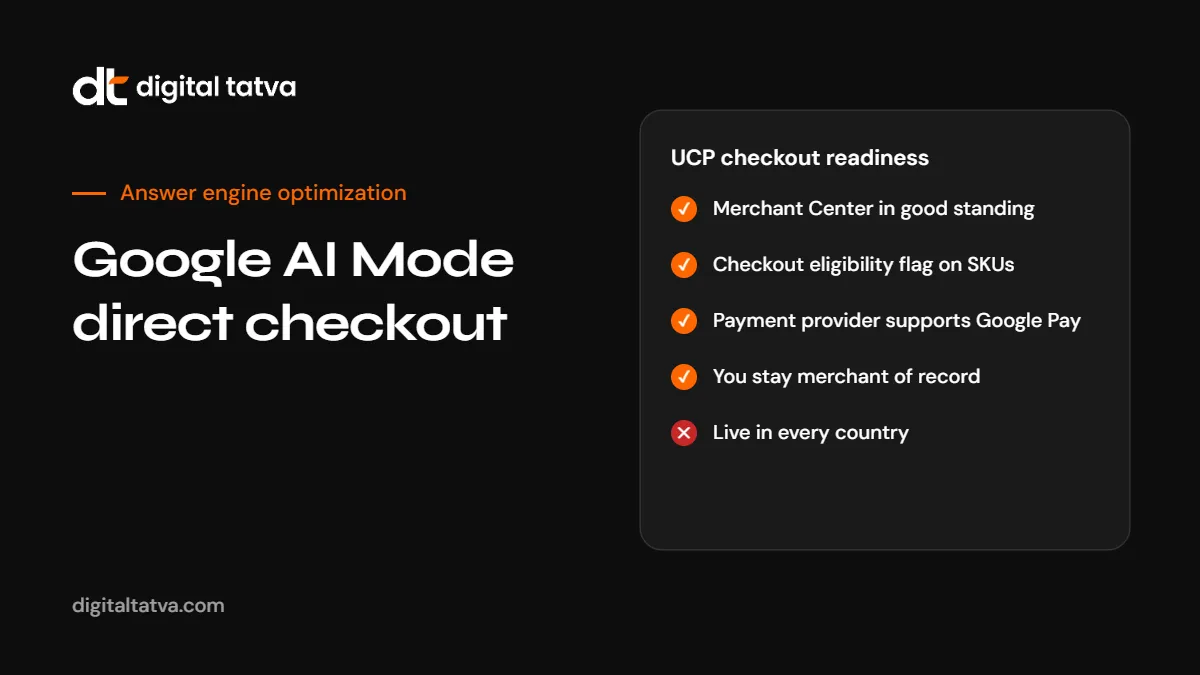
| Checkout eligibility flag | A native_commerce checkout eligibility attribute on the SKUs you want to sell this way, usually through a supplemental feed. Only flagged listings show a buy option. |
| Google Pay readiness | A Google Pay and Wallet Console account and a payment provider that can accept Google Pay tokens |
| Agreement to terms | Acceptance of the UCP checkout terms for your market |
| Technical integration | Native checkout, where Google calls your checkout APIs, is the default. Direct payment processing needs PCI documentation. |
Shopify merchants in eligible markets may get access through Shopify. BigCommerce has announced an early access path. Check your platform’s current guidance before building anything custom.
How to get ready, step by step
- Audit Merchant Center. Fix disapprovals, warnings and missing attributes. Make sure every product has a GTIN where one exists.
- Improve titles and descriptions. Write them for people asking detailed questions: material, size, use case, compatibility, who it suits.
- Keep price and stock in sync. Mismatches between your feed and your site are one of the fastest ways to lose eligibility.
- Publish clear policies. Shipping times, return windows and support contacts, stated plainly on your site and in Merchant Center.
- Check your payment provider for Google Pay support and token acceptance.
- Review your order workflow. Plan how orders from AI Mode or Gemini will flow into your systems, including tax, refunds and loyalty.
- Watch for the Merchant Center integration in 2027 if you are outside the launch group.
What this means for ecommerce AEO
Direct checkout is the end of a journey that starts with visibility. Before a shopper can buy from you in AI Mode, Google’s AI has to pick your product for the answer. That depends on many of the same things that drive answer engine optimization for ecommerce:
- Feed quality. Google’s own guidance says current Merchant Center feeds help ecommerce sites in its AI features.
- Specific product information. Long, conversational AI Mode questions reward products with detailed attributes.
- Reviews and ratings. Shoppers and AI answers both lean on them.
- Helpful buying guides on your site that compare options by clear criteria.
- Consistent brand facts across your site, Merchant Center and marketplaces.
For the full approach, see AEO for ecommerce and Google AI Mode SEO.
Direct checkout and Google ads
UCP sits alongside Google’s ad formats in AI Mode. In January 2026 Google also announced Direct Offers, an AI Mode ad pilot that lets retailers show exclusive discounts to shoppers who are ready to buy, drawn only from the verified feed and promo codes the advertiser uploads. Sponsored product listings now appear in AI Mode in more markets, including India. See our guide to ads in AI Mode and AI Overviews.
Google has not yet explained how direct checkout orders are attributed in Merchant Center and Google Ads, or how they interact with Shopping and Performance Max campaigns. If you run paid Shopping, watch your reporting closely once checkout reaches your account.
Risks and open questions
- Less control over the experience. Shoppers may buy without seeing your site, cross-sells or brand pages.
- Attribution gaps. Reporting for AI-driven orders is still being defined.
- Dependency on one platform. Direct checkout ties more of your sales to Google’s surfaces.
- Customer communication. Make sure order confirmations clearly show your brand, so customers know who to contact.
- Payment method limits. Google Pay is supported. PayPal support has been announced but had not shipped at the time of writing.
What Indian and other non-launch retailers should do now
If you sell in India, direct checkout in AI Mode is not available yet. That does not mean you should wait:
- Set up or clean up Merchant Center with complete, accurate feeds.
- Test how your products appear in AI Mode for real shopper questions.
- Improve product pages with specifications in text, not only images.
- Build genuine reviews on your site and marketplaces.
- Publish buying guides for your main categories.
When checkout arrives, retailers with strong data and visibility will be ready first. For AI tools that help with product content, see AI product descriptions and AI for ecommerce.
Product data that helps AI shopping answers
| Attribute | Weak | Strong |
|---|---|---|
| Title | “Running Shoe Blue” | “Men’s stability running shoe, wide fit, navy, for flat feet” |
| Description | “Comfortable and stylish.” | Materials, cushioning, weight, intended use, who it suits, care instructions |
| Identifiers | Missing GTIN | Correct GTIN, brand and MPN |
| Price and stock | Out of sync with site | Updated automatically and matching the product page |
| Shipping and returns | Not set | Delivery times and return window stated |
| Images | One small photo | Several clear images, including in use |
Detailed attributes help AI match products to long, specific questions such as “waterproof hiking boots for wide feet under ₹6,000 that ship this week”.
Testing how AI shopping answers see your products
- Write 20 questions shoppers ask about your category, including budget, size and use.
- Ask them in Google AI Mode, Gemini and ChatGPT.
- Record which products and stores appear, and what reasons the AI gives.
- Compare those products’ data and reviews with yours.
- Fix the gaps and re-test in four to six weeks.
Questions to raise with your ecommerce platform
- Will you support UCP checkout for our market, and when?
- How will AI Mode orders appear in our order management system?
- How are taxes, refunds and loyalty points handled for these orders?
- Can we choose which products are eligible?
- How will we see reporting on AI-driven sales?
How Digital Tatva can help
Digital Tatva helps ecommerce brands get chosen in AI shopping answers as part of our answer engine optimization service. We audit product data and Merchant Center readiness, test how AI Mode, Gemini and ChatGPT present your products, improve product pages and buying guides, and track visibility over time. We do not promise placement, because Google decides what to show.
See how AI shopping answers present your products. Request an AI visibility audit or run our free AI visibility checker.
Frequently asked questions
What is Google’s Universal Commerce Protocol?
UCP is an open standard announced in January 2026 that lets AI agents and stores exchange product, cart, checkout and order data, so shoppers can buy inside Google’s AI surfaces.
Can shoppers buy directly in Google AI Mode?
Yes, from select retailers in the US and, since 4 November 2026, Canada. They pay with Google Pay without leaving the conversation.
Who is the seller when someone buys through AI Mode?
The retailer stays the merchant of record and handles the order, fulfilment, returns and support.
Is UCP checkout available in India?
Not yet. Google has not announced a date for India. Retailers should focus on Merchant Center data and AI shopping visibility in the meantime.
How do I enable direct checkout for my store?
Eligible retailers need a Merchant Center account in good standing, complete feeds, checkout-eligible SKUs, Google Pay support and a technical integration. Google plans a simpler Merchant Center option in 2027.
Does UCP work with Shopify?
Shopify co-developed UCP, and select Shopify merchants in launch markets can be bought from directly in AI Mode and Gemini.
Will direct checkout reduce traffic to my website?
Some purchases may happen without a site visit. Your product data and reputation inside Google’s systems become more important.
Can Digital Tatva help my store appear in AI shopping answers?
Yes. We improve product data, pages and reputation signals and track how AI engines present your products.
Product details, prices and features are checked at the time of writing and can change. Sources are linked in the text so you can check them yourself.
How does your brand appear in AI answers?
We test the questions your buyers ask across the major AI assistants and search engines, then show you what to fix first.
Get an AI Visibility Audit