Ads in Google AI Mode and AI Overviews: What Changes for Organic Visibility
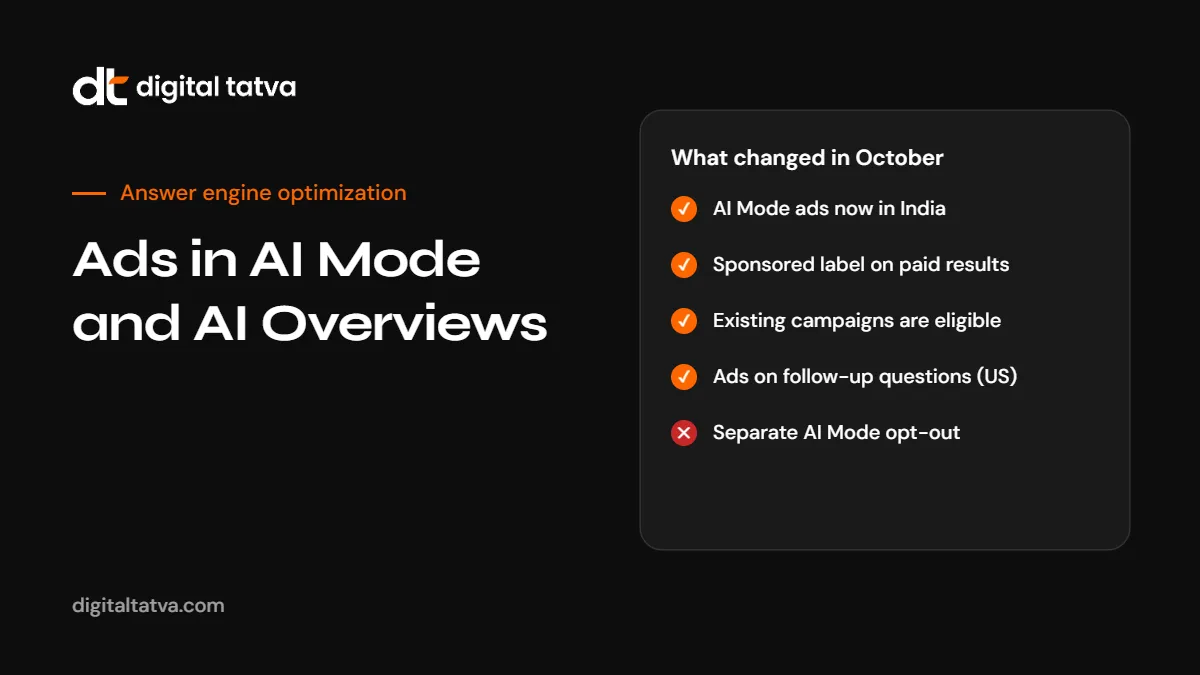
Google has expanded ads in AI Mode to India and nine other markets and now shows ads on follow-up questions in the US. Here is how the ads work, what advertisers can control and what it means for brands that rely on organic AI visibility.
On this page
- Key takeaways
- What Google announced
- How AI Mode ads work
- Do ads affect the organic AI answer?
- What changes for organic visibility
- What advertisers should do
- What organic and AEO teams should do
- What it means for Indian businesses
- AI Mode ads vs ChatGPT ads
- Measuring the impact
- Common misunderstandings
- Which queries are most affected
- A combined organic and paid playbook
- What small businesses should do this month
- How Digital Tatva can help
- Frequently asked questions
Last updated: 9 November 2026
Quick answer: Google now shows ads inside AI Mode and AI Overviews. On 28 October 2026 it expanded English-language AI Mode ads to India, Australia, Canada, Kenya, Malaysia, New Zealand, Nigeria, Pakistan, the Philippines and Singapore, and in the US it added ads to follow-up questions in AI Mode conversations. The ads are labelled “Sponsored”, come from existing Search, Shopping and Performance Max campaigns with no separate opt-out, and Google says they do not influence the organic AI answer. For brands, the practical effect is more competition for attention on commercial queries. Organic AI visibility still matters, because the answer itself, and the sources it cites, remain unpaid.
Key takeaways
- AI Mode ads went live in India on 28 October 2026, in English. Brazil, Mexico and the UK are planned for the fourth quarter of 2026.
- Ads can match the user’s question and the AI answer, not only keywords.
- Advertisers cannot buy or exclude AI Mode placements separately from Search, and reporting is combined.
- Google says paid and unpaid product listings in AI Mode get similar click rates, based on its own US data.
- Organic citations in AI answers are not for sale. Ads sit beside them, not inside the answer text.
What Google announced
Google announced the expansion during Alphabet’s third-quarter earnings on 28 October 2026. The key changes:
| Change | Details |
|---|---|
| New markets for AI Mode ads | Australia, Canada, India, Kenya, Malaysia, New Zealand, Nigeria, Pakistan (text ads only), the Philippines and Singapore, in English |
| Planned markets | Brazil, Mexico and the United Kingdom in the fourth quarter of 2026 |
| Multi-turn ads in the US | Sponsored results can now appear on follow-up questions within an AI Mode conversation |
| Ads in AI Overviews | Ads can appear in AI Overviews, and standard Search ads can show above or below them |
| Labelling | Paid placements carry a “Sponsored” label |
The context matters. Alphabet reported that Search and other revenue grew 12% year over year in the third quarter, slower than 19% in the first quarter and 17% in the second. Google’s chief business officer listed lower AI Mode monetisation as one of three reasons, alongside currency movements and retail and media spending. At the same time, Google said search queries grew at their fastest rate in five years. More searching, monetised less per query, is exactly why ads are coming to AI answers.
How AI Mode ads work
Matching
Traditional Search ads match keywords. AI Mode ads can match the meaning of the user’s question and the AI answer. Google says exact and phrase match keywords apply only when a search already shows buying intent. In practice, broad, AI-driven matching does most of the work.
Formats
- Sponsored product listings shown alongside organic product listings in AI Mode.
- Text ads related to the conversation.
- Conversational ads tested since May 2026, where Gemini writes a short explanation of why a product fits. Advertisers cannot write, edit or opt out of these explanations.
- Direct Offers, a pilot announced in January 2026 that shows exclusive discounts to shoppers ready to buy, using only the advertiser’s verified feed and promo codes.
Campaigns and controls
Existing Search, Shopping and Performance Max campaigns are eligible automatically, using the same budgets and auction, with no extra fee. Advertisers can use negative keywords, brand exclusions and asset pinning, but cannot target or exclude AI Mode on its own. Results are folded into normal campaign and search term reports, with no separate AI Mode breakdown.
Do ads affect the organic AI answer?
Google’s support documentation says these ads do not influence the organic responses generated by Google AI. The AI answer and the sources it cites are still chosen by Google’s ranking and quality systems, not by bids. That separation is important for anyone doing answer engine optimization:
- You cannot buy a citation in the answer text.
- A competitor’s ad can appear next to an answer that cites you, and the reverse.
- Your organic presence in the answer shapes what the shopper believes before they ever look at the ads.
What changes for organic visibility
More competition for attention
On commercial queries, an AI answer may now share space with sponsored product cards and text ads. Organic listings and citations still appear, but they compete with more elements on the screen. Google says sponsored and unpaid product entries in AI Mode receive similar click rates, based on its US data from August and September 2026. That is Google’s own figure, and it applies to product listings, not to every format.
Commercial queries matter more
Ads follow commercial intent. Expect the most ad density on “best”, “price”, “buy” and comparison queries, exactly the ones that drive revenue. These are also the queries where being named in the AI answer itself carries the most weight.
Follow-up questions are now commercial space
In the US, ads can now appear on follow-up questions in an AI Mode conversation. A shopper who starts with an informational question and narrows down to a product may meet ads at each step. Pages that answer the natural follow-ups (cost, comparison, setup, suitability) give you organic presence across that journey. See Google AI Mode vs AI Overviews.
What advertisers should do
- Review search term reports for longer, conversational queries, which are a sign of AI Mode traffic.
- Tighten negative keywords and brand exclusions, since you cannot exclude AI Mode separately.
- Improve Merchant Center feeds. Sponsored product listings and AI explanations draw on your product data.
- Write assets for broader matching. Headlines and descriptions should make sense for detailed questions, not only short keywords.
- Watch conversion quality, not just click volume, because AI Mode queries average about three times longer than traditional searches, according to Google.
- Check AI-written explanations about your products when they appear, and fix the product data if they are inaccurate.
What organic and AEO teams should do
- Prioritise commercial prompts in your AEO tracking, where ads now compete.
- Win the answer, not just the link. Clear positioning, comparison pages and genuine reviews help you get named in the answer text. See comparison pages for AEO.
- Cover follow-up questions on your key pages.
- Coordinate with paid search so organic and paid messages agree on prices, offers and positioning.
- Measure leads, not just traffic. See AEO KPIs.
What it means for Indian businesses
India is one of the first markets outside the US to get AI Mode ads, in English. For Indian businesses this means:
- Google Ads campaigns targeting India are now eligible for AI Mode placements automatically.
- Commercial English-language queries in AI Mode will carry more ads, especially in ecommerce, travel, education and financial products.
- Hindi and other Indian-language AI Mode experiences are not part of this announcement. English is the only listed language for ads in these markets.
- Organic AI visibility in English answers becomes more competitive, which raises the value of being cited for the right questions.
For ChatGPT’s own advertising in India, see ChatGPT ads in India.
AI Mode ads vs ChatGPT ads
| Aspect | Google AI Mode ads | ChatGPT ads |
|---|---|---|
| How to buy | Through existing Google Ads campaigns | Through OpenAI’s ad offering |
| Separate targeting | No separate AI Mode targeting or opt-out | See our ChatGPT ads guide |
| Labelling | “Sponsored” | Labelled as ads, shown separately from the answer |
| Effect on organic answer | Google says none | OpenAI says ads do not change the answer |
Measuring the impact
- Search Console: AI Mode and AI Overviews data sits in the general performance report. Watch click-through on commercial queries.
- Google Ads: AI Mode results are mixed into campaign reports. Look for long, conversational search terms.
- AEO tracking: monitor whether you are named in AI answers for commercial prompts, monthly. See AI share of voice.
- Analytics: compare conversion rates from organic and paid Google traffic over time.
Common misunderstandings
- “I can pay to be cited in AI Mode.” No. Ads are separate from the answer and its sources.
- “I can opt out of AI Mode ads.” Not separately. Eligible campaigns participate automatically.
- “AEO is pointless now that there are ads.” The organic answer still shapes decisions, and ads do not change it.
- “Ads are only in AI Mode.” Ads can also appear in and around AI Overviews.
Which queries are most affected
| Query type | Ad pressure in AI Mode | Organic priority |
|---|---|---|
| “Buy”, “price”, “deal” queries | High | Accurate prices and offers on your site and feeds |
| “Best X for Y” comparisons | High | Honest comparison pages and third-party reviews |
| Follow-up questions in a shopping journey (US) | Rising | Pages covering cost, fit, setup and alternatives |
| How-to and definitions | Lower | Clear answers that earn citations |
| Local services | Varies by market | Business Profile, reviews and service pages |
A combined organic and paid playbook
- List your top 30 commercial questions as buyers ask them.
- Check AI Mode answers for each: are you named, cited, advertised, or absent?
- Where you are cited organically, consider whether ads add value or just cost.
- Where competitors are cited and you are not, fix content and reputation first, and use ads as a short-term bridge.
- Align messages: make sure ad copy, landing pages and organic pages agree on price and positioning.
- Review monthly with both teams in the same meeting.
What small businesses should do this month
- If you run Google Ads in India, check your search terms report for longer, conversational queries.
- Make sure your Merchant Center feed or service pages state prices clearly.
- Ask a few AI Mode questions your customers would ask and note who appears.
- Fix the one page that should answer your most valuable question.
See AEO quick wins for more fast fixes.
How Digital Tatva can help
Digital Tatva helps brands win the organic side of AI answers through our answer engine optimization service. As ads arrive in AI Mode and AI Overviews, we focus your effort on the commercial questions that matter most, improve the pages and sources that shape the answer, and track whether you are named. We never promise placement, because no one controls Google’s AI answers.
Find out where you stand in Google’s AI answers. Request an AI visibility audit or run our free AI visibility checker.
Frequently asked questions
Are there ads in Google AI Mode in India?
Yes. Google expanded English-language AI Mode ads to India and nine other markets on 28 October 2026.
Do ads influence the AI answer?
Google says ads do not influence the organic responses generated by Google AI. They appear separately and are labelled “Sponsored”.
How do I advertise in AI Mode?
Existing Search, Shopping and Performance Max campaigns are eligible automatically. There is no separate AI Mode campaign type.
Can I exclude AI Mode from my campaigns?
No. You cannot opt out of AI Mode separately from Search. You can use negative keywords, brand exclusions and asset pinning.
Do ads appear in AI Overviews too?
Yes. Ads can appear in AI Overviews, and standard Search ads can appear above or below them.
Can I see AI Mode ad performance separately?
No. Google folds AI Mode results into standard campaign and search term reports.
Does this make AEO less important?
No. The answer text and its citations remain organic, and they shape what shoppers think before they see ads.
Can Digital Tatva manage AI Mode ads?
Digital Tatva focuses on organic AI visibility. We coordinate with your paid team so organic and paid messages support each other.
Product details, prices and features are checked at the time of writing and can change. Sources are linked in the text so you can check them yourself.
How does your brand appear in AI answers?
We test the questions your buyers ask across the major AI assistants and search engines, then show you what to fix first.
Get an AI Visibility Audit