EU AI Act Article 50: AI Content Labelling Rules for Marketers
The EU AI Act's transparency rules have applied since 2 August 2026. Here is what Article 50 means for marketers who use AI for chatbots, images, video and text, including deepfakes, the human review exemption and watermarks.
On this page
- Key takeaways
- Who Article 50 applies to
- The four Article 50 duties
- Chatbots and AI agents
- Deepfakes in marketing
- AI-generated text and the human review exemption
- Watermarks and machine-readable marking
- Dates and enforcement
- A compliance checklist for marketing teams
- What it means for businesses outside the EU
- Does labelling AI content hurt SEO or AI visibility?
- Sample disclosure wording
- Roles and responsibilities in a marketing team
- Common misunderstandings
- How Digital Tatva can help
- Frequently asked questions
Last updated: 9 November 2026
Quick answer: Article 50 of the EU AI Act sets transparency rules for AI that interacts with people or generates content, and it has applied since 2 August 2026. For marketers, the main duties are: tell people when they are talking to an AI chatbot or agent unless it is obvious; clearly disclose deepfakes, meaning realistic AI-generated or altered images, audio or video of real-seeming people, places or events; and label AI-generated text published to inform the public on matters of public interest, unless a person has reviewed it and someone takes editorial responsibility. AI providers must also mark outputs in a machine-readable way, which is why Claude, ChatGPT and Google now watermark content. Fines can reach €15 million or 3% of worldwide turnover. These rules apply to businesses outside the EU that reach EU audiences. This is general information, not legal advice.
Key takeaways
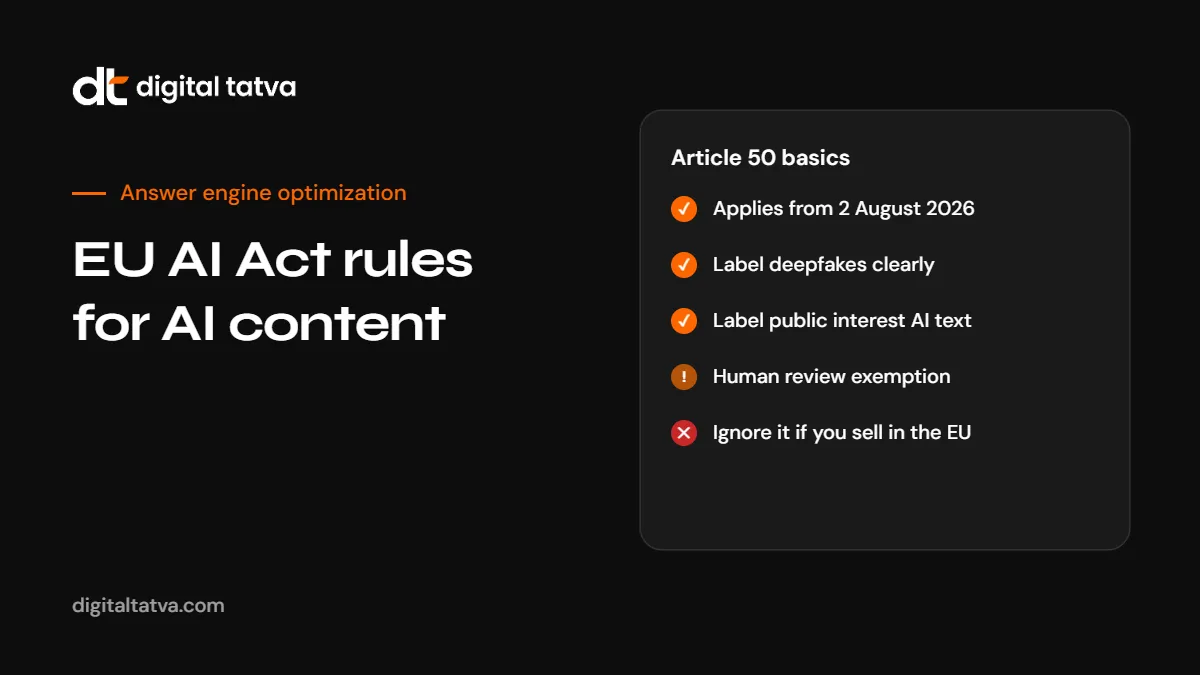
- Article 50 applies from 2 August 2026. AI systems already on the market had until 2 December 2026 to meet the machine-readable marking duty only.
- Chatbots and AI agents must make clear that people are dealing with AI, from the first interaction, unless it is obvious.
- Deepfakes must be disclosed clearly at the latest on first exposure. A hidden watermark alone does not meet this duty.
- AI text on matters of public interest needs a label, unless it has had real human review and someone holds editorial responsibility.
- Most ordinary marketing copy that a person reviews and approves is not caught by the text labelling duty, but deepfake and chatbot rules still apply.
Who Article 50 applies to
The AI Act separates two roles:
| Role | Who it is | Example |
|---|---|---|
| Provider | A company that develops an AI system and places it on the market | OpenAI, Anthropic, Google, a startup selling an AI video tool |
| Deployer | A business or person using an AI system in a professional capacity | A brand using AI to make ads, a company running an AI chatbot on its site |
Most marketers are deployers. Personal, non-professional use is outside the Act, but use that is part of a business or freelance activity counts as deployment. The rules also reach businesses outside the EU when their AI systems or outputs are used in the EU, which matters for Indian, US and other companies marketing to European audiences.
The four Article 50 duties
| Duty | Who | What it requires |
|---|---|---|
| AI interaction disclosure | Providers (design) and, in practice, the businesses deploying chatbots | People must know they are dealing with AI from the first interaction, unless it is obvious |
| Machine-readable marking | Providers of generative AI | Mark synthetic audio, images, video and text so they can be detected as AI-generated |
| Deepfake disclosure | Deployers | Clearly disclose realistic AI-generated or manipulated images, audio or video at first exposure |
| Public interest text labelling | Deployers | Label AI-generated text published to inform the public on matters of public interest, unless reviewed and editorially controlled |
There are also duties for emotion recognition and biometric categorisation systems, which are less common in marketing.
Chatbots and AI agents
If you run an AI chatbot, voice agent or avatar that talks to customers, people must be able to tell it is AI, at the start of the first interaction, unless it is obvious from context. In practice:
- Add a clear line at the start: “You’re chatting with an AI assistant.”
- Do not give the bot a human name and photo that suggest a person.
- For voice agents, say it is an AI at the start of the call.
- Offer a route to a human for complex or sensitive issues.
See the best AI website chatbots and how to add an AI chatbot to your website.
Deepfakes in marketing
The Act defines a deepfake as AI-generated or manipulated image, audio or video content that resembles existing persons, objects, places, entities or events and would falsely appear to be authentic or truthful. The European Commission’s guidance describes three combined tests: high resemblance, a subject that exists or could plausibly exist, and the capacity to falsely appear real.
Marketing examples that are likely to count:
- A realistic AI video of a real person, such as a founder or celebrity, saying something they did not say.
- A photorealistic AI image presented as a real customer, location or event.
- An AI voice clone of a real person in an ad.
- A realistic “news style” AI video about real events.
Examples that are less likely to count, depending on context:
- Obviously stylised illustrations or cartoons.
- Abstract or clearly fictional scenes.
- Product renders that do not claim to be photographs of real events.
When disclosure is needed, it must be clear and distinguishable, at the latest when people first see or hear the content. A machine-readable watermark added by the AI provider does not satisfy this on its own. For evidently artistic, creative, satirical or fictional work, disclosure only needs to be appropriate and must not spoil the work.
For AI video and avatar tools, see AI avatar generators and AI UGC video generators.
AI-generated text and the human review exemption
Deployers must label AI-generated text that is published, informs the public and concerns a matter of public interest. Examples of public interest topics include politics, public health, public security, environmental protection, consumer safety and relevant economic, scientific or cultural developments.
The key exemption: text that has undergone human review or editorial control does not need a label, when a person or organisation holds editorial responsibility for publishing it. The Commission’s guidance says:
- Human review means substantive examination by people with relevant expertise.
- Editorial control means a responsible entity can approve, change or reject the text on substantive grounds, including fact-checking.
- Spell-checking or grammar correction alone does not count.
- A person must hold ultimate legal responsibility for publication.
| Scenario | Label likely needed? |
|---|---|
| Product description drafted by AI, reviewed and approved by your team | Generally no: usually not public interest, and reviewed |
| Health advice blog post generated by AI and published without expert review | Likely yes: public health topic without substantive review |
| Finance explainer drafted with AI, fact-checked by a qualified editor who approves it | Generally no, if review is substantive and responsibility is clear |
| Auto-published AI news summaries on economic developments | Likely yes |
This is one more reason for real editorial review of AI-assisted content, which also helps quality and AI visibility. See how to write a blog post with AI and our AI usage policy template.
Watermarks and machine-readable marking
Providers of generative AI must mark outputs so they can be detected as AI-generated. That is why major AI companies have added watermarks and provenance data in 2026:
- Anthropic has added an invisible watermark to Claude text and C2PA provenance data to images and files, with a free checker to verify them.
- OpenAI added watermarking in October 2026. See ChatGPT watermark.
- Google uses SynthID and has expanded its SynthID Detector globally. See SynthID Detector guide.
Some outputs are not covered, such as short strings, source code and standard editing assistance. For marketers, the important point is that these marks are for detection. They do not replace your own visible disclosure for deepfakes or public interest text.
Dates and enforcement
| Date or rule | What it means |
|---|---|
| 2 August 2026 | Article 50 applies |
| 2 December 2026 | End of the grace period for systems placed on the market before 2 August 2026, for the machine-readable marking duty only |
| Content made before 2 August 2026 | No retroactive labelling required, though voluntary labelling is encouraged |
| Enforcement | Mainly national market surveillance authorities |
| Fines | Up to €15 million or 3% of worldwide annual turnover, with proportionality for small companies |
The Commission has also approved a voluntary Code of Practice on transparency of AI-generated content, which signatories can use to show compliance with some duties.
A compliance checklist for marketing teams
- Map your AI use. List every place you use AI: chatbots, images, video, voice, copy, personalisation.
- Add chatbot disclosure at the start of every AI conversation.
- Create a deepfake rule. Any realistic AI image, audio or video of real-seeming people, places or events gets a clear visible label.
- Set editorial review standards for AI-assisted text, especially health, finance, safety and news-style topics. Name who approves.
- Keep records of who reviewed and approved content.
- Do not strip provenance data from AI files.
- Brief agencies and freelancers so their work follows the same rules.
- Update your AI policy. See our AI usage policy template.
What it means for businesses outside the EU
If you are an Indian, US or other non-EU business marketing to people in the EU, these rules can apply to you. Many global brands are adopting one standard everywhere rather than separate rules per market. Clear AI disclosure also tends to build trust with customers, wherever they are.
For related questions on ownership, see can you copyright AI content, and on data, AI data privacy for business.
Does labelling AI content hurt SEO or AI visibility?
There is no evidence that a disclosure label itself harms rankings. Google’s guidance focuses on whether content is helpful and original, not whether AI was involved. What hurts is low-quality, unreviewed content, which is exactly what the human review exemption discourages. Reviewed, expert-checked content tends to be better for readers, for compliance and for being cited by AI engines. See Google’s AI optimization guide.
Sample disclosure wording
Keep disclosures short, clear and close to the content. Adapt these to your brand and legal advice:
| Context | Example wording |
|---|---|
| Website chatbot | “Hi, I’m an AI assistant. I can help with orders and product questions, or connect you to our team.” |
| Realistic AI image in an ad | “AI-generated image” placed visibly on or next to the image |
| AI video featuring a synthetic person | “This video features an AI-generated presenter” at the start and in the caption |
| AI voice in a phone line | “You’re speaking with an automated AI assistant” at the start of the call |
| Unreviewed AI text on a public interest topic | “This article was generated with AI” near the headline |
Roles and responsibilities in a marketing team
| Role | Responsibility |
|---|---|
| Marketing lead | Owns the AI content policy and approves exceptions |
| Content editor | Performs substantive review and holds editorial responsibility for published text |
| Designer or video lead | Applies deepfake labels and keeps provenance data intact |
| Web or CRM owner | Ensures chatbots and voice agents disclose they are AI |
| Legal or compliance adviser | Confirms how the rules apply to your business |
Common misunderstandings
- “All AI content must be labelled.” No. The text duty is narrower, and reviewed text on most topics is not covered.
- “The watermark covers us.” Not for deepfakes, which need visible disclosure.
- “We are not in the EU, so it does not apply.” It can apply when your AI outputs reach people in the EU.
- “A spell-check counts as human review.” No. Review must be substantive.
How Digital Tatva can help
Digital Tatva builds content processes that are useful, accurate and easy to defend. As part of our answer engine optimization work, we set up editorial review for AI-assisted content, make sure brand facts are consistent and help your content earn trust with readers and AI engines. We are not a law firm; for legal questions, consult a qualified adviser.
Want your content to be both trusted and visible? Request an AI visibility audit.
Frequently asked questions
What is Article 50 of the EU AI Act?
It sets transparency rules for AI that interacts with people or generates content, including chatbot disclosure, deepfake labelling, labelling of some AI text and machine-readable marking.
When does Article 50 apply?
From 2 August 2026. Systems already on the market had until 2 December 2026 to meet the machine-readable marking duty.
Do I have to label all AI-written marketing copy?
Generally no. The text duty covers AI text on matters of public interest, and reviewed, editorially controlled text is exempt. Deepfake and chatbot rules apply separately.
What counts as a deepfake?
Realistic AI-generated or manipulated image, audio or video resembling real people, objects, places or events that would falsely appear authentic.
Is a watermark enough for deepfakes?
No. Deepfakes need a clear, visible disclosure to people. Machine-readable marks do not meet this duty on their own.
Does the EU AI Act apply to Indian companies?
It can, when AI systems or outputs are used in the EU, for example in marketing to EU audiences.
What are the fines?
Up to €15 million or 3% of worldwide annual turnover, with proportionality for smaller companies.
Can Digital Tatva help with AI content processes?
Yes, with editorial review processes and content quality. For legal advice, consult a qualified lawyer.
Product details, prices and features are checked at the time of writing and can change. Sources are linked in the text so you can check them yourself.
How does your brand appear in AI answers?
We test the questions your buyers ask across the major AI assistants and search engines, then show you what to fix first.
Get an AI Visibility Audit