Does ChatGPT Watermark Text? OpenAI’s Text Watermark Explained
Does ChatGPT watermark text? Yes, for EU users since October 2026. How OpenAI's textGrain watermark works, how accurate detection is, and how Claude and Gemini compare.

On this page
- Key takeaways
- Does ChatGPT watermark its text?
- How does the ChatGPT watermark work?
- How accurate is ChatGPT watermark detection?
- Can anyone check if text has a ChatGPT watermark?
- What the ChatGPT watermark means for students, businesses and writers
- Do Claude and Gemini watermark text too?
- Why is OpenAI watermarking ChatGPT text?
- Frequently asked questions
- The bottom line
- Sources
Last updated: 22 October 2026
Quick answer: Yes, but only in some places. Since October 2026, OpenAI adds an invisible watermark called textGrain to ChatGPT and Codex text for users in the European Union, on every plan, to meet the EU AI Act. Outside the EU, ChatGPT text is not watermarked by default, though API developers can opt in. The watermark changes word choices, not visible characters.
OpenAI announced on 5 October 2026 that “over the coming weeks” it would add an invisible watermark to eligible ChatGPT and Codex text in the EU. The mark is a statistical pattern in which words the model picks, so you cannot see it, copy it out or delete it with a “find and replace”. Anthropic’s Claude has watermarked text from newer models worldwide since August 2026, and Google uses SynthID in Gemini.
This guide explains how the ChatGPT watermark works, who it affects, how reliable detection is, what it means for students, businesses and writers, and how other AI tools handle watermarking.
Key takeaways
- ChatGPT watermarks text only for EU users (rolling out from October 2026); OpenAI says it is not a global default.
- The watermark is invisible: it slightly shifts word choices using a secret key and adds no hidden characters.
- OpenAI’s detector is not public; only approved researchers and expert organizations can apply for access.
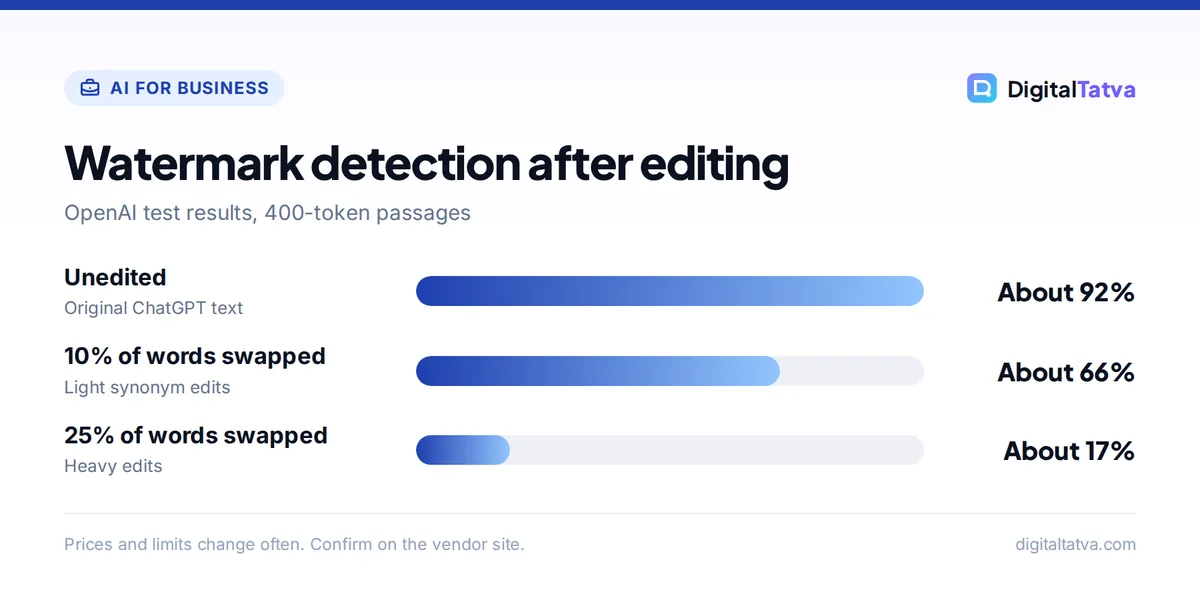
- Editing weakens it: replacing 25 percent of words in a 400-token passage cut detection to about 17 percent in OpenAI’s tests.
- A missing watermark does not prove a human wrote something, and a detected one does not reveal who generated it.
Does ChatGPT watermark its text?
ChatGPT watermarks text for users in the European Union only, as of October 2026. Users in India, the US and other regions receive unwatermarked text in the ChatGPT app, because OpenAI said, “We are not making text watermarking a global default at launch.”
| Key fact | Detail |
|---|---|
| Company | OpenAI |
| Technology name | textGrain |
| Announced | 5 October 2026 |
| Applies to | Eligible ChatGPT and Codex text for EU users, all plans |
| Outside the EU | No watermark by default in ChatGPT |
| API | Opt-in for supported models worldwide, off by default |
| Detector | Not public; access for approved researchers and expert organizations |
| Why | EU AI Act transparency rules (Article 50), in force from 2 August 2026 |
For a broader view of what OpenAI changed in ChatGPT this year, see our roundup of ChatGPT’s new features.
How does the ChatGPT watermark work?
The ChatGPT watermark works by nudging which words the model chooses so that, across a passage, the choices form a statistical pattern only OpenAI’s secret key can detect. Every AI model picks each next word from several likely options; textGrain tilts those choices in a way readers cannot notice.
Because the mark lives in the words themselves, it survives copying and pasting into Word, Google Docs or an email. It does not add zero-width characters, hidden spaces or metadata, so tools that “clean” invisible characters do nothing to it. Developers who want the mark on their own apps can enable it through the API, which our OpenAI API pricing guide covers alongside model costs. According to OpenAI, the watermark does not meaningfully change output quality, with GPT-6 Astra benchmark results broadly similar with textGrain on.
Images work differently. AI image tools typically attach C2PA content credentials, which are signed metadata recording that an image was AI-generated, and Google adds SynthID marks to images. Our guide to ChatGPT image generation covers image labels in more detail.
How accurate is ChatGPT watermark detection?
ChatGPT watermark detection is accurate on longer, unedited text and much weaker on short or edited text, according to OpenAI’s own tests. At a 1 percent false positive target, detection reached about 80 percent on 200-token passages and about 95 percent on 400-token passages.
| Test (OpenAI figures) | Detection rate |
|---|---|
| 400 tokens, unedited | About 92 to 95 percent |
| 200 tokens, unedited | About 80 percent |
| 400 tokens, 10 percent of words swapped for synonyms | About 66 percent |
| 400 tokens, 25 percent of words swapped | About 17 percent |
OpenAI also notes that math answers are harder to watermark because the model has less freedom in word choice, and translation can prevent reliable detection. Most importantly, OpenAI states that a missing watermark does not prove human authorship, and a detected watermark cannot reveal who generated the text, their account, the prompt or how much a person edited it.
Note: 400 tokens is roughly 300 English words. Short replies, captions and social posts are usually too short to detect reliably.
Can anyone check if text has a ChatGPT watermark?
No. As of October 2026, OpenAI’s watermark detector is not available to the public, teachers or employers. OpenAI is accepting applications only from approved researchers and expert organizations, granted case by case.
That means the AI detectors you find online cannot read OpenAI’s watermark; they guess from writing style, and they make mistakes, especially on non-native English writing. Read our honest review of the best AI detectors before trusting any score, and never treat a detector result as proof on its own.
What the ChatGPT watermark means for students, businesses and writers
For most people outside the EU, the ChatGPT watermark changes nothing today, but it signals that labelling AI text is becoming normal. The practical impact depends on how you use AI.
Students and teachers
EU students’ ChatGPT text now carries a watermark, but schools cannot check it without detector access. The safer path is to follow your school’s AI policy, use ChatGPT as a tutor rather than a ghostwriter, and disclose AI help when asked. Our study prompts for students focus on learning, and AI for teachers covers fair classroom policies.
Businesses and marketers
If you serve EU customers, assume AI-generated text may be marked and that EU rules increasingly expect disclosure, especially for public-interest content and chatbots. Write a clear internal policy with our AI usage policy template, and keep humans editing and fact-checking every published piece. The ownership question is separate; see can you copyright AI content.
Writers and freelancers
Heavy editing weakens the watermark, but the honest approach is simply to use AI for outlines, research and drafts, then rewrite in your own voice and tell clients how you work. Trying to “beat” watermarks with paraphrasing tools to pass off AI text as fully human can breach client contracts and school rules.
Do Claude and Gemini watermark text too?
Yes. Anthropic’s Claude and Google’s Gemini both watermark AI text, and Claude goes further than ChatGPT by applying it worldwide. Here is how the three compare as of October 2026.
| Tool | Text watermark | Where | Detector access |
|---|---|---|---|
| ChatGPT (OpenAI) | textGrain | EU users; API opt-in worldwide | Approved researchers and experts |
| Claude (Anthropic) | Based on SynthID-Text | Worldwide for models released after 2 August 2026 | Private preview for regulators, media, researchers, educators |
| Gemini (Google) | SynthID | Gemini app text and images | Limited |
As reported by ThePrint, Anthropic said it applied Claude’s watermark globally because it cannot yet limit it by region, and that it is weaker in code, factual passages and lightly proofread text. Claude-generated images carry signed C2PA credentials. Compare the assistants overall in GPT-6 vs Claude vs Gemini.
Why is OpenAI watermarking ChatGPT text?
OpenAI is watermarking ChatGPT text in the EU to comply with Article 50 of the EU AI Act, which from 2 August 2026 requires providers of generative AI to mark AI-generated text, images, audio and video in a machine-readable format. Fines for breaking these rules can reach EUR 15 million or 3 percent of global annual turnover, whichever is higher.
Article 50 also requires labelling deepfakes and AI-generated text on matters of public interest, and telling people when they are talking to a chatbot. The European Commission published a voluntary Code of Practice in June 2026. These rules are part of a wider push against AI misinformation and scams; our guide to spotting deepfake scams shows why labels matter.
Frequently asked questions
Is ChatGPT text watermarked in India?
No, not by default. OpenAI’s text watermark applies to ChatGPT and Codex users in the European Union. Users in India and other non-EU countries receive unwatermarked ChatGPT text, although API developers anywhere can choose to turn watermarking on for supported models.
Can you remove the ChatGPT watermark?
Heavy editing weakens it: in OpenAI’s tests, swapping 25 percent of words cut detection to about 17 percent. But there are no hidden characters to delete. If your school or client requires original work, rewriting to evade detection breaks their rules; disclose AI use instead.
Can teachers detect ChatGPT watermarks?
Not directly. OpenAI’s detector is not public and is limited to approved researchers and expert organizations. Teachers rely on style-based AI detectors, which are unreliable and cannot read OpenAI’s watermark, so a detector score alone should never be treated as proof.
Does the watermark affect ChatGPT answer quality?
No, according to OpenAI. It says watermarking does not meaningfully affect output quality, with GPT-6 Astra benchmark results broadly similar when textGrain is enabled. The mark only tilts word choices among equally good options.
Does the watermark reveal my identity?
No. OpenAI says a detected watermark does not reveal who generated the text, their account, the prompt or the conversation. It only indicates the text likely came from an OpenAI model with watermarking turned on.
The bottom line
ChatGPT’s watermark is real but limited: EU users get invisible, word-level marks, the detector is not public and editing weakens it. Expect more AI tools to label their output as laws like the EU AI Act take effect, and build habits now: disclose AI help, edit thoroughly and keep your own voice. Policies and rollout details can change, so check OpenAI’s announcements and your school or company rules for the latest position.
Sources
- OpenAI is adding invisible watermarks to ChatGPT and Codex text in the EU, BleepingComputer, 5 October 2026, checked 22 October 2026
- OpenAI to watermark ChatGPT text in EU; Claude users in India already getting marked output, ThePrint, October 2026, checked 22 October 2026
- Article 50: Transparency obligations, EU Artificial Intelligence Act, checked 22 October 2026
- ChatGPT release notes, OpenAI Help Center, checked 22 October 2026
Pricing and features are checked at the time of writing and can change. Some links may be affiliate links, which never affect our verdicts.