Is DeepSeek Safe? Privacy, Bans and Safer Ways to Use It
Is DeepSeek safe? What happens to your data, why the US ordered DeepSeek off federal systems in October 2026, which countries restrict it and five safer ways to use it.

On this page
Last updated: 22 October 2026
Quick answer: DeepSeek is safe for everyday, non-sensitive questions, but its official app and website store your data on servers in China, which is why the US Department of Homeland Security ordered it removed from federal civilian systems in October 2026. Avoid entering personal, client or company data. The safest option is running DeepSeek’s open-weight models locally or through a trusted host.
DeepSeek, built by Hangzhou DeepSeek Artificial Intelligence Co., Ltd, is one of the world’s most used AI chatbots because it is free and strong at reasoning and coding. The safety question is not about the quality of its answers but about where your data goes and who could access it.
This guide explains DeepSeek’s privacy risks in plain words, which governments have restricted it (including the new US order), how risky it is for individuals and businesses in India and elsewhere, and five safer ways to use DeepSeek.
Key takeaways
- DeepSeek’s privacy policy says user data is stored on servers in the People’s Republic of China.
- On 20 October 2026, a DHS order requiring US civilian agencies to remove DeepSeek products, including third-party tools built on DeepSeek, was published in the Federal Register.
- Italy, Taiwan, South Korean ministries, Australia’s government and several US agencies restricted DeepSeek in 2025; India advised officials against AI tools on office devices but has no consumer ban.
- Running the open-weight model on your own computer keeps your data entirely on your device.
- Never paste passwords, ID numbers, health records, client files or source code into any free AI chatbot.
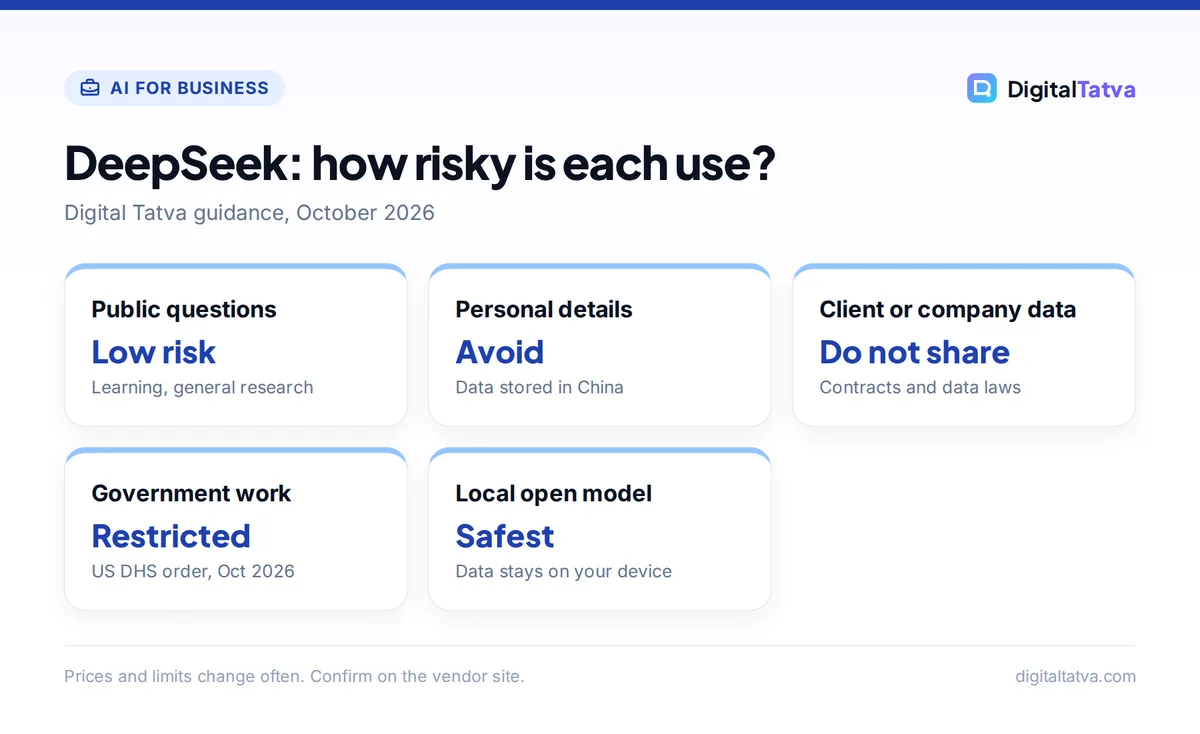
Is DeepSeek safe to use?
DeepSeek is reasonably safe for general questions, learning and public information, but it is not safe for confidential personal or business data. The main risk is data access: your prompts, files and account details go to servers in China, where companies can be required to share data with authorities.
| Key fact | Detail |
|---|---|
| Developer | Hangzhou DeepSeek Artificial Intelligence Co., Ltd (China) |
| Current models | DeepSeek V4.1 Flash and V4 Pro (V4 weights released under the MIT license in April 2026) |
| Price | Free web and app; low-cost API |
| Data storage | Servers in the People’s Republic of China (privacy policy) |
| Latest restriction | US DHS exclusion and removal order, published 20 October 2026 |
| Status in India | Available; no consumer ban |
New to the tool? Start with how to use DeepSeek, then come back to set up the privacy steps below.
What are the main DeepSeek privacy risks?
The main DeepSeek privacy risks are data storage in China, broad data collection, and past security lapses. None of these mean DeepSeek is malware, but together they make it a poor home for sensitive information.
- Data location: DeepSeek’s privacy policy states that data is stored on servers in the People’s Republic of China. Chinese law allows extensive government access to private company infrastructure, a concern the US government cited directly.
- Data collected: account details such as email or phone number, your prompts and uploaded files, device and network information. US officials said account creation may allow tracking and fingerprinting of users.
- Security track record: in late January 2025, security firm Wiz Research found a publicly exposed DeepSeek database containing chat history and internal keys, which DeepSeek secured after being alerted. Researchers have also reported vulnerabilities in DeepSeek’s iOS app.
- Censorship: DeepSeek’s hosted chatbot avoids or reshapes answers on topics sensitive to the Chinese government, so do not rely on it for political or historical research. Our DeepSeek vs ChatGPT comparison shows where answers differ.
The same “do not share secrets” rule applies to every chatbot. Compare how OpenAI handles your data in Is ChatGPT safe?
Why did the US ban DeepSeek from government systems?
The US Department of Homeland Security issued Exclusion and Removal Order 2026-01 under the Federal Acquisition Supply Chain Security Act, barring civilian federal agencies from buying DeepSeek products and requiring them to remove existing ones. The order was published in the Federal Register on 20 October 2026.
The order covers products from DeepSeek and its affiliates and also “third-party products and services developed using DeepSeek implementations”, which means some outside software vendors may be affected too. National security systems are handled by separate orders. Agencies can request exceptions within 60 days. According to reporting by IBTimes UK, the government’s concerns were China-based servers, collection of personal information, the risk of sensitive prompts reaching China, and possible software vulnerabilities.
Note: the US order applies to federal civilian agencies, not to ordinary people. Using DeepSeek as a private individual remains legal in the US and in India.
Which countries have restricted DeepSeek?
Most DeepSeek restrictions target government devices, not the general public. Italy is the main example of a consumer restriction, after its data protection authority had the app removed from app stores in January 2025.
| Country or body | Restriction | When |
|---|---|---|
| United States (DHS) | Removal from civilian federal IT, including third-party tools built on DeepSeek | Published 20 October 2026 |
| US Senate, US Navy, Commerce Department | Barred on government devices | 2025 |
| New York, Tennessee, Virginia | Barred for state government personnel | 2025 |
| Italy | App removed from app stores by the data regulator | January 2025 |
| Taiwan | Government departments, state firms and public schools | February 2025 |
| Australia | Government devices and systems | February 2025 |
| South Korea | Several ministries’ devices | February 2025 |
| India | Finance Ministry advised staff to avoid AI tools such as ChatGPT and DeepSeek on office devices; no consumer ban | Early 2025 |
Is DeepSeek safe for businesses?
DeepSeek’s hosted app and API are risky for businesses handling customer data, regulated data or trade secrets, and they may break your clients’ or partners’ security policies. If you sell software to US government agencies, the new DHS order means products built on DeepSeek could be excluded.
- Check contracts: many enterprise and government contracts now ask vendors to disclose AI providers and data locations.
- India’s data law: the Digital Personal Data Protection Act requires care with personal data shared with third parties; get legal advice before sending customer data to any overseas AI service.
- Write a policy: list approved AI tools and banned data types using our AI usage policy template, and follow our AI data privacy checklist for business.
The DeepSeek API is still attractive on price. Our DeepSeek API pricing guide shows the numbers, and Claude vs DeepSeek weighs quality and privacy side by side.
How to use DeepSeek more safely: 5 options
The safest way to use DeepSeek is to run its open-weight model on your own hardware, so no data leaves your device. If you use the official app, limit what you share and lock down your account.
- Run DeepSeek locally. DeepSeek releases model weights under the MIT license. Tools such as Ollama let you run smaller DeepSeek models on a laptop; see how to run an LLM locally.
- Use a trusted host. Some cloud providers in the US, EU and India host open DeepSeek models on their own servers, so data does not go to DeepSeek. Read the host’s data terms.
- Share only public information. Use the official app for general learning, coding questions on non-confidential code and public research. Strip names, numbers and client details.
- Protect your account. Sign up with an email you do not use for banking, use a unique password, and delete chats you no longer need. Delete the account if you stop using it.
- Pick an alternative for sensitive work. For confidential tasks, use a business plan from a provider with clear data controls, or another open model such as Qwen. Compare options in our ChatGPT alternatives and open-source AI models guides.
Watch out: fake “DeepSeek” apps and websites have appeared in app stores and search ads. Download only from the official chat.deepseek.com site or the verified app listing.
Frequently asked questions
Is DeepSeek safe to use in India?
Yes, for non-sensitive tasks. DeepSeek is legal and available in India, with no consumer ban. The Finance Ministry advised staff in early 2025 to avoid AI tools such as ChatGPT and DeepSeek on office devices. Because data is stored in China, avoid sharing personal, financial or client information.
Does DeepSeek send data to China?
Yes. DeepSeek’s privacy policy says user data from its app and website is stored on servers in the People’s Republic of China. If you run DeepSeek’s open-weight model locally or on a non-DeepSeek host, your prompts do not go to DeepSeek’s servers.
Is DeepSeek banned in the US?
Not for the public. A DHS order published on 20 October 2026 requires US federal civilian agencies to remove DeepSeek products and tools built on DeepSeek. The Senate, Navy and several states had already barred it on government devices. Individuals can still legally use it.
Is running DeepSeek locally safe?
Yes, it is the safest way. When you run a DeepSeek model with a tool like Ollama on your own computer, your prompts and files never leave the device. Download weights only from official sources such as DeepSeek’s Hugging Face page.
Is DeepSeek safer than ChatGPT?
For privacy, generally no. ChatGPT stores data in the US and offers data controls and business plans with no training on your data, while DeepSeek stores data in China with fewer controls. For maximum privacy, a locally run open model beats both.
The verdict
Use DeepSeek freely for learning, public research and non-confidential code, but treat everything you type as data that leaves your control. For business or sensitive work, run the open-weight model locally, use a trusted host or pick a provider with stronger data protections. Government rules and DeepSeek’s policies keep changing, so check the latest official notices before you build anything important on it.
Sources
- Notice of Exclusion and Removal Order (DeepSeek), US Department of Homeland Security via Federal Register, 20 October 2026, checked 22 October 2026
- US orders DeepSeek off government systems, IBTimes UK, October 2026, checked 22 October 2026
- Which countries have banned DeepSeek, Tech.co, checked 22 October 2026
- DeepSeek API models and pricing, DeepSeek, checked 22 October 2026
Pricing and features are checked at the time of writing and can change. Some links may be affiliate links, which never affect our verdicts.