What Is GEO? Generative Engine Optimization vs SEO and AEO
What is GEO? Generative Engine Optimization explained: how it differs from SEO and AEO, what research says works, a practical GEO checklist and how to measure results.

On this page
- Key takeaways
- What is GEO (Generative Engine Optimization)?
- What is the difference between SEO, AEO and GEO?
- What does research say improves AI visibility?
- How do you do GEO? A practical checklist
- What does Google say about optimizing for AI Overviews and AI Mode?
- How do you measure GEO results?
- Is GEO replacing SEO?
- Frequently asked questions
- Start with GEO this month
- Sources
Last updated: 22 October 2026
Quick answer: GEO, or Generative Engine Optimization, is the practice of making your content easy for AI systems such as ChatGPT, Google AI Overviews, AI Mode, Perplexity and Gemini to find, quote and cite in their answers. SEO aims to rank pages in search results, AEO aims to be the direct answer, and GEO aims to be mentioned and cited inside AI-generated responses.
GEO matters because a growing share of searches now end with an AI answer instead of a list of links. Google said at I/O in May 2026 that AI Overviews reach more than 2.5 billion monthly users and AI Mode more than 1 billion, and ChatGPT passed 1 billion weekly users in 2026, according to reports of OpenAI’s announcement. If your brand is not in those answers, many buyers never see you.
This guide explains what GEO is, how it differs from SEO and AEO, what research says actually improves AI visibility, a practical GEO checklist, and how to measure results.
Key takeaways
- GEO is about being cited and recommended inside AI answers, not just ranking blue links.
- The term comes from a 2023 research paper (published at KDD 2024) that found visibility gains of up to 40 percent from adding quotations, statistics and source citations.
- Google says there are no special requirements for AI Overviews or AI Mode beyond normal SEO: indexable, helpful, well-structured content.
- Strong GEO combines clear answers, original facts, consistent brand mentions across the web and technical access for AI crawlers.
- Measure GEO with AI visibility tools that track how often your brand appears for real prompts.
What is GEO (Generative Engine Optimization)?
Generative Engine Optimization is a set of content, technical and brand practices that increase how often generative AI systems mention, quote or link to your website. A “generative engine” is any AI system that writes an answer from multiple sources, such as ChatGPT search, Perplexity, Google AI Overviews and AI Mode, Microsoft Copilot or Gemini.
| Key fact | Detail |
|---|---|
| Full name | Generative Engine Optimization |
| Origin | Research paper “GEO: Generative Engine Optimization” (arXiv, November 2023; KDD 2024) by researchers from Princeton and IIT Delhi |
| Goal | Be mentioned, quoted and cited in AI-generated answers |
| Main platforms | ChatGPT, Google AI Overviews and AI Mode, Gemini, Perplexity, Copilot, Claude |
| Related terms | AEO (Answer Engine Optimization), LLMO, AI SEO, AI visibility |
| Google’s position | No extra requirements for AI features beyond being indexed and eligible for snippets |
AI engines usually retrieve web pages first and then summarize them, a process similar to retrieval-augmented generation. GEO is about making your page the one they retrieve and trust.
What is the difference between SEO, AEO and GEO?
SEO, AEO and GEO overlap heavily, but each targets a different result: SEO targets rankings, AEO targets direct answers, and GEO targets mentions and citations inside AI-written responses. Good GEO is built on good SEO.
| SEO | AEO | GEO | |
|---|---|---|---|
| Full name | Search Engine Optimization | Answer Engine Optimization | Generative Engine Optimization |
| Goal | Rank pages in search results | Be the direct answer (snippets, voice, AI answers) | Be cited or recommended in AI answers |
| Where | Google, Bing results pages | Featured snippets, voice assistants, AI Overviews | ChatGPT, Perplexity, AI Mode, Gemini, Copilot |
| Main signals | Relevance, links, page experience | Clear question-and-answer content, structure | Clear facts, authority, brand mentions, citations |
| Success metric | Rankings, clicks | Snippet and answer wins | Share of voice, citations, mentions in AI answers |
In practice, most marketers treat AEO and GEO as one discipline often called AI visibility. Our guide on how to rank in AI search covers the practical overlap.
What does research say improves AI visibility?
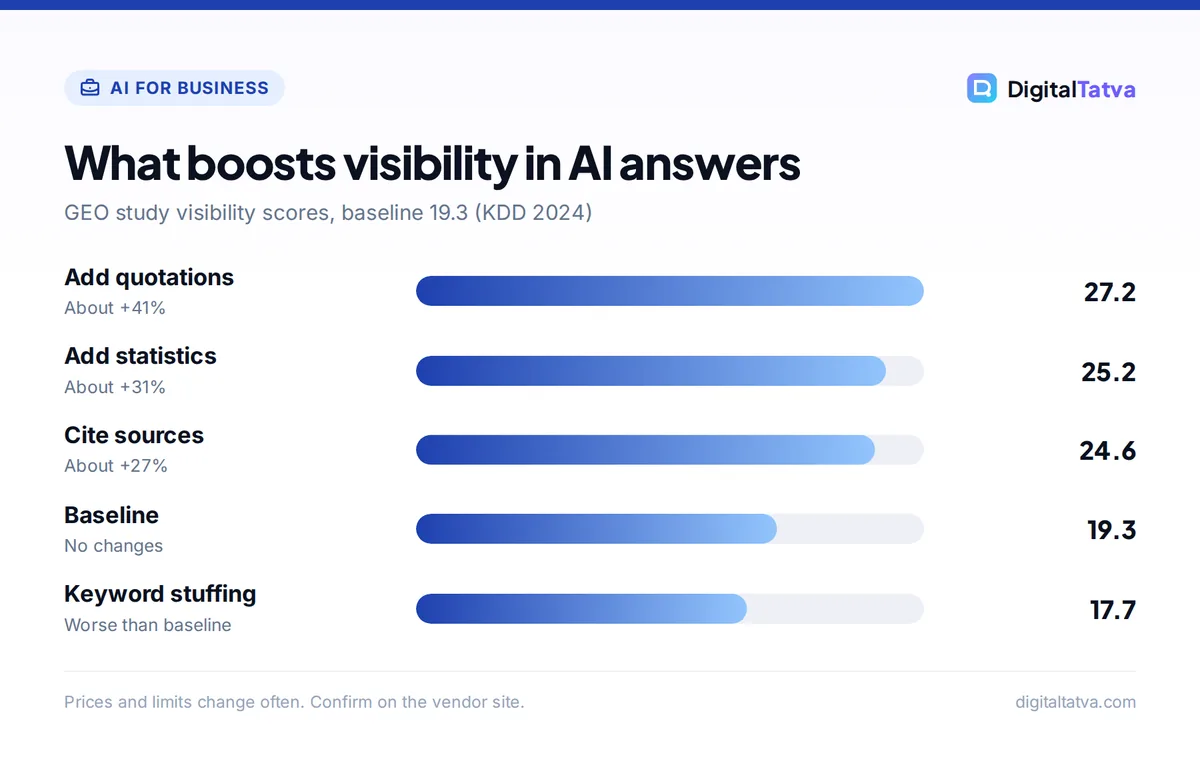
The original GEO study found that adding quotations, statistics and cited sources to content increased its visibility in generative engine answers by up to 40 percent, while keyword stuffing performed worse than doing nothing. The researchers tested nine methods across thousands of queries.
| Method (GEO paper) | Visibility score | Change vs baseline (19.3) |
|---|---|---|
| Quotation addition | 27.2 | About +41 percent |
| Statistics addition | 25.2 | About +31 percent |
| Cite sources | 24.6 | About +27 percent |
| Keyword stuffing | 17.7 | Below baseline |
The effects varied by subject: some methods worked better for law and history, others for facts and opinions. The lesson is clear, though: AI engines favor content that is specific, evidence-backed and easy to quote. Generic, keyword-heavy text loses. For more numbers on how people use AI, see our roundup of AI statistics.
How do you do GEO? A practical checklist
You do GEO by making each page answer real questions clearly, backing claims with original or sourced facts, building brand mentions across trusted sites and keeping your site technically accessible to search and AI crawlers. Here is a working checklist.
Content
- Answer first. Put a 40 to 60 word direct answer at the top of the page that works on its own if quoted.
- Use question headings. Phrase H2s the way people ask AI assistants: “How much does X cost?”, “Is X safe?”
- Make each section self-contained. Start every section with a one or two sentence answer, so an AI can lift it without context.
- Add facts with sources and dates. Statistics, prices and quotes with named sources, as the GEO study recommends.
- Publish original data. Surveys, price trackers and test results give AI engines a reason to cite you rather than a competitor.
- Use comparison tables and definitions. Clean tables and “X is a Y that Z” definitions are easy for models to extract.
- Keep content fresh. Show a visible last updated date and refresh facts regularly.
Brand and authority
- Earn mentions on trusted sites, reviews, directories, communities such as Reddit and industry publications; AI answers often reflect what the wider web says about you.
- Keep entity facts consistent: the same brand name, description, founders, location and prices everywhere, including your Google Business Profile.
- Show expertise: author bios, credentials and first-hand experience.
Technical
- Allow crawling by search engines and the AI crawlers you want (for example OAI-SearchBot for ChatGPT search, PerplexityBot) in robots.txt.
- Put key content in HTML text, not only in images, PDFs or scripts.
- Add structured data (Article, FAQ, Product, Organization) that matches the visible text.
- Consider llms.txt for AI agents, while knowing Google says it does not use it; see what llms.txt is.
What does Google say about optimizing for AI Overviews and AI Mode?
Google says there are no additional requirements to appear in AI Overviews or AI Mode: pages must be indexed and eligible to show a snippet, and standard SEO best practices apply. Google also says no special schema or AI text files are needed.
Google’s developer documentation lists the same fundamentals it always has: allow crawling, use internal links, provide a good page experience, put important content in text, use high-quality images and video, keep structured data consistent with visible content, and keep Merchant Center and Business Profile information up to date. AI Mode uses “query fan-out”, running many related searches at once, which rewards sites that cover a topic in depth. Clicks from AI features are counted in Search Console under the Web search type. Learn the interface in our guide to Google AI Mode.
Note: ChatGPT, Perplexity and Copilot use their own crawlers and search partners, so being strong on Google helps but does not guarantee visibility elsewhere. Test your brand in each assistant.
How do you measure GEO results?
You measure GEO by tracking how often AI assistants mention or cite your brand for a fixed set of buyer prompts, and by watching referral traffic from AI platforms in analytics. Rankings alone no longer tell the full story.
- Prompt tracking: AI visibility tools such as Peec AI, Otterly.AI, Profound, Semrush and Ahrefs Brand Radar run your prompts across engines and report mention rate, citations and share of voice. Compare them in our best AI visibility tools guide.
- Referral traffic: in Google Analytics, look for sessions from chatgpt.com, perplexity.ai, gemini.google.com and copilot.microsoft.com.
- Search Console: watch impressions and clicks for pages that appear in AI Overviews (counted under Web).
- Manual spot checks: ask the assistants your top ten buyer questions each month and record who they recommend.
For tools that also help with traditional rankings, see the best AI SEO tools and how to use ChatGPT for SEO.
Is GEO replacing SEO?
No, GEO is not replacing SEO; it builds on it. AI Overviews, AI Mode and many chat assistants retrieve pages through search indexes, so pages that rank, load fast and answer clearly are also the pages AI cites most.
What changes is the goal and the content style. Clicks may fall for simple questions that AI answers fully, while brand mentions and citations become valuable even without a click. Many brands are also testing paid placements such as ChatGPT ads. The winning approach in 2026 is one content program that serves both: helpful pages for people, structured so machines can quote them. Our comparison of ChatGPT vs Google Search shows how user behavior is shifting.
Frequently asked questions
What does GEO stand for in marketing?
GEO stands for Generative Engine Optimization. It means optimizing content and brand presence so generative AI systems like ChatGPT, Google AI Overviews, AI Mode, Perplexity and Gemini mention, quote and cite you in their answers. It is different from geographic targeting, which is also sometimes called geo.
Is GEO the same as AEO?
Mostly. AEO (Answer Engine Optimization) focuses on being the direct answer in snippets, voice assistants and AI answers, while GEO focuses on being cited and recommended inside generative AI responses. The tactics overlap so much that many teams combine them under the name AI visibility.
Do I need special schema or files for GEO?
Not for Google. Google says no special schema, AI text files or optimizations are needed for AI Overviews or AI Mode. Standard structured data that matches your visible content still helps understanding, and some AI agents read llms.txt, but clear, helpful content matters far more.
How long does GEO take to work?
Usually weeks to months. AI engines that search the web live, like Perplexity and ChatGPT search, can pick up new pages within days of indexing, while brand reputation signals across the web build slowly. Track a fixed prompt set monthly to see progress.
What is the most important GEO tactic?
Answering real questions clearly with specific, sourced facts. The original GEO research found adding quotations, statistics and citations raised visibility the most, while keyword stuffing hurt. Original data that others reference is the strongest long-term advantage.
Start with GEO this month
Pick your ten most important buyer questions, test them in ChatGPT, Gemini, Perplexity and Google AI Mode, and note who gets cited. Then rewrite your matching pages with answer-first summaries, question headings, sourced facts and comparison tables, and recheck in 30 days. AI search features and Google’s guidance keep evolving, so review official documentation every quarter.
Sources
- GEO: Generative Engine Optimization, Aggarwal et al., arXiv and KDD 2024, checked 22 October 2026
- AI features and your website, Google Search Central, checked 22 October 2026
- Sundar Pichai at Google I/O 2026, Google Blog, May 2026, checked 22 October 2026
- ChatGPT tops 1 billion weekly users, Yahoo Tech, August 2026, checked 22 October 2026
Pricing and features are checked at the time of writing and can change. Some links may be affiliate links, which never affect our verdicts.