ChatGPT Ads in India: How They Work, What They Cost and Whether Your Business Should Try Them
ChatGPT ads are live in India through a self-serve Ads Manager, and OpenAI has now expanded to 89 countries. Here is who sees the ads, how bidding works, what the reported minimums are, how to set up a first campaign and how ads fit alongside organic AI visibility.
On this page
- Key takeaways
- Where ChatGPT ads stand today
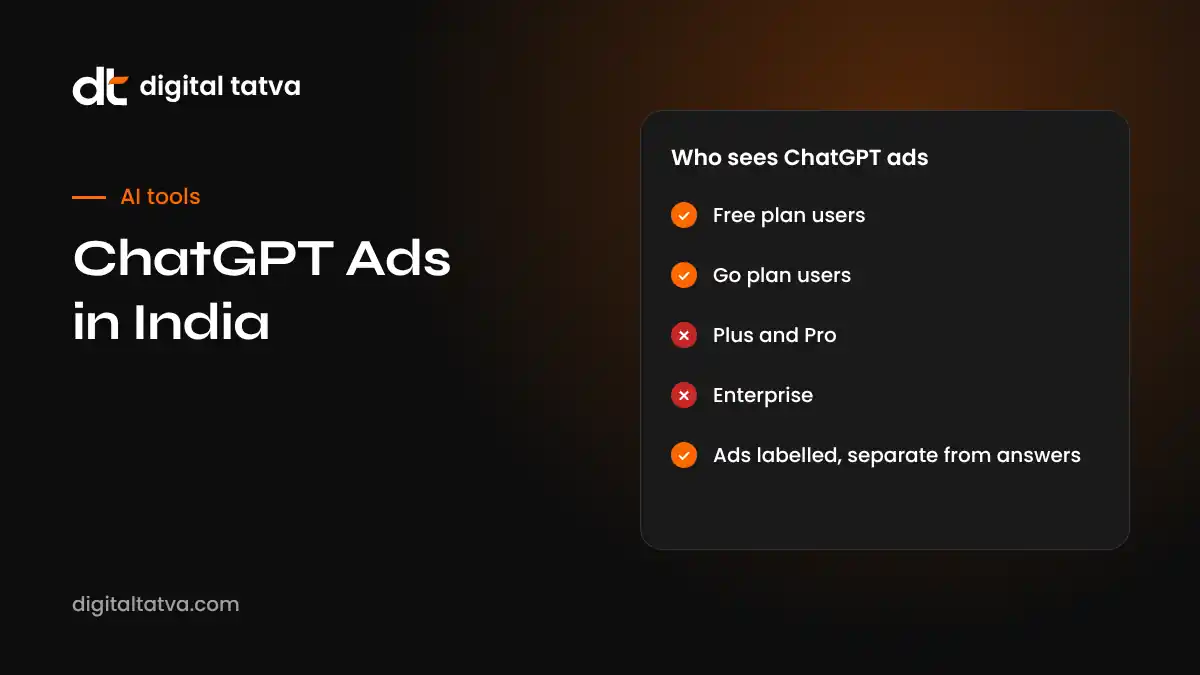
- Who sees ChatGPT ads in India
- How ChatGPT ads work
- Is ChatGPT advertising right for your business?
- How to set up your first campaign
- Writing ads that work in a chat
- Measuring results honestly
- Ads versus organic AI visibility
- Example plans by business type
- Risks and things to watch
- A 30-day test plan
- Building landing pages for ChatGPT ad traffic
- How to budget for a test in rupees
- Policy and compliance basics for Indian advertisers
- Common mistakes in early ChatGPT campaigns
- How ChatGPT ads compare with Google and Meta ads
- What to watch over the next few months
- Frequently asked questions
- Sources
Last updated: 4 November 2026
Quick answer: ChatGPT ads went live in India in late August 2026 with a self-serve Ads Manager, and on 21 October 2026 OpenAI expanded advertising to 26 more countries, bringing the total to 89. Ads appear only to users on the Free and Go plans; Plus, Pro and Enterprise users see no ads. Advertisers can bid on a CPM or CPC basis, with CPA and outcome-based bidding also cited. The legal entity that is billed must be in a supported country. For Indian businesses, ChatGPT ads are worth a small, measured test if your buyers research in ChatGPT, but they do not replace organic AI visibility, which reaches every user including paying ones.
Key takeaways
- India has had access to self-serve ChatGPT ads since late August 2026.
- Only Free and Go plan users see ads. Paid plan users do not.
- Bidding options include CPM and CPC, with CPA and outcome-based bidding also reported.
- OpenAI says more than 100,000 advertisers have used the platform, and HubSpot and Shopify integrations launched on 16 September 2026.
- Start with a small test budget, clear conversion tracking and a landing page that answers the question the ad appears next to.
Why does this matter now? OpenAI says ChatGPT has about 1.2 billion weekly users and that search-like queries equal about 20% of Google’s volume. We explain what that claim means in ChatGPT search vs Google.
Where ChatGPT ads stand today
OpenAI began testing ads in ChatGPT in the United States earlier in 2026 and has expanded quickly since then. Our earlier overview of ChatGPT ads covers how the format started. Here is the current picture for Indian advertisers.
| Item | Current status |
|---|---|
| India availability | Live since late August 2026, self-serve Ads Manager |
| Countries with ads | 89, after an expansion of 26 countries announced 21 October 2026 |
| Newly added markets (examples) | Argentina, Chile, Colombia, Peru, Nigeria, South Africa, Serbia, Ukraine, Cambodia, Bangladesh and Pakistan |
| Who sees ads | Free and Go plan users only |
| Ad-free plans | Plus, Pro and Enterprise |
| Bidding | CPM and CPC; CPA and outcome-based bidding also cited |
| Advertisers | More than 100,000 cumulatively, according to reports |
| Integrations | HubSpot and Shopify, since 16 September 2026 |
| Billing requirement | The billed legal entity must be in a listed country |
Details change often in a new ad platform. Check Ads Manager and OpenAI’s advertiser documentation for the current rules before you plan a campaign.
Who sees ChatGPT ads in India
Ads are shown to people using ChatGPT on the Free plan and the lower-priced Go plan. The Go plan has been popular in India because it offers more usage than Free at a lower price than Plus. People who pay for Plus, Pro or Enterprise, and business users on team and enterprise products, do not see ads.
That has a practical effect on targeting. Your ads will mostly reach students, early-career professionals, price-sensitive users and people who use ChatGPT casually. Senior decision-makers in large companies are more likely to use paid or enterprise plans and will not see your ads. If your buyers are enterprise CIOs, ads may not reach them. If your buyers are consumers, students or small business owners, they very likely use the Free or Go plan.
How ChatGPT ads work
Where the ads appear
Ads appear alongside ChatGPT’s answers, clearly labelled and separate from the answer itself. OpenAI has said that ads do not influence the content of ChatGPT’s answers. The ad is matched to the topic of the conversation, so an ad for accounting software might appear when someone asks about GST filing for a small business.
Ad formats
The platform has added new formats since launch:
- Standard format, now available in a wider layout.
- Multi-image ads, in open beta, for showing several products or features.
- Automatic creative enhancements, which adjust creative to fit placements.
Bidding and pricing
Advertisers can choose to pay per thousand impressions (CPM) or per click (CPC). Reports also cite cost-per-action and outcome-based options. During the early US pilot, a $60 CPM was widely reported, which is high compared with most display advertising. Prices in India will depend on competition in each topic and will change as more advertisers join.
Minimum spend
A minimum spend table reported in August listed daily minimums ranging from $25 to ₹725 per day, depending on market. Treat that as a reported figure and confirm the current minimum in Ads Manager when you set up your account.
Is ChatGPT advertising right for your business?
ChatGPT ads are most useful when people ask ChatGPT questions that lead to buying decisions in your category. Use this table as a quick guide.
| Good fit | Weaker fit |
|---|---|
| Software and apps for small businesses | Emergency local services |
| Online courses, test prep and education | Products bought mainly on impulse in stores |
| Travel planning, hotels and experiences | Enterprise deals with very senior buyers |
| Consumer products researched before purchase | Categories with strict advertising rules |
| Financial tools such as budgeting apps (where permitted) | Businesses without online conversion tracking |
| D2C brands on Shopify | Very low-margin products with small budgets |
Before spending, test your category manually. Ask ChatGPT ten questions your buyers ask and see whether ads appear and which competitors are named in the answers. If no one in your category is advertising and the answers rarely involve buying decisions, organic visibility may be the better first investment.
How to set up your first campaign
- Check eligibility. Make sure the legal entity you will bill is registered in a supported country, such as India, and that your category is allowed under OpenAI’s ad policies.
- Create an Ads Manager account and add billing details for your business.
- Set up conversion tracking. Connect your website or store. If you use Shopify or HubSpot, use the integrations so purchases and leads flow back to Ads Manager.
- Choose one clear goal for the test: leads, sales or sign-ups. Avoid mixing goals in a first campaign.
- Pick topics carefully. List the questions your buyers ask in ChatGPT and group them into a few themes.
- Write creative that matches the question. An ad next to “best GST software for a small shop” should speak to small shop owners, not to accountants at large firms.
- Build a focused landing page. The page should answer the same question in its first lines, show pricing or a clear next step and load fast on mobile.
- Start with a small budget. Set a daily budget at or slightly above the minimum and run for at least two to four weeks.
- Compare CPC and CPM if you have enough budget, or start with CPC so you pay only for visits.
- Review weekly. Look at cost per lead or sale, not only clicks, and pause topics that do not convert.
Tip: Set up a separate channel for ChatGPT ads in GA4 using UTM parameters, so you can compare paid ChatGPT traffic with organic AI referrals. Our guide to tracking AI traffic in GA4 explains the setup.
Writing ads that work in a chat
People in ChatGPT are in the middle of a conversation, often asking detailed questions. Ads that feel like a helpful next step work better than ads that shout.
- Answer the need, then offer the product. “Filing GST for a small shop? Try a 14-day free plan built for shop owners.”
- Be specific. Name the user type, the problem and the result.
- Show price signals where you can, such as “from ₹499 a month”, if your pricing is competitive.
- Avoid exaggeration. Claims such as “number one” or “guaranteed” may break ad policies and erode trust.
- Use images that show the real product, especially in multi-image formats.
- Write in the language your buyers use. Many Indian users ask in English, Hinglish or regional languages. Test variants.
Measuring results honestly
New ad platforms are exciting, and that excitement can lead to poor measurement. Keep these rules in mind.
- Measure cost per outcome, not cost per click. A cheap click that never converts is not cheap.
- Compare with your other channels. Put ChatGPT ads next to Google Ads, Meta Ads and organic results in one report.
- Watch for overlap. Some people who click an ad would have found you organically. Run tests long enough to see the real lift.
- Check lead quality. Ask your sales team whether ChatGPT ad leads are as good as leads from other sources.
- Record learnings. Note which topics, formats and messages worked, so the next test is smarter.
Ads versus organic AI visibility
Ads and organic visibility work differently in ChatGPT, and the strongest strategy uses both.
| Aspect | ChatGPT ads | Organic AI visibility |
|---|---|---|
| Who sees it | Free and Go users only | All users, including Plus, Pro and Enterprise |
| Where it appears | Labelled ad next to the answer | Inside the answer, as a named brand or cited source |
| Speed | Immediate once approved | Builds over weeks and months |
| Cost | Pay per impression, click or outcome | Content, technical and PR effort |
| Trust | Users know it is paid | Often seen as a recommendation |
| Control | You control message and timing | Engines decide what to say |
| Other engines | ChatGPT only | Also helps Google AI features, Perplexity, Copilot |
OpenAI says ads do not affect what ChatGPT writes in its answers, so you cannot buy your way into being recommended. Organic visibility depends on clear content, accurate facts, strong entity signals and mentions on sites that AI engines trust. That is the work described in our guides to ChatGPT SEO and ranking in AI search.
A sensible approach for many Indian businesses is to run a small ads test for quick learning about which questions drive buyers, while building organic visibility for long-term reach across all users and engines.
Example plans by business type
These are illustrations to help you plan, not results from real campaigns.
An edtech startup selling exam prep
Students preparing for competitive exams use ChatGPT daily, mostly on Free or Go plans. The startup targets questions about study plans and practice tests, uses multi-image ads to show its app, and sends clicks to a landing page with a free mock test. It measures cost per sign-up against its Meta campaigns.
A Shopify D2C skincare brand
The brand connects Shopify, targets questions about skincare routines for specific concerns and shows product images that match the question. It tracks purchases through the integration and compares return on ad spend with Google Shopping. It also checks that its product pages answer common ingredient questions clearly, to support organic answers.
A B2B SaaS company selling to SMEs
The company uses HubSpot. It targets questions from small business owners about invoicing and payroll, uses CPC bidding and sends leads straight into HubSpot. It knows enterprise buyers on paid plans will not see the ads, so it relies on organic visibility and review site presence for that audience.
A travel agency in Gujarat
Families ask ChatGPT for itinerary ideas. The agency runs ads on questions about specific destinations and seasons, and its landing pages show sample itineraries with price ranges. It keeps its Google Business Profile and reviews strong, because many customers still call after searching on Google.
Risks and things to watch
- Policy changes. A young ad platform changes rules often. Review OpenAI’s ad policies before each campaign.
- Price changes. As more advertisers join, costs may rise in popular topics.
- Limited reach for some audiences. Paid plan users never see ads.
- Brand safety. Check where your ads appear and use the platform’s controls.
- Data and privacy. Make sure your tracking and lead handling comply with Indian data protection rules.
- Over-reliance. Do not move your whole budget to one new channel before you have results.
A 30-day test plan
- Days 1 to 3: check eligibility, set up Ads Manager, connect tracking and build one landing page.
- Days 4 to 7: launch one campaign with two or three topic groups and two creative variants each.
- Days 8 to 14: review spend, clicks and early conversions; pause clear losers.
- Days 15 to 21: shift budget to the best topic group; test a multi-image ad if relevant.
- Days 22 to 30: compare cost per outcome with other channels and decide whether to scale, adjust or stop.
Alongside the test, run our free AI visibility checker to see whether your site is ready for organic AI answers, so you build both paid and organic presence at the same time.
Building landing pages for ChatGPT ad traffic
People arriving from ChatGPT have usually just read a detailed answer. They expect the page they land on to continue that conversation, not restart it. A landing page built for this traffic tends to share a few features.
- A headline that repeats the question. If the ad ran on questions about GST software for shops, the page should say so at the top.
- A short answer before the pitch. Two or three sentences that confirm the visitor is in the right place.
- Clear prices or ranges. ChatGPT users often ask about cost. Hiding prices sends them back to the chat.
- A comparison or “who it is for” section. Help visitors see quickly whether your product fits their situation.
- One main action. A free trial, a quote form or a purchase button, not five competing options.
- Fast mobile loading. Most Free and Go plan users in India are on phones.
- Trust signals. Real reviews, recognised payment options, a physical address and clear refund terms.
These same features help your page in organic AI answers, so the work pays twice.
How to budget for a test in rupees
A first test should be big enough to produce a decision and small enough that losing it would not hurt. Here is a simple way to size it.
- Know your target cost per lead or sale from your other channels, for example ₹600 per lead.
- Decide how many conversions you need to judge the test. Twenty to thirty is a reasonable minimum for a directional read.
- Multiply to get a test budget. At ₹600 per lead and 25 leads, plan for about ₹15,000, plus some room for learning.
- Spread it over three to four weeks to smooth out daily swings, while staying at or above the platform’s minimum daily spend.
- Set a stop rule. If cost per lead is more than double your target after half the budget, pause and rethink topics and creative.
The example figures are for illustration. Use your own numbers, and include the cost of creative and landing page work in your decision.
Policy and compliance basics for Indian advertisers
- Read OpenAI’s ad policies before writing creative. Some categories are restricted or need extra checks.
- Follow Indian advertising standards. The ASCI code applies to claims, comparisons and influencer-style messaging.
- Be careful with regulated sectors. Financial products, health claims, education outcomes and real estate have specific rules in India.
- Handle personal data properly. Lead forms should explain how data will be used, in line with the Digital Personal Data Protection Act.
- Keep invoices and tax records in the name of the billed legal entity, which must be in a supported country.
We are not lawyers, so check specific questions with a qualified adviser, especially in regulated categories.
Common mistakes in early ChatGPT campaigns
- Reusing Google search ads word for word. Short keyword-style copy often feels out of place next to a conversational answer.
- Sending traffic to the homepage. Visitors lose the thread and leave.
- Running without conversion tracking. Without it, you can only judge clicks, which says little about value.
- Targeting enterprise buyers. Many of them use paid plans that show no ads.
- Stopping too early. A few days of data is rarely enough to judge a new channel.
- Ignoring organic answers. If ChatGPT names competitors in its answers next to your ad, your ad has to work harder. Improving organic visibility helps your ads too.
How ChatGPT ads compare with Google and Meta ads
| Aspect | ChatGPT ads | Google Ads | Meta Ads |
|---|---|---|---|
| User intent | Mid-conversation research and planning | Active search for a product or answer | Browsing a feed, less active intent |
| Targeting basis | Conversation topic | Keywords, audiences, location | Interests, demographics, lookalikes |
| Maturity | New, changing quickly | Very mature | Very mature |
| Reporting and tools | Basic, growing | Extensive | Extensive |
| Audience gaps | No ads for paid plan users | Broad reach | Broad reach |
| Best use today | Testing and learning in research-heavy categories | Capturing demand | Creating demand and retargeting |
For most Indian businesses, ChatGPT ads are a test channel added to an existing mix, not a replacement for Google or Meta. The lessons you learn, such as which questions lead to purchases, are also valuable for your content and organic AI strategy.
What to watch over the next few months
- New bidding options and whether CPA bidding becomes widely available.
- Changes to minimum spends and pricing as competition grows in India.
- More formats beyond the current standard and multi-image ads.
- Better reporting and integrations with other ecommerce and CRM tools.
- Any change to which plans see ads, which would change your reachable audience.
Frequently asked questions
Are ChatGPT ads available in India?
Yes. ChatGPT ads went live in India in late August 2026 with a self-serve Ads Manager.
Who sees ChatGPT ads?
Users on the Free and Go plans. Plus, Pro and Enterprise users do not see ads.
How much do ChatGPT ads cost in India?
Costs depend on bidding type and competition. A reported August minimum spend table listed daily minimums ranging from $25 to ₹725 depending on market. Check Ads Manager for current figures.
Can I pay per click?
Yes. CPM and CPC bidding are available, and CPA and outcome-based bidding have also been reported.
Do ads help my brand appear in ChatGPT’s answers?
No. OpenAI says ads do not influence answers. Organic mentions depend on your content, reputation and the sources AI engines trust.
Can I connect Shopify or HubSpot?
Yes. Integrations with HubSpot and Shopify have been available since 16 September 2026.
Sources
- Advertisers in 26 more countries gain ChatGPT ads, bringing the total to 89, PPC Land
- Where ChatGPT ads are sold: every market and date, Digital Applied
- OpenAI: ChatGPT search is about 20% of Google, Big Technology
Product details, prices and features are checked at the time of writing and can change. Sources are linked in the text so you can check them yourself.
How does your brand appear in AI answers?
We test the questions your buyers ask across the major AI assistants and search engines, then show you what to fix first.
Get an AI Visibility Audit