ChatGPT Search Is About 20% of Google’s Volume: What the New Numbers Mean for Your Marketing
OpenAI says search-like queries in ChatGPT now equal about 20% of Google's volume, with 1.2 billion weekly users. Here is what the claim does and does not mean, and how businesses should rebalance SEO and AEO effort.
On this page
- Key takeaways
- What OpenAI actually said
- What “search-like queries” means
- Why you should be careful with the 20% figure
- What this means for businesses
- How ChatGPT search differs from Google search
- A practical plan: rebalance, do not replace
- How to tell if ChatGPT matters for your category
- Example: two businesses, two responses
- What the other numbers tell us
- Common mistakes after headlines like this
- Questions to discuss with your team
- The bigger picture
- What makes a page more likely to be cited in ChatGPT search
- Content formats that work in both Google and ChatGPT
- How to track the shift in your own data
- What this means for agencies and consultants
- What this means for Indian businesses
- Frequently asked questions
- Sources
Last updated: 4 November 2026
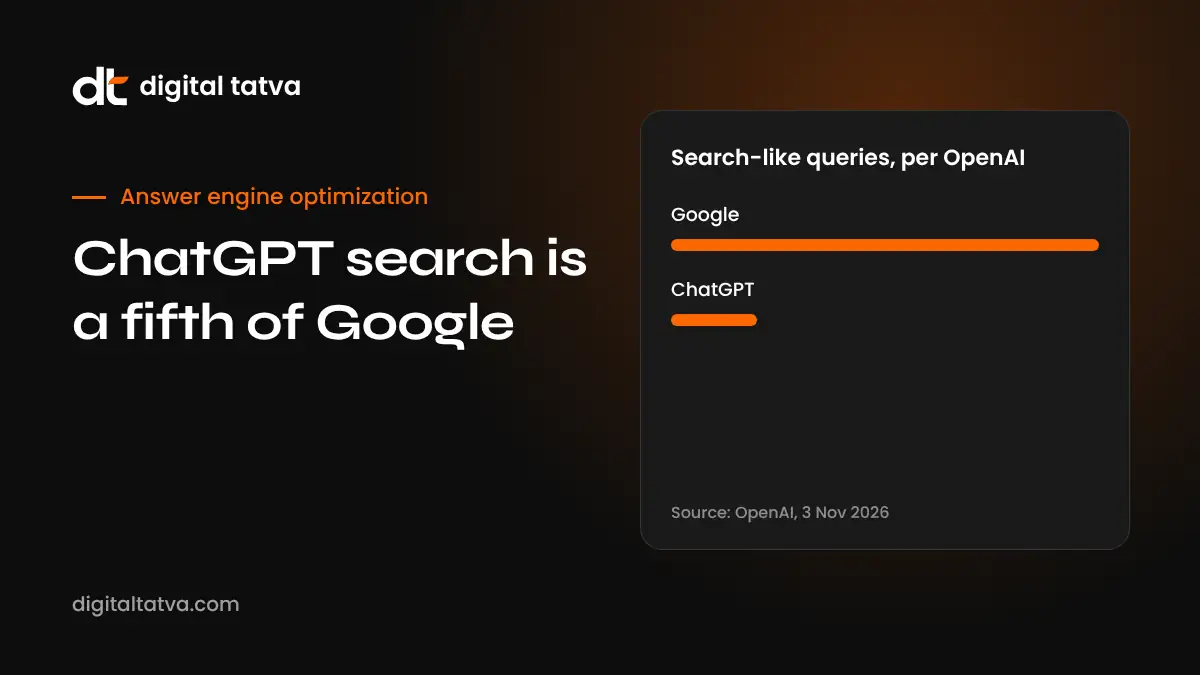
Quick answer: On 3 November 2026, Adam Fry, who leads ChatGPT’s consumer product at OpenAI, told Big Technology that search-like queries in ChatGPT (prompts that trigger a web search) now equal about 20% of Google’s search volume. OpenAI did not share how it calculated this. In the same conversation it said ChatGPT has about 1.2 billion weekly users, up from 1 billion roughly 60 days earlier. For businesses, the message is not “Google is over”. It is that a meaningful share of research now happens inside an AI assistant, so your content needs to work for both search results and AI answers.
Key takeaways
- The 20% figure is OpenAI’s own claim, with no published method. Treat it as a direction, not a precise measurement.
- “Search-like queries” means prompts where ChatGPT searched the web, not every conversation.
- Even at 20%, Google remains far larger, and Google itself now answers with AI in AI Overviews and AI Mode.
- ChatGPT’s growth to about 1.2 billion weekly users makes AI visibility a mainstream marketing channel, not an experiment.
- The practical response is the same work that helps both: clear answers, trustworthy facts, strong entity signals and crawler access.
What OpenAI actually said
The figure comes from an interview between Adam Fry, ChatGPT’s consumer product lead, and Alex Kantrowitz of Big Technology, published on 3 November 2026. Several numbers came out of the conversation:
| Claim | Figure | What to keep in mind |
|---|---|---|
| Search-like queries compared with Google | About 20% of Google’s volume | No methodology given |
| Weekly users | About 1.2 billion | Up from 1 billion in about 60 days |
| Weekly voice and dictation users | About 250 million | Voice queries tend to be longer and more conversational |
| Images generated per week | About 1.5 billion | Shows breadth of use beyond text |
| Product direction | Chat and Work modes merging | Described as “coming soon” |
| Advertising | More than $1 billion annual run rate within 200 days | Ads appear only on certain plans |
| Subscriptions | More than 50 million | Paid plans are ad-free |
Every one of these numbers comes from OpenAI. They have not been independently audited, and companies naturally choose how to frame their own metrics. That does not make them wrong, but it does mean you should read them as OpenAI’s view of its own product.
What “search-like queries” means
ChatGPT handles many kinds of requests: writing, coding, planning, image generation, studying and casual conversation. Only some of these trigger a web search. When ChatGPT decides it needs current information, or the user asks it to search, it fetches pages from the web and cites them. Those are the “search-like” queries OpenAI is comparing with Google.
This matters for two reasons. First, it means the comparison is narrower than “all ChatGPT use versus all Google use”, which would be meaningless. Second, it means these are exactly the queries where your website can appear as a source. When ChatGPT searches, it uses crawlers such as OAI-SearchBot to find and read pages. If your site is readable and useful, it can be cited. If your site blocks those crawlers, it cannot. Our guide to ChatGPT SEO explains how this works in more detail.
Why you should be careful with the 20% figure
- No method was shared. We do not know how OpenAI counted Google’s volume, which period it compared or how it defined a “query”.
- Different units. One ChatGPT conversation can include several searches, and one Google session can include several queries. Comparing them is hard.
- Google’s AI is also search. Many Google searches now show AI Overviews or happen in AI Mode. The line between “search” and “AI answers” is blurring on both sides.
- Market variation. The share will differ widely by country, age group and topic. A B2B software buyer and a local restaurant customer behave differently.
- Self-reported growth. A company sharing its own growth rate in a media interview has reasons to present it well.
The honest reading is that ChatGPT has become a large research tool, large enough that ignoring it would be a mistake, but not large enough to replace Google for most businesses.
What this means for businesses
1. AI visibility is now a mainstream channel
With roughly 1.2 billion weekly users, ChatGPT reaches a large share of internet users. For many categories, some of your future customers are asking ChatGPT who to buy from before they ever search on Google. That is the core idea behind answer engine optimisation: making sure AI assistants can find, understand and recommend you.
2. Google is still the biggest source of demand
Even if the 20% figure is accurate, Google’s search volume is around five times larger. For most businesses, classic SEO still drives most organic traffic. The good news is that most of what helps in AI answers also helps in Google, including Google’s own AI features.
3. Fewer clicks, more influence
AI answers often satisfy the question without a click. That means your brand can influence a buying decision without a visit showing up in analytics. Measure mentions and citations, not only traffic. Our guide to AEO KPIs covers what to track.
4. Conversational queries are different
With 250 million weekly voice and dictation users, more questions are long and natural: “I run a 20-person clinic in Pune, what billing software is easiest for my staff?” Content that answers specific situations, with clear facts and examples, tends to be more useful in these answers than generic keyword pages.
5. Paid options are arriving
OpenAI says advertising passed a $1 billion annual run rate within 200 days. Ads are now a real option in many markets, including India. We cover that in detail in our guide to ChatGPT Ads in India. Organic visibility still matters, because Plus, Pro and Enterprise users see no ads at all.
How ChatGPT search differs from Google search
| Aspect | Google Search | ChatGPT search |
|---|---|---|
| Result format | Links, rich results, AI Overviews, AI Mode | Written answer with cited sources |
| Query style | Short keywords and questions | Longer, conversational, with context |
| Follow-up | New search | Same conversation, building on context |
| Sources shown | Many links per page | A handful of citations per answer |
| Personalisation | Location, history | Conversation, memory settings, location |
| Crawler | Googlebot | OAI-SearchBot and ChatGPT-User, often alongside Bing’s index |
| Measurement | Search Console | GA4 referrals and prompt tracking |
The biggest difference is the number of sources. A Google results page can show dozens of links. A ChatGPT answer usually cites a few. Being one of those few is more valuable, and more competitive.
A practical plan: rebalance, do not replace
We do not recommend moving your whole SEO budget into AI. We recommend making sure every piece of work counts for both. Here is a plan we use with clients.
- Check access. Make sure OAI-SearchBot, ChatGPT-User, Googlebot, Bingbot and PerplexityBot can reach your site and are not blocked by robots.txt or a firewall. Our free AI visibility checker tests this in a minute.
- Test your brand. Ask ChatGPT ten to twenty questions your buyers ask. Note whether you are named, who is named instead and which sites are cited. See how to check if ChatGPT recommends your brand.
- Fix the facts. If AI describes you wrongly, correct the sources it relies on. Our guide to fixing wrong AI answers explains the steps.
- Answer real questions. Add clear answers, comparison tables, pricing ranges and FAQs to the pages that matter for buying decisions.
- Earn mentions on cited sites. Find the review sites, directories, publications and forums that AI cites for your category and work to be included there.
- Measure both channels. Track Google search with Search Console, AI referrals with GA4 and AI mentions with regular prompt tests.
- Review quarterly. Move effort toward whatever is producing leads, not toward whatever is in the news.
How to tell if ChatGPT matters for your category
The 20% figure is an average across everything. Your category may be very different. These signals suggest ChatGPT matters more for you:
- Your buyers research complex decisions: software, professional services, education, health products, finance or travel.
- Your buyers are younger, technical or work in knowledge jobs.
- You already see referral traffic from chatgpt.com in GA4.
- Competitors are named when you test buying questions in ChatGPT.
- Your sales team hears “ChatGPT suggested you” from new leads.
And these suggest Google still dominates for you:
- Most demand is local and urgent, such as emergency repairs or nearby food.
- Buyers rely on maps, reviews and calls rather than research.
- Your GA4 shows almost no AI referral traffic after you set up tracking properly.
Even in the second group, Google’s own AI features increasingly answer questions directly, so the same content principles apply.
Example: two businesses, two responses
These are illustrations, not client results.
A SaaS company selling HR software
Buyers ask ChatGPT for shortlists before booking demos. The company tests twenty prompts and is named in only three. Competitors are cited from review sites and comparison articles. It updates its comparison pages with honest feature tables, adds clear pricing ranges, works on getting listed on the review sites AI cites and sets up GA4 tracking for AI referrals. It keeps its Google SEO programme running, because most demo requests still come from search.
A plumbing business in one city
Customers search “plumber near me” on Google Maps when a pipe bursts. ChatGPT barely features. The business focuses on its Google Business Profile, reviews and a clear service area page, which also helps Google’s AI features. It checks once a quarter that ChatGPT describes it correctly, but it does not shift budget.
What the other numbers tell us
Voice is growing
About 250 million people use voice or dictation in ChatGPT every week. Spoken questions are longer and include context. Pages that answer “for a family of four”, “on a small budget” or “in Ahmedabad” style questions directly are better suited to these answers than pages written for short keywords.
Images are a big part of use
About 1.5 billion images a week shows that ChatGPT is not only a search tool. For marketers, it also means AI-generated visuals are everywhere, which raises questions about authenticity. Our guide to checking AI-made content with SynthID covers one way to verify media.
Chat and Work modes are merging
OpenAI says it plans to merge Chat and Work modes. If that happens, more professional tasks such as research for a purchase, vendor comparison or proposal writing will happen in the same interface that searches the web. B2B brands should expect more buyer research to start in ChatGPT.
Ads and subscriptions
Over 50 million subscriptions and over $1 billion in ad run rate show two audiences: paying users who see no ads, and free users who do. Organic visibility reaches both. Ads reach only the second.
Common mistakes after headlines like this
- Abandoning SEO. Google is still the larger channel, and its AI features rely on the same foundations.
- Blocking AI crawlers by accident. Some sites block OAI-SearchBot while trying to block training bots. Check your robots.txt rules.
- Chasing tricks. There is no secret prompt or hidden tag that makes ChatGPT recommend you. Clear, accurate, well-cited information is what works.
- Buying guarantees. No agency can guarantee ChatGPT placement. Be wary of anyone who promises it.
- Measuring only traffic. Many AI influences never produce a click. Track mentions too.
Questions to discuss with your team
- Do we know how often ChatGPT names us for our top buying questions?
- Can AI search crawlers access our website today?
- Which pages answer buying questions clearly, with facts and prices?
- Are we listed on the sites AI cites for our category?
- Do we track AI referral traffic and conversions in GA4?
- Should we test ChatGPT ads, and if so, with what budget and goal?
The bigger picture
Search is splitting into several places at once: Google’s classic results, Google’s AI features, ChatGPT, Perplexity, Copilot, Gemini and voice assistants. The 20% claim is one data point in that shift. The businesses that do well will not be the ones that bet everything on one platform, but the ones whose information is clear, consistent and trusted wherever buyers ask. That is the goal of our five elements framework: be readable, answerable, trusted, visible and clearly defined, so any engine can use you.
What makes a page more likely to be cited in ChatGPT search
When ChatGPT searches, it has to pick a handful of pages from many candidates. Nobody outside OpenAI knows the full selection process, and it changes over time. But the patterns we see across client testing and public research are consistent enough to act on.
- The page is reachable. OAI-SearchBot can fetch it, the firewall does not block it and the main content is in the HTML rather than loaded only by JavaScript.
- The answer is easy to find. A direct answer appears near the top, under a heading that matches the question.
- The facts are specific. Prices, ranges, dates, locations, steps and named options give the AI something concrete to quote.
- The page is current. A visible updated date and recent facts help, especially for topics where details change.
- The source is credible. The brand is clearly identified, the author or organisation is named, and the site is mentioned elsewhere on the web.
- It covers the situation. Pages that address “for small businesses”, “in India” or “under a budget” fit conversational queries better than generic pages.
None of these guarantees a citation. Together, they make your page a better candidate for both ChatGPT and Google’s AI features.
Content formats that work in both Google and ChatGPT
| Format | Why it works | Example |
|---|---|---|
| Comparison pages | AI answers often compare options for the user | “Tally vs Zoho Books for a small trading firm” |
| Pricing guides | Cost questions are common and need specific numbers | “How much does a website cost in India in 2026” |
| Step-by-step guides | Process questions map cleanly to numbered steps | “How to register for GST online” |
| Situation-specific advice | Matches long conversational prompts | “Best CRM for a 10-person real estate team” |
| FAQ sections | Short, direct answers that are easy to quote | Common objections answered on a service page |
| Original data | Gives AI a unique fact that others lack | A survey of your customers’ average budgets |
If you already have strong SEO content, you rarely need to start again. Refreshing existing pages with clearer answers, tables and updated facts is usually the fastest win. Our guide to content refresh for AEO walks through the process.
How to track the shift in your own data
Headlines describe averages. Your own data tells you what is happening to your business. Set up these three views and check them monthly.
- AI referral sessions in GA4. Create a custom channel group that captures chatgpt.com, perplexity.ai, copilot.microsoft.com, gemini.google.com and similar referrers. Track sessions and conversions over time.
- Branded search trend in Search Console. If more people hear about you in AI answers, branded searches on Google often rise. Watch branded query impressions month by month.
- Prompt tests. Keep a fixed list of 20 to 50 buying questions and test them in ChatGPT every month. Record whether you are named and which sources are cited.
Within a few months you will know whether ChatGPT is a meaningful channel for you, regardless of what the industry-wide figure says. For a ready-made structure, use our AEO reporting template.
What this means for agencies and consultants
Clients will read headlines like “ChatGPT is 20% of Google” and ask what to do. Agencies that respond well will avoid two extremes: dismissing AI search, or selling it as a replacement for SEO. The honest message is that the foundations overlap heavily, measurement needs to expand and no one can promise placement in AI answers. Reports should show AI referrals, prompt-test results and Google’s new Search Console AI performance data alongside classic SEO metrics, so clients see the whole picture.
What this means for Indian businesses
India is one of ChatGPT’s largest markets, helped by the lower-priced Go plan and heavy use among students and young professionals. For Indian businesses, a few points stand out.
- Younger buyers research in ChatGPT. Education, software, consumer electronics, travel and personal finance are categories where AI research is already common.
- Language matters. Many users ask in English, Hinglish or regional languages. Pages that explain things simply, with local examples, prices in rupees and Indian rules, are more useful in answers.
- Local facts must be consistent. Business names, addresses, phone numbers and service areas should match across your website, Google Business Profile, Justdial, IndiaMART and other directories that AI engines may cite.
- Reviews and marketplaces count. AI answers often draw on review sites, marketplaces and forums. Being present and well reviewed there helps.
- Ads are an option. ChatGPT ads are live in India for Free and Go users. See our guide to ChatGPT Ads in India before testing.
For small and mid-sized Indian firms, the most cost-effective first step is usually technical: make sure AI crawlers can read your site, then fix the facts AI gets wrong. Our guide to AI tools for MSMEs in India also covers practical ways to use AI in daily operations.
Frequently asked questions
Is ChatGPT search really 20% of Google?
That is OpenAI’s claim, made by Adam Fry in a Big Technology interview on 3 November 2026. OpenAI did not explain the method, so treat it as a rough indicator rather than a precise figure.
What counts as a search-like query in ChatGPT?
A prompt that causes ChatGPT to search the web and cite sources, rather than answering only from what the model already knows.
How many people use ChatGPT?
OpenAI says about 1.2 billion people use ChatGPT weekly, up from 1 billion about 60 days earlier.
Should I stop investing in Google SEO?
No. Google remains larger, and most work that improves AI visibility also helps Google, including AI Overviews and AI Mode. Rebalance effort so each piece of work serves both.
How can I get my business cited in ChatGPT answers?
Allow AI search crawlers, answer buying questions clearly on your pages, keep facts accurate and earn mentions on sites AI cites for your category. No one can guarantee placement.
How do I measure ChatGPT traffic?
Set up a custom channel group for AI referrers in GA4 and run regular prompt tests to track mentions and citations.
Sources
- OpenAI: ChatGPT search is about 20% of Google, Big Technology
- Overview of OpenAI crawlers, OpenAI
- AI features and your website, Google Search Central
- Search news recap, 2 November 2026, Search Engine Roundtable
Product details, prices and features are checked at the time of writing and can change. Sources are linked in the text so you can check them yourself.
How does your brand appear in AI answers?
We test the questions your buyers ask across the major AI assistants and search engines, then show you what to fix first.
Get an AI Visibility Audit