How to Refresh Old Content So AI Engines Cite It Again
Old blog posts and service pages often hold your best rankings but outdated facts. A practical content refresh process for AEO: what to update, how to restructure for AI answers, and how to prioritise.
On this page
- Key takeaways
- Why content refresh matters more in the AI era
- What AI engines want from a page
- Step 1: Build your refresh inventory
- Step 2: Prioritise what to refresh
- Step 3: Decide the refresh type
- Step 4: Update the facts
- Step 5: Restructure for AI answers
- Step 6: Add expertise and sources
- Step 7: Technical checks
- Step 8: Update dates honestly
- Step 9: Strengthen internal links
- Step 10: Measure the impact
- A refresh checklist you can copy
- How often to refresh
- Worked example
- Using AI tools to speed up a refresh
- Consolidating overlapping posts
- Refreshing different page types
- Who should do the refresh
- Prioritisation scoring example
- Common refresh mistakes
- Getting help
- In summary
- Frequently asked questions
- Sources
Last updated: 4 November 2026
Quick answer: A content refresh for AEO means updating existing pages so AI assistants can use and trust them again. Find pages that already get traffic, rank or cover important buyer questions; fix outdated facts, prices and screenshots; move the direct answer to the top; break long sections into question-led headings; add a short FAQ from real customer questions; cite current sources; and show a clear “last updated” date. Refreshing a strong old page is often faster and more effective than writing a new one, because the page already has links, history and authority that AI engines and search results recognise.
Key takeaways
- Most websites have dozens of older pages that rank or have links but contain outdated facts or weak structure.
- AI engines prefer current, clear, well-structured passages, so refreshed pages often get cited more than new ones.
- Prioritise by business value and existing visibility, not by age alone.
- A real refresh changes substance: facts, structure, sources and answers, not just the date.
- Measure results with AI citations, mention rate and AI referral traffic, alongside rankings.
Why content refresh matters more in the AI era
For years, content teams focused on publishing more: more blog posts, more landing pages, more keywords. Many websites now have hundreds of pages written between 2018 and 2024. Some still rank well. Many are slowly decaying, with old statistics, outdated screenshots, discontinued products and advice that no longer applies.
AI assistants change the value of that archive. When ChatGPT, Perplexity, Gemini or Google AI Overviews answer a question, they look for passages that are clear, accurate and current. An old page with a strong backlink profile but 2021 pricing is a risk to the AI, which may skip it or, worse, repeat the outdated fact and attribute it to you. Our guide to fixing wrong AI answers about your brand shows how often old pages are the source of errors.
At the same time, older pages often have advantages new pages lack: internal and external links, a history in search results and established relevance. Refreshing them combines that authority with the current, structured content AI engines want. In our experience, a well-planned refresh programme is one of the fastest AEO quick wins available to an established website.
What AI engines want from a page
Before refreshing anything, be clear about the target. AI assistants tend to lift and cite pages that:
- Answer the question directly near the top, in plain language.
- Use question-shaped headings so each section can stand on its own.
- Contain specific, current facts such as prices, dates, specifications and steps, ideally with sources.
- Show who wrote or reviewed the content and when it was last updated.
- Are easy to read for machines: content in HTML, clear structure, tables for comparisons, no key facts locked in images.
- Agree with other trusted sources, or explain clearly why they differ.
Our guides to answer-first content and the types of pages AI assistants cite explain these qualities in depth.
Step 1: Build your refresh inventory
Start with a list of existing pages and some basic data for each. A spreadsheet is enough.
- URL and title.
- Page type: blog post, guide, service page, product page, comparison, FAQ.
- Publish date and last updated date.
- Organic traffic over the last 12 months, from your analytics or Search Console.
- Search impressions and top queries from Search Console.
- Number of referring domains, if you have a backlink tool.
- AI referral visits, if you track them. See how to track AI traffic in GA4.
- Business value: does the page support a product, service or conversion path?
- Obvious problems: outdated year in title, old prices, broken links, missing images.
A crawler can speed this up. Our list of the best SEO crawlers for AI search readiness includes tools that export titles, dates, word counts and status codes in minutes.
Step 2: Prioritise what to refresh
Not every old page deserves attention. Score each page on three questions:
| Question | High priority if |
|---|---|
| Is the topic valuable? | It answers questions your buyers ask before they choose a provider or product |
| Does the page have existing strength? | It has impressions, traffic, links or AI citations already |
| Is it at risk? | It contains outdated facts, prices, product names or advice that could mislead AI answers |
Pages that score high on all three come first. Pages with high value but no strength may need a rewrite or consolidation. Pages with low value and no strength may be candidates for removal or redirection.
Tip: Check your baseline prompt set too. If AI assistants answer an important buyer question without citing you, find the page on your site that should answer it. That page is a refresh priority even if its traffic is low.
Step 3: Decide the refresh type
Each page needs a different level of work.
- Light update: correct facts, update prices and dates, fix broken links, add a last updated date. Suitable for pages that are well structured but slightly out of date.
- Restructure: keep most content but reorganise it answer first with question-led headings, a summary, a table and an FAQ. Suitable for long, rambling posts that rank but are hard to quote.
- Rewrite: keep the URL and topic but write substantially new content. Suitable when the old content is thin, outdated or off target.
- Consolidate: merge several overlapping posts into one stronger page and redirect the others. Suitable when you have three posts on “AEO tips” competing with each other.
- Retire: remove or redirect pages that have no value and could mislead, such as announcements for discontinued products.
Step 4: Update the facts
Facts are the foundation. Go through each page and check:
- Prices and plans: your own and any tools or competitors you mention. Note the date you checked.
- Statistics: replace old figures with current ones and cite the source. If you cannot find a current figure, remove or clearly date the old one.
- Product and feature names: many tools have renamed features or retired products.
- Screenshots: old interface screenshots confuse readers and make the page look stale.
- Laws, rules and policies: anything regulatory must reflect current rules.
- Links: fix broken external links and update internal links to point to your newest, best pages.
- Your own details: company name, services, locations and contact details should match your current website.
If a fact cannot be verified, do not guess. Remove it or state clearly what you know and when it was true.
Step 5: Restructure for AI answers
Many older posts were written for keyword density and time on page, with long introductions and answers buried halfway down. Restructure them:
- Add a direct answer at the top. Two to four sentences that answer the main question completely.
- Add key takeaways as a short list for readers who skim.
- Turn headings into questions or clear statements. “Benefits” becomes “What are the benefits of solar water heaters for hotels?”
- Answer each heading in the first sentence beneath it, then add detail.
- Use tables for comparisons, prices and specifications.
- Use numbered steps for processes.
- Cut filler. Remove generic introductions, repeated points and paragraphs that say nothing specific.
- Add an FAQ with real questions from customers, sales calls, support tickets and AI prompt research.
Step 6: Add expertise and sources
- Name the author or reviewer with a link to their profile page. See author pages for AEO.
- Add first-hand experience: examples from your own work, data from your own projects, photos you took.
- Cite primary sources: official documentation, regulators, research papers and vendor pricing pages.
- Explain your method when you present data or recommendations.
Step 7: Technical checks
- Content is in HTML, not only in images or embedded documents.
- The page is indexable: no noindex tag, correct canonical, included in the sitemap.
- AI crawlers can access it. Check with our free AI visibility checker.
- Schema is current: Article with dateModified, FAQPage if appropriate, Product or Service where relevant. See schema markup for AEO.
- The page loads quickly on mobile.
- Images have descriptive alt text.
Step 8: Update dates honestly
Show a “last updated” date only when you have made a real update. Changing the date without changing the content is misleading to readers, and search engines are wary of it. A meaningful update changes facts, structure or substance. Keep the original publish date where your CMS shows it, and update the modified date and visible “last updated” line.
Step 9: Strengthen internal links
A refresh is a good moment to improve how the page connects to the rest of your site:
- Link from the refreshed page to your current service pages and related guides.
- Link to the refreshed page from newer posts and relevant hub pages.
- Use descriptive anchor text that says what the linked page covers.
- Remove links to retired or redirected pages.
Our guide to internal linking for AEO explains how to build topic hubs that help AI engines understand your expertise.
Step 10: Measure the impact
Record a baseline before you publish the refresh, then compare after four to eight weeks:
- Search impressions, clicks and average position in Search Console.
- AI citations: whether the page appears as a source for your tracked prompts.
- Mention rate for the related buyer questions.
- AI referral traffic to the page.
- Conversions or enquiries from the page.
Our AEO reporting template and AEO KPIs guide show how to track these together.
A refresh checklist you can copy
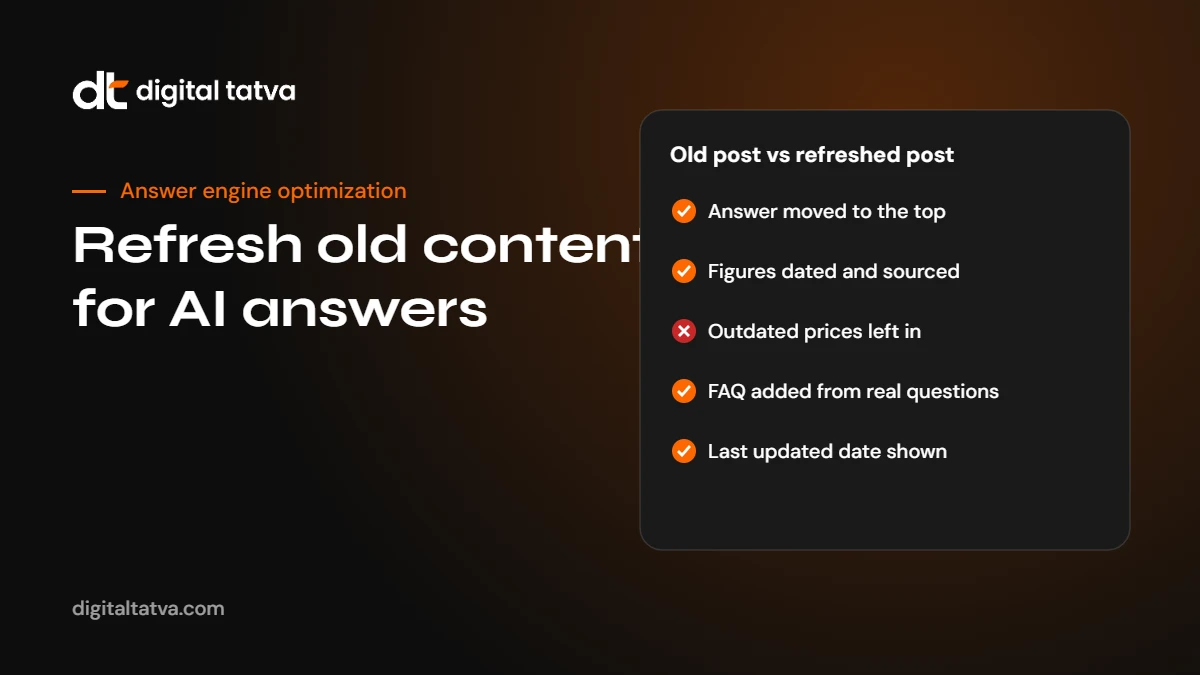
- Direct answer added at the top
- Key takeaways added
- Headings rewritten as questions or clear statements
- Outdated facts, prices and statistics replaced and sourced
- Old screenshots replaced
- Comparison table added where useful
- FAQ added from real questions
- Author or reviewer named and linked
- Primary sources cited
- Internal links updated in both directions
- Schema updated with dateModified
- Crawlability and indexability confirmed
- Visible last updated date changed only after real changes
- Baseline metrics recorded before publishing
How often to refresh
There is no single rule, but these intervals work well for most businesses:
| Content type | Suggested review cycle |
|---|---|
| Pricing pages and comparisons | Every 3 months, or whenever prices change |
| Tool lists and “best of” posts | Every 3 to 6 months |
| Service and product pages | Every 6 months |
| How-to guides | Every 6 to 12 months |
| Regulatory or medical content | Whenever rules change, at least yearly |
| Evergreen explainers | Yearly |
Worked example
Here is an illustration. An HR software company has a 2022 post titled “10 Tips for Payroll Management” that still gets traffic. The post opens with a 300-word introduction about the importance of payroll, lists generic tips and mentions a pricing plan that no longer exists.
After the refresh, the post is retitled “Payroll Management for Small Businesses in India: A Practical Guide”. It opens with a three-sentence answer explaining what payroll management involves and the main statutory deductions. Headings become questions: “What deductions must Indian employers make?”, “How often should payroll be run?”, “Should a small business outsource payroll?” A table compares in-house, software and outsourced payroll. Statutory figures are checked against official sources and dated. The outdated pricing mention is replaced with a link to the current pricing page. A five-question FAQ comes from real support tickets. The payroll lead is named as reviewer.
The URL stays the same, so existing links and history are preserved, but the page is now far more useful for both readers and AI assistants.
Using AI tools to speed up a refresh
AI assistants can make refresh work much faster, as long as a person stays responsible for facts and judgement.
- Find outdated claims. Paste the page and ask: “List every statistic, price, product name, date and screenshot reference in this page that may be outdated, with the sentence it appears in.”
- Draft the answer-first summary. Ask for a two to four sentence answer to the page’s main question, using only facts from the page and the new facts you supply.
- Rewrite headings. Ask for question-shaped alternatives to each heading, based on how buyers phrase searches.
- Suggest FAQs. Give the AI your list of real customer questions and ask it to pick the five most relevant to the page.
- Tighten copy. Ask it to cut repetition and filler without removing facts.
- Check consistency. Ask whether any statement contradicts another page you provide, such as your pricing page.
Never let AI supply new facts or statistics on its own. Every new figure should come from a source you have checked. Our guide to AI writing tools for AEO explains how to keep quality high.
Consolidating overlapping posts
Many blogs have several posts that cover the same topic from slightly different angles, often written years apart: “AEO tips”, “10 ways to improve AI visibility” and “How to get into ChatGPT answers”. They compete with each other, split links and confuse both readers and AI systems about which page is authoritative.
- Group posts by topic using your inventory and Search Console queries.
- Pick the strongest URL as the survivor, usually the one with the most links, impressions or traffic.
- Merge the best content from the others into it, removing duplication.
- Redirect the old URLs to the survivor with permanent redirects.
- Update internal links so they point to the survivor directly.
- Re-test the related prompts after a few weeks.
Consolidation often produces one of the biggest visibility gains in a refresh programme, because all the signals that were split across several pages now point to one strong page.
Refreshing different page types
Service pages
Service pages often have the biggest commercial value and the weakest content. A refresh should add a direct summary of what the service is and who it is for, the process step by step, typical timelines, pricing or the factors that drive cost, examples of work, and an FAQ. Link to the guides that explain the problems the service solves.
“Best tools” and comparison posts
These go out of date fastest. Recheck every tool’s pricing and features on the official site, remove tools that have shut down, add notable new ones, update the comparison table and show the date you checked. Readers and AI engines both favour lists that are clearly current. See our guide to comparison pages for AEO.
How-to guides
Check each step still works, replace screenshots, update menu names and settings that have changed, and add troubleshooting for common problems. Numbered steps and short paragraphs make guides easy to quote.
Statistics and data posts
Replace old figures with the latest available, cite the original source for each, and say clearly when a figure is the latest you could find even if it is not recent. Remove statistics you cannot trace.
Who should do the refresh
The best refreshes combine a writer who understands structure with a subject expert who knows what has changed. Ask the expert to review facts and add first-hand insight, and let the writer handle structure, clarity and links. For pages on pricing, regulations or technical specifications, the expert’s sign-off is essential before publishing.
Keep a short change log for each refreshed page: what changed, who reviewed it and when. It makes the next refresh faster and helps explain any change in performance.
Prioritisation scoring example
Here is a simple scoring method you can use in a spreadsheet. Give each page a score from 1 to 3 on each factor, then add them up.
| Factor | 1 point | 2 points | 3 points |
|---|---|---|---|
| Business value | Loosely related to what you sell | Supports a product or service | Directly answers a buying question |
| Existing strength | Little traffic or links | Some impressions or links | Strong traffic, links or AI citations |
| Risk | Mostly current | Some outdated details | Outdated facts that could mislead |
| Effort (reverse) | Full rewrite needed | Restructure needed | Light update needed |
Pages scoring 10 to 12 go first. Pages scoring 4 to 6 are candidates for consolidation or retirement.
Common refresh mistakes
- Changing only the date. It misleads readers and adds no value.
- Changing the URL unnecessarily. You lose history and links unless you redirect carefully.
- Adding AI-generated filler. Longer is not better; specific is better. See AI writing tools for AEO.
- Removing content that earned links without keeping its key points.
- Refreshing low-value pages first while important pages stay outdated.
- Forgetting internal links to the refreshed page.
Getting help
Large websites with hundreds of pages benefit from a structured content audit that combines search data, AI citation tracking and business priorities. Digital Tatva’s content optimization service does exactly this, and our AI visibility audit shows which pages AI already relies on and which should be refreshed first.
In summary
A content refresh programme turns your existing archive into one of your strongest AEO assets. Build an inventory, score pages on value, strength and risk, and refresh the best candidates properly: current facts, answer-first structure, question-led headings, sources, an FAQ, honest dates and better internal links. Consolidate overlapping posts, retire pages that could mislead and measure the results against a baseline. Done steadily, a few pages a month, it compounds into a site that AI engines can trust and quote.
Frequently asked questions
What is a content refresh for AEO?
It is the process of updating existing pages so AI assistants can use and trust them: correcting outdated facts, restructuring content answer first, adding FAQs and sources, and showing a clear last updated date.
Is it better to refresh old content or write new content?
For topics where you already have a page with traffic, links or history, refreshing is usually faster and more effective. Write new content when no existing page covers the question well.
Does changing the date help AI visibility?
Not on its own. Only change the visible date after real updates to facts, structure or substance.
How long until a refreshed page gets cited by AI?
Search engines and AI systems need to recrawl the page. Changes can appear within weeks for pages that are crawled often, longer for less visible pages.
Should I keep the same URL when refreshing?
Yes, in most cases. Keeping the URL preserves links and history. If you must change it, set up a permanent redirect from the old URL.
How many pages should I refresh each month?
It depends on your resources, but a steady pace of five to ten high-priority pages a month, done properly, usually beats a rushed update of everything.
Sources
- Creating helpful, reliable, people-first content, Google Search Central
- AI features and your website, Google Search Central
- Influencing your byline dates in Google Search, Google Search Central
Product details, prices and features are checked at the time of writing and can change. Sources are linked in the text so you can check them yourself.
How does your brand appear in AI answers?
We test the questions your buyers ask across the major AI assistants and search engines, then show you what to fix first.
Get an AI Visibility Audit