How to Report AEO Results: A Monthly AI Visibility Report Template
A practical template for reporting AEO and AI visibility results to founders, clients or management: which metrics to include, how to present them honestly, and a section-by-section monthly report you can copy.
On this page
- Key takeaways
- Why AEO reporting is different
- Set up the method before the first report
- The monthly AEO report template
- How to present results honestly
- Report formats that work
- Spreadsheet structure for raw results
- Monthly reporting workflow
- Quarterly and annual reviews
- Presenting AEO to sceptical stakeholders
- Reporting for agencies and consultants
- Worked example: a three-month view
- Metrics definitions to agree up front
- Reporting by market and language
- Linking AEO to revenue
- Tools that help with AEO reporting
- Common reporting mistakes
- A copyable report outline
- How we report at Digital Tatva
- In summary
- Frequently asked questions
- Sources
Last updated: 4 November 2026
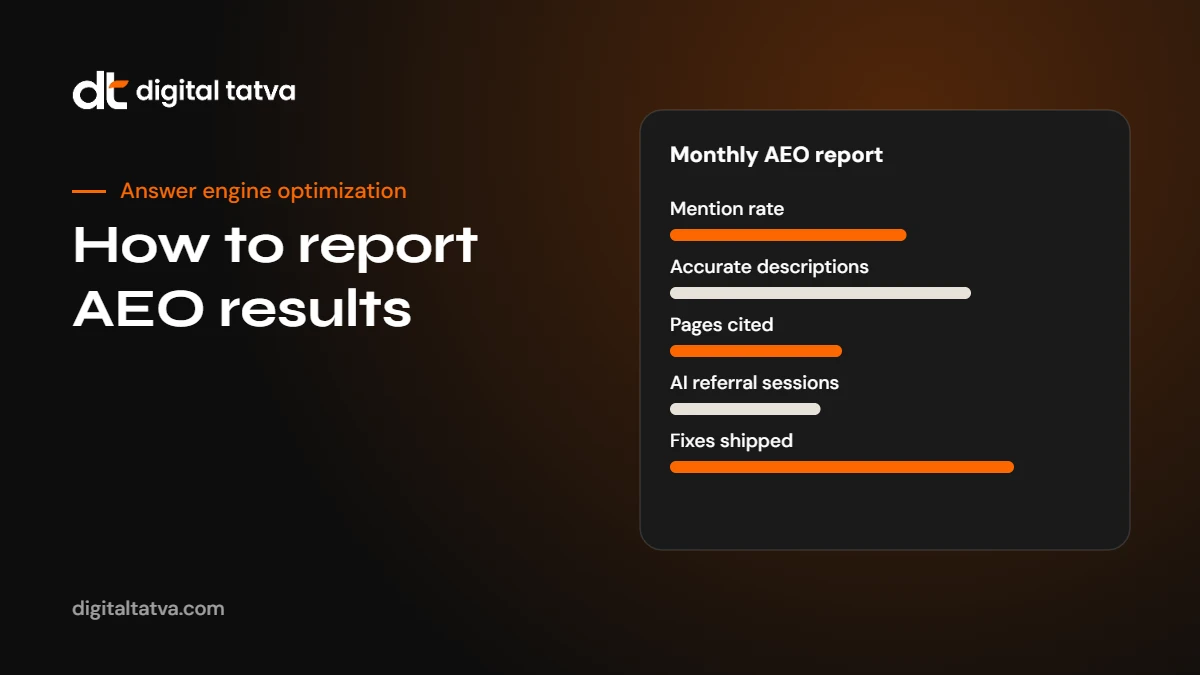
Quick answer: A good AEO report shows, for a fixed set of buyer questions tested on the same engines each month, how often your brand is mentioned, whether it is described accurately, which of your pages are cited, which competitors appear instead, how much traffic arrives from AI assistants, what work was shipped and what comes next. Keep the prompt set, engines and method constant so month-to-month changes mean something, show trends over at least three months rather than single snapshots, and be honest about variability and what you cannot control. The template below gives you nine sections you can copy into a document, slide deck or spreadsheet.
Key takeaways
- AEO reporting must be built on a consistent method: same prompts, same engines, same settings, every month.
- Lead with a short executive summary in plain language; detail comes later.
- Mention rate, accuracy and citations matter as much as traffic.
- Always report the work done and the work planned, linking effort to results.
- Be transparent about variability. AI answers change between runs, and nobody can guarantee placement.
Why AEO reporting is different
Traditional SEO reports have a familiar shape: rankings, organic traffic, conversions, backlinks. Most stakeholders know how to read them. AEO is newer, and the main outcome, being named in AI answers, does not show up neatly in analytics. AI answers are generated fresh each time, vary between users and sessions and change as models are updated. Some AI usage never produces a click at all, because the user gets the answer in the chat.
That makes reporting both more important and more delicate. Without a clear report, AEO work can look invisible. With a poorly designed one, it can look better or worse than reality depending on which day someone checked ChatGPT. The goal of the template below is to make AEO progress visible, comparable and honest.
If you are new to the metrics themselves, start with our guide to AEO KPIs, then come back here to see how to present them.
Set up the method before the first report
A report is only as good as the data behind it. Before you publish a first report, agree on these foundations with your stakeholders.
1. The prompt set
Write a fixed list of buyer questions, usually 20 to 100 depending on the business. Group them by theme, such as category questions (“best AEO agency in India”), problem questions (“how do I get my brand into ChatGPT answers”), comparison questions and brand questions (“is Digital Tatva good”). Our guide to AEO prompt research explains how to build one.
2. The engines
Choose the engines that matter to your buyers, typically ChatGPT, Google AI Overviews and AI Mode, Gemini, Perplexity and Microsoft Copilot. Record which mode you test (for example, ChatGPT with search on).
3. The testing method
Decide whether you test manually or with a tracking tool, how many times each prompt is run, whether you use logged-out sessions, and which location and language settings apply. Tools can automate this. See our comparisons of AI visibility tools and Peec AI vs Otterly vs Profound.
4. The competitors
List three to eight competitors whose mentions you track alongside your own.
5. The baseline
Run the full set before any work starts. Every later report compares with this baseline.
Tip: Freeze the prompt set for at least a quarter. Adding or removing prompts every month makes trends impossible to read. If you must change prompts, report the old and new sets separately for one cycle.
The monthly AEO report template
Here is a nine-section structure. Each section includes what to show, how to calculate it and a short example of how it might read. The figures in the examples are illustrations, not real client results.
Section 1: Executive summary
Three to five sentences a busy founder can read in thirty seconds. What changed, why, and what happens next.
Example: “Across our 40 tracked buyer questions, the brand was named in 11 answers this month, up from 7 last month and 3 at baseline. The biggest gains came in Perplexity and Google AI Overviews after the pricing and comparison pages were rewritten. ChatGPT still describes the old pricing model in two answers; the source has been identified and corrected. Next month we focus on third-party listings and two new comparison guides.”
Section 2: Mention rate
The share of tracked prompts where your brand is mentioned, by engine and overall.
| Engine | Baseline | Last month | This month |
|---|---|---|---|
| ChatGPT (search on) | 2 of 40 | 3 of 40 | 4 of 40 |
| Google AI Overviews | 1 of 40 | 2 of 40 | 3 of 40 |
| Perplexity | 0 of 40 | 1 of 40 | 3 of 40 |
| Gemini | 0 of 40 | 1 of 40 | 1 of 40 |
Show the trend as a simple line chart over months. If each prompt is run several times, report the average rate and note the variability.
Section 3: Share of voice against competitors
For the same prompts, how often each competitor is mentioned compared with you. This puts your numbers in context. Our guide to AI share of voice explains the calculation.
Section 4: Accuracy
Mentions are only good if they are accurate. List any errors found in AI descriptions of your brand: wrong prices, locations, services, people or claims. For each, show the source if known, the fix applied and the status.
| Error | Engines | Likely source | Action | Status |
|---|---|---|---|---|
| Old pricing tier quoted | ChatGPT | 2024 comparison article | Publisher emailed with current pricing | Waiting |
| Closed branch listed | Gemini | Unclaimed map listing | Marked permanently closed | Fixed, re-test next month |
See what to do when AI gets your brand wrong for the full correction process.
Section 5: Citations
Which of your pages are cited as sources, for which prompts and engines. Also list the third-party domains most often cited for your category, because those are opportunities for mentions. Our guide to getting cited by AI explains how to use this list.
Section 6: AI referral traffic and conversions
Sessions from AI assistants in your analytics, with engaged sessions, conversions and the top landing pages. Note that this undercounts AI influence, because many users read the answer without clicking. See how to track AI traffic in GA4.
If you collect “how did you hear about us?” data on enquiry forms, include the number of leads that mention an AI assistant. This is often the most persuasive number for business owners.
Section 7: Search performance for supporting pages
Because AI answers draw on search results, include impressions, clicks and positions for the pages that AEO work targets, from Search Console. This shows whether the foundations are improving even before mentions move.
Section 8: Work shipped
A list of what was done this month, linked to the metrics it should affect. For example:
- Rewrote pricing page answer first with a dated comparison table (targets prompts 4, 9, 17).
- Fixed firewall rule that blocked PerplexityBot (affects all Perplexity prompts).
- Published “X vs Y” comparison guide (targets prompts 21 to 24).
- Updated 14 directory listings with the current address.
This section is what turns a metrics report into a progress report. Stakeholders can see the connection between effort and outcome.
Section 9: Next month’s plan and risks
The top three to five priorities for next month, and any risks: model updates, seasonal shifts, pending fixes outside your control.
How to present results honestly
AEO reports can easily overstate or understate progress. A few rules keep them trustworthy.
- Show variability. If you run each prompt three times and the brand appears in one or two runs, say so. A single run is a snapshot, not a fact.
- Report trends, not days. Judge progress over three months or more. One good or bad month means little on its own.
- Separate what you control. Model updates can change answers overnight. Note them when they happen.
- Do not cherry-pick screenshots. A screenshot of the one answer where the brand appears is misleading if it appears in only 5% of runs.
- Never promise placement. Nobody can guarantee what an AI assistant will say. Report the odds and the trend.
- Explain zero. Early months may show little movement. Explain what has been fixed and what the expected lag is. See how long AEO takes.
Report formats that work
| Audience | Best format | Length |
|---|---|---|
| Founder or CEO | One-page summary with three charts and the next steps | 1 page |
| Marketing team | Full report with all nine sections | 5 to 10 pages |
| Agency client | Slide deck walked through on a call, plus a spreadsheet of raw results | 8 to 15 slides |
| Board or investors | Quarterly summary with trend lines and business impact | 1 to 2 slides |
Always keep the raw data available: every prompt, engine, date, result and cited source. Stakeholders who want to verify a claim should be able to.
Spreadsheet structure for raw results
Whether you test manually or export from a tool, a simple spreadsheet structure makes analysis easy:
- Date of the test.
- Prompt ID and full prompt text.
- Prompt theme: category, problem, comparison, brand.
- Engine and mode.
- Run number if prompts are repeated.
- Brand mentioned: yes or no.
- Position: first, second, third or later mention.
- Description accurate: yes, partly, no.
- Competitors mentioned.
- Sources cited: URLs.
- Notes.
From this, a pivot table gives you mention rate by engine, theme and month in minutes.
Monthly reporting workflow
- Run the tests in the same week each month, with the same settings.
- Export analytics and Search Console data for the same period.
- Update the raw results spreadsheet and pivot tables.
- Review errors and citations and update the accuracy log.
- List work shipped from your task tracker.
- Write the executive summary last, once you understand the full picture.
- Share and walk through the report; agree next month’s priorities.
Quarterly and annual reviews
Monthly reports track progress. Every quarter, step back and look at the bigger picture.
- Trend over three months: mention rate, accuracy and citations, with a simple line chart for each engine.
- What worked: which shipped work is most clearly linked to improvements.
- What did not: work that had no visible effect, and why.
- Prompt set review: whether the questions still reflect how buyers ask. Add new questions as a separate set so trends stay comparable.
- Competitor movement: who gained or lost share of voice and what they did.
- Engine changes: new features, model updates or engines worth adding to tracking.
- Business impact: AI-sourced leads, revenue influenced and cost of the programme.
Once a year, run a full AI visibility audit to reset the baseline and the strategy.
Presenting AEO to sceptical stakeholders
Some founders and managers are sceptical about AEO because it is new and its results are less familiar than rankings or ad clicks. A few approaches help.
- Start with their questions. Show them the actual AI answers to the questions their customers ask, including the competitors named. Seeing a competitor recommended is often more persuasive than any chart.
- Connect to revenue where you can. AI-sourced enquiries, even a handful, make the channel real.
- Show the leading indicators. Fixed blockers, improved accuracy and pages starting to be cited all come before mention rate rises.
- Be realistic about time. Set expectations with realistic timelines before the first report.
- Keep it simple. Three numbers and one sentence each are better than a 30-slide deck nobody reads.
Reporting for agencies and consultants
If you run AEO for clients, a few extra practices build trust.
- Agree the prompt set, engines, competitors and testing method in writing at the start.
- Share raw data every month, not only charts.
- Separate your work from factors outside your control, such as model updates or a client’s site migration.
- Show the hours or deliverables behind each month’s work.
- Never claim credit for changes that started before your work or are clearly caused by something else.
- Never promise placement. Our guide on choosing an AEO agency lists this as a red flag for buyers, and it should be one for providers too.
Worked example: a three-month view
Here is an illustration of how a report reads over a quarter for a B2B software company tracking 50 prompts across four engines. The numbers are examples, not client results.
| Metric | Baseline | Month 1 | Month 2 | Month 3 |
|---|---|---|---|---|
| Mentions (out of 200 prompt and engine pairs) | 9 | 11 | 18 | 26 |
| Accuracy errors open | 6 | 4 | 2 | 1 |
| Own pages cited | 3 | 5 | 9 | 14 |
| AI referral sessions | 120 | 140 | 210 | 290 |
| Leads mentioning AI | 1 | 2 | 4 | 6 |
The executive summary for month three might read: “Mentions nearly tripled from the baseline, driven by new comparison and pricing pages that are now cited in Perplexity and Google AI Overviews. Five of six accuracy errors are resolved. ChatGPT mentions remain low for category questions; next quarter focuses on third-party coverage on the review platforms ChatGPT cites most.”
Notice what makes this useful: the same method each month, trends rather than snapshots, a link between work and results, and a clear next step.
Metrics definitions to agree up front
- Mention: the brand name appears in the answer text, not only in a citation link.
- Recommendation: the brand is presented as an option to choose, not only mentioned in passing.
- Accurate description: no factual errors about prices, location, services, people or claims.
- Citation: one of your URLs appears as a source for the answer.
- AI referral session: a session whose source is a known AI assistant domain, as defined in your analytics channel group.
- AI-sourced lead: an enquiry where the buyer says they found you through an AI assistant.
Writing these down avoids arguments later about what counts.
Reporting by market and language
Businesses that sell in several countries or languages should report each market separately. AI answers can differ significantly between India and the UAE, or between English and Hindi prompts, because engines draw on different sources. Keep a separate prompt set per market, test with the right location and language settings, and show a summary table that compares markets side by side. A brand may be strong in one market and invisible in another, and a blended number would hide that.
Linking AEO to revenue
The question every business owner eventually asks is “what is this worth?” AEO revenue attribution is imperfect, because many buyers see an AI answer and then search for you directly or call you. Practical ways to estimate value:
- Track AI referral sessions and their conversion rate in analytics.
- Add “AI assistant” as an option in “how did you hear about us?” on enquiry forms, and ask on sales calls.
- Watch branded search impressions in Search Console; rising brand searches often follow more AI mentions.
- Estimate the value of a typical deal from AI-sourced leads and compare it with the cost of the programme.
Present these as estimates with clear assumptions, not precise figures.
Over several quarters, these estimates usually become more reliable as you collect more lead source data and see how AI-sourced buyers behave compared with other channels.
Tools that help with AEO reporting
| Need | Tool type | Notes |
|---|---|---|
| Prompt tracking across engines | AI visibility trackers | Automate repeated runs and competitor comparison; see AI visibility tools |
| AI referral traffic | Google Analytics 4 or other analytics | Set up an AI channel group; see tracking AI traffic |
| Search performance | Google Search Console, Bing Webmaster Tools | Impressions and clicks for target pages |
| Raw results and pivots | Google Sheets or Excel | Simple and transparent |
| Dashboards | Looker Studio or similar | Useful once metrics are stable |
| Manual spot checks | The engines themselves | Always worth doing for important prompts |
Common reporting mistakes
- Changing prompts every month.
- Reporting traffic only and ignoring mentions and accuracy.
- Using a single run per prompt without noting variability.
- Leaving out competitors, which removes context.
- Listing work without connecting it to metrics.
- Promising specific placements or timelines.
A copyable report outline
- Executive summary (3 to 5 sentences)
- Mention rate by engine: baseline, last month, this month, chart
- Share of voice against competitors
- Accuracy log: errors, sources, actions, status
- Citations: your pages cited; top third-party domains cited
- AI referral traffic, conversions and AI-sourced leads
- Search performance of target pages
- Work shipped this month, linked to prompts and metrics
- Next month’s priorities and risks
How we report at Digital Tatva
Our own AI search visibility service uses this structure. Clients agree the prompt set, engines and competitors with us at the start, we run a baseline, and each month we report mention rate, accuracy, citations, AI traffic and the work shipped. We walk through every report on a call and share the raw data. You can read more about how we work, or request an audit to start with a baseline of your own.
In summary
Good AEO reporting rests on a fixed method: the same prompts, engines and settings every month, compared with a clear baseline. Lead with a plain-language summary, then show mention rate, share of voice, accuracy, citations, AI traffic and the work shipped. Report trends rather than single checks, be open about variability and never promise placement. A report built this way helps stakeholders understand AI visibility and make better decisions about where to invest next.
Frequently asked questions
What should an AEO report include?
Mention rate across a fixed set of prompts and engines, share of voice against competitors, accuracy of AI descriptions, pages cited, AI referral traffic and conversions, work shipped and next steps.
How often should AEO results be reported?
Monthly works well for most businesses, with a deeper quarterly review. AI answers vary, so trends over several months matter more than any single report.
How many prompts should an AEO report track?
Small businesses can start with 20 to 30 prompts. Larger brands often track 100 or more across themes and markets.
Can AEO results be measured in Google Analytics?
Partly. Analytics can show visits referred by AI assistants, but many AI interactions produce no click, so you also need prompt testing to measure mentions and accuracy.
Should screenshots be included in AEO reports?
Screenshots are useful as examples but should never replace the full dataset. Always show how often a result appears across runs and prompts.
What if mention rate does not change for months?
Check whether technical blockers are fixed, whether target pages are indexed and whether competitors dominate third-party sources. Early months often show foundation work rather than mention gains.
Sources
- AI features and your website, Google Search Central
- Explorations in Google Analytics, Google Analytics Help
Add this to your report: Google Search Console’s Generative AI features report gives page-level AI impressions. Learn what it shows and what it hides.
Product details, prices and features are checked at the time of writing and can change. Sources are linked in the text so you can check them yourself.
How does your brand appear in AI answers?
We test the questions your buyers ask across the major AI assistants and search engines, then show you what to fix first.
Get an AI Visibility Audit