How Digital Tatva Works: Our AEO Process, Step by Step
A transparent look at how Digital Tatva runs answer engine optimization projects: discover, analyse, strategise, optimise, measure and improve, with what happens in each step, what you receive and what we will never promise.
On this page
- Key takeaways
- Why we publish our process
- Our principles
- Step 1: Discover
- Step 2: Analyse
- Step 3: Strategise
- Step 4: Optimise
- Step 5: Measure
- Step 6: Improve
- How the five elements shape our work
- Typical timelines
- How we communicate during a project
- The industries we know well
- How we keep improving our own methods
- Who we work with best
- What success looks like after six months
- Ways to work with us
- What we need from you
- What we will never do
- A closer look: what a typical first month involves
- How we work with your existing team and agencies
- How we decide what not to do
- Start with the free tools
- Questions to ask any AEO provider, including us
- In summary
- Frequently asked questions
- Sources
Last updated: 4 November 2026
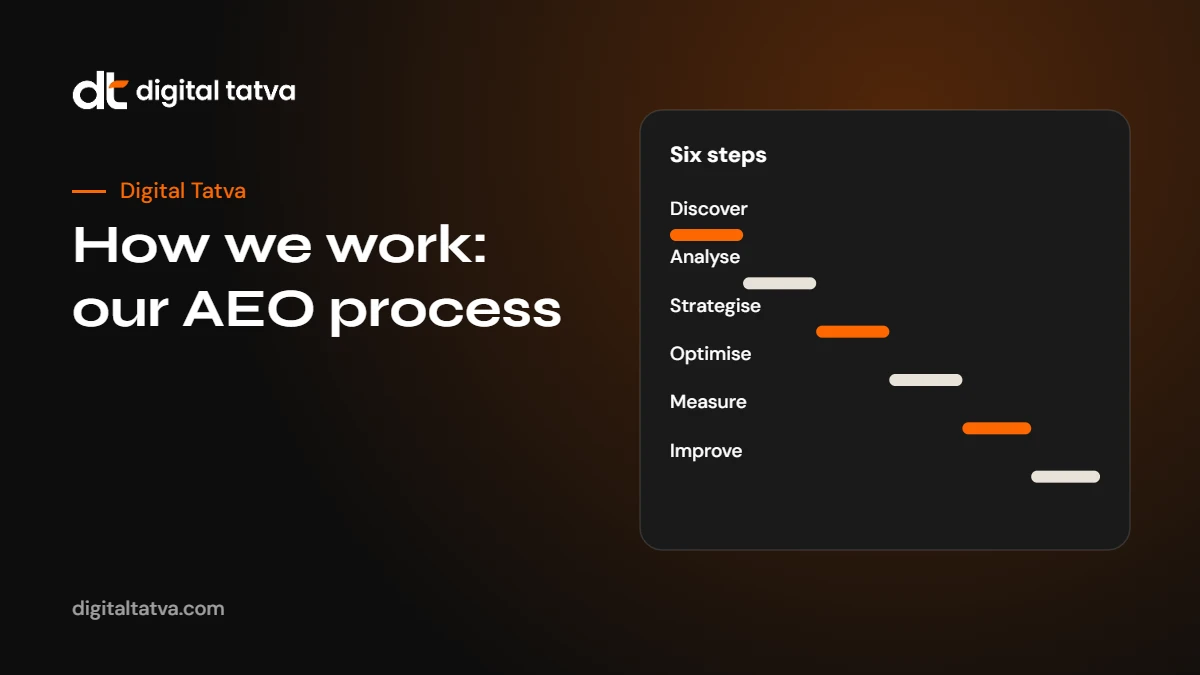
Quick answer: Digital Tatva runs every answer engine optimization (AEO) project in six steps: Discover your goals, buyers and the questions they ask; Analyse where you stand today across ChatGPT, Google AI Overviews, Gemini, Perplexity and Copilot; Strategise a ranked plan that weighs effort against likely impact; Optimise by shipping fixes in that order; Measure by repeating the same tests and reporting plainly; and Improve by using what we learn to shape the next round. We never promise placement in any AI tool, because nobody can. We do promise a clear, honest picture and a practical plan.
Key takeaways
- The process starts with your buyers’ real questions, not with a generic checklist.
- Every project begins with a baseline across the AI engines your customers use.
- Work is prioritised by likely impact against effort, so the most valuable fixes ship first.
- Progress is measured with the same prompts, engines and method every month.
- No guarantees of placement, no hidden fees, and a person reviews every finding.
Why we publish our process
Answer engine optimization is a young field. Many businesses have heard that AI assistants now recommend brands, but they do not know what an AEO consultant actually does, how long it takes or how to tell good work from hype. We think the best way to earn trust is to show exactly how we work.
This page describes the six steps we follow on every project, from a single local business to a multi-market B2B brand. The depth of each step varies, but the order and the principles do not. If you want to understand AEO itself first, read what is AEO and AEO vs SEO. If you are comparing providers, our guides on how to choose an AEO agency and AEO consultant vs agency vs in-house will help.
Our principles
Before the steps, a few principles shape everything we do.
- Buyers first. We optimise for the questions your customers actually ask, in their words, not for vanity keywords.
- Evidence over opinion. Every recommendation is linked to something we observed: an answer, a cited source, a technical issue.
- Honesty about uncertainty. AI answers vary between runs and change with model updates. We report that variability rather than hiding it.
- No guarantees of placement. Anyone who guarantees a spot in ChatGPT is not being honest with you. We improve the odds and show you the trend.
- Your assets, your knowledge. Content, data and documentation we create belong to you. We explain our work so your team can continue it.
- A person reviews everything. We use tools to collect data, but a person checks every finding before it reaches you.
Step 1: Discover
Goal: understand your business, your buyers and the questions they ask.
Every project starts with a conversation, not a scan. We want to know what you sell, who buys it, how they decide, which competitors they consider and which markets and languages matter. We also ask what you have already tried, what your team can do in-house and what success would look like in six months.
What happens in Discover
- A kickoff call with the people who know your customers best, often sales or support as well as marketing.
- A review of your website, key pages, existing SEO data and analytics access.
- Agreement on the AI engines to track, usually ChatGPT, Google AI Overviews and AI Mode, Gemini, Perplexity and Copilot.
- Agreement on three to eight competitors to compare against.
- A first draft of the prompt set: the buyer questions we will test.
How we build the prompt set
We gather questions from sales calls, support tickets, enquiry forms, search data, community discussions and AI suggestions, then group them into themes: category questions (“best AEO consultancy in India”), problem questions (“how do I get my brand cited by AI”), comparison questions and brand questions. You review and approve the final set before any testing. Our guide to AEO prompt research explains the method in detail.
What you receive
- An agreed prompt set, engines and competitor list.
- A short summary of goals and constraints.
Step 2: Analyse
Goal: a clear baseline of where you stand today.
This is the heart of our AI visibility audit. We test every prompt across every agreed engine, using consistent settings, and record who is named, how they are described and which sources are cited. Then we look at why the answers look the way they do.
What we analyse
- Visibility: mention rate for your brand and each competitor, by engine and theme.
- Accuracy: whether AI describes your business correctly, and the source of any errors.
- Sources: which pages and domains AI engines cite for your category, and whether your pages appear.
- Access: whether AI crawlers can reach and read your site, including robots.txt rules, firewall behaviour and JavaScript rendering. See our technical AEO checklist.
- Entity clarity: whether your brand is described consistently across your site, Google Business Profile, directories and social profiles. See entity SEO for AEO.
- Content: whether your key pages answer buyer questions directly and clearly.
- Third-party presence: reviews, listings and mentions on the sources AI engines trust in your category.
What you receive
- Baseline metrics for every engine and theme.
- A source map of the domains AI cites for your category.
- A list of technical blockers and accuracy errors.
- The raw data: every prompt, answer and source.
Step 3: Strategise
Goal: a ranked plan that puts the most valuable work first.
An audit that lists 80 problems is not a plan. We turn findings into a ranked list, weighing likely impact against effort, and agree it with you.
How we prioritise
| Priority | Typical examples | Why first |
|---|---|---|
| Fix blockers | AI crawlers blocked, firewall rejecting bots, key content not in HTML | Nothing else works until AI can read your site |
| Fix errors | Wrong prices, closed locations, mixed-up entities | Inaccurate mentions can do harm |
| Strengthen key pages | Service, pricing, comparison and FAQ pages rewritten answer first | These pages answer high-value buyer questions |
| Clarify the entity | Consistent listings, Organization schema, About page | Helps AI recognise and trust your brand |
| Earn third-party coverage | Reviews, directories, digital PR, community presence | AI looks for confirmation beyond your site |
| Expand content | New guides for unanswered buyer questions | Covers gaps once the foundation is solid |
What you receive
- A ranked plan with effort, likely impact and owner for each item.
- A clear split between work we do, work your team does and work that needs your developer.
- A timeline and fixed scope, confirmed in writing before work starts.
Step 4: Optimise
Goal: ship the fixes in priority order.
Depending on what you choose, we implement the work ourselves, guide your team or developer, or a mix of both. Typical work in this step includes:
- Technical AEO: robots.txt and firewall changes, rendering fixes, indexing and sitemap clean-up, structured data. See our technical AEO service.
- Content optimization: rewriting key pages answer first, building comparison and FAQ pages, refreshing outdated content. See content optimization and content refresh for AEO.
- Entity work: consistent listings, About and author pages, Organization schema and sameAs links. See entity SEO.
- Citation work: identifying the third-party sources AI trusts in your category and earning accurate mentions there. See AI citation optimization.
- Generative engine optimization: shaping the sources AI answers are built from, including original data and expert content. See GEO.
Every change is logged with the date and the prompts it is expected to affect, so we can connect work to results later.
Step 5: Measure
Goal: repeat the same tests and report plainly.
Each month we rerun the agreed prompt set with the same engines and settings and report what changed. Reports follow the structure in our AEO reporting template:
- Executive summary in plain language.
- Mention rate by engine and theme, against baseline and competitors.
- Accuracy log with errors, sources and fixes.
- Your pages cited and the third-party domains cited most.
- AI referral traffic and AI-sourced enquiries.
- Work shipped and the prompts it targeted.
- Next priorities and risks.
We walk through each report on a call and share the raw data. If something did not work, we say so. For context on timelines, see how long AEO takes.
Step 6: Improve
Goal: use what we learn to shape the next round.
AI search changes constantly: new engines, model updates, new competitor content and shifts in buyer behaviour. Every quarter we review the strategy as a whole:
- Which actions moved mention rate, accuracy or citations, and which did not.
- Whether the prompt set still reflects how buyers ask.
- New competitors or sources appearing in answers.
- New engines or features worth tracking.
- What your team can now do in-house.
The output is an updated ranked plan for the next quarter.
How the five elements shape our work
Our name comes from Tatva, the Sanskrit word for element. We think about AI visibility as five layers, and every step above touches them: readable (can AI crawlers fetch and read your site?), answerable (do your pages answer buyer questions clearly?), trusted (do other sources back you up?), visible (are you tracked across engines and prompts?) and defined (is your brand one clear, consistent entity?). Read the five elements of AI visibility for the full framework.
Typical timelines
| Phase | Typical duration | Notes |
|---|---|---|
| Discover | 1 week | Faster if you already know your buyer questions |
| Analyse | 1 to 3 weeks | Depends on prompt set size and number of markets |
| Strategise | Under 1 week | Plan agreed with you on a call |
| Optimise | Ongoing, usually 2 to 6 months for the first round | Pace depends on scope and your team’s capacity |
| Measure | Monthly | Same prompts, engines and settings |
| Improve | Quarterly | Strategy review and updated plan |
Technical and accuracy fixes can be reflected within weeks of the next crawl. Becoming a regular recommendation in a competitive category usually takes several months.
How we communicate during a project
- One named contact on our side who knows your project in detail.
- A shared task list showing what is planned, in progress and done, with dates.
- Monthly report and call walking through results, work shipped and next priorities.
- Quarterly strategy review with the decision makers in your business.
- Plain language. We explain technical findings in terms of what they mean for your buyers and your business.
- Quick alerts when something urgent appears, such as an AI answer that describes you incorrectly in a damaging way, or a site change that blocks AI crawlers.
The industries we know well
The process is the same for every client, but the questions buyers ask differ widely by industry. We have published detailed guides for several sectors that show how the process adapts: healthcare, real estate, education, hotels and travel, professional services, manufacturing and exports, SaaS, ecommerce and local businesses. Each guide reflects the same principles: start with buyer questions, fix what blocks AI, make your facts clear and consistent, earn trust where AI looks, and measure honestly.
How we keep improving our own methods
AI search changes quickly, so our methods have to change too. We regularly re-test our own assumptions: which engines show sources, how often answers vary, which page types are cited most, and how crawler behaviour changes. We follow official documentation from search engines and AI providers, and we update our guides when it changes. Our own website is a testing ground: we apply the same five-element framework to Digital Tatva and track our own prompt set, so we see the effects of changes first-hand before recommending them to clients.
Who we work with best
- Businesses whose buyers research seriously before choosing, such as B2B services, healthcare, education, real estate, software and manufacturing.
- Teams willing to publish clear, honest information about what they offer, including prices or price ranges where possible.
- Owners and marketers who want a measured, evidence-based approach rather than quick tricks.
- Companies in India and abroad that sell to buyers who use AI assistants in English or Indian languages.
If that sounds like you, the next step is simple: send us your website and objective for a free first look.
What success looks like after six months
Every business is different, but after six months of steady work, clients typically see some combination of these: technical blockers removed and AI crawlers reaching every important page; AI descriptions of the brand that are accurate and consistent; key pages cited as sources for important buyer questions; mentions in more answers across more engines; and the first enquiries where buyers say they found the business through an AI assistant. We report each of these honestly, including where progress is slower than hoped and why.
Ways to work with us
- Free first look. Send your website and objective through our audit request form. A person reviews your site, runs a small set of questions and replies with what we found.
- Full AI visibility audit. A complete baseline, source map and ranked fix list, with a fixed fee confirmed in writing.
- Ongoing AEO. Implementation, monthly measurement and quarterly strategy reviews.
- Advisory. For teams that want to do the work in-house with expert guidance.
For pricing context, see our guide to AEO pricing.
What we need from you
- A main contact who can make decisions and gather information.
- Access to analytics and Search Console, ideally read-only.
- Access to your website or a developer who can implement technical changes.
- Input from sales or support on buyer questions.
- Timely review of content and plans.
What we will never do
- Promise or imply guaranteed placement in any AI assistant.
- Publish fake reviews, testimonials or invented statistics.
- Use tactics that try to manipulate AI systems in ways their providers prohibit.
- Charge for work you have not agreed in writing.
- Hide raw data or methods from you.
A closer look: what a typical first month involves
To make the process more concrete, here is what the first month often looks like for a mid-sized service business. Every project is different, so treat this as an illustration of the rhythm, not a fixed schedule.
- Week 1: kickoff call with marketing and sales, access to analytics and Search Console, agreement on engines and competitors, first draft of 40 buyer questions.
- Week 2: prompt set approved; baseline testing across engines; technical checks of robots.txt, firewall responses, rendering and schema; review of the top 15 pages.
- Week 3: analysis across the five layers; source map of the domains cited for the category; accuracy log; draft ranked plan.
- Week 4: walkthrough call; plan agreed; quick technical fixes shipped, such as unblocking a crawler or correcting an outdated listing; content briefs prepared for the first page rewrites.
From month two onwards, the rhythm settles into implementation, a monthly report and a call, with a strategy review every quarter.
How we work with your existing team and agencies
Many clients already have an SEO agency, a content team, a web developer or a PR partner. AEO works best when it supports their work rather than duplicating it. We typically:
- Share findings with your existing partners and explain the reasoning behind each recommendation.
- Write clear briefs for developers, with the exact change, why it matters and how to test it.
- Give content teams page-level briefs: the buyer questions to answer, facts to include and structure to follow.
- Give PR partners the list of domains AI cites for your category, so outreach targets the sources that matter most.
- Join existing meetings rather than adding new ones where we can.
If you have no team in place, we can implement most work ourselves, or recommend specialists where needed.
How we decide what not to do
A good plan says no to many things. We usually advise against:
- Publishing large volumes of thin, AI-generated pages in the hope of being cited.
- Tactics that try to manipulate AI systems with hidden text, fake reviews or misleading markup.
- Chasing every new engine or feature before the basics are fixed.
- Rewriting pages that already work well, just for the sake of change.
- Spending heavily on third-party coverage before your own site and listings are accurate.
Saying no protects your budget and keeps the work focused on what is most likely to help.
Start with the free tools
If you want to see where you stand before talking to anyone, use our free AI visibility checker. It checks in about 30 seconds whether AI crawlers can access your site, whether your firewall blocks them and how much content is readable, then writes buyer questions you can test in ChatGPT, Perplexity, Google AI Mode and Copilot yourself. Our guide on how to use the checker explains every result.
Questions to ask any AEO provider, including us
- How do you build the prompt set, and can we approve it?
- Which engines do you test, with what settings, and how often?
- Do we get the raw data?
- How do you prioritise recommendations?
- What exactly is included in the fee, and what is extra?
- Do you promise placement? (The honest answer is no.)
In summary
Our process is simple to describe and careful in practice: discover your buyers and their questions, analyse where you stand across AI engines, agree a ranked plan, ship the fixes in order, measure with the same tests every month and improve each quarter. Everything is grounded in evidence, explained in plain language and shared with you, including the raw data. We do not promise placement, because nobody honestly can. We do promise to show you clearly what is happening and what is most likely to help.
Frequently asked questions
What is the first step in working with Digital Tatva?
Send your website and main objective through the audit request form. A person reviews your site, runs a small set of questions through the main AI assistants and replies with what we found and what we would examine next.
Does Digital Tatva guarantee ChatGPT placement?
No. Nobody can honestly guarantee what an AI assistant will say. We improve the odds through technical, content, entity and citation work and report the results transparently.
How long before we see results?
Technical and accuracy fixes can be reflected within weeks of the next crawl. Regular recommendations in competitive categories usually take several months of consistent work.
Which AI engines do you track?
Usually ChatGPT, Google AI Overviews and AI Mode, Gemini, Perplexity and Microsoft Copilot, agreed with each client based on where their buyers search.
Can our team do the work in-house?
Yes. Many clients implement the plan themselves with our guidance. We explain every recommendation so your team can continue the work.
Where is Digital Tatva based?
Digital Tatva is based in Ahmedabad, India, and works with businesses in India and abroad. Read more on our About page.
Sources
- AI features and your website, Google Search Central
- Overview of OpenAI crawlers, OpenAI
Product details, prices and features are checked at the time of writing and can change. Sources are linked in the text so you can check them yourself.
How does your brand appear in AI answers?
We test the questions your buyers ask across the major AI assistants and search engines, then show you what to fix first.
Get an AI Visibility Audit